
Cold-Formed Thin-Walled Steel Structures: Material Properties & Lightweight Building Advantages

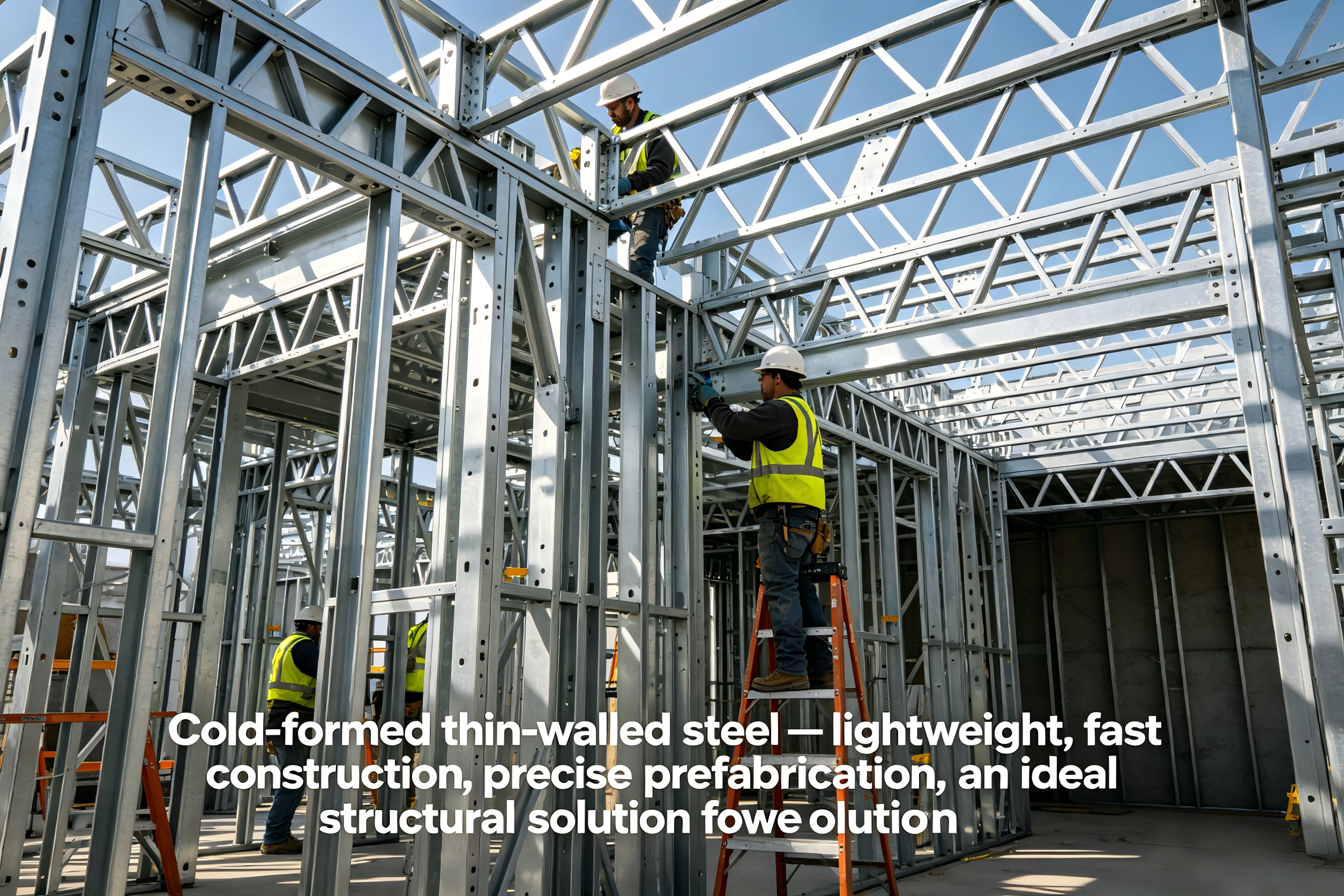
Cold-formed steel (CFS) sections: material grades, section properties, and applications in low-rise residential and light commercial buildings. Discover lightweight, high-efficiency steel framing.
Traditional heavy steel sections (H-beams, channels) are not always the answer. For low-rise buildings, residential homes, and light commercial structures, cold-formed thin-walled steel (CFS) offers a superior alternative: lighter, faster, and often more economical than both hot-rolled steel and timber framing.
Cold-formed steel is made by roll-forming or pressing thin steel sheets into C-sections, U-channels, and other shapes at room temperature. The cold-working process increases yield strength while using significantly less material.
For overseas clients exploring steel construction for residential projects, holiday villas, small warehouses, or office extensions, understanding CFS materials is essential.
This guide covers:
- Material grades and properties.
- Section shapes and structural behavior.
- Design and load capacity considerations.
- Construction speed and cost advantages.
- Applications in low-rise and light-gauge steel buildings.
1. What Is Cold-Formed Thin-Walled Steel?
Cold-formed steel (CFS), also called light-gauge steel or thin-walled steel, is manufactured by bending or roll-forming steel sheets (typically 0.75mm to 3.0mm thick) into structural shapes at ambient temperature. The cold-working process increases the steel’s yield strength through strain hardening.
| Property | Hot-Rolled Steel (e.g., H-beam) | Cold-Formed Steel (CFS) |
|---|---|---|
| Forming temperature | 900-1200°C (red hot) | Room temperature |
| Typical thickness | 6-50mm+ | 0.75-3.0mm |
| Yield strength (base material) | 235-355 MPa | 250-550 MPa (cold-working increases strength) |
| Weight per meter | Heavy | Light (1/5 to 1/10 of hot-rolled) |
| Section shapes | I, H, channel, angle | C (stud), U (track), Z, hat, sigma |
| Typical span | Large (6-30m) | Small to medium (2-6m) |
Key distinction: CFS is not for massive industrial buildings or long-span structures. It excels in low-rise construction (1-4 stories) where weight reduction and speed of erection are priorities.
2. Material Grades for Cold-Formed Steel
Cold-formed steel starts as hot-rolled steel coil, then is cold-rolled (further reduced in thickness) and finally cold-formed into shape.
Common material standards:
| Standard | Grade | Min. Yield (MPa) | Min. Tensile (MPa) | Elongation | Typical Use |
|---|---|---|---|---|---|
| ASTM A1003 (USA) | 33 ksi (230) | 230 | 310 | – | Light framing (non-structural) |
| 50 ksi (340) | 340 | 420 | – | Structural studs, joists | |
| 80 ksi (550) | 550 | 550 | – | High-strength, long spans | |
| GB/T 2518 (China) | S250GD | 250 | 330 | 20% | General light framing |
| S350GD | 350 | 420 | 18% | Standard structural CFS | |
| S450GD | 450 | 480 | 16% | High-strength, long spans | |
| S550GD | 550 | 560 | 12% | Special applications | |
| EN 10346 (Europe) | S280GD | 280 | 360 | – | Light framing |
| S350GD | 350 | 420 | – | Standard structural | |
| S450GD | 450 | 480 | – | High-strength |
Recommended for most CFS structural applications: S350GD or S450GD (350-450 MPa yield).
Coating for corrosion protection (critical for CFS):
| Coating Type | Coating Mass (typical) | Durability | Best For |
|---|---|---|---|
| Galvanized (Zinc) | Z120-Z275 (120-275 g/m²) | 20-30 years | Indoor, dry climates |
| Galvalume (Al-Zn) | AZ150 (150 g/m²) | 25-40 years | Outdoor, humid, coastal |
| Zinc-aluminum-magnesium | ZM80-ZM200 | 30-50+ years | Extreme corrosion (marine, agricultural) |
Minimum recommended for structural CFS: Z275 or AZ150.
3. Common CFS Section Shapes & Their Applications
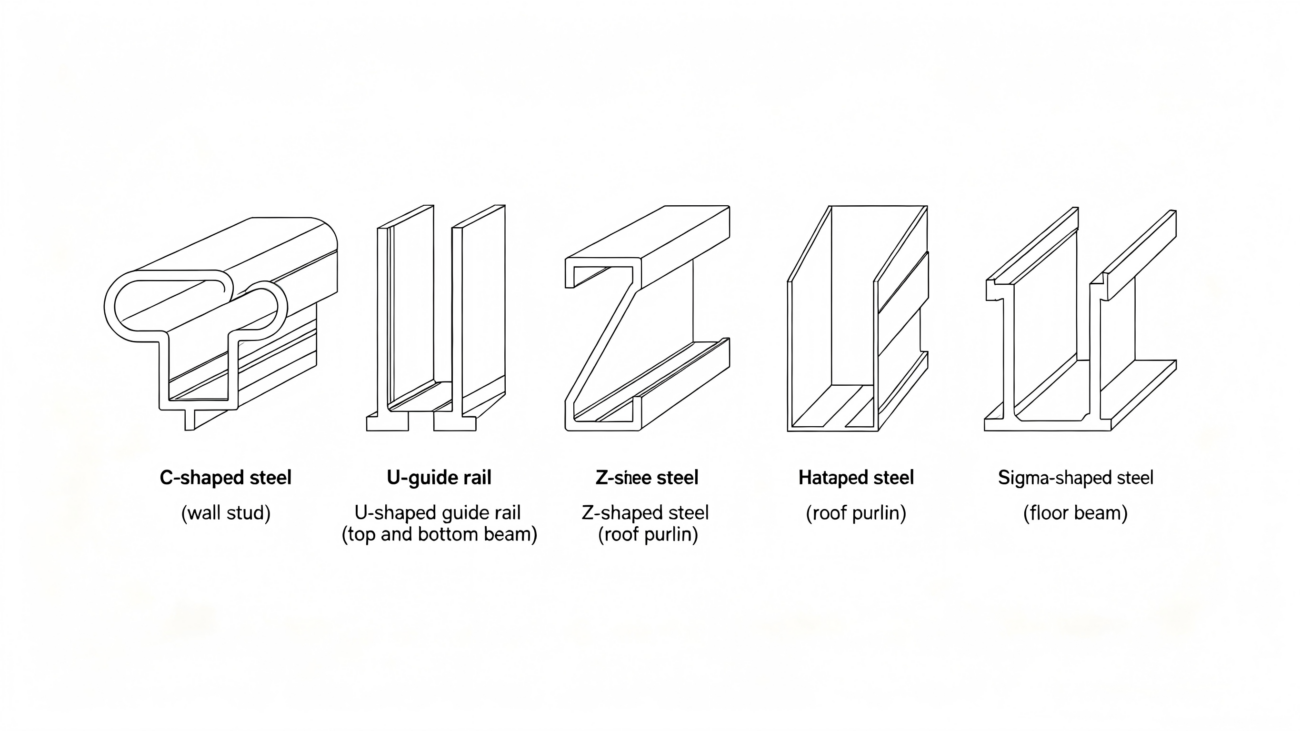
Cold-formed steel sections are designed for specific functions. The most common are C-sections (studs) and U-sections (tracks).
| Section | Shape | Typical Sizes | Primary Function |
|---|---|---|---|
| C-section (Stud) | [C shape with lips] | Web: 50-300mm; Flange: 30-80mm; Lip: 5-15mm | Vertical framing (walls, columns) |
| U-section (Track) | [U shape, no lips] | Web: 50-300mm; Flange: 30-50mm | Top and bottom track for walls |
| Z-section | [Z shape] | Web: 100-300mm | Roof purlins (overlaps at supports) |
| Hat section | [Hat shape] | 50-150mm wide | Floor joists, furring channels |
| Sigma section | [Σ shape] | 150-300mm | Long-span purlins, light beams |
| Box section (closed) | Two C-sections back-to-back | As combined | Built-up columns, beams |
C-section (Stud) Naming Example:
C89×44×12×1.2
- 89 = web depth (mm)
- 44 = flange width (mm)
- 12 = lip length (mm)
- 1.2 = base metal thickness (mm)
Common sizes for residential construction:
| Application | Section | Typical Size | Thickness | Spacing |
|---|---|---|---|---|
| Load-bearing wall stud | C-section | 89×44×12mm | 1.2-1.6mm | 400-600mm |
| Non-load-bearing wall stud | C-section | 64×38×10mm | 0.8-1.0mm | 600mm |
| Floor joist | C-section or sigma | 150-250mm | 1.2-2.0mm | 400-600mm |
| Roof rafter | C-section or sigma | 150-250mm | 1.2-2.0mm | 600-1200mm |
| Top/bottom track | U-section | Web matches stud | 1.0-1.6mm | Continuous |
4. Structural Behavior & Design Considerations
Cold-formed steel differs from hot-rolled steel in several critical ways.
A. Local Buckling (Unique to Thin-Walled Sections)
Because CFS has thin walls (t/b ratio is high), the flat elements (web, flange, lip) can buckle locally before the overall column buckles. This is managed by:
- Flange lips (stiffeners): Return bends that stiffen the flange against local buckling.
- Web stiffeners: Intermediate stiffeners for deeper webs.
- Limiting width-to-thickness ratios: Design codes prescribe maximum b/t ratios.
B. Distortional Buckling
The entire cross-section distorts (flange rotates relative to web). Prevented by proper lip sizing and spacing of lateral restraints (sheathing or bracing).
C. Effective Width Method
Design codes (AISI S100, EN 1993-1-3, GB 50018) use the effective width method: only parts of the section near corners (where cold-working increased strength) are considered fully effective. The center of wide flanges or webs is reduced.
Practical implication: Doubling thickness more than doubles strength (because the effective area increases faster than the gross area). For CFS, thickness is the most powerful design variable.
D. Corrosion Protection
Thin steel means less sacrificial material. Corrosion that removes 0.5mm from a 3mm hot-rolled flange is a 17% loss. The same 0.5mm loss from a 1.2mm CFS section is a 42% loss—structurally critical.
Requirement: High-quality galvanized or Galvalume coating. Do not use bare or thinly coated CFS for structural applications.
Edge case: In high-corrosion environments (coastal within 1km, chemical plants), specify ZM coating or post-assembly hot-dip galvanizing (complex and expensive for CFS frames). Alternative: use stainless steel CFS (grade 304/316) for extreme conditions.
5. Load & Span Capacity (Typical Values – S350GD, C-section)
These are approximate references. Actual values depend on exact section, spacing, bracing, and code.
| Section | Thickness | Span (simple, uniform load) | Allowable Load (kPa) |
|---|---|---|---|
| C89×44×12 | 1.2mm | 2.5m (floor joist @400mm) | 3.0 kPa (residential live) |
| C89×44×12 | 1.6mm | 3.0m (floor joist @400mm) | 3.0 kPa |
| C150×50×15 | 1.2mm | 3.5m (floor joist @450mm) | 2.5 kPa |
| C150×50×15 | 1.6mm | 4.2m (floor joist @450mm) | 3.0 kPa |
| C200×65×18 | 1.6mm | 5.0m (roof purlin @1200mm) | 1.5 kPa (snow) |
Comparison with timber (spruce-pine-fir, #2 grade):
| Material | Depth | Spacing | Span (3.0 kPa live load) |
|---|---|---|---|
| CFS C150×1.6mm | 150mm | 400mm | 4.2m |
| Timber 2×6 (38×140mm) | 140mm | 400mm | 3.0m |
CFS outperforms timber of similar depth by 25-40% in span due to higher yield strength and consistent material properties.
6. Advantages of Cold-Formed Steel Framing
A. Lightweight (Material Efficiency)
| Building Type | Typical Steel Weight (kg/m² floor) | vs. Hot-Rolled Steel | vs. Concrete |
|---|---|---|---|
| Low-rise residential (1-2 stories) | 15-25 kg/m² | 1/5 to 1/10 | 1/20 to 1/30 |
| Light commercial (2-3 stories) | 25-40 kg/m² | 1/4 to 1/8 | – |
| Multi-story CFS (4 stories) | 40-60 kg/m² | 1/3 to 1/5 | – |
Consequence: Lower foundation cost (smaller footings), easier handling (no crane needed for many components), cheaper shipping (more square meters per container).
B. High Construction Speed
| Construction Method | Framing Time (200m² house) | Labor Required |
|---|---|---|
| CFS prefabricated panels | 2-3 days | 3-4 workers |
| Timber stick frame (site cut) | 5-7 days | 4-5 workers |
| Masonry/concrete block | 10-15 days | 6-8 workers |
| Hot-rolled steel frame | 4-6 days (but heavier, crane needed) | 2-3 workers + crane operator |
Speed drivers for CFS:
- Light weight (no crane for most components).
- Pre-punched holes (for services, bracing, fasteners).
- Predictable, precision-cut lengths.
- No curing time (unlike concrete).
C. Dimensional Stability & Quality Control
CFS does not shrink, swell, warp, or twist with humidity changes (unlike timber). This means:
- No nail pops in drywall.
- Doors and windows stay square.
- Consistent quality from factory to site.
Versus timber: Timber shrinkage across the grain can be 2-4% from green to dry (≈4-8mm movement in a 200mm wall). CFS movement is negligible (thermal expansion only).
D. Non-Combustible (Fire Performance)
CFS itself does not burn. With proper fire-rated gypsum board lining (minimum 1 layer 12.5mm Type X each side), CFS walls can achieve 60-120 minutes fire resistance rating.
Comparison: Timber framing burns and contributes fuel to the fire. CFS does not.
Note: Steel conducts heat. In a fire, unlined CFS heats rapidly. But non-combustibility means CFS does not add fuel—fire spread is limited to contents.
E. Design Flexibility & Service Integration
Pre-punched knockouts in webs allow easy routing of electrical wiring, plumbing pipes, and data cables—without drilling on site. This reduces site labor and eliminates the risk of drilling through studs incorrectly.
Also: Curved walls, angled corners, and complex geometries are easier with CFS than with timber or masonry.
7. Applications in Low-Rise & Light-Gauge Steel Buildings
CFS is suitable for a wide range of low-rise projects.
| Building Type | Stories | Typical Floor Area | CFS Application |
|---|---|---|---|
| Single-family home | 1-2 | 100-300m² | Walls, floors, roof trusses |
| Multi-family (townhouses, apartments) | 2-4 | 200-1000m² | Load-bearing walls, floors |
| Hotel / motel | 2-4 | 500-3000m² | Bearing walls, interior partitions |
| Office building | 2-4 | 500-2000m² | Structural framing + infill walls |
| Retail / showroom | 1-2 | 200-1500m² | Clear-span trusses (with CFS) |
| School / dormitory | 1-3 | 500-3000m² | Load-bearing walls, floors |
| Agricultural (implement shed, stable) | 1 | 200-1000m² | CFS portal frames |
| Small warehouse / workshop | 1 | 300-1500m² | CFS purlins + girts (mixed with hot-rolled columns) |
Multi-story CFS (3-4 stories) is technically feasible and used in many countries. Beyond 4 stories, transition to hot-rolled steel frame with CFS infill walls.
8. Construction Process for CFS Buildings
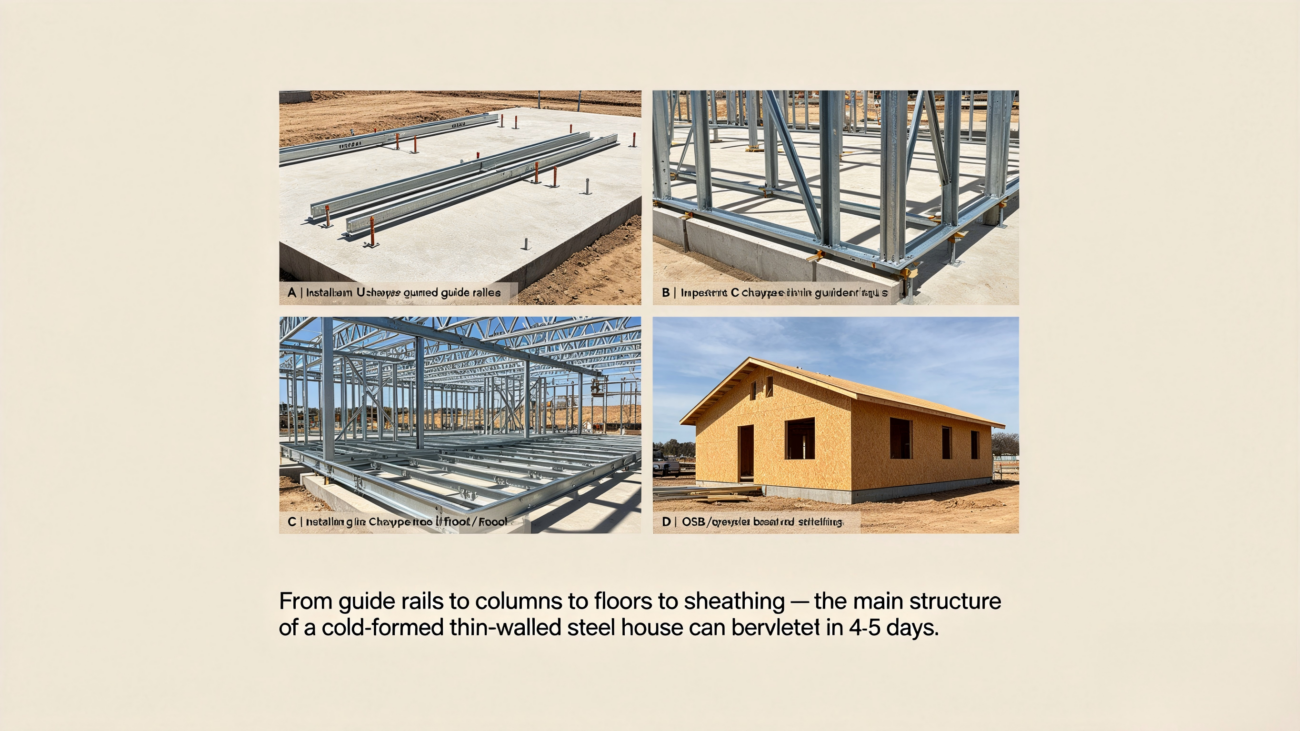
CFS construction is a prefabrication-centric process.
Step 1: Engineering & Detailing
- Load calculations (wind, snow, seismic, live loads).
- Section selection (web depth, thickness, spacing).
- Bracing and shear wall design.
- Shop drawing generation (CNC-ready files).
Step 2: Roll-forming & Fabrication
- Steel coil decoiled, flattened, punched (holes for services, bracing, fasteners), roll-formed into C/U/Z sections.
- Sections cut to exact length (CNC-controlled).
- Pre-assembly into panels (walls, floors, trusses) or shipped as sticks.
Step 3: Prefabrication (Recommended)
- Wall panels assembled on a jig or assembly table.
- Sheathing (OSB or gypsum) applied in factory (optional).
- Windows and doors framed.
- Panels stacked, labeled, and wrapped for shipping.
Step 4: Foundation & Installation
- Concrete slab or strip footing (with anchor bolts or CFS base track).
- Panels erected in sequence (starting at corners).
- Temporary bracing until roof installed.
- Top track installed, floor/roof joists placed.
Step 5: Services & Finishing
- Electrical wiring through pre-punched holes.
- Insulation (within cavity or external rigid board).
- Interior gypsum board.
- Exterior cladding (brick, timber, fiber cement, metal).
Typical timeline for 200m² house (Australia, Europe, US experience):
- Engineering: 1-2 weeks
- Fabrication: 2-5 days
- Erection (on prepared slab): 2-3 days
- Complete shell: 1 week
9. Cost Control for CFS Projects
| Cost Factor | How to Optimize |
|---|---|
| Material | Use S350GD instead of S450GD unless long spans require higher strength. Optimize thickness (1.2mm vs. 1.6mm). Standardize sections (3-4 sizes max) |
| Fabrication | Prefabricate into panels (reduces field labor). Use nesting software to minimize scrap from coil |
| Shipping | Flat-packed panels maximize container volume. Light weight reduces freight cost |
| Foundation | Lighter building = smaller slab/footing (saves 15-30% of foundation cost) |
| Labor (site) | Invest in detailed assembly drawings. Label every panel. Fasteners pre-counted |
| Corrosion protection | For indoor/dry: Z275 galvanized. For coastal/outdoor: AZ150 Galvalume or ZM coating |
Typical cost per m² of floor area (framing only, no finishes):
| Region (rough reference) | Cost (USD/m²) |
|---|---|
| CFS framing (material + fabrication) | $20-35 |
| CFS framing + erection labor | $35-55 |
| Timber framing (material + labor, comparable) | $40-65 |
| Concrete block (material + labor) | $60-90 |
CFS is typically 15-30% lower cost than timber in markets where timber is expensive, and 20-40% lower than concrete block in most markets.
10. Bracing, Shear Walls & Connections
Bracing Requirements:
CFS is light and flexible without bracing. All CFS buildings require:
- Permanent bracing: Sheathing (OSB, plywood, gypsum) attached to CFS studs acts as a structural diaphragm.
- Temporary bracing: During erection (before sheathing).
Shear wall design: A CFS wall sheathed with 11mm OSB has significant lateral load resistance (similar to timber shear walls). For high wind or seismic zones, increase fastener density or use steel strap cross-bracing.
Connections (Critical for CFS):
| Connection | Fastener Type | Notes |
|---|---|---|
| Stud to track | Self-drilling screw (2-4 per end) | #8 or #10, 12-16mm long |
| Stud to stud (back-to-back) | Self-drilling screw (at 300-600mm spacing) | For built-up columns |
| Track to foundation | Concrete anchor screw or expansion anchor | At 300-600mm o.c. |
| Sheathing to CFS | Self-drilling screw (wafer head) | #6-8, 25-32mm long. Spacing 150-300mm at edges |
| Panel to panel (wall to floor) | Self-drilling screw through track flanges | Heavy gauge (≥#12) |
Self-drilling screw specification: Drill point must be matched to steel thickness. Point types #2 (0.9-1.5mm), #3 (1.5-2.5mm), #4 (2.5-4.5mm). Wrong point = stripped threads or broken screws.
11. Thermal & Acoustic Performance
CFS conducts heat (thermal bridging) unless detailed properly.
| Problem | Solution |
|---|---|
| Thermal bridging (steel conducts heat through insulation) | Continuous exterior insulation (rigid board). Slotted clips or furring channels to separate cladding from structure |
| Condensation risk (dew point within cavity when steel is cold) | Sufficient insulation thickness (thermal analysis required). Vapor control layer on warm side |
| Sound transmission (steel transmits vibration) | Acoustic insulation (mineral wool). Resilient channels or isolation clips for drywall. Multiple drywall layers |
Recommended assembly for cold climates:
- Interior gypsum (1 layer)
- CFS stud cavity (filled with fiberglass or mineral wool)
- External rigid insulation (XPS or PIR, 25-50mm)
- Cavity (ventilated if required)
- Exterior cladding
Achievable U-values: With 140mm cavity insulation + 50mm rigid external insulation, U-values of 0.20-0.25 W/m²K are achievable (exceeds many building codes).
12. Comparison: CFS vs. Timber vs. Concrete vs. Hot-Rolled Steel
| Factor | CFS | Timber | Concrete Block | Hot-Rolled Steel |
|---|---|---|---|---|
| Weight | Very light | Light | Heavy | Medium-heavy |
| Construction speed | Fast (prefab) | Medium (site cut) | Slow (curing) | Fast (bolted) |
| Material cost | Low-medium | Variable (high in many markets) | Medium | High |
| Labor skill | Low (assembly) | Medium | High (mason) | High (welder/rigger) |
| Dimensional stability | Excellent | Poor (shrinks/swells) | Good | Excellent |
| Fire performance | Non-combustible | Combustible | Non-combustible | Non-combustible (but loses strength) |
| Corrosion risk | Requires coating | Rot risk (insects/fungus) | Low (no coating) | Requires coating |
| Thermal bridging | High (must detail) | Low | Medium | High |
| Max stories (load-bearing) | 4 typical (up to 6) | 3-4 | 3-5 | 10+ |
| Design life | 50+ years | 30-50 years (with protection) | 50+ years | 50+ years |
| Sustainability | Recyclable, low waste | Renewable, but waste | High embodied carbon | Recyclable |
When CFS is the best choice:
- Low-rise residential (1-4 stories).
- Light commercial buildings.
- Areas with expensive timber or scarce skilled masonry labor.
- Projects requiring fast construction speed.
- Builders familiar with timber framing (transition is easy).
When CFS is not the best choice:
- High-rise buildings (use hot-rolled steel frame + CFS infill).
- Very corrosive environments (without heavy coating).
- Extreme cold climates without thermal break detailing.
13. Link to Light-Gauge Steel Framing Service
We supply complete cold-formed steel framing systems—from individual sections to fully prefabricated panels.
We provide:
- Material supply: S250GD to S550GD, galvanized (Z275) or Galvalume (AZ150). Coil or cut-to-length sections.
- Roll-forming: C-sections, U-tracks, Z-purlins, hat sections. Custom dimensions available.
- Prefabrication: Wall panels, floor cassettes, roof trusses. Pre-punched for services and bracing.
- Fasteners: Self-drilling screws (matched to steel thickness), concrete anchors.
- Design support: Load calculations, bracing layouts, connection details.
- Installation drawings: Panel labels, erection sequence, fastener schedules.
For overseas clients:
We can ship flat-packed panels (up to 3.0m wide, 12m long in panels, or longer as C-sections only). We provide CNC roll-forming files so you can fabricate locally (machine purchase optional). We offer remote installation training and video support.
👉 [Request a CFS framing quote]
Send us your building type, dimensions, local loads (wind/snow/seismic), and preference (sticks or panels). We will return section recommendations, weight estimate, fabrication drawings, and budget price within 48 hours.
Summary Table: Quick CFS Selection Guide
| Your Project | Recommended Grade | Section Type | Thickness | Coating |
|---|---|---|---|---|
| Single-family home (1-2 stories) | S350GD | C89 or C150 studs | 1.2-1.6mm | Z275 |
| Multi-family (3-4 stories) | S450GD | C150 or C200 studs | 1.6-2.0mm | Z275 or AZ150 |
| Light commercial (2 stories) | S350GD | C150 studs + sigma joists | 1.2-1.6mm | Z275 |
| Small warehouse (clear span) | S450GD | Z-purlins + hot-rolled columns | 1.5-2.0mm | AZ150 |
| Coastal / high humidity | S350GD or S450GD | Any structural | 1.5mm+ | AZ150 or ZM |
| Cold climate (thermal bridge concern) | S350GD | C-sections + external rigid insulation | 1.2-1.6mm | Z275 |