
Fire Protection Materials for Steel Structures: Coatings, Encasements & Fire Resistance Ratings

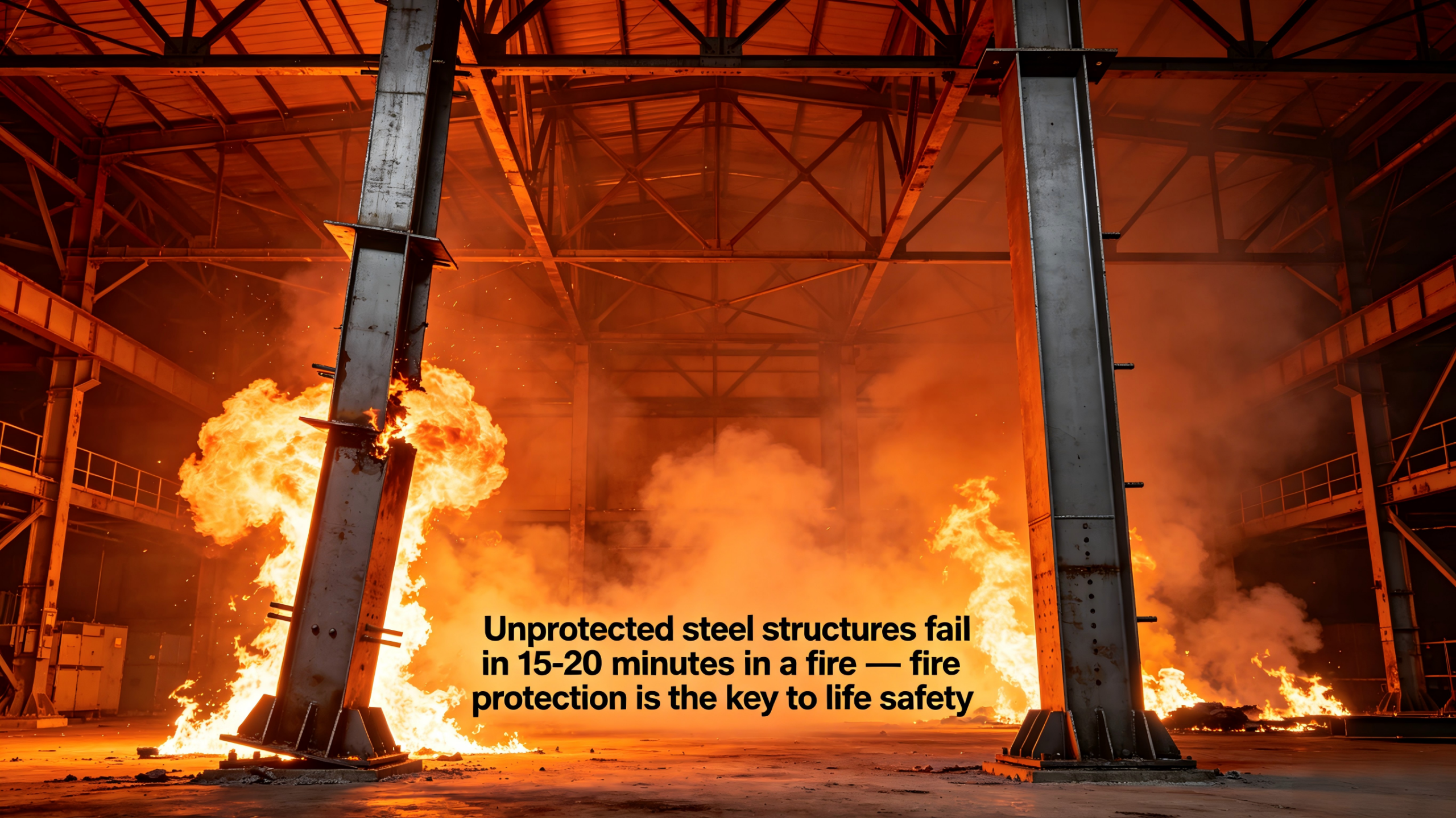
Intumescent coatings, cementitious sprays, board encasements, and fire resistance ratings. Learn how to select fire protection materials for steel structures based on building codes and project requirements.
Steel is strong. But steel has one critical weakness: fire.
At approximately 550°C (1000°F), steel loses half of its yield strength. At 600°C, it loses two-thirds. Unprotected steel columns can fail in as little as 15-20 minutes under fire conditions-9. This is why building codes worldwide require fire protection for structural steel.
For overseas clients, understanding fire protection materials is not just about compliance—it is about life safety, property protection, and project approval.
This guide covers:
- Why steel needs fire protection.
- Intumescent (thin-film) coatings.
- Cementitious (thick-film) coatings.
- Board and blanket encasement systems.
- Fire resistance ratings and code requirements.
- Material selection by project type.
1. Why Steel Requires Fire Protection
Steel does not burn, but it loses strength rapidly as temperature rises.
| Temperature | Strength Remaining | Behavior |
|---|---|---|
| 20°C (ambient) | 100% | Normal |
| 200°C | ~90% | Minimal loss |
| 400°C | ~70% | Significant reduction |
| 550°C | ~50% | Critical – design strength often exceeded |
| 600°C | ~33% | Imminent failure |
| 800°C | ~10% | Collapse |
The problem: A typical building fire reaches 800-1000°C within 30-60 minutes. Without protection, steel structures collapse rapidly-1.
Fire protection works by:
- Insulating: Slowing heat transfer to steel (cementitious coatings, boards).
- Reflecting: Forming a char layer that insulates (intumescent coatings).
- Sacrificial: Absorbing heat through chemical reactions (water release in gypsum).
2. Fire Resistance Ratings
Fire resistance is measured in hours – the time a protected steel element can withstand a standard fire test without exceeding critical temperature (typically 538°C average or 593°C single point)-2.
Common fire resistance ratings:
| Rating (hours) | Typical Application |
|---|---|
| 0.5h (30 min) | Secondary elements, single-story warehouses (some codes) |
| 1.0h (60 min) | Standard industrial buildings, offices, multi-story |
| 1.5h (90 min) | High-rise buildings, schools, hospitals |
| 2.0h (120 min) | Critical infrastructure, high-occupancy buildings |
| 3.0h (180 min) | Special applications, tunnels, petrochemical |
Reference benchmark (GB 50016 / IBC equivalents):
| Building Type | Column | Beam | Floor |
|---|---|---|---|
| Low-rise industrial (2 stories) | 1.5-2.0h | 1.0-1.5h | 1.0-1.5h |
| Multi-story office (4-8 stories) | 2.0-2.5h | 1.5-2.0h | 1.5-2.0h |
| High-rise (>24m) | 2.5-3.0h | 2.0-2.5h | 2.0-2.5h |
Always verify with local building codes (IBC, Eurocode, GB 50016).
3. Intumescent (Thin-Film) Fire Protection Coatings
Intumescent coatings are thin-film systems that expand when heated, forming a thick insulating char layer (typically 30-50× original thickness)-3.
| Property | Description |
|---|---|
| Typical thickness | 0.5 – 3.0 mm (dry film) |
| Mechanism | Expands (intumesces) under heat, forming insulating foam-like char |
| Appearance | Smooth, paintable finish (architectural) |
| Fire rating achievable | Up to 2.0 hours (some products up to 3.0h) |
| Best for | Architecturally exposed steel (visible columns/beams) |
Subtypes:
| Type | Thickness | Fire Rating | Best For |
|---|---|---|---|
| Ultra-thin (<1mm) | 0.5-1.0mm | 0.5-1.5h | Interior, architectural |
| Thin (1-2mm) | 1.0-2.0mm | 1.0-2.0h | General interior steel |
| High-build (2-3mm) | 2.0-3.0mm | 1.5-2.0h | Higher rating requirements |
Advantages:
- Aesthetic (smooth finish, can be top-coated in any color).
- Low weight (adds minimal load to structure).
- Fast application (spray equipment).
- Suitable for complex shapes (open web joists, trusses).
Disadvantages:
- Higher material cost per mm thickness.
- Requires clean, primed surface (Sa2.5 blast).
- Not suitable for high humidity or outdoor without qualified topcoat.
- Performance varies with formulation (water-based vs. solvent-based).
Water-Based vs. Solvent-Based Intumescent:
| Feature | Water-Based | Solvent-Based |
|---|---|---|
| VOC | Low | High |
| Application | Easier, faster dry | Requires ventilation |
| Appearance | Good | Very good (smoother) |
| Storage | Freeze-sensitive | Flammable |
| Cost | Moderate | Higher |
Best for: Visible structural steel, office buildings, airports, stadiums, retail spaces.
4. Cementitious (Thick-Film) Fire Protection Coatings
Cementitious coatings are thick-film systems composed of cement binders mixed with lightweight aggregates (vermiculite, perlite, or mineral wool)-1.
| Property | Description |
|---|---|
| Typical thickness | 8 – 50 mm |
| Mechanism | Insulation (low thermal conductivity) |
| Appearance | Rough, textured (industrial) |
| Fire rating achievable | 1.0 – 3.0+ hours |
| Best for | Concealed steel, industrial buildings, parking garages |
Thickness vs. Fire Rating (Typical – varies by product):
| Fire Rating | Approximate Thickness |
|---|---|
| 1.0 hour | 8-15 mm |
| 1.5 hours | 15-22 mm |
| 2.0 hours | 22-30 mm |
| 2.5 hours | 30-38 mm |
| 3.0 hours | 38-50 mm |
Subtypes:
| Type | Density | Fire Rating | Best For |
|---|---|---|---|
| Vermiculite-based | Low | 1.0-2.0h | General industrial |
| Perlite-based | Low-Medium | 1.5-2.5h | Higher ratings |
| Mineral fiber-reinforced | Medium | 2.0-3.0h | Heavy industrial, petrochemical |
Advantages:
- Lowest material cost per mm of protection.
- Excellent insulation properties.
- Good for high fire rating requirements (2-3 hours).
- Fire resistance well-understood with established calculation methods-1.
- Can achieve very long ratings (3+ hours).
Disadvantages:
- Rough, industrial appearance (not architectural).
- Heavy (adds load to structure).
- Thick coating hides detail (not for exposed connections).
- Slower application (multiple passes required).
- Susceptible to damage (impact and abrasion).
- Not suitable for high-humidity or outdoor without sealant.
Best for: Industrial buildings, warehouses (concealed steel), parking garages, utility plants, back-of-house areas.
5. Board & Blanket Encasement Systems
Rigid boards or flexible blankets are mechanically attached to steel sections.
| Material Type | Form | Fire Rating | Best For |
|---|---|---|---|
| Calcium silicate board | Rigid board | 1.0-3.0h | High durability, architectural |
| Gypsum board (plasterboard) | Rigid board | 1.0-2.0h | Interior, low cost |
| Mineral wool / rock fiber blanket | Flexible blanket | 1.0-2.0h | Irregular shapes, retrofit |
| Cementitious board | Rigid board | 1.5-3.0h | High impact areas |
Board Encasement:
- Boards cut to size, attached with adhesives, screws, or steel pins.
- Corners reinforced with metal angles.
- Provides smooth, paintable finish.
Blanket Encasement:
- Mineral wool wrapped around steel, secured with wire mesh and pins.
- Suitable for complex shapes (trusses, pipes).
- Lower cost than boards but less durable.
Advantages:
- Dry installation (no curing time).
- Very durable (boards resist impact).
- Excellent insulation properties.
- Can achieve very high ratings (3+ hours).
- No skilled spray applicator required.
Disadvantages:
- Labor-intensive (cutting and fitting).
- Requires detailing at connections and penetrations.
- Adds significant volume (increases column size).
- Higher material cost than coatings.
Best for: High-durability requirements, petrochemical plants (jet fire resistance-10), tunnels, retrofit projects, areas with high impact risk.
6. Comparison: Intumescent vs. Cementitious vs. Board
| Factor | Intumescent (Thin) | Cementitious (Thick) | Board/Blanket |
|---|---|---|---|
| Appearance | Smooth, paint-grade | Rough, industrial | Smooth (board) / Matt (blanket) |
| Thickness | 0.5-3mm | 8-50mm | 12-50mm |
| Weight | Very low | Medium | Medium-High |
| Fire rating max | 2.0h (some 3.0h) | 3.0h+ | 3.0h+ |
| Material cost | High per mm | Low per mm | Medium-High |
| Installation speed | Fast (spray) | Moderate | Slow (labor) |
| Durability (impact) | Low | Medium | High (board) |
| Suitable for outdoor | Yes (with topcoat) | No (unless sealed) | Yes (board) |
| Typical application | Visible steel | Concealed steel | High durability |
7. Specialized Fire Protection Materials
A. Gypsum-Based Plasters
Gypsum releases chemically bound water when heated (endothermic reaction). This removes heat from the fire, slowing steel temperature rise-5.
Advantages: Excellent fire performance (up to 2.0h), lower density than cementitious.
Disadvantages: Not for high humidity or outdoor (gypsum degrades).
B. Calcium Silicate-Based Materials
Calcium silicate boards and plasters provide good fire resistance with better moisture resistance than gypsum-5.
Advantages: More durable than gypsum, good for light industrial.
Disadvantages: Higher cost than gypsum.
C. Epoxy Intumescent (High-Performance)
Two-component epoxy intumescent coatings provide the highest durability for extreme environments (offshore, petrochemical, jet fire exposure-10).
Advantages: Excellent durability, chemical resistance, jet fire rating.
Disadvantages: Very high cost, requires specialized application.
D. Integrated Cladding-Fire Protection Materials
Emerging materials combine thermal insulation (building envelope) with fire protection-6. Examples: autoclaved lightweight concrete (ALC) panels, lightweight insulating mortar.
Advantage: Two functions in one material.
Disadvantage: Limited track record; consult manufacturer data.
8. Selection by Building Type & Environment
| Building Type | Visibility | Environment | Recommended Protection |
|---|---|---|---|
| Warehouse (standard) | Concealed (ceiling) | Dry | Cementitious (thick-film) – lowest cost |
| Office building | Visible (columns exposed) | Dry | Intumescent (thin-film) – architectural finish |
| Airport / Stadium | Highly visible | Dry | Intumescent (water-based) + topcoat |
| Industrial plant | Concealed / mixed | Dusty, humid | Cementitious or Board |
| Parking garage | Visible but utilitarian | Humid, salt (winter) | Cementitious (sealed) or Intumescent (qualified for outdoor) |
| Petrochemical / Offshore | Mixed | Extreme, jet fire risk | Epoxy intumescent or Cementitious board-10 |
| Cold storage | Concealed | Freezing, condensation | Cementitious (vapor barrier required) |
| Retrofit / Historic | Visible | Dry | Intumescent (thin) or Board (if impact resistant) |
9. Fire Protection for Connections & Fasteners
A critical requirement often overlooked: fire protection for connections must meet or exceed the connected elements-4.
| Connection Type | Requirement |
|---|---|
| Beam-to-column | Protection thickness ≥ max(beam protection, column protection) |
| Column splices | Same rating as column (including splice plates and bolts) |
| Base plates | Typically fire-protected by concrete floor slab |
| Bolted connections | Bolt heads/nuts must be covered if exposed-9 |
For intumescent coatings: Ensure bolts and connection plates receive same dry film thickness (DFT) as adjacent structural members.
For board encasement: Details at connection nodes require custom cutting and fitting.
10. Quality Control & Inspection
Pre-Application Requirements:
| Check | Requirement |
|---|---|
| Surface preparation | Sa2.5 blast cleaning (ISO 8501-1) for coatings |
| Primer compatibility | Check with coating manufacturer (not all primers accept intumescent) |
| Environmental conditions | Temperature >5°C, humidity <85% for most coatings |
| Material certification | Manufacturer technical data sheet, fire test report (e.g., GB 14907-2, UL 263, BS 476) |
During Application (Coatings):
| Check | Requirement |
|---|---|
| Ambient conditions | Within manufacturer limits |
| Wet film thickness (WFT) | Per specification (typically multiple passes) |
| Dry film thickness (DFT) | Measured per m² (minimum, average, maximum) |
| Visual defects | No runs, sags, bubbles, cracks |
Post-Application (Boards):
| Check | Requirement |
|---|---|
| Board thickness | Per specification |
| Joint treatment | Overlapped or sealed per manufacturer |
| Mechanical fasteners | Correct type and spacing |
| Penetrations | Sealed with fire-rated mastic |
Third-Party Testing Standards:
| Standard | Region | Scope |
|---|---|---|
| GB 14907-2018 | China | Fire protection coatings classification & testing-2 |
| UL 263 / ASTM E119 | USA | Fire tests of building construction |
| BS 476 | UK | Fire tests on building materials |
| EN 13381 | Europe | Fire resistance of structural steel |
11. Cost Comparison (Approximate, per m² of steel surface)
| System | Material | Installation | Total | Lifespan | Best Value For |
|---|---|---|---|---|---|
| Intumescent (1.5h, interior) | $15-25 | $10-15 | $25-40 | 15-20 years | Visible steel, architecture |
| Intumescent (2.0h, interior) | $25-40 | $15-20 | $40-60 | 15-20 years | Higher rating, visible |
| Cementitious (1.5h) | $5-10 | $10-15 | $15-25 | 20-30 years | Concealed steel, industrial |
| Cementitious (2.0h) | $8-15 | $15-20 | $23-35 | 20-30 years | Higher rating, concealed |
| Board encasement (2.0h) | $20-35 | $25-40 | $45-75 | 30+ years | High durability, impact areas |
| Epoxy intumescent (jet fire) | $50-100+ | $20-30 | $70-130+ | 25+ years | Petrochemical, offshore |
Value takeaway:
- Concealed steel: Cementitious is most economical.
- Visible steel: Intumescent pays for itself in aesthetics.
- High durability: Board systems last longest.
12. Link to Steel Structure Fire Protection Service
We provide complete fire protection solutions—engineered, applied, and certified.
Our services include:
- Consultation & design: Fire resistance rating determination based on local building codes (IBC, Eurocode, GB 50016).
- Surface preparation: Sa2.5 blast cleaning, primer application.
- Intumescent coating: Water-based or solvent-based. DFT up to 3.0mm. Ratings 0.5-2.0h.
- Cementitious coating: Vermiculite/perlite-based. Thickness 10-50mm. Ratings 1.0-3.0h.
- Board encasement: Calcium silicate or gypsum boards. Ratings 1.0-3.0h.
- Quality documentation: DFT reports, adhesion tests, photographic records, material certificates.
For overseas clients:
We work with internationally certified fire protection materials (UL, BS, EN, GB compliant). We provide full test reports and can arrange third-party witness testing if required.
👉 [Request a fire protection quote]
Send us your building type, local fire code requirements, steel sections, and whether steel is visible or concealed. We will return a protection recommendation, thickness calculation, and budget price within 48 hours.
Summary Table: Quick Fire Protection Selection
| Your Project | Protection Type | Typical Rating | Why |
|---|---|---|---|
| Warehouse (concealed steel) | Cementitious | 1.0-1.5h | Lowest cost |
| Office building (exposed columns) | Intumescent (water-based) | 1.0-2.0h | Architectural finish |
| Industrial plant (high durability) | Board encasement | 2.0-3.0h | Impact resistant |
| Parking garage (exposed, humid) | Cementitious (sealed) | 1.5-2.0h | Cost + moisture resistance |
| Airport / Stadium (visible, high traffic) | Intumescent + topcoat | 1.5-2.0h | Aesthetics + durability |
| Petrochemical (jet fire risk) | Epoxy intumescent or board | 2.0-3.0h | Jet fire resistance |
| Retrofit (access difficult) | Intumescent (spray) | 1.0-1.5h | Fast application, low weight |