
Steel Structures in High Salt Spray Coastal Zones: Weathering Steel & Anti-Corrosion Material Combinations

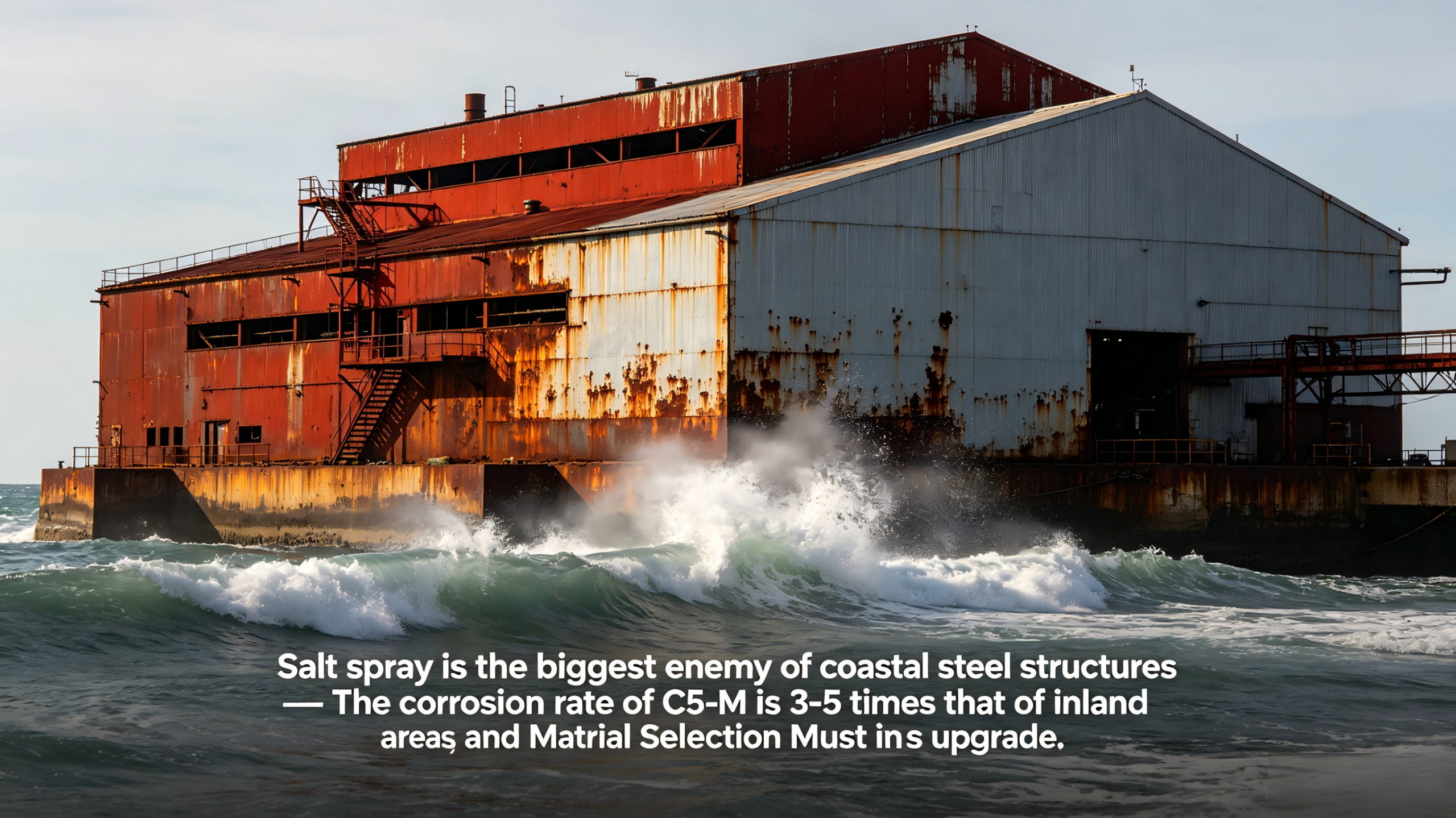
Weathering steel, zinc-aluminum-magnesium (ZAM) coated steel, heavy-duty coating systems, and C5-M/CX corrosion ratings. Comprehensive material strategies for coastal and island steel structure projects.
A steel building by the ocean faces an invisible enemy: salt spray. Chloride-laden air, high humidity, and the constant threat of condensation create one of the most aggressive corrosion environments on Earth.
Standard structural steel (Q235B, Q355B) can begin showing rust within months of installation in coastal zones. Within 3-5 years, section loss can compromise structural integrity -5. This is not a maintenance issue—it is a material selection failure.
For overseas clients developing coastal warehouses, island resorts, port facilities, or offshore-related buildings, understanding the combination of weathering steel, advanced coated products (zinc-aluminum-magnesium), and heavy-duty coating systems is essential for long-term durability.
This guide covers:
- Corrosion mechanisms in salt spray environments.
- ISO corrosion categories (C5-M, CX, Im) and what they mean.
- Weathering steel (Corten) for atmospheric coastal exposure.
- Zinc-aluminum-magnesium (ZAM) coated steel for cladding and decking.
- Heavy-duty coating systems (ISO 12944-9 / NORSOK M-501 compliant).
- Material combination strategies and life-cycle cost analysis.
1. Why Coastal Environments Destroy Steel
Salt spray accelerates corrosion through several mechanisms:
| Mechanism | Effect |
|---|---|
| Chloride ions | Break down passive oxide layer on steel, enabling continuous corrosion |
| Electrolyte film | Moisture + salt creates conductive path for galvanic corrosion |
| Oxygen availability | Thin moisture film allows rapid oxygen diffusion (faster than immersion) |
| Wet-dry cycles | Tidal cycles, sun drying, and sea spray create alternating wet/dry conditions—the most corrosive scenario |
| Temperature + UV | Warm, sunny coastal regions accelerate electrochemical reactions |
The numbers: Research shows that in marine atmospheric environments, zinc coatings (galvanized) provide only 3-5 times the corrosion resistance of bare steel. However, aluminum-zinc alloy coatings (Galvalume type) and zinc-aluminum-magnesium (ZAM) coatings provide over 6 times the corrosion resistance of standard galvanized coatings -2-7.
2. ISO Corrosion Categories for Coastal Environments
International standards classify environments by corrosion severity. This is the first step in material selection.
ISO 12944-2 (Paints and varnishes — Corrosion protection of steel structures)
| Category | Environment | Typical Locations | Corrosion Rate (steel, µm/year) |
|---|---|---|---|
| C3 | Medium (urban/industrial) | City centers, low pollution | 25-50 |
| C4 | High (industrial/coastal) | Chemical plants, coastal areas 1-10km | 50-80 |
| C5-M | Very high (marine) | Coastal areas 0-1km, ships in harbor | 80-200 |
| CX (Extreme) | Extreme marine/offshore | Offshore platforms, splash zones, tropical coastlines | >200 |
Corrosion rate reference by ISO category -9:
| Environment Type | Corrosion Rate (mm/year) | Typical Zone |
|---|---|---|
| Marine atmospheric (C5-M) | 0.05-0.08 | 0-200m from coast |
| Splash zone (Im2) | 0.3-0.5 | Tidal fluctuation zone |
| Permanent immersion (Im3) | 0.1-0.2 | Underwater |
For most coastal building projects (0-500m from coast): Minimum requirement is C5-M. For island or immediate shoreline (0-50m), CX rating may be required -4.
ISO 12944-9 (formerly ISO 20340) – The New Standard
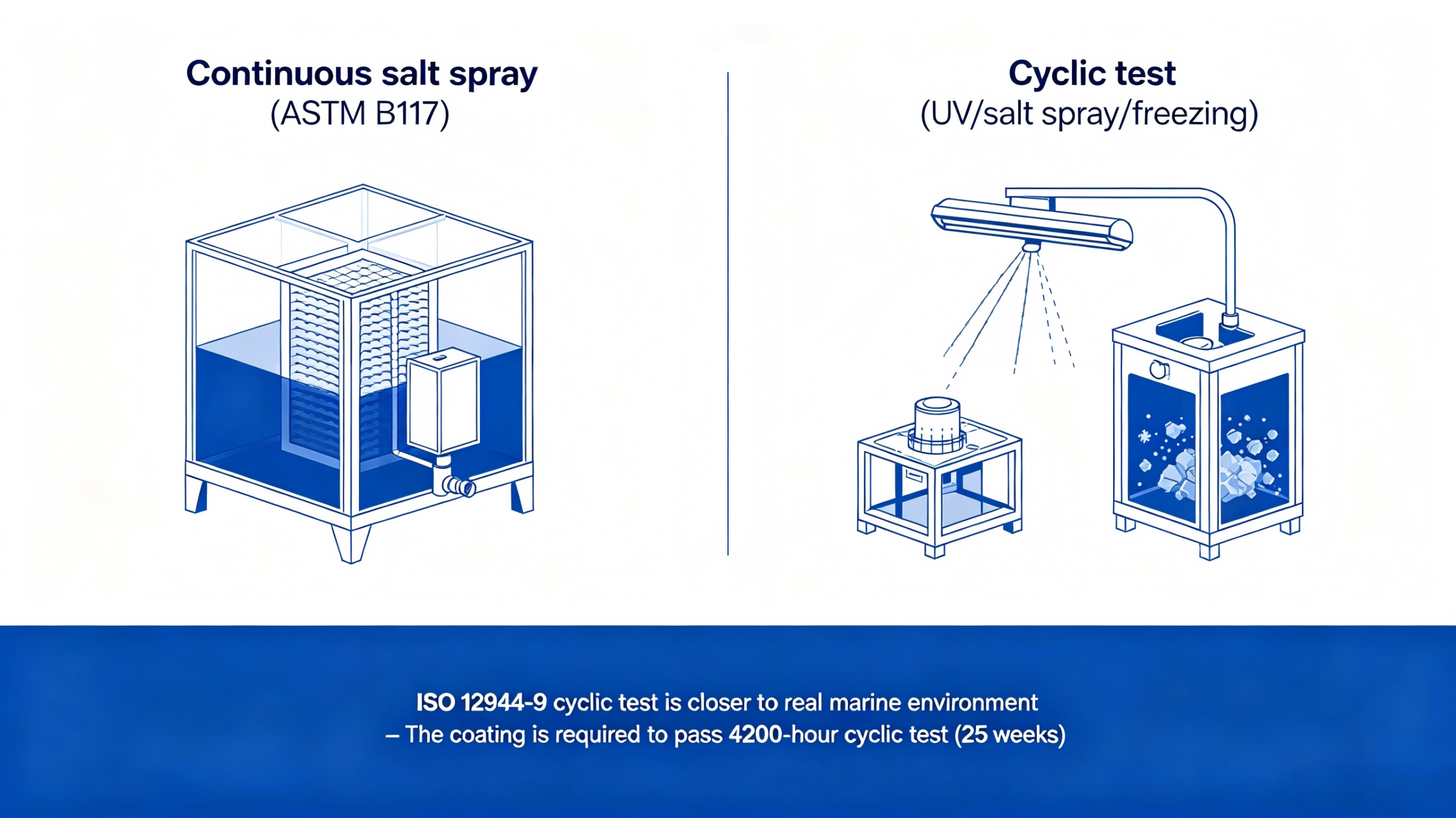
ISO 12944-9 combines the previous C5-I (industrial) and C5-M (marine) categories into a new CX (Extreme) category. More importantly, it specifies a cyclic corrosion test that better simulates real-world coastal conditions:
- 72 hours UV exposure
- 72 hours salt spray
- 24 hours freezing
This 1-week cycle repeats for 25 weeks (4,200 hours total). Testing shows this cyclic method correlates far better to actual field performance than continuous salt spray (ASTM B117) -4.
For overseas clients: Specify coatings tested to ISO 12944-9 (or its predecessor ISO 20340), not just ASTM B117. A coating that passes 10,000 hours of continuous salt spray may fail within 2-3 years in an actual tidal zone.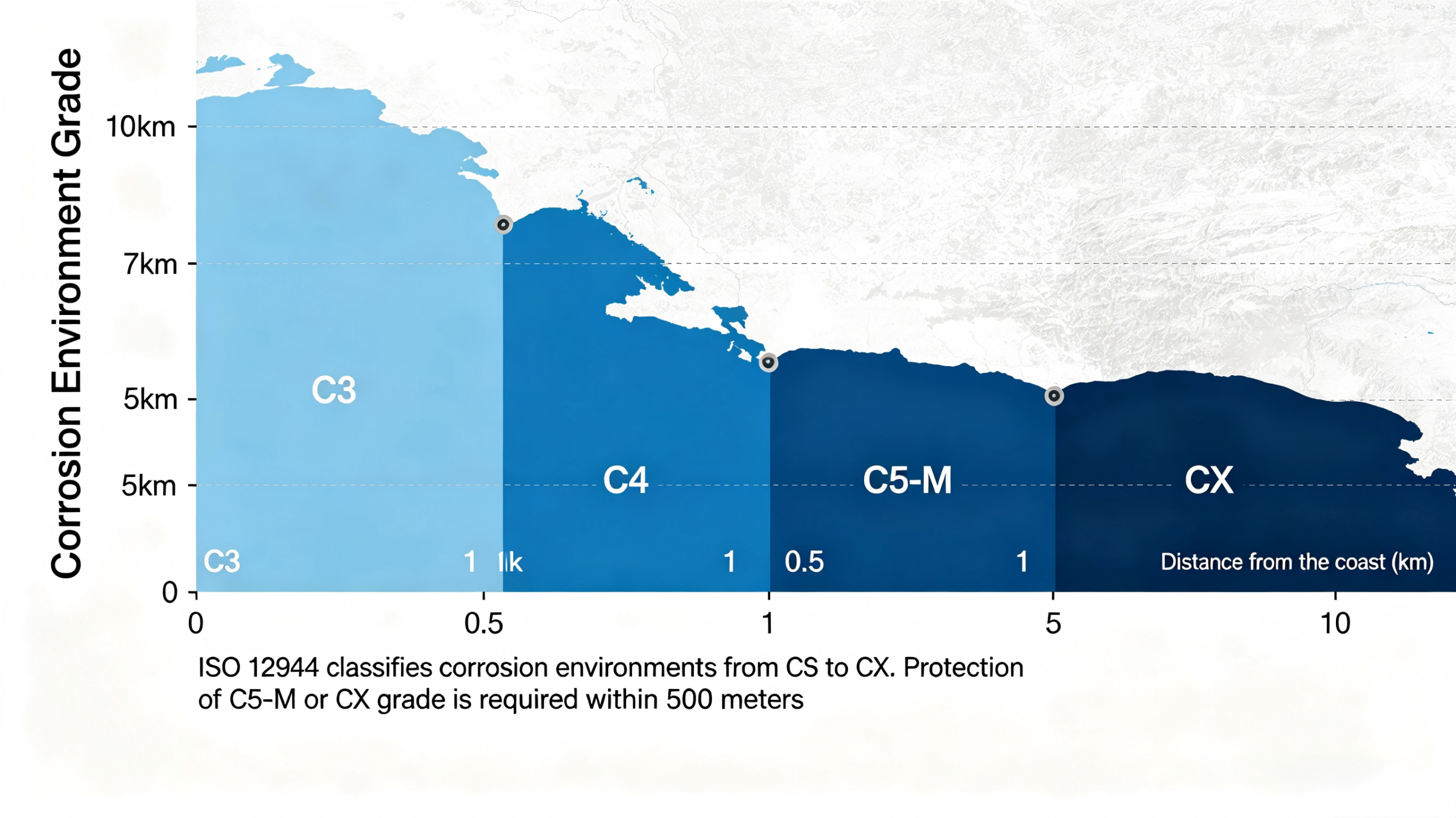
3. Material Option 1: Weathering Steel (Corten)
Weathering steel (e.g., Q355NH, A588, S355J2W) forms a stable, dense rust layer (patina) that protects the underlying steel from further corrosion.
| Property | Weathering Steel | Standard Carbon Steel |
|---|---|---|
| Alloy elements | Cu, Cr, Ni, P (0.2-0.5% each) | Trace only |
| Corrosion mechanism | Forms protective patina (adherent rust) | Rust spalls off continuously |
| Relative corrosion rate (coastal) | 2-4× better than carbon steel | Baseline |
| Requires coating? | No (bare exposure) | Yes (coating required) |
| Initial cost premium | +10-20% | Baseline |
How Weathering Steel Works:
The alloying elements (copper, chromium, nickel, phosphorus) promote the formation of a dense, adherent oxide layer (patina) that is approximately 50-100µm thick. This layer is significantly less permeable to oxygen and moisture than the loose, flaking rust that forms on carbon steel.
Limitations for Coastal Zones:
| Distance from Coast | Suitability of Weathering Steel |
|---|---|
| >2km | Excellent (ideal application) |
| 1-2km | Acceptable (patina forms, but slower) |
| 0.5-1km | Marginal (patina may not fully stabilize) |
| <0.5km | Not recommended – chlorides break down patina |
| Splash zone | Never – immersion/wet conditions prevent patina formation |
Critical limitation: In high-chloride environments (within 500m of breaking surf), the patina may not form properly. Instead, the steel corrodes similarly to carbon steel -10. For immediate coastal zones, weathering steel should be used only with coating protection on its surface—which defeats the purpose.
Best application for coastal weathering steel: Buildings and structures located 500m to 2km from the coast, where salt loading is moderate and wet-dry cycles allow patina formation. Bridges, transmission towers, and architectural features (uncoated aesthetic) are common applications.
Specification for Coastal Weathering Steel:
“Structural steel for atmospheric exposure within 0.5-2km of marine coastline shall be weathering steel conforming to [ASTM A588 / EN 10025-5 / GB/T 4171] with minimum corrosion resistance index I ≥ 6.5. Steel shall be used bare (no coating) and detailed to avoid water trapping.”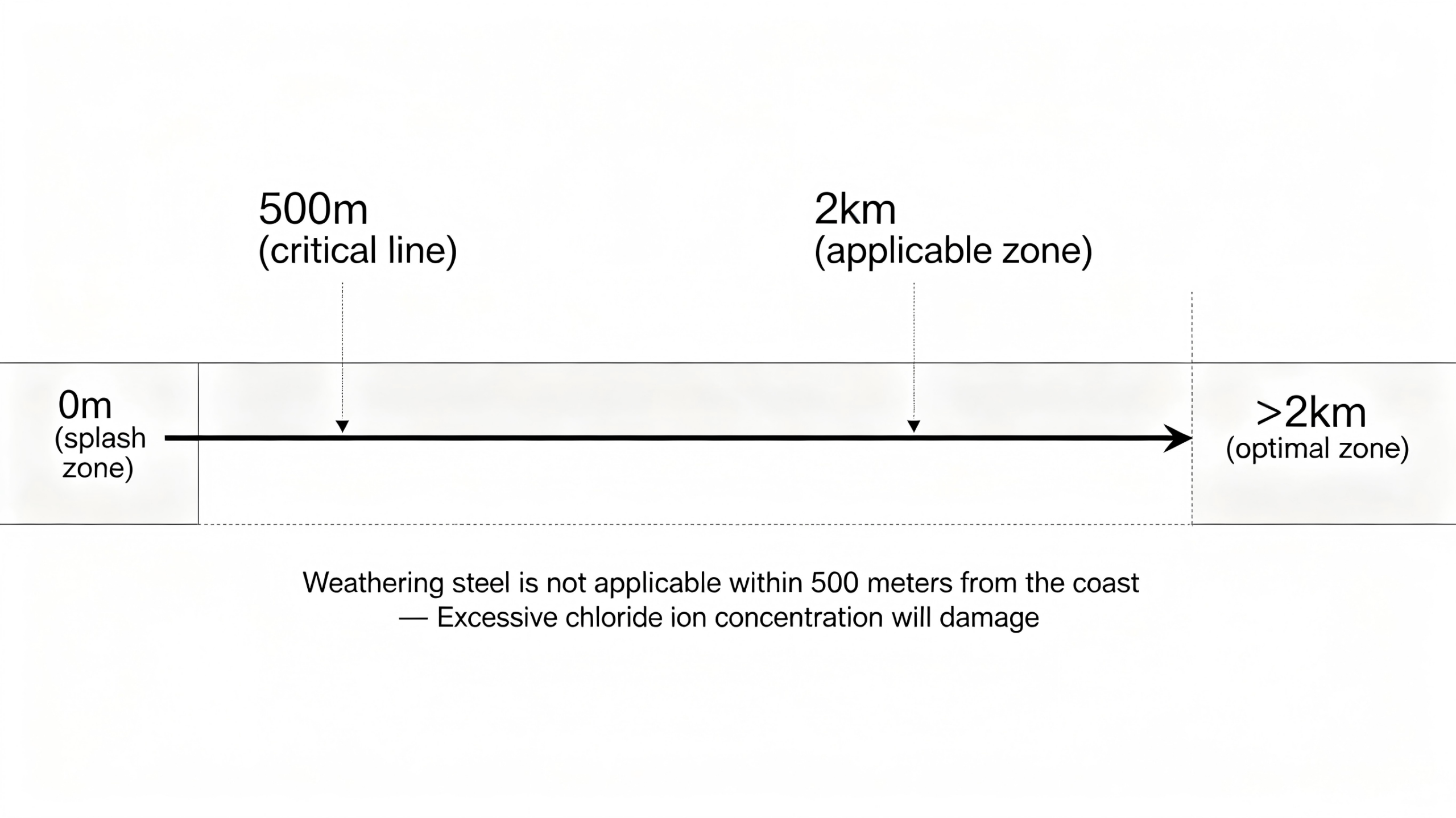
4. Material Option 2: Zinc-Aluminum-Magnesium (ZAM) Coated Steel
For secondary structural components (purlins, girts, decking, cladding) and light-gauge framing, Zinc-Aluminum-Magnesium (ZAM) alloy coated steel offers dramatically superior corrosion resistance compared to standard galvanized (Z275) or even Galvalume (AZ150).
| Coating Type | Composition | Relative Corrosion Resistance (Salt Spray) | Typical Coating Weight |
|---|---|---|---|
| Galvanized (Z) | 100% Zn | Baseline (1×) | Z275 (275g/m²) |
| Galvalume (AZ) | 55% Al, 43.4% Zn, 1.6% Si | 2-4× Z | AZ150 |
| ZAM (Zinc-Aluminum-Magnesium) | 93% Zn, 3.5% Al, 3% Mg | 6-10× Z | ZM80-ZM200 |
Research finding: A peer-reviewed study in Steel Construction journal tested five materials (Q235, weathering steel, galvanized steel, Galvalume, and ZAM-coated steel) under neutral salt spray. The corrosion resistance of ZAM-coated steel was over 6 times greater than standard galvanized steel -2-7.
Why ZAM Works Better:
| Element | Function |
|---|---|
| Aluminum (3-4%) | Forms a dense, passive oxide layer that blocks corrosion pathways |
| Magnesium (2-3%) | Refines the microstructure, promotes formation of stable corrosion products that “heal” scratches |
| Zinc (balance) | Provides sacrificial (galvanic) protection at cut edges and scratches |
Recommended ZAM Products for Coastal Projects:
| Product | Standard | Coating Weight | Applications |
|---|---|---|---|
| ZAM (generic) | ASTM A1046 / JIS G3323 | ZM80-ZM200 | Purlins, girts, wall cladding |
| SuperDyma (Nippon Steel) | Proprietary | ZM140-ZM200 | High-end cladding, decking |
| Magnelis (ArcelorMittal) | EN 10346 | ZM140-ZM310 | Roofing, industrial cladding |
| Valmount (ThyssenKrupp) | EN 10346 | ZM140-ZM200 | Light-gauge framing |
Specification for ZAM-coated coastal components:
“Cold-formed steel sections (purlins, girts, decking) shall be manufactured from ZAM (zinc-aluminum-magnesium) alloy coated steel with minimum coating weight ZM200 (200g/m² both sides) per ASTM A1046 / EN 10346. Coating shall provide minimum 6× the corrosion resistance of standard G90/Z275 galvanized coating under ISO 12944-9 cyclic testing.” 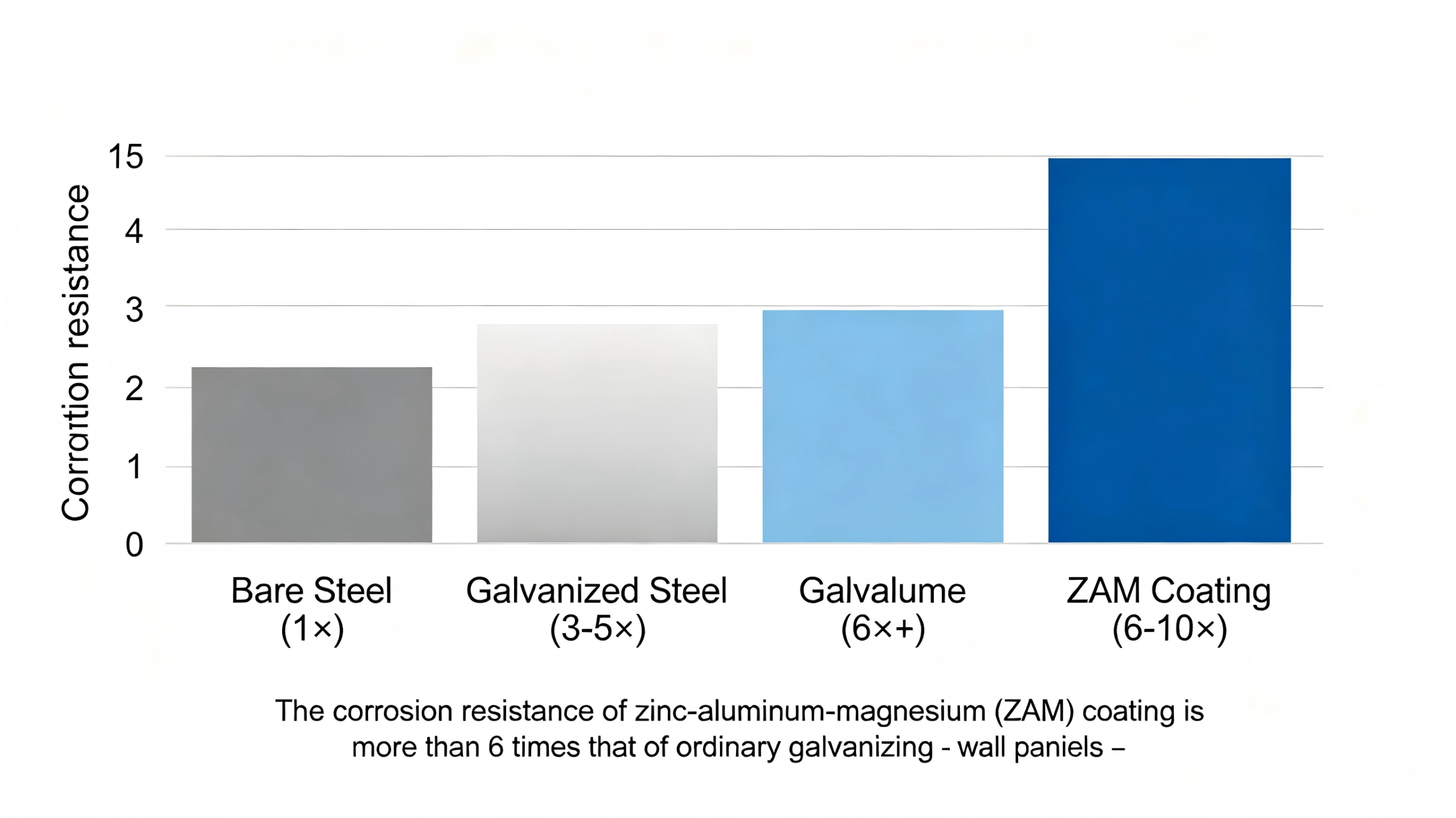
5. Material Option 3: Heavy-Duty Coating Systems (for Hot-Rolled Sections)
For primary structural steel (columns, beams,桁架) in coastal environments, weathering steel is not suitable (if within 500m), and ZAM coating is not available for heavy sections. Heavy-duty multi-layer coating systems are the standard solution.
Recommended System for C5-M (Coastal 0-500m):
| Layer | Coating Type | Thickness (DFT) | Function |
|---|---|---|---|
| Primer | Epoxy Zinc-Rich (80-85% Zn in dry film) | 40-60µm | Sacrificial protection + adhesion |
| Intermediate | Epoxy Micaceous Iron Oxide (MIO) | 80-120µm | Barrier (tortuous path for moisture) |
| Topcoat | Polyurethane (aliphatic) or Fluoropolymer | 60-80µm | UV resistance, gloss, color retention |
| Total | 180-260µm |
Recommended System for CX (Extreme – Shoreline / Tidal / Offshore):
| Layer | Coating Type | Thickness (DFT) | Function |
|---|---|---|---|
| Primer | Epoxy Zinc-Rich (≥85% Zn) or Inorganic Zinc Silicate | 60-75µm | Superior sacrificial protection |
| Intermediate 1 | High-build Epoxy MIO | 120-150µm | Primary barrier |
| Intermediate 2 | High-build Epoxy MIO or Glass Flake Epoxy | 120-150µm | Secondary barrier |
| Topcoat | Fluoropolymer (FEVE) or Polysiloxane | 60-80µm | Extreme UV + chemical resistance |
| Total | 360-455µm |
Advanced Single-Coat Alternative: Waterborne High-Ratio Zinc Silicate
For select applications, a NASA-derived technology is available: waterborne high-ratio zinc silicate (e.g., WB HRZS). Key features -3:
- Originally developed by NASA to protect launch gantries in highly corrosive coastal ocean environments
- Single coat system (no topcoat required) – reduces application time
- 10,000+ hours salt fog (ASTM B117) – proven extreme durability
- Passes hot seawater erosion test (MIL-P-23236)
- Provides both galvanic and cathodic protection
- Zinc in dry film: 77-91% by volume
- 0 VOC – environmentally compliant
- Temperature resistance up to 750°F (399°C)
Best for: Offshore platforms, marine terminals, coastal bridges, and structures where maintenance access is extremely difficult.
ISO 12944-9 Coating System Classification:
| Durability Category | Thickness Range | Test Requirement (ISO 12944-9) | Typical Life |
|---|---|---|---|
| High (H) | 200-280µm | 1,440h cyclic | 10-15 years |
| Very High (VH) | 280-360µm | 2,520h cyclic | 15-25 years |
| Extreme (E) | 360-480µm+ | 4,200h cyclic (25 weeks) | 25+ years |
For coastal projects requiring >20-year life between maintenance: Specify Very High (VH) or Extreme (E) durability per ISO 12944-9.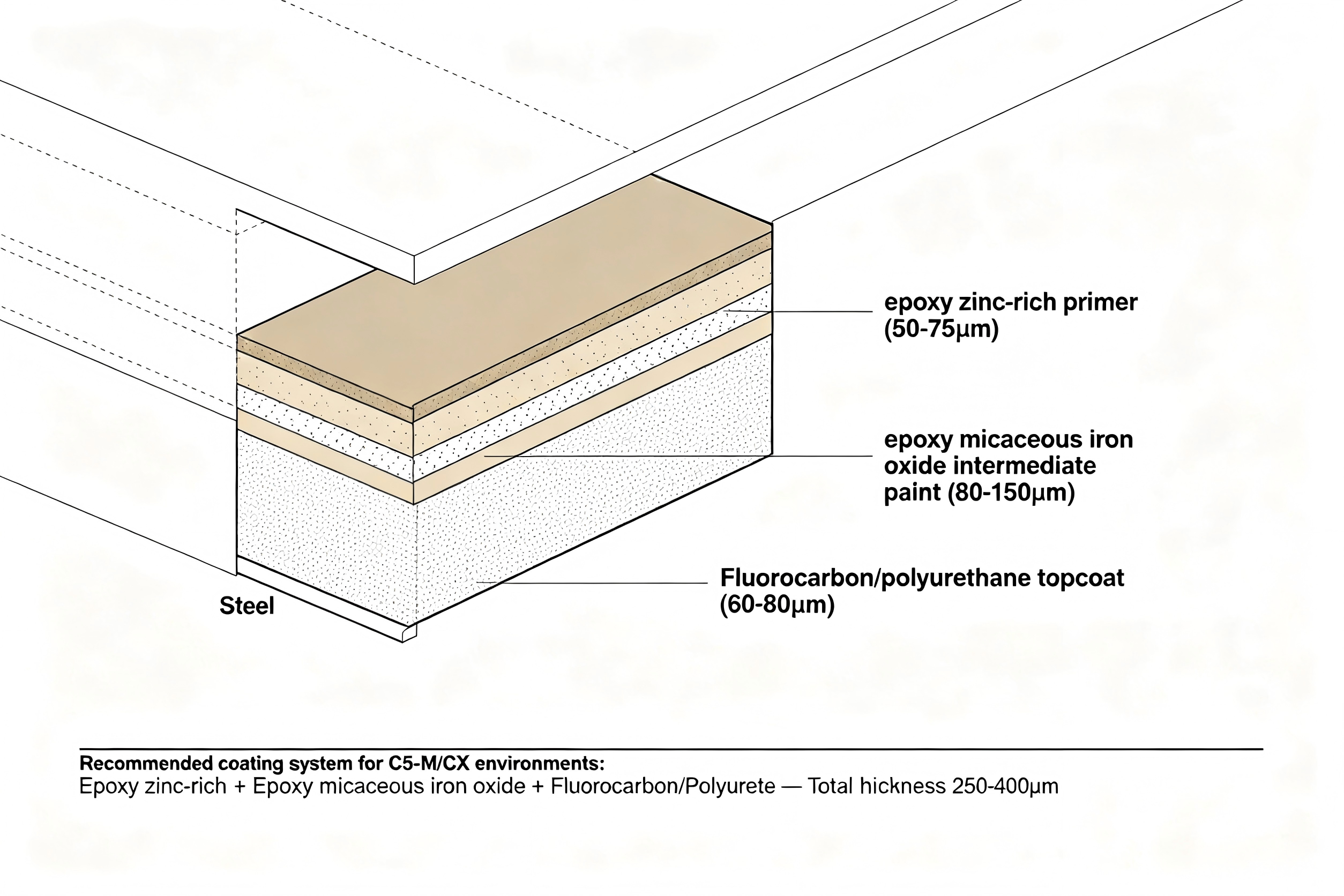
6. Specialized Treatment: Zinc-Nickel Diffusion Coating
For small structural components, fasteners, and connections in extreme salt spray, zinc-nickel diffusion coating (thermal diffusion) offers exceptional performance.
| Property | Zinc-Nickel Diffusion Coating | Hot-Dip Galvanized (HDG) |
|---|---|---|
| Thickness | 15-40µm | 50-100µm |
| Uniformity | Extremely uniform (no drip or run) | Variable (drainage affects thickness) |
| Hydrogen embrittlement risk | Very low (baking after process) | High for high-strength bolts |
| Salt spray resistance (ASTM B117) | 1000-1500 hours to red rust | 500-800 hours to red rust |
| Hardness | Higher (300-400 HV) | Lower (50-80 HV) |
| Wear resistance | Excellent | Poor |
Research finding: A 2024 study in China Construction Metal Structure tested zinc-nickel diffused steel components in 100-day neutral salt spray. Red rust area was only 0.25% on angle steel and nuts, with all other components showing less than 0.25% red rust. In 10-day sulfur dioxide corrosion tests (simulating industrial + marine mixed environments), no red rust appeared -1-6.
Best for: Coastal structural bolts, nuts, small brackets, connection plates, and any steel component that will be installed in a C5-M or CX environment and requires high reliability.
Specification:
“All bolts, nuts, washers, and small fabricated components for exterior coastal exposure shall receive zinc-nickel diffusion coating (thermal diffusion) per ISO 17668, minimum coating thickness 25µm, followed by hydrogen relief baking.”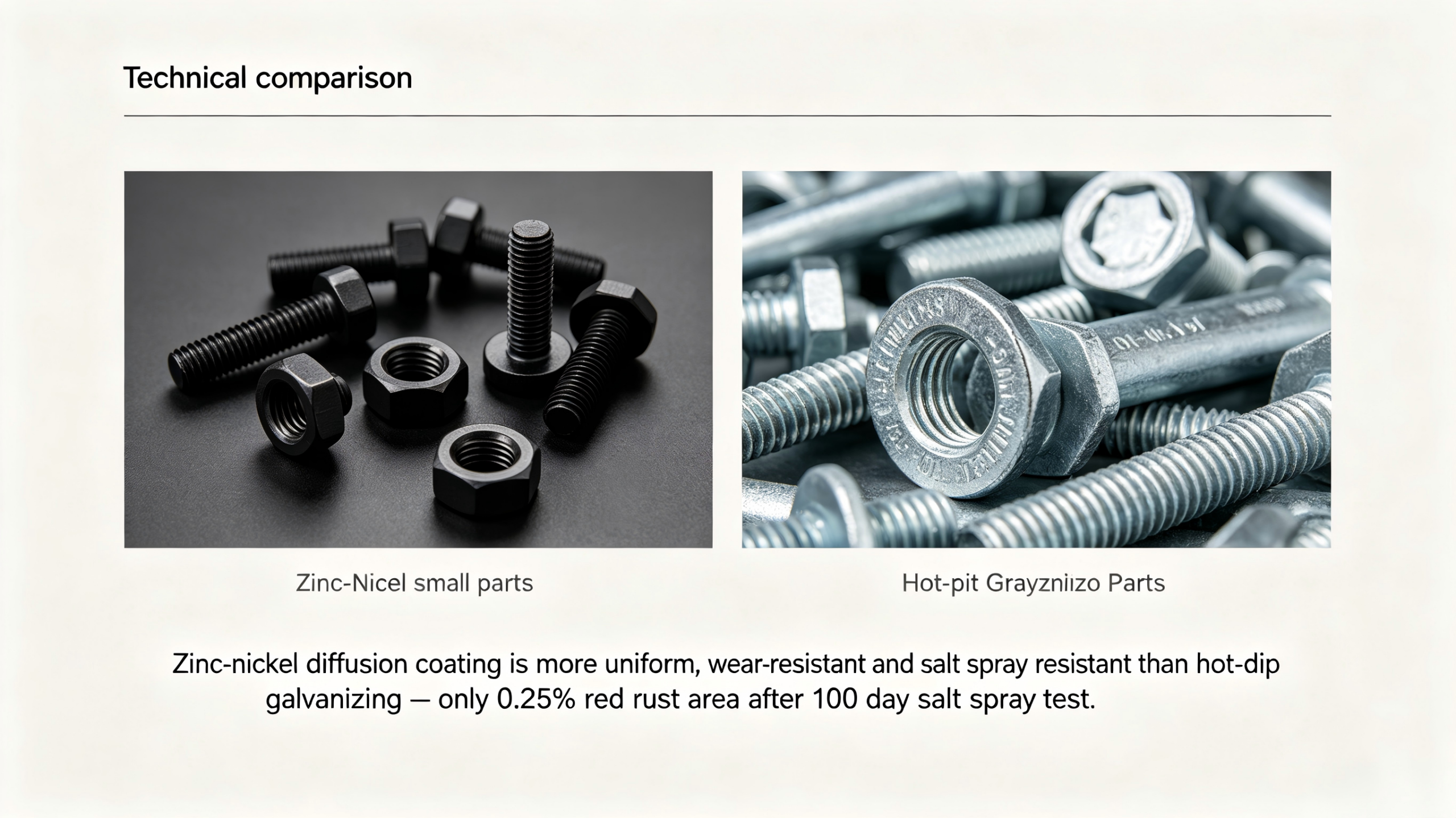
7. Material Combination Strategy by Project Zone
A coastal steel building should not use the same protection everywhere. Instead, adopt a zone-based strategy:
| Building Zone | Exposure | Recommended Material / Coating |
|---|---|---|
| Roof cladding | Direct salt spray + UV | ZAM-coated steel (ZM200) or heavy fluoropolymer-coated aluminum-zinc steel |
| Wall cladding (elevated) | Salt spray, less UV than roof | ZAM-coated steel (ZM140-ZM200) |
| Wall cladding (ground level 0-3m) | Highest salt loading + splash-back | Stainless steel or epoxy-coated ZAM with topcoat |
| Primary frame (columns/beams) | Atmospheric salt, sheltered by cladding | Epoxy zinc-rich + epoxy MIO + polyurethane (250µm+ DFT) |
| Secondary framing (purlins/girts) | Sheltered but vents | ZAM-coated steel (ZM140) or hot-dip galvanized after fabrication |
| Fasteners (screws, bolts) | Fully exposed at penetrations | Stainless steel 316, or zinc-nickel diffusion coated |
| Base plates & connections (0-1m from ground) | Splash zone + salt accumulation | Encapsulated in grout or coated with glass flake epoxy |
Key principle: Use the most durable materials at the lowest elevations (where salt water splashes and pools) and at penetrations (where coatings are breached).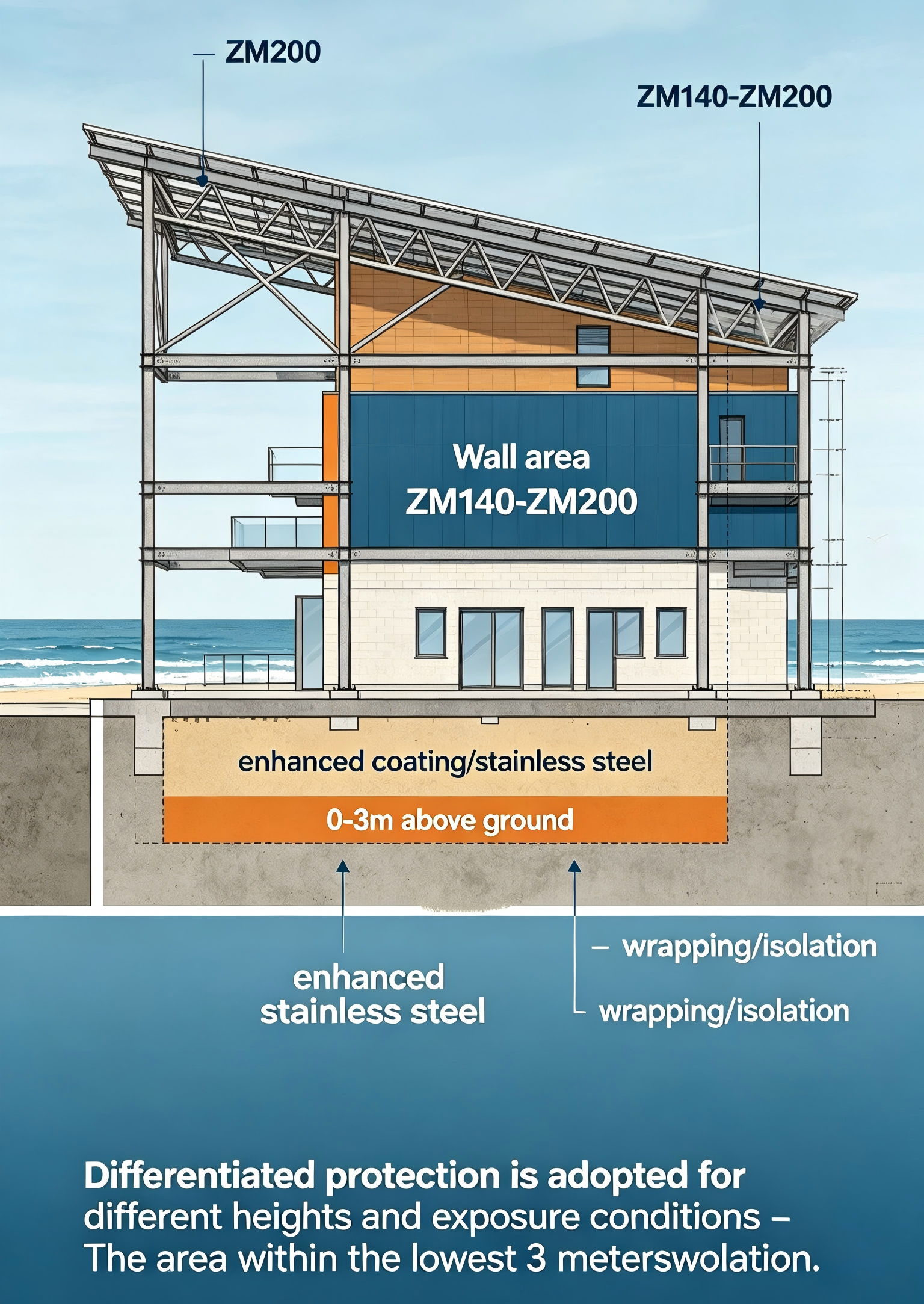
8. Surface Preparation: The Difference Between Success and Failure
No coating works properly on poorly prepared steel. For coastal environments, surface preparation requirements are mandatory, not optional.
| Requirement | Standard | Specification |
|---|---|---|
| Abrasive blasting | ISO 8501-1 | Sa2.5 minimum, Sa3 for CX environments |
| Surface profile / anchor pattern | ISO 8503-2 | 50-85µm (2-3.5 mils) |
| Soluble salt testing | ISO 8502-6 / 9 | <30 mg/m² chlorides (conductivity) |
| Dust removal | ISO 8502-3 | Rating 1 or 2 (no visible dust) |
| Priming interval | Within 4 hours of blasting (prevents flash rust) |
Critical for coastal projects: Soluble salt testing is non-negotiable. Chloride salts left on the steel surface under the coating will draw moisture through the coating film via osmosis, causing blistering and under-film corrosion within months -5.
Specification language:
“After abrasive blasting to Sa2.5, steel surfaces shall be tested for soluble salts using Bresle patch method (ISO 8502-6). Chloride concentration shall not exceed 30 mg/m². Re-blast and wash if higher.”
9. Life-Cycle Cost Analysis
Initial material cost is only part of the equation. For coastal structures, maintenance and replacement costs dominate long-term expense.
| Solution | Initial Cost (per m²) | Expected Life (C5-M) | Maintenance Frequency | 30-Year Total Cost (present value) |
|---|---|---|---|---|
| Standard carbon steel + paint (C4 spec, 160µm) | $15-25 | 3-5 years | Every 3-5 years (recoat or replace) | $60-120 |
| Epoxy zinc-rich + MIO + PU (C5-M spec, 240µm) | $35-50 | 10-15 years | Every 10-15 years (touch-up) | $50-70 |
| Inorganic zinc silicate single coat (CX spec) | $40-60 | 15-20 years | Minimal (inspect every 5 years) | $45-60 |
| Weathering steel (bare, >500m from coast) | $12-18 (material premium) | 20-30 years | None (if patina stable) | $15-25 |
| ZAM-coated steel (secondary framing) | $10-15 (premium over galvanized) | 20-25 years | None | $12-18 |
| Stainless steel 316 (structural sections) | $200-300+ | 50+ years | None (theoretically infinite) | $200-300 |
Best value for coastal primary structure: Heavy-duty coating system (240-360µm) with zinc-rich primer + epoxy MIO + fluoropolymer topcoat. Higher initial cost than standard paint, but dramatically lower life-cycle cost.
Best value for cladding/secondary: ZAM-coated steel (ZM200) – 6× the life of galvanized for only 20-30% premium.
10. Design Details That Reduce Corrosion (Constructability)
Even the best materials will fail with poor detailing. Follow these principles:
| Bad Detail | Problem | Good Detail |
|---|---|---|
| Horizontal surfaces that trap water | Prolonged moisture contact accelerates corrosion | Slope surfaces (minimum 5°) or provide drainage |
| Closed box sections without drainage | Water pools inside; corrosion from inside out | Provide 10-15mm drainage holes at low points |
| Dissimilar metal contact (steel + copper, steel + bare aluminum) | Galvanic corrosion (steel acts as anode) | Isolate with neoprene pads or insulating washers |
| Crevices (tight lap joints, back-to-back channels) | Capillary action holds moisture | Seal crevices with butyl tape or specify ventilated (open) joints |
| Bolted connections with exposed threads | Thread roots concentrate corrosion | Use bolts with full thread coverage (or cap nuts) and apply wax or sealing compound after torquing |
| Base plates in contact with soil or pooling water | Highest corrosion risk – sacrificial zone | Elevate base plate 150mm minimum above grade, grout completely, and apply heavy coating on buried portion -10 |
Design standard reference: Clause 18.2.4 of GB 50017-2017 (China Structural Steel Code) specifies that for corrosion protection -10:
- Avoid crevices that trap moisture and debris
- Close box sections with welds (no open seams)
- Coat exposed bolt threads with same system as primary steel
- Raise base plates minimum 150mm above exterior grade
11. Testing Standards & Certification to Request
When specifying materials for a coastal project, include these testing requirements:
| Material / Coating | Required Test | Minimum Passing Criteria |
|---|---|---|
| ZAM-coated steel | ASTM B117 (salt spray) | 3,000+ hours to 5% red rust |
| Heavy-duty coating system | ISO 12944-9 (cyclic, 25 weeks) | No corrosion > Ri1 (1% surface) |
| Weathering steel patina | ASTM G50 (atmospheric exposure) | Corrosion rate <15µm/year after 4 years |
| Zinc-nickel diffusion | ISO 9227 (salt spray) | 1,000+ hours no red rust |
| Fasteners | ASTM G85 (cyclic salt fog) | 2,000+ hours no red rust |
What to request from your supplier:
- “Provide ISO 12944-9 test report for the proposed coating system (not just ASTM B117).”
- “For ZAM steel, provide coating weight certificate (ZM200 minimum) and salt spray test data.”
- “For weathering steel, provide corrosion resistance index calculation (per EN 10025-5 or GB/T 4171).”
12. Link to Coastal Corrosion Protection Service
We provide complete corrosion protection solutions for coastal and marine environments—from material selection through application and testing.
Our coastal-grade services include:
- ISO 12944-9 compliant coating systems: Epoxy zinc-rich (80-85% Zn) + epoxy MIO + fluoropolymer topcoat. Thickness 240-450µm DFT. Certified to CX (Extreme) durability.
- ZAM-coated steel supply: ZM200 and ZM310 grades. Mill certificates with coating weight and salt spray validation.
- Weathering steel fabrication: Q355NH, ASTM A588. Engineered for coastal zones 0.5-2km from shoreline.
- Zinc-nickel diffusion coating: For fasteners and small components. 1,000+ hours salt spray protection. Hydrogen relief baking included.
- Surface preparation: Sa2.5 blast with soluble salt testing (<30 mg/m² chlorides). Prior to every application.
- Quality documentation: ISO 12944-9 test reports, DFT maps (per m²), adhesion pull-off tests, salt contamination logs.
For overseas clients:
We design zone-based protection strategies (cladding, frame, fasteners, ground zone) specifically for your site’s distance from the coast and prevailing wind direction. We provide third-party witness testing for critical coating applications.
👉 [Request a coastal corrosion protection quote]
Send us your project location (distance from coast), prevailing wind direction, building type, and design life target. We will return a zone-based material recommendation, coating specification, life-cycle cost analysis, and budget price within 48 hours.
Summary Table: Quick Selection by Distance from Coast
| Distance from Coast | Primary Frame | Cladding / Decking | Fasteners | Expected Life |
|---|---|---|---|---|
| >5km | Standard painted (C3/C4) | Galvanized (Z275) or ZM80 | HDG carbon steel | 10-15 years |
| 2-5km | Epoxy zinc-rich + PU (C4 spec, 200µm) | ZM140 (ZAM) | HDG + wax dip | 15-20 years |
| 0.5-2km | Epoxy zinc-rich + MIO + PU (C5-M spec, 240µm) | ZM200 (ZAM) or Galvalume AZ200 | Stainless 304 or zinc-nickel | 20-25 years |
| 0-0.5km (immediate coastal) | Epoxy zinc-rich + MIO + fluoropolymer (CX spec, 360µm+) | ZM310 (ZAM) or stainless 316 | Stainless 316 | 25-30+ years |
| Splash zone / tidal | Glass flake epoxy or stainless steel | Not applicable (concrete or stainless) | Stainless 316 or super duplex | 30+ years |