
High-Strength Bolts in Steel Structures: Grade 8.8 vs. 10.9 – Properties, Slip Factors & Selection Guide

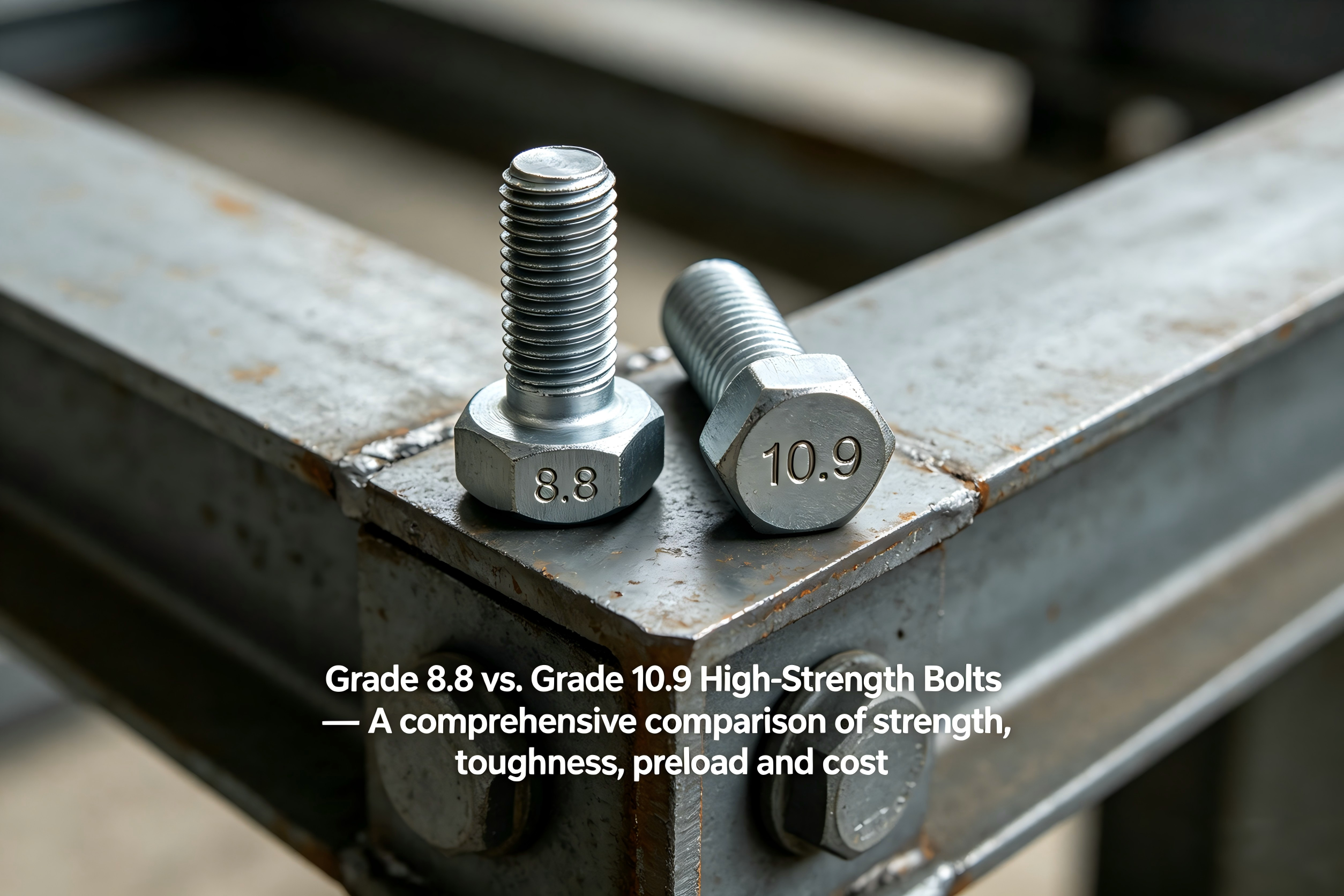
Grade 8.8 vs. 10.9 high-strength bolts. Compare material properties, slip factors, preload control, and connection stability for steel structure nodes. Optimize your bolted joint reliability.
A bolted connection is only as strong as the bolt. But strength alone does not tell the full story. Grade 10.9 bolts are stronger than Grade 8.8, but they are also more brittle, more sensitive to hydrogen embrittlement, and more expensive.
For overseas clients designing steel structures—warehouses, crane-runway buildings, seismic frames, or heavy industrial plants—understanding the difference between 8.8 and 10.9 is essential for safety, cost control, and long-term reliability.
This guide covers:
- Material properties and strength differences.
- Slip factors and connection behavior.
- Preload control methods.
- Selection by application (bearing vs. slip-critical).
- Hydrogen embrittlement risks and galvanization.
- Cost-benefit analysis.
1. Bolt Grade Decoding: 8.8 vs. 10.9
Both grades are high-strength quenched and tempered steel bolts. The numbers tell the strength story.
| Grade | Tensile Strength (MPa) | Yield Strength (MPa) | Yield/Tensile Ratio | Elongation (%) |
|---|---|---|---|---|
| 8.8 | 800 min | 640 min | 0.80 | 12% min |
| 10.9 | 1000 min | 900 min | 0.90 | 9% min |
What the numbers mean:
- First digit × 100 = ultimate tensile strength (MPa)
- Second digit ÷ 10 = yield strength as percentage of tensile
Example 8.8: 8 × 100 = 800 MPa tensile; 800 × 0.8 = 640 MPa yield
Example 10.9: 10 × 100 = 1000 MPa tensile; 1000 × 0.9 = 900 MPa yield
Key observation: Grade 10.9 is 25% stronger in tension and 40% stronger in yield. However, it has lower ductility (9% elongation vs. 12%)—meaning it is more brittle and less forgiving of over-tightening or misalignment.
2. Material Chemistry & Heat Treatment
| Element | Grade 8.8 (Typical) | Grade 10.9 (Typical) |
|---|---|---|
| Carbon (C) | 0.25-0.55% | 0.30-0.60% |
| Manganese (Mn) | 0.40-1.20% | 0.50-1.20% |
| Phosphorus (P) | ≤0.035% | ≤0.035% |
| Sulfur (S) | ≤0.035% | ≤0.035% |
| Chromium (Cr) | ≤0.30% (optional) | 0.30-1.20% (often added) |
| Molybdenum (Mo) | ≤0.10% (optional) | 0.10-0.30% (for high strength) |
Base steel for Grade 8.8: Medium carbon steel (35#, 45#) or low-alloy.
Base steel for Grade 10.9: Alloy steel (40Cr, 35CrMo, 35CrMoA) typically required.
Heat treatment:
Both grades are quenched (heated to 830-880°C, rapidly cooled in oil or water) and tempered (reheated to 400-600°C to reduce brittleness). Grade 10.9 requires more precise control.
Hardness (HRC – Rockwell C):
| Grade | Hardness Range |
|---|---|
| 8.8 | 23-34 HRC |
| 10.9 | 32-39 HRC |
The higher hardness of 10.9 means greater resistance to thread stripping but also greater susceptibility to hydrogen embrittlement and stress corrosion cracking.
3. Connection Types: Bearing vs. Slip-Critical
The choice between 8.8 and 10.9 depends heavily on the connection type.
Bearing Connection
- How it works: Bolt shank contacts hole edge. Load transfers through bearing (steel compression) and bolt shear.
- Clamping force: Not critical (snug tight + 1/4 turn is sufficient).
- Bolt grade impact: Lower grade (8.8) is often adequate because shear strength of bolt typically exceeds bearing strength of connected plates.
- Typical use: Standard frames, warehouses, secondary connections.
Slip-Critical Connection (Friction Grip)
- How it works: High clamping force creates friction between plates. Load transfers through friction—joint cannot slip.
- Clamping force: Critical. Must achieve specified minimum preload (usually 70% of bolt yield strength).
- Bolt grade impact: Higher preload from 10.9 (higher yield) provides greater slip resistance for the same bolt size.
- Typical use: Crane runway beams, bridge trusses, seismic frames, vibrating equipment, connections requiring fixed alignment.
Slip resistance formula:
Slip Resistance = μ × Preload × Number of friction interfaces
Where μ = slip factor (coefficient of friction between plates)
| Surface Condition | Slip Factor (μ) Typical |
|---|---|
| Clean mill scale (uncoated) | 0.30-0.50 |
| Blast cleaned (Sa2.5) | 0.40-0.55 |
| Zinc-rich primer (thin) | 0.20-0.35 |
| Hot-dip galvanized (HDG) | 0.15-0.25 |
| Painted (thick coating) | 0.10-0.20 (not recommended) |
Example: M20 Grade 8.8 bolt, preload = 142 kN, μ = 0.35 (blast cleaned, zinc primer), 2 interfaces
Slip resistance = 0.35 × 142 × 2 = 99.4 kN
Same bolt in Grade 10.9: preload = 182 kN
Slip resistance = 0.35 × 182 × 2 = 127.4 kN (28% higher with same bolt size)
4. Preload (Tension) Values by Grade and Size
Preload is the clamping force applied when tightening the bolt. For slip-critical connections, achieving minimum preload is mandatory.
Minimum bolt preload (kN) – ISO 898-1 / EN 14399:
| Bolt Size (metric) | Grade 8.8 | Grade 10.9 |
|---|---|---|
| M12 | 49 kN | 63 kN |
| M16 | 92 kN | 118 kN |
| M20 | 142 kN | 182 kN |
| M22 | 176 kN | 226 kN |
| M24 | 207 kN | 265 kN |
| M27 | 274 kN | 350 kN |
| M30 | 346 kN | 442 kN |
Practical meaning: An M20 Grade 10.9 bolt clamps with 40 kN (≈4 metric tons) more force than an M20 Grade 8.8. This allows either:
- Higher slip resistance (as shown above), or
- Smaller bolt diameter for the same load (e.g., M16 10.9 replaces M20 8.8)
5. Preload Control Methods
Achieving correct preload is critical—especially for 10.9 bolts, which have less margin between yield and fracture.
| Method | Accuracy | Best For | Notes |
|---|---|---|---|
| Torque wrench | ±15-20% | General assembly, bearing connections | Calibration required. Lubrication affects reading |
| Turn-of-nut | ±5-10% | Slip-critical, large diameters | Most accurate field method. Requires marking |
| TC bolts (tension control) | ±5% | Production environments, consistent joints | Spline shears at correct tension. No torque wrench needed |
| Hydraulic tensioner | ±3-5% | Large diameter, critical joints (bridges, wind towers) | Expensive equipment. Not for general use |
Torque values for reference (Grade 8.8, non-lubricated, clean threads):
| Bolt Size | Torque (Nm) – Grade 8.8 | Torque (Nm) – Grade 10.9 |
|---|---|---|
| M12 | 75-85 | 95-110 |
| M16 | 180-200 | 230-260 |
| M20 | 350-390 | 450-500 |
| M24 | 600-660 | 770-850 |
| M30 | 1200-1320 | 1540-1700 |
Critical warning for 10.9: The margin between target torque and yield is smaller than for 8.8. Over-torque by 20% on an 8.8 bolt → still safe. Over-torque by 15% on a 10.9 bolt → stripped threads or bolt fracture. Always use calibrated tools.
Turn-of-nut method (slip-critical):
- Snug tight (hand tight + few turns until plates contact).
- Mark nut and plate with a line.
- Rotate nut specified additional angle (e.g., 120° for standard length).
- Verify rotation with witness marks.
| Bolt Length | Rotation after Snug |
|---|---|
| Up to 4× diameter | 120° (1/3 turn) |
| 4× to 8× diameter | 180° (1/2 turn) |
| Over 8× diameter | 240° (2/3 turn) |
6. Hydrogen Embrittlement Risk (Critical for 10.9)
Hydrogen embrittlement is a delayed failure mechanism. Hydrogen atoms diffuse into the steel, accumulate at grain boundaries, and cause sudden fracture under sustained tension—hours or days after installation.
Risk by grade:
| Grade | Hydrogen Embrittlement Risk | Galvanization Recommendation |
|---|---|---|
| 8.8 | Moderate | Acceptable with proper baking (4 hours at 190-220°C within 8 hours of plating) |
| 10.9 | High | Not recommended for hot-dip galvanizing |
| 12.9 | Very high | Never hot-dip galvanize |
Why 10.9 is more susceptible:
- Higher hardness (>32 HRC) creates stress concentration.
- Higher applied preload (closer to yield) means less margin.
- Alloy chemistry (Cr, Mo) increases sensitivity.
Safe alternatives for 10.9 in corrosive environments:
- Mechanical zinc plating (no acid pickling → no hydrogen)
- Zinc flake coating (Geomet, Dacromet) – thin, hydrogen-free
- Stainless steel bolts (Grade A4-80 – equivalent to 8.8, not 10.9)
- Uncoated 10.9 + galvanized plates (dissimilar metals, but acceptable if isolated)
If you must galvanize Grade 8.8:
Specify “baking for hydrogen relief” (4 hours at 190-220°C within 8 hours of plating). Request baking certificate.
7. Fatigue Performance
Connections under cyclic loads (crane runways, vibrating equipment, bridges) must resist fatigue failure.
| Bolt Grade | Fatigue Strength (endurance limit, approx) | Best For |
|---|---|---|
| 8.8 | ~160-200 MPa (at 2 million cycles) | General dynamic loads |
| 10.9 | ~180-220 MPa | Higher cyclic loads, but notch-sensitive |
Important: Higher static strength does not always translate to higher fatigue strength. Notch sensitivity increases with hardness. Sharp thread roots, poor fit-up, or misalignment affect 10.9 more than 8.8.
For crane runway beams (high cycle fatigue):
- Many codes (including CMAA) recommend against 10.9 for severe fatigue applications.
- The combination of high preload, high hardness, and stress concentration from misalignment can lead to premature failure.
- Grade 8.8 is often the safer (and more conservative) choice.
Rule of thumb:
- Static or low-cycle loads → 10.9 acceptable.
- High-cycle fatigue (millions of load reversals) → prefer 8.8 or consult specialist.
8. Cost Comparison
| Bolt Grade | Raw Material Cost | Relative Cost per Bolt | Total Installed (including kitting) |
|---|---|---|---|
| 8.8 | Baseline | 1.0× | 1.0× |
| 10.9 | +30-50% | 1.3-1.5× | 1.2-1.4× |
But consider value:
- M20 10.9 provides 28% higher slip resistance than M20 8.8.
- Alternatively, M16 10.9 (cheaper than M20 8.8? – smaller size, higher grade) may achieve same slip resistance at lower total cost.
Optimization example:
| Option | Bolt | Preload | Slip Resistance (μ=0.35, 2 faces) | Cost per bolt |
|---|---|---|---|---|
| A | M20 8.8 | 142 kN | 99 kN | $1.00× |
| B | M16 10.9 | 118 kN | 83 kN | ~$0.80× (smaller bolt) |
| C | M20 10.9 | 182 kN | 127 kN | ~$1.40× |
| D | M24 8.8 | 207 kN | 145 kN | ~$1.60× |
For required slip resistance of 100 kN: Options A and C work. Option A is cheaper. Option C is over-designed.
Cost-saving strategy: Use Grade 8.8 for bearing connections (most joints). Upgrade to Grade 10.9 only for slip-critical joints where smaller bolt diameter or higher slip resistance is needed.
9. Selection Decision Matrix
| Application | Recommended Grade | Why |
|---|---|---|
| Standard warehouse (bearing connection) | 8.8 | Sufficient strength, lower cost, more forgiving |
| Column splice in tension (bearing) | 8.8 or 10.9 | 8.8 adequate for most; 10.9 if space limits bolt number |
| Crane runway beam (slip-critical, high fatigue) | 8.8 | Lower hardness = better fatigue resistance. CMAA recommendation |
| Seismic frame (moment connection, slip-critical) | 10.9 | Higher preload for friction; seismic loads are low-cycle (fatigue less critical) |
| Bridge truss (slip-critical, high cycle) | 8.8 with special detailing | Fatigue governs; 8.8 more conservative |
| Vibrating equipment support | 8.8 | Lower risk of hydrogen embrittlement and fatigue |
| Coastal / outdoor corrosive (HDG required) | 8.8 (baked) | 10.9 not recommended for HDG |
| Space-constrained joint (fewer bolts possible) | 10.9 | Higher strength per bolt reduces bolt count |
| Turn-of-nut installation (field) | Either | Both work; 10.9 requires more precise angle control |
| TC bolt (tension control) system | Often 10.9 | TC bolts typically manufactured to 10.9 class |
10. Nuts & Washers for 8.8 and 10.9
Using the correct nut and washer grade is mandatory.
| Bolt Grade | Minimum Nut Grade | Washer Requirement |
|---|---|---|
| 8.8 | Grade 8 (or Grade 10) | Hardened washer (35-45 HRC) under rotated element for torque method |
| 10.9 | Grade 10 (only; Grade 8 nut will strip) | Hardened washer required |
Mixing grades is dangerous:
- Grade 8 nut on Grade 10.9 bolt → nut strips before bolt reaches preload.
- Grade 10 nut on Grade 8.8 bolt → acceptable (over-matching nut is fine).
Washer importance:
For torque-controlled tightening, a hardened washer under the rotating nut:
- Reduces friction scatter (more consistent preload).
- Prevents galling (especially on galvanized bolts).
- Protects base material from damage.
11. Common Failures & Prevention
| Failure Mode | Cause | Prevention |
|---|---|---|
| Thread stripping | Nut grade too low, or over-torque | Match nut grade to bolt. Use calibrated torque wrench |
| Hydrogen cracking (delayed) | HDG on 10.9 without baking | Do not HDG 10.9. Use 8.8 with baking or zinc flake |
| Fatigue failure at threads | Sharp thread root, misalignment, insufficient preload | Use rolled threads (not cut). Achieve proper preload |
| Nut loosening under vibration | Insufficient preload, no locking mechanism | Achieve preload. Use double nuts or nylon-insert lock nuts |
| Galling (threads seize during tightening) | Stainless or galvanized bolts, high speed/friction | Lubricate threads. Reduce speed. Use hardened washer |
| Over-torque fracture | Margin too low (especially 10.9) | Use torque wrench at 75-80% of proof load |
12. Link to High-Strength Bolt Supply & Kitting Service
We supply traceable, certified high-strength bolts with full配套 services for prefabricated steel structures.
We provide:
- Grade 8.8 bolts: Medium carbon steel, quenched + tempered. Mill certificates with heat numbers.
- Grade 10.9 bolts: Alloy steel (40Cr/35CrMo). Full traceability.
- Matching nuts: Grade 8 for 8.8 bolts; Grade 10 for 10.9 bolts.
- Hardened washers: 38-42 HRC, flat and parallel ground.
- Galvanization options: HDG with baking (8.8 only), zinc flake (Geomet, for 8.8 or 10.9), mechanical zinc (hydrogen-free).
- Bolt kitting: Pre-counted, labeled per joint, with printed torque card.
- Installation tools: Calibrated torque wrenches, turn-of-nut gauges (optional).
For overseas clients:
We design bolted connections to minimize bolt types (max 2-3 diameters per project). We provide laminated torque cards with every shipment. For slip-critical connections, we specify required surface condition and slip factor testing references.
👉 [Request a high-strength bolt quote]
Send us your connection drawings or required preload/slip resistance. We will return bolt grade recommendation, size, quantity, and kitting proposal within 48 hours.
Summary Table: 8.8 vs. 10.9 Quick Selection
| Consideration | Grade 8.8 | Grade 10.9 |
|---|---|---|
| Tensile strength | 800 MPa | 1000 MPa |
| Yield strength | 640 MPa | 900 MPa |
| Ductility (elongation) | 12% (more forgiving) | 9% (more brittle) |
| Preload (M20 example) | 142 kN | 182 kN (+28%) |
| Cost | Baseline | +30-50% |
| Hydrogen embrittlement risk (HDG) | Moderate (manageable with baking) | High (not recommended) |
| Fatigue performance | Good (preferred for high cycle) | Moderate (notch-sensitive) |
| Best for | Most structural connections, crane runways, bearing joints | Slip-critical, seismic, space-constrained, high preload needs |
Final recommendation for overseas clients:
For 90% of steel building connections (warehouses, workshops, standard frames), Grade 8.8 is the right choice—adequate strength, lower cost, more forgiving, and compatible with hot-dip galvanizing.
Reserve Grade 10.9 for slip-critical connections requiring maximum preload, joints with limited space for bolt quantity, or seismic frames where low-cycle high-strength is beneficial.
Never specify Grade 10.9 for hot-dip galvanizing unless you have expert review of baking processes and hydrogen embrittlement mitigation.