
Welding Consumable Selection for Steel Structures: E7018, Low-Hydrogen Electrodes & Weld Strength Standards

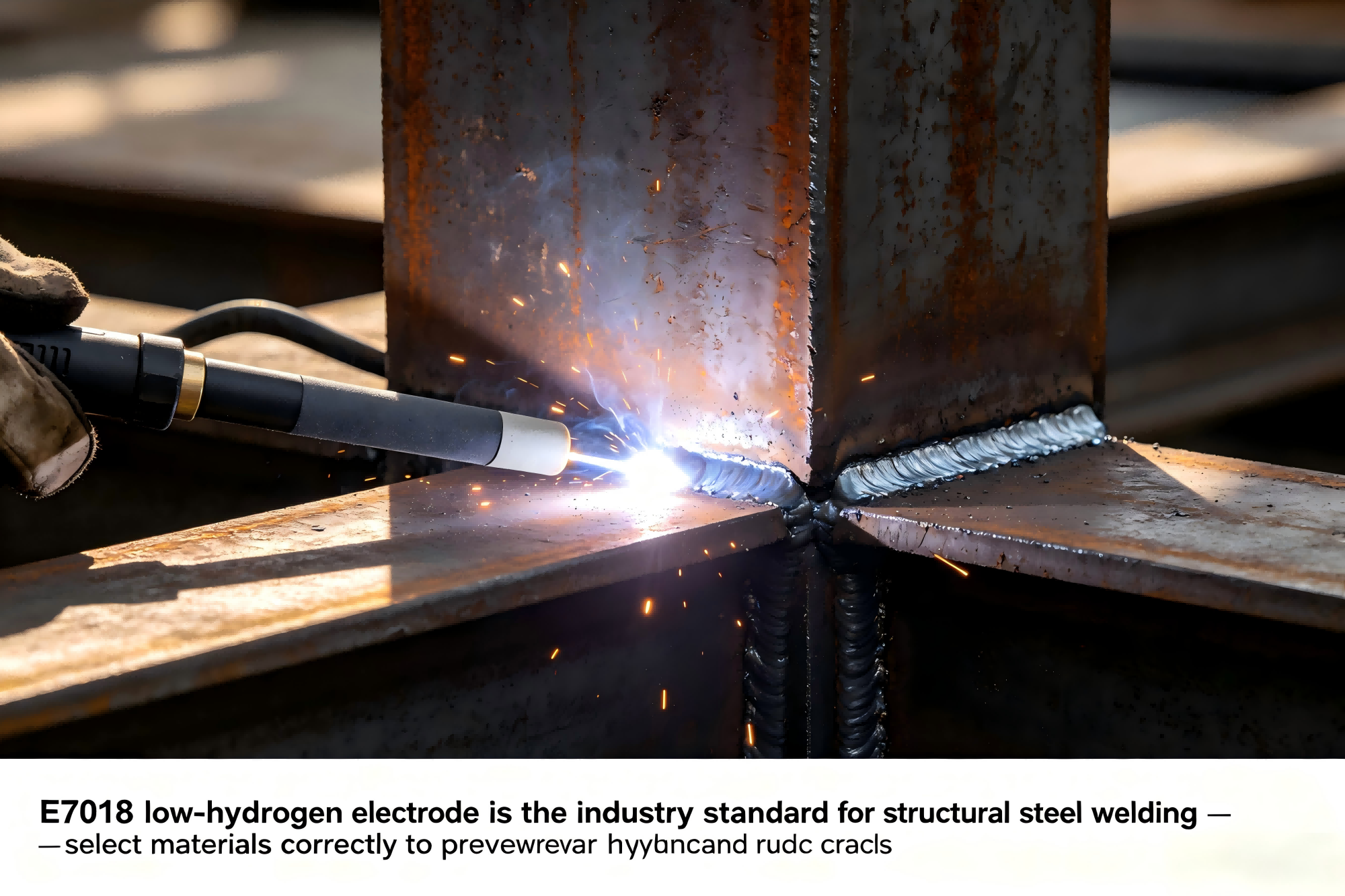
E7018 vs. E6013 vs. E8018. Mechanical properties, hydrogen cracking prevention, weld strength standards, and how to specify the right electrode for Q235B, Q355B, and high-strength steel.
A certified mill certificate for Q355B steel means nothing if the welder uses the wrong electrode. The weld metal must match—or properly complement—the base metal. Mismatched consumables create weak joints, hydrogen cracking, and failed inspections.
For overseas clients demanding high weld quality, understanding electrode classification is not optional. E7018 is the industry standard for structural steel, but why? And when should you use something else?
This guide covers:
- Electrode classification decoding (E7018, E6013, E8018).
- Mechanical properties of common structural electrodes.
- Hydrogen cracking: cause, prevention, and why low-hydrogen matters.
- Welding procedure specifications (WPS) and qualification.
- Linking consumable selection to your fabrication order.
1. Understanding Electrode Classification (AWS A5.1)
The most common standard for carbon steel electrodes is AWS A5.1. The electrode designation (e.g., E7018) contains critical information.
Example: E7018
| Part | Meaning | Value |
|---|---|---|
| E | Electrode (for manual SMAW – stick welding) | – |
| 70 | Minimum tensile strength (70 × 1000 psi = 70,000 psi) | ≈ 480 MPa |
| 1 | Welding position (1 = all positions; 2 = flat/horizontal only) | All positions |
| 8 | Coating type, current, and hydrogen level (8 = low-hydrogen, iron powder, AC/DC+) | Low-hydrogen |
Converting psi to MPa for overseas clients:
- E60 = 60 ksi ≈ 420 MPa
- E70 = 70 ksi ≈ 480 MPa
- E80 = 80 ksi ≈ 550 MPa
- E90 = 90 ksi ≈ 620 MPa
- E100 = 100 ksi ≈ 690 MPa
2. Common Structural Electrodes Compared
| Electrode | Tensile (MPa) | Yield (MPa) | Elongation | Hydrogen Level | Position | Best For |
|---|---|---|---|---|---|---|
| E6013 | 480 | 400 | 17-22% | Medium (not low-hydrogen) | All | Light structures, sheet metal, non-critical |
| E7014 | 480 | 400 | 17-22% | Medium | All | General purpose, higher deposition than E6013 |
| E7018 | 480 | 400 | 22-26% | Low (<8 mL/100g) | All | Structural steel (Q235B, Q355B) |
| E7018-1 | 480 | 400 | 22-26% | Low | All | Low-temperature impact (to -46°C) |
| E8018-C3 | 550 | 460 | 19-22% | Low | All | High-strength steel (Q420, A572 Gr60/65) |
| E9018-M | 620 | 520 | 17-20% | Low | All | Very high strength, armor plate |
Key takeaway: For structural connections on Q235B or Q355B, always specify E7018 (or E7018-1 for cold climates).
3. E7018: The Structural Workhorse
E7018 is a low-hydrogen, iron-powder electrode. It is the default choice for code-compliant structural steel welding worldwide.
Mechanical Properties (Typical, as-welded)
| Property | Value | Requirement for Q355B match |
|---|---|---|
| Tensile strength | 480-550 MPa | ✓ Exceeds Q355B (470-550 MPa) |
| Yield strength | 400-450 MPa | ✓ Exceeds Q355B (355 MPa) |
| Elongation | 22-26% | ✓ Matches or exceeds base metal |
| Charpy V-notch (CVN) | 27 J at -29°C (standard) | For low-temperature toughness |
| Hydrogen content | ≤8 mL/100g (diffusible) | Prevents hydrogen cracking |
Why Low-Hydrogen Matters
Hydrogen is the enemy of steel welds. During welding, hydrogen from moisture (in electrode coating, base metal surface, or atmosphere) dissolves into the molten weld metal. As the weld cools, hydrogen becomes trapped. It diffuses to stress-concentration points (weld toes, root, heat-affected zone) and causes cracking—hours or days after welding.
| Hydrogen Level | Classification | Cracking Risk |
|---|---|---|
| >15 mL/100g | High (E6013, E6010) | High, especially in thick sections |
| 8-15 mL/100g | Medium | Moderate (acceptable for thin, low-restraint) |
| ≤8 mL/100g | Low (E7018, E8018) | Low (preferred for structural) |
| ≤5 mL/100g | Extra low (E7018-1, some specialty) | Very low (for high-strength or very thick) |
Conditions that increase hydrogen cracking risk:
- Thick steel (>20mm)
- High restraint (rigid joints, heavy sections)
- Low ambient temperature (<5°C)
- High carbon equivalent (Q355B has moderate CE)
Prevention requires all four:
- Low-hydrogen electrode (E7018 or better)
- Proper storage (dry rod oven)
- Clean base metal (no oil, rust, moisture)
- Preheat (for thicker sections, typically >20mm)
Storage and Handling (Critical for Overseas Clients)
E7018 electrodes are delivered in sealed metal cans. Once opened, they absorb moisture from humid air. A rod oven (120-150°C / 250-300°F) is required for storage after opening.
| Condition | Requirement |
|---|---|
| New, unopened can | Acceptable as received (sealed) |
| Opened, exposed to air <8 hours | Acceptable (but best to store in rod oven) |
| Opened, exposed >8 hours | Must be baked at 250-350°C for 1-2 hours |
| Re-baked more than 3 times | Discard (coating degrades) |
| Wet or visibly damp coating | Discard (will cause hydrogen cracking) |
What to ask your fabricator:
- “Do you have a calibrated rod oven on site? What temperature?”
- “Are E7018 electrodes stored in the oven once the can is opened?”
- “Can you provide baking records for critical welds?”
4. E6013: When (and When Not) to Use It
E6013 is a general-purpose, rutile-coated electrode. It is easier to use than E7018—smoother arc, less spatter, easier slag removal. But it is not low-hydrogen.
| Aspect | E6013 | E7018 |
|---|---|---|
| Ease of use | Easy (forgiving) | Moderate (requires cleaner technique) |
| Hydrogen level | Medium-High (15-25 mL/100g) | Low (≤8 mL/100g) |
| Impact toughness | Low (poor at cold temperatures) | Good |
| Crack resistance | Poor for thick/restrained joints | Excellent |
| Cost | Lower (slightly) | Higher (due to iron powder and low-hydrogen chemistry) |
Acceptable uses for E6013 in steel buildings:
- Non-structural attachments (clips, small brackets)
- Light gauge steel (purlins, girts, sheet metal)
- Welding of secondary members with low restraint
- Root passes on thin material (with caution)
Unacceptable uses:
- Main frame columns or beams (primary structure)
- Thick plates (>12mm) with high restraint
- Seismic connections
- Any weld requiring impact toughness
Rule: If the weld is structural (in the primary load path), use E7018 minimum.
5. E8018-C3: For Higher Strength Steels
When base metal strength exceeds Q355B (e.g., Q420, Q460, or ASTM A572 Gr60/65), E7018 may under-match. Use E8018-C3 or E9018-M.
| Base Metal | Recommended Electrode | Notes |
|---|---|---|
| Q355B (450-550 MPa tensile) | E7018 | Proper match |
| Q420 (550-650 MPa tensile) | E8018-C3 | Undermatching E7018 is not acceptable |
| Q460 (600-700 MPa tensile) | E9018-M | Requires low-hydrogen and preheat |
| A572 Gr50 (485 MPa min) | E7018 | OK |
| A572 Gr60 (550 MPa min) | E8018-C3 | Required |
| A572 Gr65 (620 MPa min) | E9018-M | Required plus PWHT often |
Important: Strength matching is not always 1:1. Undermatching (weld weaker than base metal) can be acceptable for some joints if the weld is in shear and the weaker weld deforms plastically. But for tension-loaded butt welds, the weld metal should meet or exceed base metal specified minimum tensile strength.
6. Other Common Electrodes (Brief)
| Electrode | Best Use | Hydrogen Level |
|---|---|---|
| E6010 | Root pass on pipe, deep penetration (cellulosic coating) | High (field use only with preheat) |
| E7016 | Low-hydrogen, similar to E7018 but less iron powder | Low |
| E7024 | High deposition (flat/horizontal only) | Medium (not low-hydrogen) |
| E7018-1 | Low-temperature service (-46°C / -50°F impact tested) | Extra low |
| E11018-M | Ultra-high strength (760 MPa) | Low |
For 95% of steel building structural welds: E7018 is the answer.
7. Welding Procedure Specifications (WPS) & Qualification
A WPS is a written document that specifies the variables for a sound weld: electrode class, current range, voltage, travel speed, preheat, interpass temperature, etc.
What a proper WPS includes (AWS D1.1 or EN 288):
| Variable | Example Value |
|---|---|
| Base metal | Q355B, 16mm thick |
| Electrode | E7018, 4.0mm diameter |
| Polarity | DC+ (electrode positive) |
| Amperage range | 130-180 amps |
| Preheat temp (min) | 50°C for 16-20mm |
| Interpass temp (max) | 230°C |
| Shielding gas (if FCAW/GMAW) | 75% Ar / 25% CO2 |
| Position | 1G (flat) or 3G (vertical up) |
For overseas clients: Ask for the WPS for each joint type before fabrication begins. A fabricator without WPS (or using a generic “one-size-fits-all” WPS) is a red flag.
Qualification testing (PQR):
A Procedure Qualification Record (PQR) documents that a specific WPS produces acceptable mechanical properties. Tests include:
- Tensile test (weld strength)
- Bend test (ductility)
- Macro etch (fusion and penetration)
- Charpy V-notch (impact toughness, if required)
What to request: “Please provide the PQR for E7018 on Q355B, thickness range matching my project.”
8. Weld Strength Standards (International)
Different codes, similar principles.
| Code | Region | Key Weld Strength Requirement |
|---|---|---|
| AWS D1.1 | USA (global use) | Weld metal tensile strength ≥ specified minimum of base metal, or 70 ksi (480 MPa) minimum |
| EN 1090 | Europe | Consumables must comply with EN 13479. Weld metal properties declared in EN 13480 (or product standard) |
| ISO 5817 | International | Quality levels for imperfections (B = high, C = medium, D = low) |
| AS/NZS 1554 | Australia/NZ | Similar to AWS D1.1, with GP (general purpose) and SP (structural) classifications |
For a typical overseas warehouse (non-seismic, non-crane):
- AWS D1.1 (or international equivalent) is standard.
- Weld metal tensile strength: 480 MPa minimum (E7018 meets this).
- Visual inspection: All welds.
- UT/MT: Typically not required for thin sections (<12mm) under low fatigue.
For crane beams, seismic frames, or thick plates:
- AWS D1.1 or EN 1090 Class EXC3.
- Weld metal to match base metal.
- UT on all full-penetration welds.
- MT on fillet welds >10mm.
- Charpy V-notch testing (27 J at -29°C or colder).
9. Common Welding Failures Related to Consumables
| Failure | Root Cause | Prevention |
|---|---|---|
| Hydrogen cracking (under bead or HAZ) | E7018 not used, or damp electrodes, or no preheat on thick material | Use E7018 from rod oven, preheat when required |
| Porosity | Dirty base metal (oil, rust, paint), or arc blow, or gas contamination (if FCAW/GMAW) | Clean joint surfaces, check gas flow |
| Slag inclusions | Poor interpass cleaning (especially with E7018, which has heavier slag than E6013) | Chip and wire-brush between passes |
| Lack of fusion | Low amperage, wrong electrode angle, or magnetic arc blow | Increase amps, adjust technique |
| Undercut | Excessive current, too long arc, wrong angle | Reduce amps, maintain short arc, angle 15-20° from vertical |
| Root cracking (butt weld) | Insufficient root opening or excessive chill (thick plate) | Preheat, increase root gap (2-4mm) |
Most common overseas finding: Fabricator uses E6013 because “it welds nicer” or “that’s what we have.” For structural steel, this is unacceptable. Specify E7018 by name in your purchase order.
10. Welding Process Stability: SMAW vs. FCAW vs. SAW
Electrode selection interacts with welding process. Here is the quick comparison:
| Process | Consumable | Deposition Rate | Best For | Hydrogen Risk |
|---|---|---|---|---|
| SMAW (stick) | E7018 electrode | Low (1-3 kg/hr) | Field welding, small shops, repairs | Low (if dried properly) |
| FCAW (gas-shielded) | E71T-1 wire (flux-cored) | Medium (3-6 kg/hr) | Shop fabrication, thicker sections | Low (if stored correctly) |
| FCAW (self-shielded) | E71T-8 wire | Medium (3-6 kg/hr) | Field welding (windy), no gas cylinder | Low (but more fume) |
| SAW (submerged arc) | Wire + flux (e.g., EM12K + F7A6) | High (8-15 kg/hr) | Long, straight seams (beams, columns) | Very low (flux protects) |
For prefabricated steel buildings:
- Main frame (beams, columns): SAW in workshop (most consistent, lowest cost per kg).
- Attachments (shear tabs, end plates): FCAW or SMAW with E71T-1 or E7018.
- Field splices: SMAW with E7018 (most common for remote sites).
11. Cost Implications of Electrode Selection
E7018 costs more per kg than E6013. But the total cost difference is small relative to project value—and the risk of failure is enormous.
| Electrode | Approximate Cost per kg (USD) | Relative Cost |
|---|---|---|
| E6013 | $2.50-3.50 | Baseline |
| E7014 | $3.00-4.00 | +15-30% |
| E7018 | $3.50-5.00 | +30-50% |
| E8018-C3 | $5.00-8.00 | +80-120% |
| E9018-M | $8.00-12.00 | +150-250% |
But consider weld metal weight per joint:
A typical fillet weld (6mm leg, 100mm long) consumes about 20-25 grams of electrode. Even at a 50% premium for E7018 over E6013, the cost difference per joint is less than $0.10.
Value argument for overseas clients: Paying 30-50% more for E7018 adds <0.5% to total steel structure cost but eliminates hydrogen cracking risk. This is the best insurance you can buy.
12. Link to Steel Structure Welding Service
Welding quality starts with consumable control. We do not guess—we specify, store, and inspect.
We provide:
- Consumable selection: E7018 standard for Q235B/Q355B. E8018-C3 for higher strength. Full traceability.
- Storage compliance: Rod ovens calibrated and logged. E7018 never exposed to moisture.
- Procedure qualification: AWS D1.1 or EN 1090 compliant WPS and PQR for your material and thickness.
- Welder qualification: All welders certified (visual, bend, and UT testing on coupons).
- Process selection: SAW for main beam seams, FCAW/SMAW for attachments, SMAW for field splices.
- Inspection: VT on 100% structural welds. UT/MT as required by code or your specification.
- Reporting: Weld maps, NDT reports, consumable certificates, baking records.
For overseas clients:
We include a consumable data sheet with every shipment—listing electrode class, lot numbers, storage conditions, and WPS reference. We can also provide a sample weld coupon (destructively tested) to demonstrate procedure qualification.
👉 [Request a welding consumable + procedure quote]
Send us your base material grades, thickness range, and applicable code (AWS D1.1, EN 1090, or your local standard). We will return electrode recommendations, WPS references, and a welding quality plan within 48 hours.
Summary Table: Quick Electrode Selection Guide
| Your Base Metal | Thickness | Recommended Electrode | Why |
|---|---|---|---|
| Q235B (A36) | <12mm | E7018 or E7014 (non-critical) | E7018 is safer; E7014 is cheaper for non-structural |
| Q235B (A36) | 12-25mm | E7018 | Low-hydrogen prevents cracking |
| Q355B (GR50) | Any | E7018 | Required for structural welds |
| Q355B (GR50) + cold climate (<-20°C) | Any | E7018-1 | Low-temperature impact tested |
| Q420 (A572 Gr60) | Any | E8018-C3 | Match higher strength |
| Q460 (A572 Gr65) | Any | E9018-M | Required for strength and ductility |
| Dissimilar (Q355B to Q235B) | Any | E7018 | Match stronger base metal (Q355B) |
| Non-structural (bracing, clips) | Any | E6013 or E7014 | Acceptable for secondary, non-load path |
Golden rule for overseas buyers:
If you do not know what electrode to specify, specify E7018. It works for Q235B, Q355B, and most structural applications. It is low-hydrogen, all-position, and code-compliant. You cannot go wrong.
- Prefab Warehouse Product
- Cold Climate Steel Selection
- Purlin And Bracing Design
- Steel Staircase Design
- Contact The Engineering Team
Use these linked guides to compare material grades, secondary framing, welding quality, and warehouse procurement requirements before requesting a project quotation.
Welding Consumable FAQ
Q: E7018 and E6013 — what is the difference, and when do you use which?
E7018 is a low-hydrogen electrode with strong resistance to hydrogen cracking and is the standard choice for structural steel. E6013 is a rutile electrode that is easy to operate and gives a clean bead, but its mechanical properties are lower — it suits light, non-load-bearing work or cosmetic repair. Use E7018 for load-bearing connections and E6013 only for non-structural touch-up.
Q: Why do steel fabricators prefer low-hydrogen electrodes?
Low-hydrogen electrodes such as E7018 keep the hydrogen content of the weld metal very low, and hydrogen is the main cause of cold (delayed) cracking. This matters most for Q355B and higher grades, thick plates, and highly restrained joints, where cracks can appear hours or days after welding if the wrong electrode is used.
Q: What do the numbers in AWS A5.1 electrode E7018 mean?
E = electrode; 70 = minimum tensile strength of 70,000 psi (about 490 MPa); 1 = all-position welding; 8 = low-hydrogen potassium coating usable with DC or AC and suited to toughness-critical work. Reading this code tells you immediately whether an electrode meets the strength requirement of your project.
Q: Do electrodes need baking before use? What happens if you skip it?
Yes. Low-hydrogen electrodes such as E7018 must be baked after opening (typically 300-350°C for 1-2 hours per the manufacturer’s instructions) and kept in a heated quiver. If the coating absorbs moisture and the electrode is used as-is, hydrogen levels rise and the risk of cold cracking increases significantly.
Q: How should overseas buyers confirm electrode standards and welder qualifications?
Confirm that the electrode meets the standard named in the project spec (AWS A5.1, ISO 2560, or EN 13479), that welds are accepted per AWS D1.1 or the project specification, and that the contractor provides welder certificates (AWS-certified or equivalent). Put the acceptance criteria in the contract so there is no dispute on site.