
Steel Staircase Materials & Design: Stringers, Treads, Railings & Safety Standards

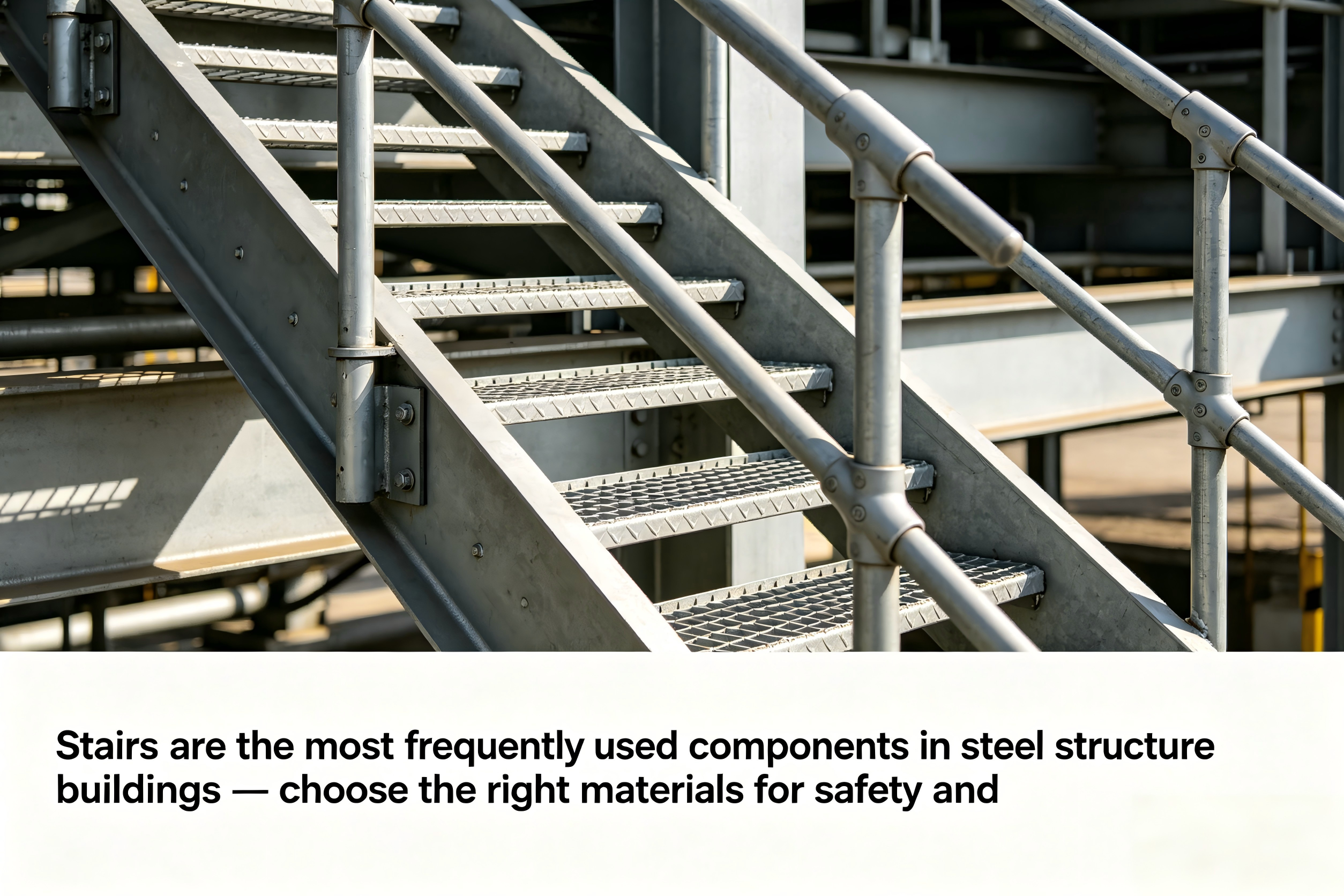
Channel vs. cut plate stringers, checkered plate vs. bar grating treads, handrail requirements, and material selection for industrial and commercial steel staircases.
A steel building needs access. Mezzanines require stairs. Emergency exits require stairs. Equipment platforms require stairs. Yet, staircases are often treated as an afterthought—designed poorly, fabricated with leftover materials, and installed unsafely.
For overseas clients, a well-designed steel staircase is not just a convenience. It is a safety requirement, a durability investment, and often a daily-use component that sees more wear than the main structure.
This guide covers:
- Stair stringer materials (channel, cut plate, welded beam).
- Tread materials (checkered plate, bar grating, expanded metal).
- Handrail and guardrail requirements.
- Material selection by application and load.
- Linking staircase fabrication to your main structure order.
1. Types of Steel Staircases
Before selecting materials, understand the three common staircase configurations for steel buildings.
| Stair Type | Typical Use | Space Required | Best Material Approach |
|---|---|---|---|
| Straight run | Mezzanine access, emergency exits | Long, narrow footprint | Simple, lowest cost |
| L-shaped (quarter turn) | Space-constrained, commercial buildings | More compact than straight | Intermediate landing required |
| U-shaped (half turn) | Very tight footprint | Most compact (stacked flights) | Two landings, more complex fabrication |
| Spiral | Utility access, secondary egress | Minimal footprint | Curved stringer or center column |
| Ship ladder (steep) | Infrequent access to equipment | Very small | Steep angle (60-70°), industrial only |
For most industrial and commercial steel buildings: Straight run or L-shaped stairs are the most cost-effective and code-compliant.
2. Stair Stringer Materials
Stringers are the inclined beams that support treads and carry the stair load to the structure. They are the most critical structural component.
Option A: Channel Stringers (C-Channel)
| Channel Size | Typical Use | Max Span (between supports) |
|---|---|---|
| C100×50×5mm | Light duty, infrequent use, width ≤800mm | 2.0m |
| C150×75×6mm | Standard industrial stairs, width 800-1000mm | 3.0m |
| C200×80×7.5mm | Heavy duty, wide stairs (>1000mm), high traffic | 4.0m |
Advantages:
- Lowest cost per meter.
- Simple fabrication (cut length, bolt or weld).
- Readily available in most steel grades (Q235B or Q355B).
Disadvantages:
- Treads sit on top of channel flanges → steeper rise per tread.
- Less aesthetic (industrial appearance).
- Channel web must be checked for combined bending + torsion.
Option B: Cut Plate Stringers (Tapered Steel Plate)
A single steel plate is cut (laser or plasma) into a sawtooth shape. Treads sit on the horizontal “teeth.”
| Plate Thickness | Typical Use | Max Span |
|---|---|---|
| 6mm | Light duty, narrow width (600-800mm) | 2.5m |
| 8mm | Standard industrial, width 800-1000mm | 3.5m |
| 10mm | Heavy duty, wide (>1000mm), frequent use | 4.5m |
| 12mm | Very heavy (forklift accessible? Use ramp) | 5.0m+ |
Advantages:
- Clean, modern appearance.
- Treads sit flush within the stringer (smoother walking).
- Can be laser-cut with bolt holes precisely positioned.
- Better load distribution.
Disadvantages:
- Higher material cost (wide plate, significant waste from cutout holes).
- Fabrication requires CNC cutting (not all workshops have large-format lasers).
- Heavier than channel stringers.
Material grade: Q355B recommended for cut plate stringers (thinner plates for same strength).
Option C: Welded I-Beam or H-Beam Stringers
For very heavy loads or very long spans (e.g., stairs serving equipment floors with live loads >5 kPa).
| Beam Size | Typical Use |
|---|---|
| 200×100mm H-beam | Heavy industrial, wide stairs |
| 250×125mm H-beam | Very heavy, long span (>5m) |
Note: I-beam stringers are rarely needed for standard access stairs. Over-specifying adds cost and weight.
3. Tread Materials
Treads are the horizontal walking surfaces. Material selection affects slip resistance, durability, and cost.
Option A: Checkered Plate (Diamond Plate / Durbar)
| Thickness | Typical Use | Slip Resistance |
|---|---|---|
| 3mm | Light duty (offices, low traffic) | Moderate (dry only) |
| 4mm | Standard industrial | Moderate-Good (dry) |
| 5mm | Heavy duty, outdoor | Good |
| 6mm | Very heavy, fork truck access (not recommended for frequent use) | Good |
Material grade: Q235B or Q355B (Q355B allows thinner plate for same load).
Advantages:
- Solid surface (debris cannot fall through → good for mezzanine offices).
- Easy to clean.
- Lowest cost of slip-resistant options.
- Can be painted any color.
Disadvantages:
- Becomes slippery when wet, oily, or icy (not for outdoor or wet areas without additional coating).
- Heavy (solid plate is heavier than grating).
Best for: Indoor, dry environments; mezzanine offices; commercial spaces.
Option B: Bar Grating (Welded or Press-Locked)
Bar grating consists of bearing bars (load-carrying direction) and cross bars (spacing). Open area allows debris, water, and light to pass through.
| Bearing Bar Size | Pitch (center-to-center) | Typical Use |
|---|---|---|
| 25×3mm | 30-40mm | Light duty, walkways |
| 32×5mm | 30-40mm | Standard industrial |
| 40×5mm | 30-40mm | Heavy duty, truck access |
| 50×5mm | 30-40mm | Very heavy (crane access) |
Material: Q235B carbon steel (hot-dip galvanized standard) or stainless steel 304.
Surface options:
- Smooth bar (standard) – moderate slip resistance.
- Serrated bar (notched teeth) – high slip resistance (recommended for stairs).
Advantages:
- Excellent slip resistance (especially serrated).
- Self-draining (no water pooling → no ice buildup outdoors).
- Lightweight (reduces stringer load and cost).
- Debris falls through (reduces tracking into buildings).
Disadvantages:
- Uncomfortable for bare feet or thin-soled shoes (not for offices).
- Small items (pens, keys, hardware) can fall through.
- Higher cost than checkered plate (on a per-square-meter basis).
- Requires galvanizing for outdoor use (adds cost).
Best for: Industrial stairs, outdoor stairs, platforms, catwalks, areas with oil/grease/water.
Option C: Expanded Metal
Sheet steel is slitted and stretched to create diamond-shaped openings.
| Thickness | Typical Use | Slip Resistance |
|---|---|---|
| 3mm | Light duty, infrequent use | Moderate |
| 4mm | Standard industrial | Good |
| 5mm | Heavy duty | Good |
Advantages:
- Lightweight (less steel than checkered plate).
- Lower cost than bar grating.
- Self-draining.
Disadvantages:
- Less durable than bar grating (edges can bend under heavy point loads).
- Lower load capacity than bar grating or thick checkered plate.
Best for: Secondary stairs, maintenance access, catwalks with light loads.
Option D: Fiberglass Grating (Non-steel, but relevant)
For corrosive environments (chemical plants, wastewater, marine), fiberglass reinforced plastic (FRP) grating is an alternative.
Advantages: No corrosion, non-conductive (electrical safety), lightweight.
Disadvantages: Higher cost than steel, lower load capacity, UV degradation over time.
Best for: Chemical plants, electrical substations, marine environments where steel corrodes rapidly.
4. Handrail & Guardrail Materials
Handrails and guardrails are required by most building codes for stairs with a drop of more than 600mm (approx 24 inches).
| Component | Typical Material | Height (code minimum) |
|---|---|---|
| Handrail (on stairs) | Steel pipe (42-48mm OD) or tube | 900-1000mm (35-39 inches) |
| Guardrail (landings/open sides) | Steel pipe or tube | 1100mm (43 inches) typical |
| Mid-rail (intermediate) | Steel pipe or angle | Half of guardrail height |
| Toe board (prevents dropped objects) | Steel plate (75-100mm high) | Required for platforms over people |
Material options for handrails:
| Material | Pros | Cons | Best For |
|---|---|---|---|
| Steel pipe (round), 42mm OD, 3mm wall | Strong, comfortable grip, standard | Welding requires coping | Most stairs |
| Steel tube (square), 40×40×3mm | Easy to weld (no coping) | Less comfortable grip | Industrial, utility |
| Stainless steel (304/316) | No corrosion, clean appearance | Expensive, difficult welding | Food, marine, architectural |
| Aluminum (6061-T6) | Lightweight, no corrosion | Low strength, not for heavy use | Portable stairs |
Finish options:
- Shop primer + field paint (lowest cost, indoor only).
- Hot-dip galvanized (outdoor, corrosive, long life).
- Powder coat (architectural, color options).
5. Stair Connection to Main Structure
The staircase must be attached to the steel building frame safely.
| Connection Method | Best For | Detailing Requirement |
|---|---|---|
| Bolted to column flange | Prefabricated stairs (field assembly) | Pre-drilled holes in column and stringer |
| Welded to column or beam | Site-welded stairs (less common for prefab) | Field welding (requires certified welder) |
| Bearing on concrete floor | Bottom landing only | Minimum 150mm bearing on foundation or slab |
| Hanging from beam above | Top stringer connection (vertical load transfer) | Design for tension (not just compression) |
For prefabricated steel buildings: Specify bolted connections for stairs. Field welding stairs adds cost and risk.
6. Material Selection by Application
| Application | Stringer | Tread | Handrail | Finish |
|---|---|---|---|---|
| Mezzanine office (indoor, dry) | Cut plate (6-8mm) or channel | Checkered plate (3-4mm) | Steel pipe, painted | Shop primer + paint |
| Industrial workshop (indoor, dry) | Channel (C150) | Bar grating, serrated (32×5mm) | Steel pipe or tube | Painted or galvanized |
| Outdoor stairs (general) | Channel or cut plate (galvanized) | Bar grating, serrated (32×5mm) | Steel pipe, galvanized | Hot-dip galvanized |
| Chemical plant (corrosive) | Cut plate (stainless or coated) | FRP grating or stainless bar grating | Stainless pipe 316 | None (stainless) |
| Food processing (wet, washdown) | Stainless steel channel | Stainless bar grating or FRP | Stainless pipe 304/316 | None (stainless) |
| Emergency exit (infrequent) | Channel (C100-C150) | Checkered plate (3mm) or expanded metal | Steel pipe | Basic painted |
| Equipment platform access (heavy loads) | Cut plate (10-12mm) or I-beam | Bar grating, heavy (40×5mm or 50×5mm) | Steel pipe or tube | Galvanized or painted |
7. Design Guidelines & Code References (International)
For overseas clients, refer to these common standards:
| Standard | Region | Key Requirements |
|---|---|---|
| IBC (International Building Code) | Global (US-origin) | Max rise 7″, min tread 11″, handrail 34-38″ |
| BS 5395 (UK) | UK, Commonwealth | Max rise 220mm, min tread 250mm |
| EN 14122 (Europe) | EU | Fixed ladders, stairs for machinery access |
| OSHA 1910.25 (US) | US workplaces | Stair angle 30-50°, tread depth ≥9.5″ |
Common dimensional guidelines (safe for most codes):
| Parameter | Recommendation |
|---|---|
| Riser height | 175-200mm (7-8 inches) |
| Tread depth | 250-300mm (10-12 inches) |
| Stair angle | 30-35° (comfortable), 35-45° (industrial) |
| Stair width (min) | 600mm (single person), 900mm (two-way), 1100mm (high traffic) |
| Railing height | 900-1000mm on stairs, 1100mm on landings |
| Max flight length without landing | 3.0-3.6m (10-12 risers) |
Rule of thumb: 2 × Rise + 1 × Tread = 600-630mm (24-25 inches). This formula produces comfortable stairs.
8. Load Requirements
Stairs must be designed for live loads (people, equipment).
| Application | Uniform Live Load (kPa) | Concentrated Load (kN) |
|---|---|---|
| Residential / office | 2.5-3.0 kPa | 1.5 kN |
| Industrial (general) | 4.0-5.0 kPa | 3.0 kN |
| Heavy industrial (equipment access) | 6.0-8.0 kPa | 4.5 kN |
| Emergency exit | 3.0-4.0 kPa | 2.0 kN |
For bar grating treads: The concentrated load is more critical. A 3.0 kN point load (≈300kg) applied to a single tread should not cause permanent deflection.
9. Cost Control for Steel Stairs
| Cost Driver | How to Reduce |
|---|---|
| Stringer material | Use channel instead of cut plate for simple stairs |
| Tread material | Use checkered plate instead of bar grating for dry indoor use |
| Finish | Paint instead of galvanizing for indoor only |
| Standard widths | Design stairs at 900mm or 1000mm (common grating and plate widths) |
| Standard rise/tread | Use 175mm/250mm (matches standard grating dimensions) |
| Bolted connections | Design for bolted attachment to main structure (no field welding) |
| Prefabrication | Fabricate stairs complete in workshop, ship as assembly (reduces field labor) |
Typical cost per meter of rise (standard industrial stair, 900mm wide):
| Configuration | Low Cost | Standard | High (architectural) |
|---|---|---|---|
| Channel stringer + checkered plate + painted | $600-800/m | $800-1000/m | N/A |
| Cut plate stringer + bar grating (serrated) + galvanized | $1000-1300/m | $1300-1600/m | N/A |
| Stainless steel (304) complete | $2000-3000/m | $3000-4000/m | $4000-6000/m |
Note: Cost per meter of rise means if your stair rises 3m (15 risers at 200mm), multiply by 3.
10. Link to Steel Staircase Custom Fabrication Service
We design, fabricate, and finish steel stairs as complete assemblies or knock-down kits for container shipping.
We provide:
- Structural design: Stringer sizing, tread selection, handrail height, code compliance (IBC, BS, or your local code).
- Material selection: Q235B, Q355B, stainless 304/316, or FRP grating.
- Fabrication: CNC cut stringers, pre-punched tread bolt holes, handrails with pre-welded pickets.
- Finish: Shop primer + paint, hot-dip galvanizing, or powder coat.
- Shipping: Assembled (for short stairs) or knocked down (long stairs, stringers separate from treads/handrails).
- Installation drawings: Bolt-by-bolt assembly guide, anchor bolt locations, connection details.
For overseas clients:
We pre-drill all connections to match your main structure column bolt holes. We ship stair bolt kits labeled by location. We provide 3D assembly views showing exactly how each component fits.
👉 [Request a steel staircase quote]
Send us your floor-to-floor height, available footprint, application (industrial/office/outdoor), and code requirement. We will return a stair design, material list, and budget price within 48 hours.
Summary Table: Quick Staircase Selection
| Your Building | Stair Type | Stringer | Tread | Handrail | Finish |
|---|---|---|---|---|---|
| Small mezzanine, office use | Straight | Cut plate (6mm) | Checkered plate (3mm) | Steel pipe, painted | Paint |
| Large warehouse, frequent use | L-shaped | Channel (C150) | Bar grating, serrated (32×5mm) | Steel pipe | Paint or galvanized |
| Outdoor equipment access | Straight or ship ladder | Channel (C150) galvanized | Bar grating, serrated (32×5mm) | Steel pipe galvanized | Hot-dip galvanized |
| Chemical / food plant | Straight or L-shaped | Stainless channel | Stainless bar grating | Stainless pipe | None (stainless) |
| Emergency exit only | Straight (narrow) | Channel (C100) | Checkered plate (3mm) or expanded metal | Steel pipe | Basic paint |
| High-traffic industrial | U-shaped or straight | Cut plate (10mm) | Bar grating heavy (40×5mm) | Steel pipe, heavy gauge | Galvanized |
- Prefab Warehouse Product
- Welding Consumable Selection
- Purlin And Bracing Design
- Contact The Engineering Team
Use these linked guides to compare material grades, secondary framing, welding quality, and warehouse procurement requirements before requesting a project quotation.
Steel Staircase FAQ
Q: What are the standard riser height and tread depth for steel staircases?
Industrial stairs commonly use risers of 150-180 mm and treads of 250-300 mm; commercial stairs with heavier foot traffic use gentler proportions such as 170 mm riser with 280 mm tread. Always confirm against the project’s local code (IBC in the US, EN standards in Europe) before fabrication.
Q: Checkered plate or bar grating treads — how do you choose?
Checkered steel plate is slip-resistant, hard-wearing, and low-cost, and suits indoor and general industrial use. Bar grating is lighter, lets light and water through, and suits outdoor, wet, oily, or ventilated locations. In corrosive or wet environments grating usually wins; for heavy loads and wheel traffic, thicker checkered plate is safer.
Q: What are the handrail height and baluster spacing requirements?
Common requirements are handrail heights of 900-1100 mm (1067-1100 mm for commercial/public buildings) and baluster spacing no more than 100-150 mm to stop children passing through. Exact values follow the local code (IBC, EN ISO 14122, etc.), so confirm them during design, not on site.
Q: Can steel staircases be prefabricated for shipping? What is the max piece size?
Yes. Stairs are normally prefabricated in platform segments, with individual pieces kept under 12 m so they fit in 40-foot containers, and joined with bolted connections on site. Design the stringer-to-platform joints as bolted rather than welded to minimize site work.
Q: What corrosion protection do outdoor steel staircases need?
Outdoor stairs should use hot-dip galvanizing per ASTM A123 / ISO 1461, or galvanizing plus a paint topcoat for dual protection; handrails, bolts, and shims need the same level of protection. In coastal or industrial atmospheres, specify a thicker zinc coating or weathering steel. Indoor stairs can use a paint system, but state the coating requirement in writing.