
Steel Warehouse Export Packaging: Structural Specs, Load Standards, and Delivery Planning

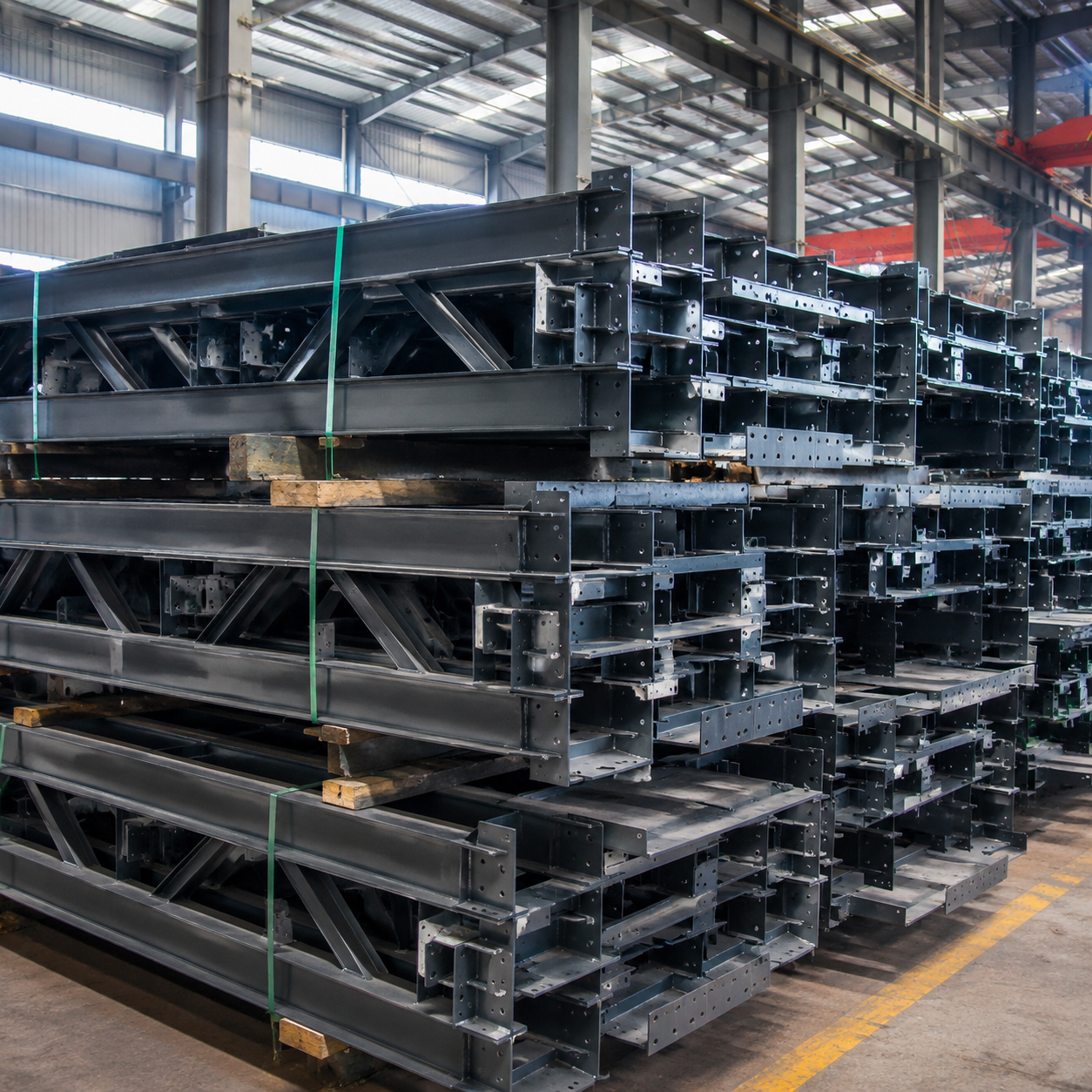
Steel warehouse export packaging is the bridge between a completed structural design and a building that actually rises on the buyer’s site. Portal frames, purlins, girts, cladding panels, and fastener kits are manufactured to tight tolerances, but those tolerances are meaningless if parts arrive bent, corroded, or missing. For construction companies and project buyers sourcing prefabricated steel buildings, the packaging specification is not a logistics afterthought — it is the first step of the erection sequence.
Why Export Packaging Matters for Steel Warehouse Components
A prefabricated steel warehouse kit mixes extremely heavy and extremely light components. Primary portal frames can range from 12 m to 25 m in length; C and Z purlins typically ship in 6 m to 12 m bundles; roof and wall cladding panels are only a few millimeters thick; and fasteners are counted by the thousand. One packing plan has to accommodate all of them.
Each category has its own damage mechanism. An H-section column can be permanently bent if dropped on one flange. A roll-formed purlin can distort under the pressure of an overstacked bundle. Cladding panels suffer micro-scratches that become visible corrosion after a few months in a humid climate. Fastener boxes can open and mix bolts, nuts, and washers — turning a one-day erection task into a sorting job. The purpose of export packaging is to lock every item in its three-dimensional position, separate it from moisture and salt air, and keep it identifiable when it reaches the site.
Structural Specs and Load Data That Drive Packaging Design
Every steel warehouse export package is sized around component weight, length, and section shape. Heavier members — columns, rafters, and crane beams — are placed at the bottom of the packing plan; lighter, more flexible members are bundled separately and stacked above.
Transport loads are handled with general engineering assumptions:
- Static stacking load. Containers are often stacked in a ship’s hold, and the bottom package in a stack must carry the weight of the packages above it.
- Lifting load. Each package is lashed, landed, and re-picked several times after leaving the factory. The most common planning assumption is a dynamic factor of 1.5 times the package mass.
- Sea-motion load. Vessel rolling and pitching produce horizontal and vertical accelerations. A typical planning rule assumes vertical acceleration around 0.8 g and transverse acceleration around 0.5–0.6 g at the lashing level.
- Container payload limits. A 20-ft container in a common fleet configuration has a maximum gross mass around 30,480 kg and a payload around 28,000 kg; a 40-ft high-cube container has similar payload but more volume. Package sizes must be planned to stay inside these figures.
These load assumptions are not a substitute for a specific engineering check. They explain why a 20 m primary frame is not simply “placed” in a container; it is secured to wooden saddles and steel lashing points so that its weight does not shift under combined static and dynamic forces.
Export Standards and Packing Methods
Most overseas shipments of steel warehouse components involve solid wood packing material, and that material must meet the ISPM 15 phytosanitary standard. In practice, this means the wooden pallets, crates, and dunnage used for steel export are heat-treated and marked. Buyers should request the ISPM 15 mark in the packing specification and verify it during the pre-shipment inspection.
In addition, many project buyers reference ASTM D4169 as the testing practice for shipping containers, and some suppliers run drop, compression, and vibration tests on prototype packages. Packing methods in the steel structure industry generally follow this pattern:
- Primary frames are mounted on heavy steel skids or wooden cradles. The base plate and end plates are protected with VCI (vapor corrosion inhibitor) paper, wrapped in PE film, and the entire frame is bolted or strapped to the skid with steel bands. Wooden corner protectors prevent the straps from cutting into the steel edges.
- Purlins and girts are packed in bundles of 10–30 pieces with protective sheets between layers. Steel strapping is applied at regular intervals, with edge protectors beneath each strap, followed by a full shrink-wrap.
- Cladding panels are stacked face-to-face with interleaving film, banded onto a wooden pallet, and covered with waterproof paper or a cardboard cap.
- Fasteners and small parts go into partitioned cartons, are sealed inside a moisture barrier, and are often assembled into a single “small parts” pallet so that site workers can access everything at once.
- Container lashing uses tensioning straps or steel wires with bottle-screws, wooden wedges, and inflatable air bags to stop all packages from moving during the voyage.
Delivery, Unloading, and Installation Preparation
Every package in a steel warehouse export shipment carries a marking plate showing the project name, package number, overall dimensions, net and gross mass, and center of gravity. Lashing points and “do not stack” symbols are also marked where relevant. The packing list accompanying the shipment should match the bill of lading item by item, and the receiving team should use it as the primary document during site inspection.
When the shipment arrives, the receiving crew should inspect the outer packaging before signing the carrier’s delivery note. If package damage is visible, that fact must be recorded in writing and with photographs on the spot, because it directly affects any later claim with the carrier or insurer. After the delivery note is signed, the packages are removed or opened in the order defined by the erection plan — that way, the first structural frame to be installed is the first package to be opened.
Steel members should not be stored directly on the ground. Keep them on the original skids, on timber dunnage, or on a prepared hardstand area. Fastener cartons and VCI-sealed parts should be moved into a dry room before installation. ISPM 15-marked wooden material from crates and pallets must be disposed of according to local waste and phytosanitary regulations.
FAQ: How Long Can Steel Warehouse Components Stay in Their Export Packaging?
In a dry, covered warehouse, sealed packages with VCI paper are generally sufficient to protect steel for several months, which covers typical shipping and site-storage situations. In open-air storage or after a route with wide temperature swings, condensation can form inside the wrapping. The safest approach is to inspect one package after the voyage, check the VCI paper and steel surfaces, then re-seal or store the components in a dry place until installation.
FAQ: Do Steel Warehouse Kits Need Extra Packaging for Humid or Tropical Destinations?
Yes. Ocean voyages create a temperature gradient between the container walls and the cargo, which can cause internal condensation even when the outside environment is dry. For tropical or high-humidity destinations — such as Southeast Asia, the Middle East, or coastal Africa — suppliers typically add desiccants inside the wrapping, increase the amount of VCI material, use thicker PE film, and specify a vapor-barrier liner inside the fastener cartons. Buyers should raise this requirement in the packing specification so that the CIF or DAP price includes the additional material.
