
EN vs. ASTM Steel Standards: A Guide to Material Selection for International Projects

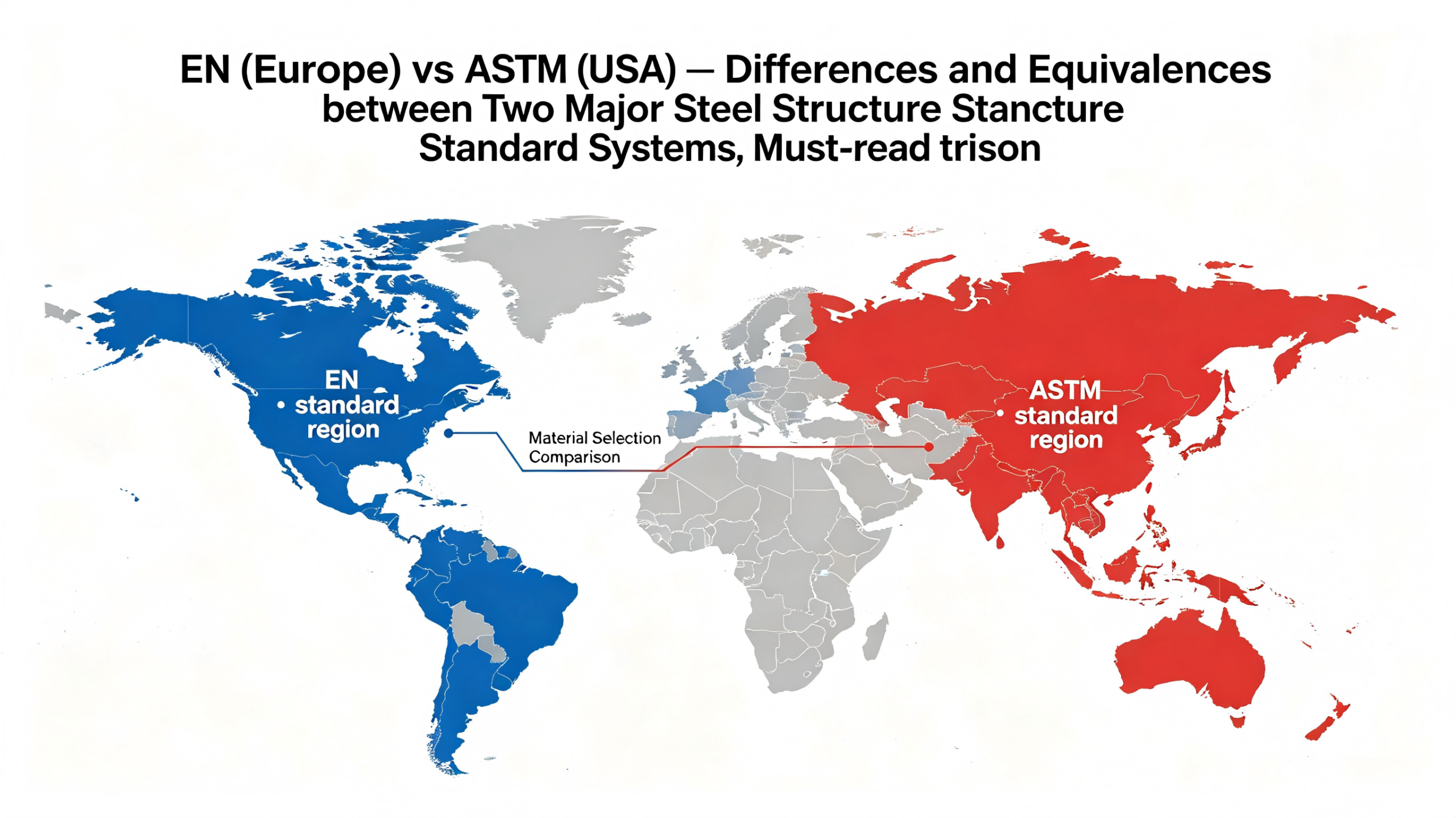
Compare European (EN) and American (ASTM) structural steel standards. Understand grade equivalents, mechanical properties, impact toughness requirements, and compliance strategies for global steel structure projects.
When a structural steel project crosses borders, the first challenge is not shipping or installation—it is standards compliance.
A steel grade that works perfectly for a warehouse in Texas may not be acceptable for a similar building in Germany. The loads may be the same, but the material specifications, testing requirements, and certification systems are fundamentally different.
For overseas clients sourcing steel structures from international suppliers, understanding the differences between EN (European) and ASTM (American) standards is essential for project approval, material traceability, and avoiding costly rework.
This guide covers:
- Overview of EN and ASTM steel standard systems.
- Grade comparison and equivalents (S355 vs. A992, S275 vs. A36).
- Mechanical properties and impact toughness (sub-grades).
- Material testing and certification requirements.
- Design code interactions (Eurocode 3 vs. AISC).
- Material substitution principles and compliance strategies.
1. Two Dominant Steel Standard Systems
| Aspect | EN (European) | ASTM (American) |
|---|---|---|
| Standards body | European Committee for Standardization (CEN) | ASTM International (formerly American Society for Testing and Materials) |
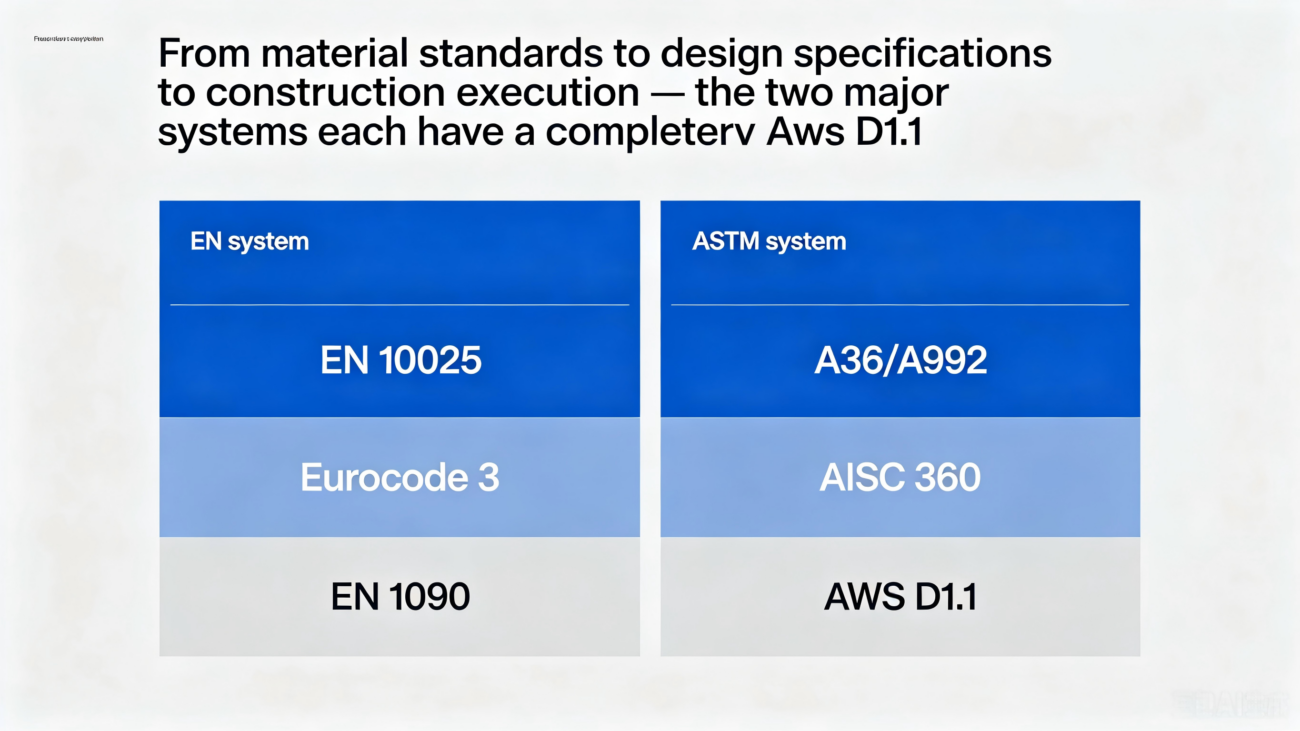
| Primary structural steel standard | EN 10025-2 (hot-rolled products) | ASTM A36 / A572 / A992 |
| Design code | Eurocode 3 (EN 1993) | AISC 360 (Specification for Structural Steel Buildings) |
| Execution standard | EN 1090 (fabrication & erection) | AWS D1.1 (welding) + AISC Code of Standard Practice |
| Primary markets | Europe, UK, former Commonwealth, Middle East (Eurocode adopters) | USA, Canada, Americas, many global EPC projects |
| Grade designation | S235, S275, S355 (S = structural steel) | A36, A572 Gr50, A992 (no systematic naming) |
Key insight: Neither standard is “better.” They evolved from different engineering traditions and regulatory environments. The correct choice is dictated by project location, design code, and local building authority requirements -1.
2. Grade-to-Grade Comparison: The Most Common Equivalents
A. S355 (EN) vs. ASTM A992 (USA)
This is the most common comparison for building frames (beams and columns).
| Property | S355 (EN 10025-2) | ASTM A992 | Unit |
|---|---|---|---|
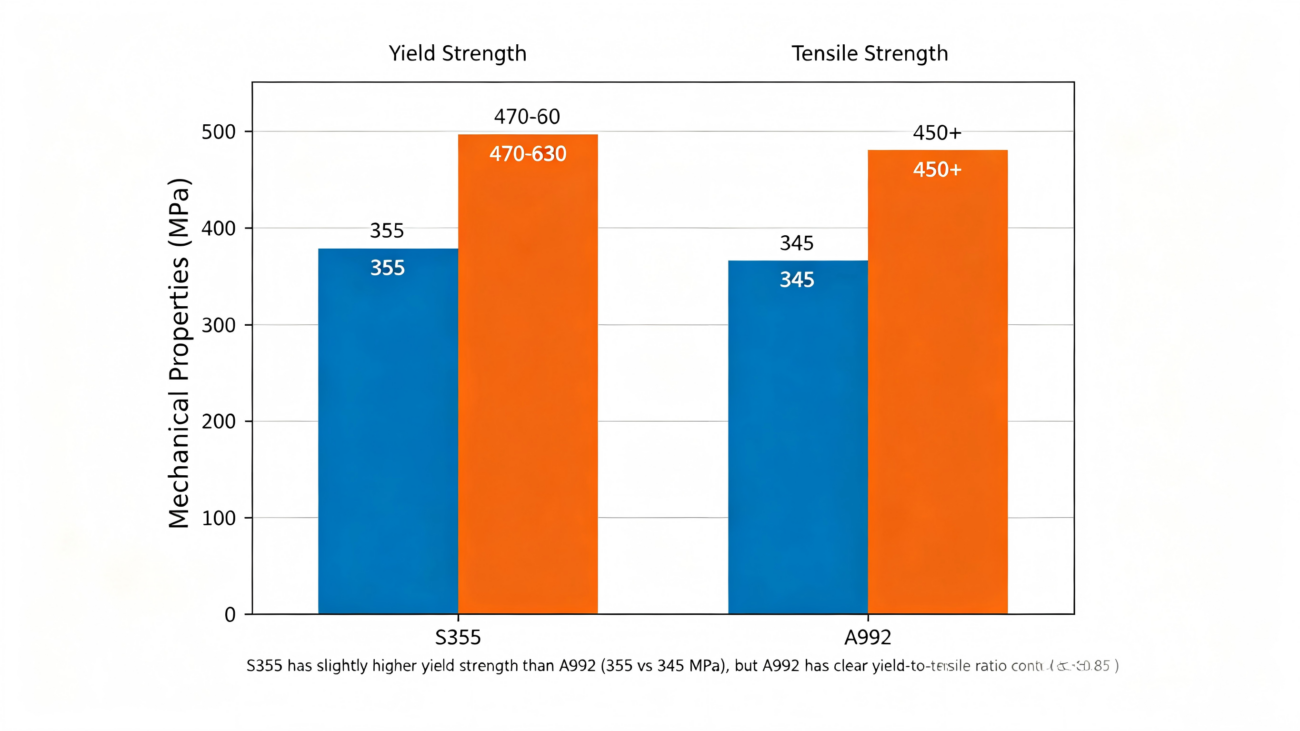
| Minimum yield strength | 355 MPa | 345 MPa (50 ksi) | MPa |
| Tensile strength | 470-630 MPa | 450 min MPa | MPa |
| Yield/tensile ratio (max) | Not specified | 0.85 | Ratio |
| Elongation (min) | 22% | 18% (in 200mm) | % |
| Standard product forms | Plates, sections, hollow sections | Primarily wide-flange shapes | – |
Analysis: While S355 shows a slightly higher nominal yield strength, the practical difference is minimal in most applications. The more significant differences are:
- Impact toughness: S355 has mandatory sub-grades (JR, J0, J2, K2) with specified test temperatures. A992 does not require impact testing by default (supplementary requirement S1 can specify 27J at -20°C) -4-9.
- Yield/tensile ratio: A992 explicitly limits this to 0.85, which is critical for seismic design. S355 does not have this requirement (though typical values are similar) -4.
Thickness effect on yield strength:
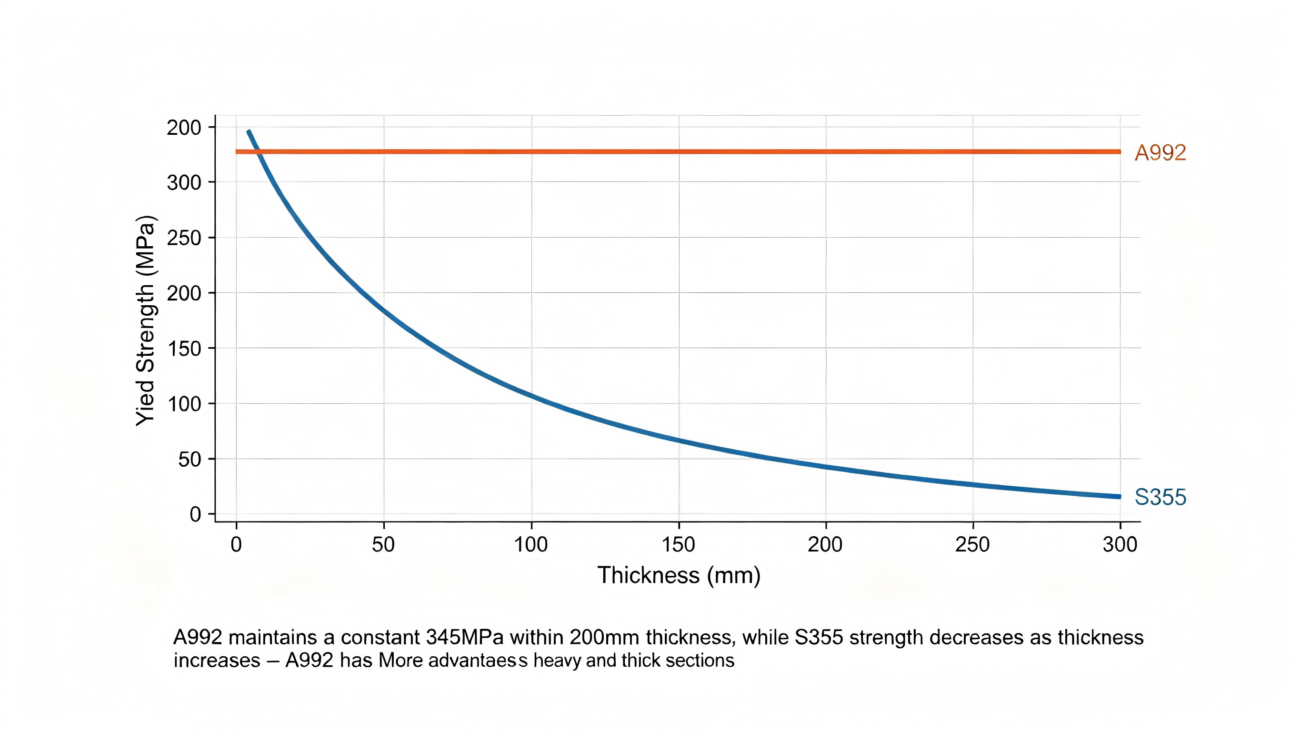
| Thickness Range | S355 | ASTM A992 |
|---|---|---|
| ≤16mm | 355 MPa | 345 MPa |
| 40-63mm | 335 MPa | 345 MPa |
| 63-100mm | 325 MPa | 345 MPa |
| >100mm | 315 MPa (to 150mm) | 345 MPa (to 200mm) |
A992 maintains its 345 MPa yield strength up to 200mm thickness, while S355 reduces significantly with increasing thickness -9.
B. S275 (EN) vs. ASTM A36 (USA)
These are the standard “general purpose” structural steel grades.
| Property | S275JR (EN 10025-2) | ASTM A36 |
|---|---|---|
| Minimum yield strength | 275 MPa | 250 MPa |
| Tensile strength | 410-560 MPa | 400-550 MPa |
| Elongation | ≥23% | ≥20% |
| Impact test | 27J at +20°C (JR) | Not required |
Verdict: S275JR and A36 are not fully equivalent. A36 has a lower yield strength (250 MPa vs. 275 MPa). For applications where 250 MPa is sufficient, A36 can substitute for S275JR. For higher requirements, ASTM A572 Gr50 (345 MPa) may be needed -2-7.
C. S235 (EN) vs. ASTM A36 (USA)
| Property | S235JR | ASTM A36 |
|---|---|---|
| Yield strength | 235 MPa | 250 MPa |
| Tensile strength | 360-510 MPa | 400-550 MPa |
S235JR is roughly equivalent to A36, though A36 has slightly higher yield strength. S235JR is often specified for lighter structures or secondary elements -7.
3. Impact Toughness: The Critical Differentiator
Impact toughness is the most important difference between EN and ASTM standards for many projects.
EN Sub-Grades (S355 example)
| Sub-Grade | Charpy V-Notch Requirement | Test Temperature | Typical Application |
|---|---|---|---|
| S355JR | 27J | +20°C | Indoor, warm climates |
| S355J0 | 27J | 0°C | General outdoor, moderate climates |
| S355J2 | 27J | -20°C | Cold climates, bridges |
| S355K2 | 40J | -20°C | Arctic, offshore, critical dynamic |
EN sub-grades are mandatory based on service temperature. The designer selects the appropriate sub-grade, and the material must be tested and certified accordingly -4-9.
ASTM Approach
ASTM standards do not require impact testing by default. For applications requiring low-temperature toughness, supplementary requirements must be specified:
| Supplementary Requirement | Impact Energy | Test Temperature |
|---|---|---|
| S1 | 27J | -20°C (similar to S355J2) |
| S5 | 20J | -20°C (for A36) |
Critical for overseas clients: If your project requires low-temperature toughness (common in European cold climates, mountain regions, or Arctic projects), specify:
- For EN projects: S355J2 or S355K2
- For ASTM projects: “ASTM A992 with supplementary requirement S1 (27J at -20°C)” -9
Why This Matters: Eurocode 3 Requirements
EN 1993-1-10 (Eurocode 3 Part 1-10) specifically addresses material toughness and through-thickness properties to avoid brittle fracture. The standard provides rules for selecting steel grades based on:
- Minimum service temperature
- Steel thickness
- Stress level
- Strain rate
This codified approach means EN projects have explicit, enforceable requirements for impact testing. ASTM projects rely on the engineer to specify supplementary requirements when needed -3-8.
4. Chemical Composition & Weldability
Both EN and ASTM standards control elements that affect weldability, but with different emphases.
| Element | S355 (EN) | ASTM A992 | Significance |
|---|---|---|---|
| Carbon (C) | ≤0.23% | ≤0.23% | Higher = harder to weld |
| Manganese (Mn) | ≤1.60% | 0.80-1.35% | Improves strength, affects ductility |
| Phosphorus (P) | ≤0.035% | ≤0.035% | Impurity (low for toughness) |
| Sulfur (S) | ≤0.035% | ≤0.050% | Impurity (affects formability) |
| Silicon (Si) | ≤0.55% | ≤0.40% | Deoxidizer |
| Carbon Equivalent (CEV) | ≤0.45% | ≤0.47% (thick sections) | Predicts weldability |
Analysis: Both standards have similar carbon limits, ensuring comparable weldability. EN allows higher manganese content, contributing to strength. A992 explicitly allows microalloying elements (vanadium, niobium) to achieve properties -9.
Weldability conclusion: For common structural grades (S355 and A992), both are readily weldable using standard procedures (E7018 electrodes, proper preheat for thicker sections). The differences are not practically significant for most fabrication.
5. Design Code Interactions (Eurocode 3 vs. AISC)
Material selection is not independent of the design code. Each standard is optimized for its corresponding design framework.
| Aspect | Eurocode 3 (EN 1993) | AISC 360 |
|---|---|---|
| Safety format | Partial safety factors (γM) | Load and Resistance Factor Design (LRFD) / ASD |
| Material factor (γM0) | 1.00 | N/A (resistance factor φ = 0.90 for yielding) |
| Design yield strength | fy / γM0 = 355 MPa (S355) | φ × Fy = 0.90 × 345 = 310.5 MPa (A992 LRFD) |
| Tension member design | Gross section yielding or net section rupture | Similar principles |
| Compression member design | Buckling curves (a, b, c, d) based on section type | Single column curve with modification |
Practical implication: While S355 has a higher specified yield strength (355 MPa vs. 345 MPa), the design approaches yield similar allowable stresses when safety factors are applied. Direct substitution of material without re-engineering is not recommended -9.
What this means for overseas clients:
- If your structure is designed to Eurocode 3, specify EN steels (S235, S275, S355) with appropriate sub-grades.
- If your structure is designed to AISC 360, specify ASTM steels (A36, A992, A572).
- If you must cross-specify (e.g., using S355 on an AISC design), the engineer must verify all applicable limit states with the actual material properties.
6. Execution Standards: EN 1090 vs. AWS D1.1
Fabrication and erection quality are governed by separate standards.
EN 1090 (European)
EN 1090 is the European standard for execution of steel structures. Key features:
- Execution Classes (EXC1, EXC2, EXC3, EXC4): Higher classes require more stringent quality control, inspection, and documentation.
- CE marking: Mandatory for structural steelwork placed on the European market.
- Comprehensive scope: Covers materials from S235 to S700 (including up to S960 with verification) -5.
EN 1090-2 covers hot-rolled structural steel. EN 1090-4 (currently in development) will cover cold-formed steel elements for roof, ceiling, floor, and wall applications -10.
AWS D1.1 (American)
AWS D1.1 is the American standard for welding structural steel. Key features:
- Welding procedure specification (WPS): Required for all structural welding.
- Welder qualification: Performance qualification testing.
- Inspection: Visual, UT, MT, RT as specified.
For overseas clients sourcing from international fabricators: Ensure your fabricator is qualified under the applicable standard for your project location.
7. Material Testing & Certification
EN Requirements (EN 10204)
| Certificate Type | Description | When Required |
|---|---|---|
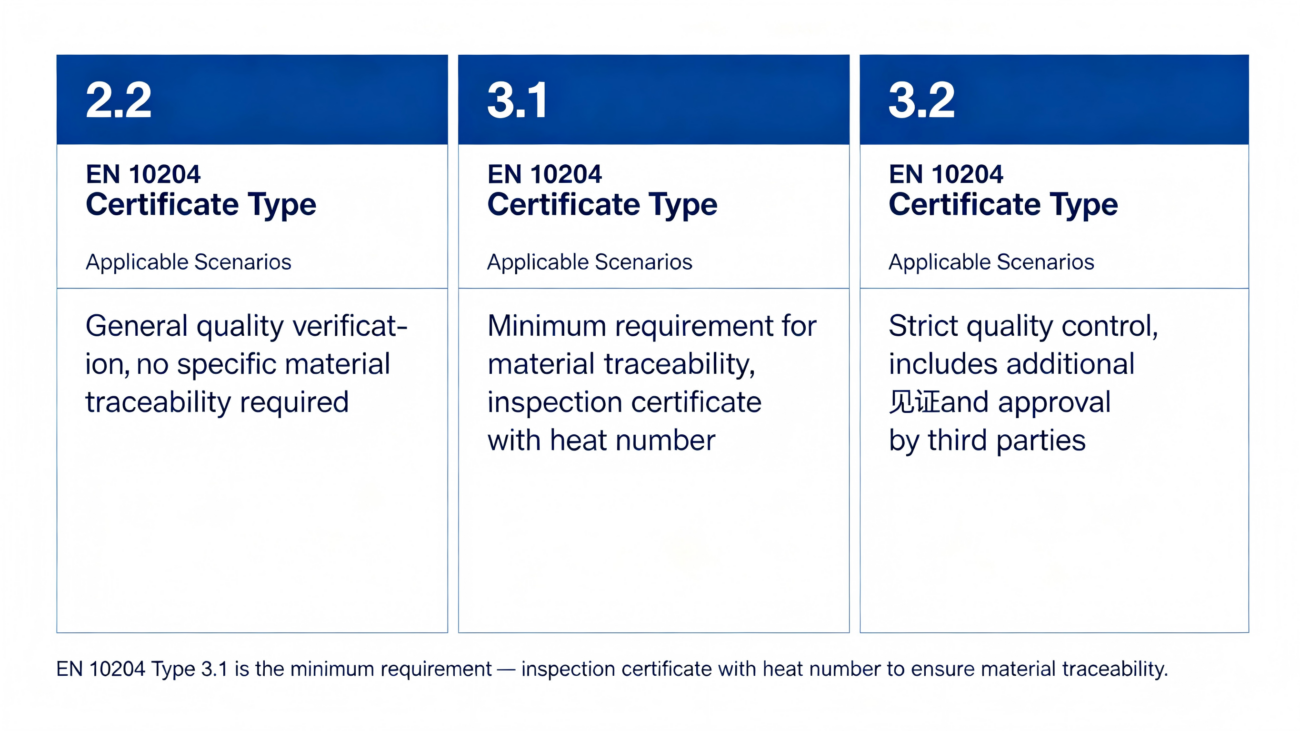
| Type 2.2 | Test report (not necessarily by an independent body) | Non-critical applications |
| Type 3.1 | Inspection certificate (by manufacturer’s independent department) | Standard structural applications |
| Type 3.2 | Inspection certificate (by independent third party) | High-critical applications (e.g., offshore, nuclear) |
ASTM Requirements
- Mill Test Report (MTR): Required for all structural steel. Includes heat number, chemical analysis, mechanical properties.
- Third-party testing: Specified by project requirements (not automatically required by ASTM).
For overseas clients: Always require EN 10204 Type 3.1 or equivalent ASTM MTR with traceable heat numbers. This is the minimum for code-compliant structural steel.
8. Material Substitution Principles
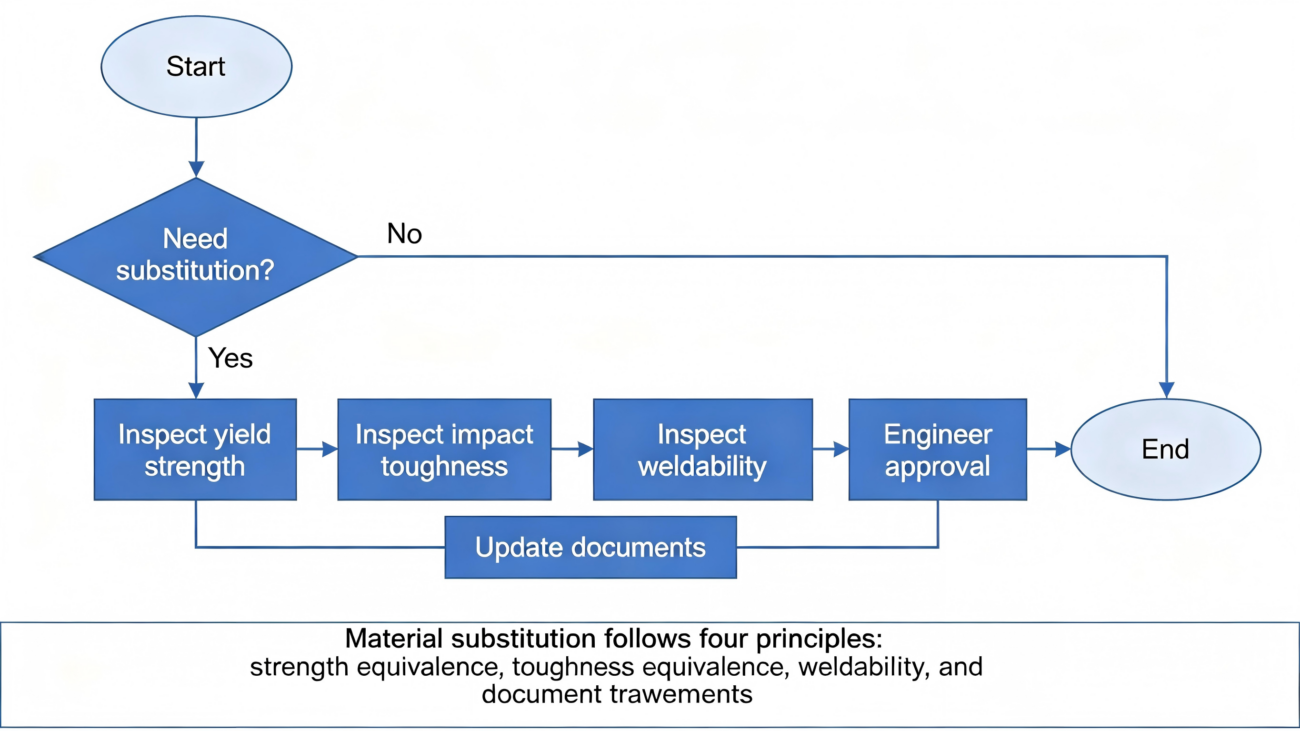
When a specific grade is unavailable, substitution may be necessary. Follow these principles:
Principle 1: Strength Equivalence
| Required Grade | Acceptable Substitutes | Notes |
|---|---|---|
| S355 (355 MPa min) | A992 (345 MPa) | 345 vs 355 = 2.8% difference (often acceptable with engineering review) |
| S355 (355 MPa min) | A572 Gr50 (345 MPa) | Same as above |
| S275 (275 MPa min) | A36 (250 MPa) | 25 MPa difference (9%)—check design before substituting |
| A992 (345 MPa min) | S355 (355 MPa) | Slightly stronger, generally acceptable |
Principle 2: Impact Toughness Equivalence
| Required | EN Equivalent | ASTM Equivalent |
|---|---|---|
| 27J at +20°C | S235/S275/S355JR | A36 (no impact) or A992 |
| 27J at 0°C | S235/S275/S355J0 | Requires supplementary requirement |
| 27J at -20°C | S235/S275/S355J2 | ASTM with supplementary S1 |
| 40J at -20°C | S355K2 | Requires enhanced specification |
Principle 3: Weldability
Both EN and ASTM structural steels are weldable with standard procedures (SMAW with E7018, GMAW, FCAW, SAW). No special adaptation required.
Principle 4: Documentation
When substituting, maintain traceability:
- Mill certificates for both original and substitute material.
- Engineer’s letter of acceptance for the substitution.
- Updated material test reports (if retesting required).
9. Selection Decision Matrix for Overseas Projects
| Project Location / Design Code | Recommended Steel Standard | Typical Grades | Notes |
|---|---|---|---|
| Europe / UK (Eurocode) | EN 10025 | S235JR, S275JR, S355J2 | CE marking required. Select sub-grade based on service temperature |
| USA / Canada (AISC) | ASTM | A36, A992, A572 Gr50 | A992 is default for wide-flange beams |
| Middle East (Eurocode) | EN 10025 | S275JR, S355J0 | Many ME projects follow Eurocodes |
| Middle East (American consultants) | ASTM | A36, A992 | Oil & gas facilities often use US standards |
| Australia / New Zealand | AS/NZS (similar to EN) | AS 3678 grades | Local standard based on EN principles |
| Southeast Asia | Either (depending on consultant) | S275/S355 or A36/A572 | No regional preference; follow design code |
| Africa (former British) | EN typically | S275, S355 | Follows UK/Eurocode tradition |
| Africa (US-funded) | ASTM typically | A36, A992 | Follows US funding requirements |
| Cold climate (any region) | EN with J2/K2 or ASTM with S1 | S355J2, S355K2, A992+S1 | Impact testing required |
| Seismic zone | A992 (preferred for yield ratio) or S355K2 | A992 (yield ratio ≤0.85) | A992 has explicit yield ratio control |
10. Cross-Reference Table: EN vs. ASTM Grades
| EN Grade | Yield (MPa) | Nearest ASTM Equivalent | Notes |
|---|---|---|---|
| S235JR | 235 | A36 (250 MPa yield) | A36 slightly stronger; generally acceptable substitute |
| S275JR | 275 | A572 Gr42 or A36 (if design allows) | A36 is weaker (250 MPa)—check before substituting |
| S355JR | 355 | A992 (345 MPa) | 2.8% difference—often acceptable with engineering review |
| S355J2 | 355 | A992 + S1 (27J at -20°C) | Impact requirement matches |
| S355K2 | 355 | A992 + enhanced impact (40J at -20°C) | Requires special specification |
| E295 (EN 10025) | 295 | A572 Gr50 | Higher strength than A36 |
| S460 | 460 | A572 Gr65 (450 MPa) or A514 | High-strength, less common |
11. Common Compliance Pitfalls (And How to Avoid Them)
| Pitfall | Consequence | Prevention |
|---|---|---|
| Assuming A36 = S275 | Under-strength structure (A36 is 250 MPa, S275 is 275 MPa) | Verify yield strength requirements. Use A572 Gr50 (345 MPa) if S275 specified |
| Assuming S355 = A992 without impact verification | Missing impact requirements (A992 requires S1 for 27J at -20°C) | Specify “A992 with supplementary requirement S1” for cold climates |
| No CE marking for European projects | Structural steel rejected by building authority | Require EN 1090 compliance and CE marking for EU projects |
| Wrong certificate type | Traceability insufficient for code compliance | Require EN 10204 Type 3.1 (or 3.2) minimum |
| Mixing standards in one structure | Legal liability ambiguity, inspection confusion | Choose one standard for primary structure. Document any cross-grades |
| Ignoring thickness effects | S355 yield drops to 335 MPa at 40mm; A572 Gr50 maintains | Check thickness-specific properties. For heavy plates, A572 may be more consistent |
12. Link to International Standard Steel Structure Service
We supply structural steel components to both EN and ASTM standards, with full traceability and certification.
Our international standard capabilities include:
- EN standard steel: S235JR/J0/J2, S275JR/J0/J2, S355JR/J0/J2/K2. EN 10204 Type 3.1 certificates.
- ASTM standard steel: A36, A992, A572 Gr50. MTRs with heat numbers.
- Fabrication to both execution standards: EN 1090 (EXC2/EXC3) or AWS D1.1.
- Impact testing: Charpy V-notch at specified temperatures. EN sub-grades or ASTM supplementary requirements.
- CE marking: For European-bound projects.
- Documentation packages: Mill certificates, material test reports, weld maps, NDT reports, traceability logs.
For overseas clients:
We can source and fabricate to the standard required by your project location. Tell us your design code and service temperature, and we will recommend the correct material grade and sub-grade. We provide bilingual documentation (EN/ASTM cross-reference) for clarity.
👉 [Request an international standard steel quote]
Send us your project location, design code (Eurocode or AISC), design temperature, and required grades. We will return material recommendations, mill certificate samples, and a fabrication compliance plan within 48 hours.
Summary Table: Quick Selection Guide
| If your project is in… | Design code likely… | Specify… | Impact requirement |
|---|---|---|---|
| Germany, France, UK | Eurocode | S355J2 | 27J at -20°C (J2) |
| USA, Canada | AISC | A992 | S1 if cold climate |
| UAE, Saudi (Eurocode) | Eurocode | S355J0 or J2 | J0 (0°C) or J2 (-20°C) |
| UAE, Saudi (US spec) | AISC | A992 | Standard or S1 |
| Australia | AS (EN-based) | AS 3678 Gr350 | Typically 27J at 0°C |
| Singapore | Eurocode or British | S355JR or J0 | JR (+20°C) or J0 (0°C) |