
EN vs. ASTM Steel Plate & Sheet: Grade Differences & Substitution Rules for International Projects

S275/S355 vs. A36/A992/A572 Gr50 – compare mechanical properties, chemical composition, impact toughness, and substitution rules. Navigate material compliance and avoid project rejection.
When a steel structure crosses borders, the material specification becomes a compliance battleground. A plate specified as S355JR under EN 10025 may be rejected if the mill certificate says “ASTM A572 Gr50” – even though the mechanical properties are nearly identical.
For overseas clients sourcing steel plates and sheets from international suppliers, understanding the nuanced differences between EN and ASTM grades is essential. It is not enough to know that “S355 is like A992.” You must understand impact sub-grades, thickness effects, chemical limits, and the rules of substitution that inspectors actually enforce.
This guide provides a detailed comparison of the most common structural steel plate grades, a clear substitution framework, and practical steps to avoid costly rejections.
1. The Core Grades: EN vs. ASTM at a Glance
The most common structural steel plates fall into two strength tiers: 250-275 MPa (general purpose) and 345-355 MPa (high strength).
| EN 10025-2 Grade | Yield (MPa) | Approx. ASTM Equivalent | ASTM Grade | Yield (MPa) |
|---|---|---|---|---|
| S235JR | 235 | A36 | 250 | |
| S275JR | 275 | A36 (with caution) | 250 | |
| S355JR | 355 | A572 Gr50 / A992 | 345 | |
| S355J0 | 355 | A572 Gr50 (with impact) | 345 | |
| S355J2 | 355 | A572 Gr50 + S1 (27J at -20°C) | 345 | |
| S355K2 | 355 | A572 Gr50 + enhanced impact | 345 |
Key insight: No single ASTM grade perfectly matches all EN sub-grades because of impact toughness. The JR/J0/J2/K2 suffixes are mandatory in Europe based on service temperature. ASTM does not require impact testing by default – it must be specified as a supplementary requirement -1-4.
2. Detailed Grade-by-Grade Comparison
A. S275JR vs. ASTM A36
This is the most common – and most misunderstood – comparison.
| Property | S275JR (EN 10025-2) | ASTM A36 | Notes |
|---|---|---|---|
| Minimum yield (≤16mm) | 275 MPa | 250 MPa | S275JR is 10% stronger |
| Tensile strength | 410-560 MPa | 400-550 MPa | Comparable |
| Elongation | ≥23% | ≥20% (in 200mm) | S275JR slightly more ductile |
| Carbon (C) max | 0.21% | 0.26% | A36 allows more carbon |
| Manganese (Mn) | ≤1.50% | Not specified | |
| Phosphorus (P) max | 0.035% | 0.04% | Comparable |
| Sulfur (S) max | 0.035% | 0.05% | EN tighter on sulfur |
| Impact test | 27J at +20°C (JR) | Not required | JR is room temperature only |
| Weldability | Good | Good | Both readily weldable with E7018 |
Source: EN 10025-2 chemical composition tables confirm S275JR carbon max 0.21% vs. ASTM A36 carbon max 0.26% -8-3.
Substitution verdict:
| Direction | Acceptable? | Conditions |
|---|---|---|
| A36 → S275JR | ⚠️ With caution | A36 yield (250 MPa) is 9% lower than S275JR’s 275 MPa. Requires engineering review. Only substitute if design allows 250 MPa. |
| S275JR → A36 | ✅ Generally acceptable | S275JR exceeds A36 requirements. Provide mill certificate proving compliance. |
Practical example: An A36 plate has a specified minimum yield of 250 MPa -3. An S275JR plate has a specified minimum yield of 275 MPa -1. If your design requires 275 MPa, A36 is under-strength. If your design only requires 250 MPa, S275JR is acceptable as a substitute for A36.
B. S355JR/S355J0/S355J2 vs. ASTM A992 / A572 Gr50
This comparison is more complex because EN has multiple sub-grades for impact temperature, while ASTM grades do not automatically include impact testing.
| Property | S355JR / J0 / J2 | ASTM A992 | ASTM A572 Gr50 |
|---|---|---|---|
| Minimum yield (≤16mm) | 355 MPa | 345 MPa (50 ksi) | 345 MPa (50 ksi) |
| Tensile strength | 470-630 MPa | 450 min MPa | 450 min MPa |
| Elongation | 22% | 18% (in 200mm) | 18% |
| Carbon (C) max | 0.24% | 0.23% | 0.23% |
| Carbon Equivalent (CEV) | ≤0.45% (typical) | ≤0.45% (for weldability) | ≤0.45% |
| Yield/Tensile ratio max | Not specified | 0.85 | Not specified |
| Impact test (standard) | JR: 27J at +20°C | Not required | Not required |
| J0: 27J at 0°C | (S1 supplement: 27J at -20°C) | ||
| J2: 27J at -20°C | |||
| K2: 40J at -20°C |
Source: A992 has a specified minimum yield of 345 MPa (50 ksi) and is optimized for wide-flange shapes, while A572 Gr50 is the plate specification -3-9.
Key difference – Impact Toughness:
| Required Service Temperature | EN Requirement | ASTM Requirement |
|---|---|---|
| Indoor / warm climate (+20°C) | S355JR | Standard A992/A572 (no impact) |
| Mild winter (0°C) | S355J0 | Must specify supplementary requirement |
| Cold winter (-20°C) | S355J2 | ASTM A572 Gr50 + S1 (27J at -20°C) |
| Arctic / offshore (-20°C, 40J) | S355K2 | Requires enhanced specification |
Why this matters: In Europe, selecting the correct sub-grade is mandatory under Eurocode 3 (EN 1993-1-10) based on service temperature, steel thickness, and stress level -4. In North America, impact testing is optional unless specified. An A992 plate without supplementary requirements may be rejected in a European cold-climate project because it lacks documented impact toughness.
Substitution verdict:
| Direction | Acceptable? | Conditions |
|---|---|---|
| A992/A572 Gr50 → S355JR | ✅ Generally acceptable | Yield difference is small (345 vs 355 MPa = 2.8%). Provide mill certificate. But: Must verify impact requirement. For J0/J2, specify ASTM with S1 supplement. |
| S355J2 → A992 | ✅ Acceptable | S355J2 exceeds A992 strength and includes impact testing at -20°C. Provide EN 10204 Type 3.1 certificate. |
Third-party engineering perspective: Engineers on Eng-Tips confirm that S275JR is comparable to A36 and S355JR is comparable to A992 for general structural applications, but emphasize that JR suffix indicates impact testing at room temperature only (20°C), which may be insufficient for outdoor European projects -4.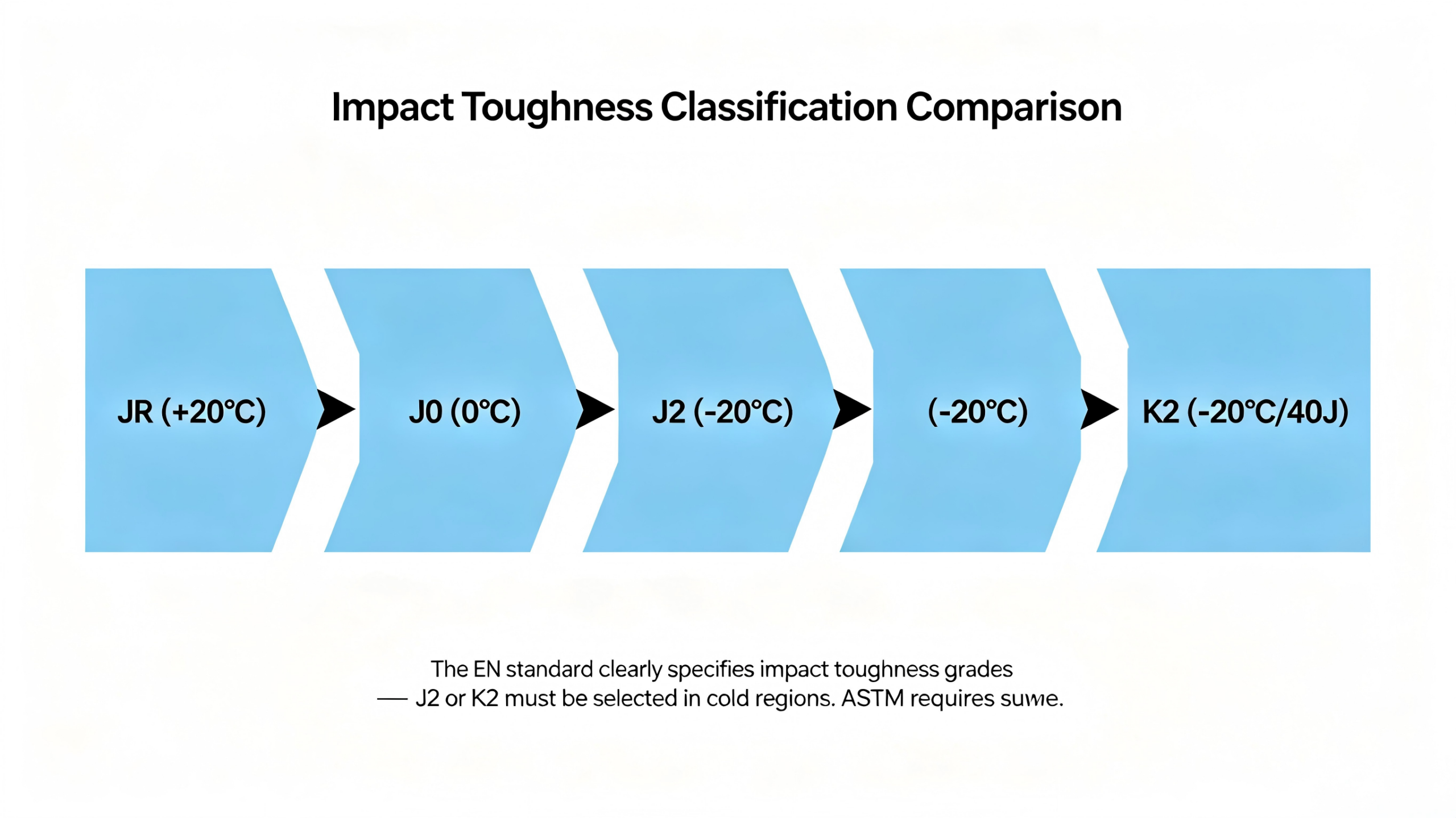
3. Chemical Composition: The Hidden Differences
Even when mechanical properties align, chemical differences can affect weldability and corrosion resistance -8.
| Element | S275JR | ASTM A36 | S355J2 | ASTM A572 Gr50 |
|---|---|---|---|---|
| Carbon (C) | ≤0.21% | ≤0.26% | ≤0.20% | ≤0.23% |
| Manganese (Mn) | ≤1.50% | – | ≤1.60% | 0.80-1.35% |
| Silicon (Si) | – | ≤0.40% | ≤0.55% | ≤0.40% |
| Phosphorus (P) | ≤0.035% | ≤0.04% | ≤0.025% | ≤0.035% |
| Sulfur (S) | ≤0.035% | ≤0.05% | ≤0.025% | ≤0.04% |
| Copper (Cu) | ≤0.55% | – | ≤0.55% | – |
| Niobium (Nb) | – | – | – | 0.005-0.05% |
| Vanadium (V) | – | – | – | 0.01-0.10% |
Practical implications:
- Higher carbon in A36 (0.26% vs S275JR 0.21%) : A36 may require more preheat for thick sections. If your WPS was qualified for S275JR, switching to A36 could require re-qualification -8.
- Alloying elements in A572 Gr50 (Nb, V): These microalloying elements increase strength but also increase hardenability. For sections thicker than 20mm in cold climates, preheat requirements may differ from S355.
The welding impact: These compositional differences can trigger the need to requalify welding procedures. Many project delays originate from mismatched material chemistries where the supplier assumed equivalence without verifying -5.
4. The Impact Toughness Gap (Most Critical Difference)
This is the single most important section for overseas clients.
EN approach (mandatory sub-grades):
- JR: 27J at +20°C (room temperature) – indoor only.
- J0: 27J at 0°C – mild outdoor climates.
- J2: 27J at -20°C – cold climates, bridges, standard outdoor.
- K2: 40J at -20°C – arctic, offshore, critical dynamic.
Eurocode 3 (EN 1993-1-10) provides explicit tables linking service temperature, steel thickness, and required sub-grade. For example, a 30mm thick S355 plate in a -20°C environment requires at least J2 -4.
ASTM approach (supplementary requirements only):
- No impact test required by default.
- Supplementary Requirement S1: Charpy V-notch 27J at -20°C.
- Supplementary Requirement S5: Charpy V-notch 20J at -20°C (for A36).
- Higher energy values (40J, 60J) require custom specification.
Real-world consequence: An ASTM A572 Gr50 plate without S1 has no documented impact toughness. In a European project requiring S355J2, that plate would be rejected during document review – even if the steel itself might pass the test. The missing paper is the problem -5.
Recommendation for cross-standard projects:
- For EN project using ASTM material: Specify “ASTM A572 Gr50 with Supplementary Requirement S1 (27J at -20°C)”. Also verify that the thickness-specific yield meets EN requirements (see thickness effects below).
- For ASTM project using EN material: Specify “S355J2” (not S355JR). J2 provides impact testing at -20°C, which meets or exceeds typical ASTM requirements.
5. Thickness Effects on Yield Strength
Both standards reduce allowable yield strength for thicker plates – but at different rates.
S355 (EN 10025-2):
| Thickness (mm) | Minimum Yield (MPa) |
|---|---|
| ≤16 | 355 |
| 16-40 | 345 |
| 40-63 | 335 |
| 63-80 | 325 |
| 80-100 | 315 |
| 100-150 | 295 |
| 150-200 | 285 |
| 200-250 | 275 |
ASTM A572 Gr50:
| Thickness (mm) | Minimum Yield (MPa) |
|---|---|
| ≤100 (4 inches) | 345 |
| 100-150 (4-6 inches) | 345 |
| >150 | Subject to agreement |
A992 (wide-flange shapes): Maintains 345 MPa yield up to 200mm thickness.
Critical observation: S355 yield drops to 315 MPa at 100mm , while A572 Gr50 maintains 345 MPa at the same thickness. For heavy plate applications (>50mm), A572 Gr50 has a significant strength advantage -8-3.
Substitution implication: When substituting S355 for A572 Gr50 in thick plates (>63mm), verify that the reduced yield strength of S355 is acceptable for the design. Do not assume “355 = 345” across all thicknesses.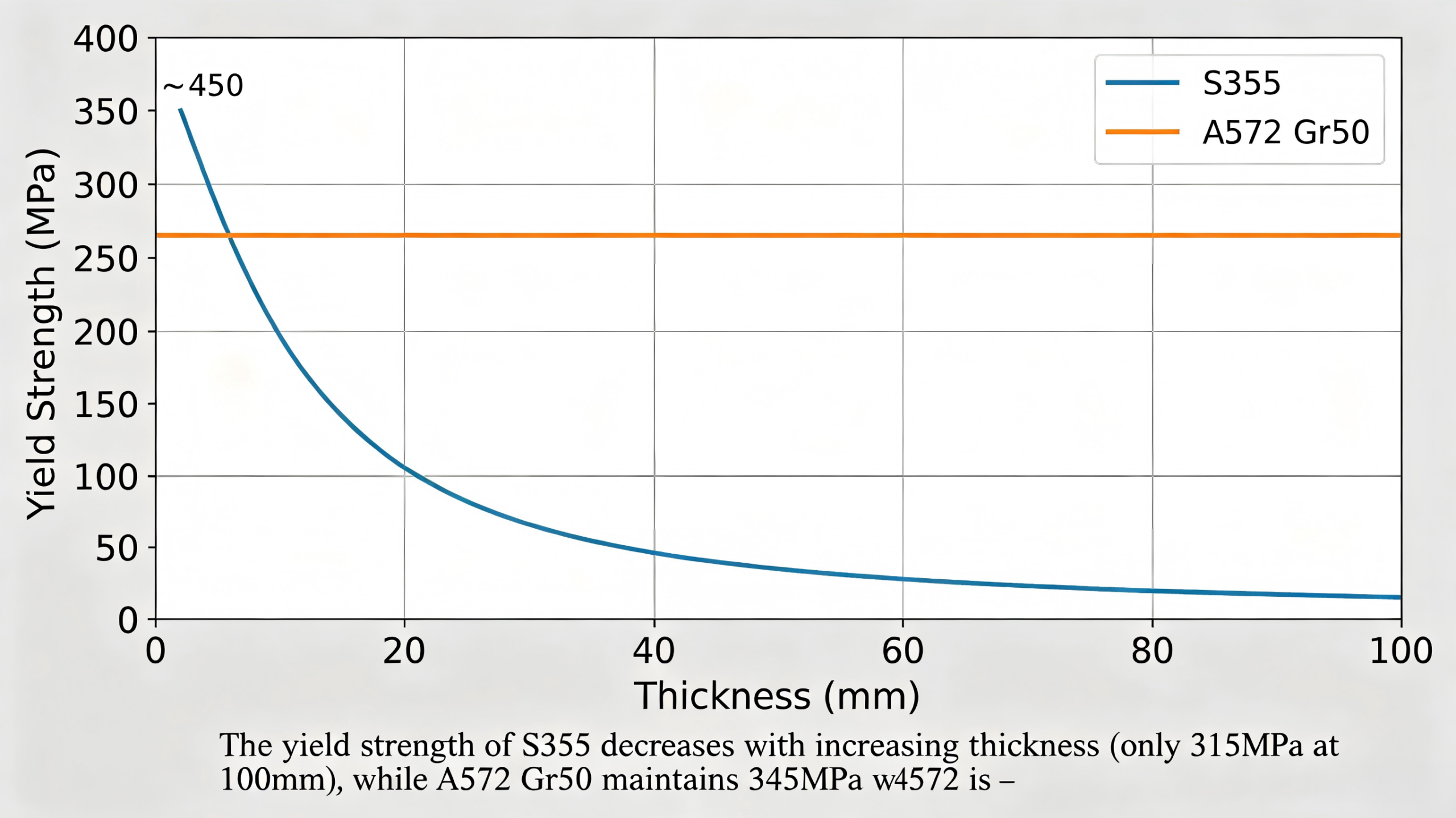
6. Material Substitution Rules for Plates
Rule 1: Strength Equivalence First
| Required Grade | Acceptable Substitutes | Not Acceptable |
|---|---|---|
| S275JR (275 MPa min) | A572 Gr50 (345 MPa) – over-strength is fine; A36 (250 MPa) – under-strength for 275 MPa requirement | A36 if design requires 275 MPa |
| A36 (250 MPa min) | S275JR, S355JR | None – many grades exceed |
| S355JR/J0/J2 (355 MPa min) | A992 (345 MPa) – 2.8% lower; A572 Gr50 (345 MPa) | A36 (250 MPa) |
| A992 (345 MPa min) | S355JR, S355J2, S355K2 | S275JR |
Pro tip: Over-strength substitution (using a stronger grade) is almost always acceptable with proper documentation. Under-strength substitution (using a weaker grade) requires engineering approval and is rarely allowed in code-based design.
Rule 2: Impact Toughness Matching
| EN Sub-grade Required | ASTM Equivalent Specification |
|---|---|
| S355JR (27J at +20°C) | Standard A572 Gr50 or A992 (no impact required) |
| S355J0 (27J at 0°C) | A572 Gr50 + specify 27J at 0°C (not standard S1, which is -20°C) |
| S355J2 (27J at -20°C) | A572 Gr50 + Supplementary Requirement S1 |
| S355K2 (40J at -20°C) | A572 Gr50 + enhanced impact specification (40J at -20°C) – requires custom order |
Documentation requirement: The mill certificate must explicitly state the impact test temperature and energy value. “Standard A572 Gr50” without impact data does NOT satisfy J2 or K2 requirements.
Rule 3: Chemical Compatibility for Welding
| Scenario | Action Required |
|---|---|
| Substituting A36 for S275JR | Re-qualify welding procedure if carbon exceeds original WPS limit (0.21% vs 0.26%) |
| Substituting A572 Gr50 for S355 | WPS qualified for S355 typically works. Verify CEV limits |
| Substituting S355 for A572 Gr50 | Generally fine. S355 has tighter sulfur limits (better weldability) |
Rule 4: Documentation & Traceability
| Document Type | EN Requirement | ASTM Requirement |
|---|---|---|
| Mill certificate | EN 10204 Type 3.1 minimum | MTR with heat number |
| Third-party inspection | Type 3.2 for higher EXC classes | Specified by project |
| Impact test report | Required for J0/J2/K2 | Required only if S1 specified |
| Traceability | Heat number to final component | Heat number to final component |
Practical rule: Maintain traceability from mill certificate to final installed component. “File not found” is a rejection reason in international projects .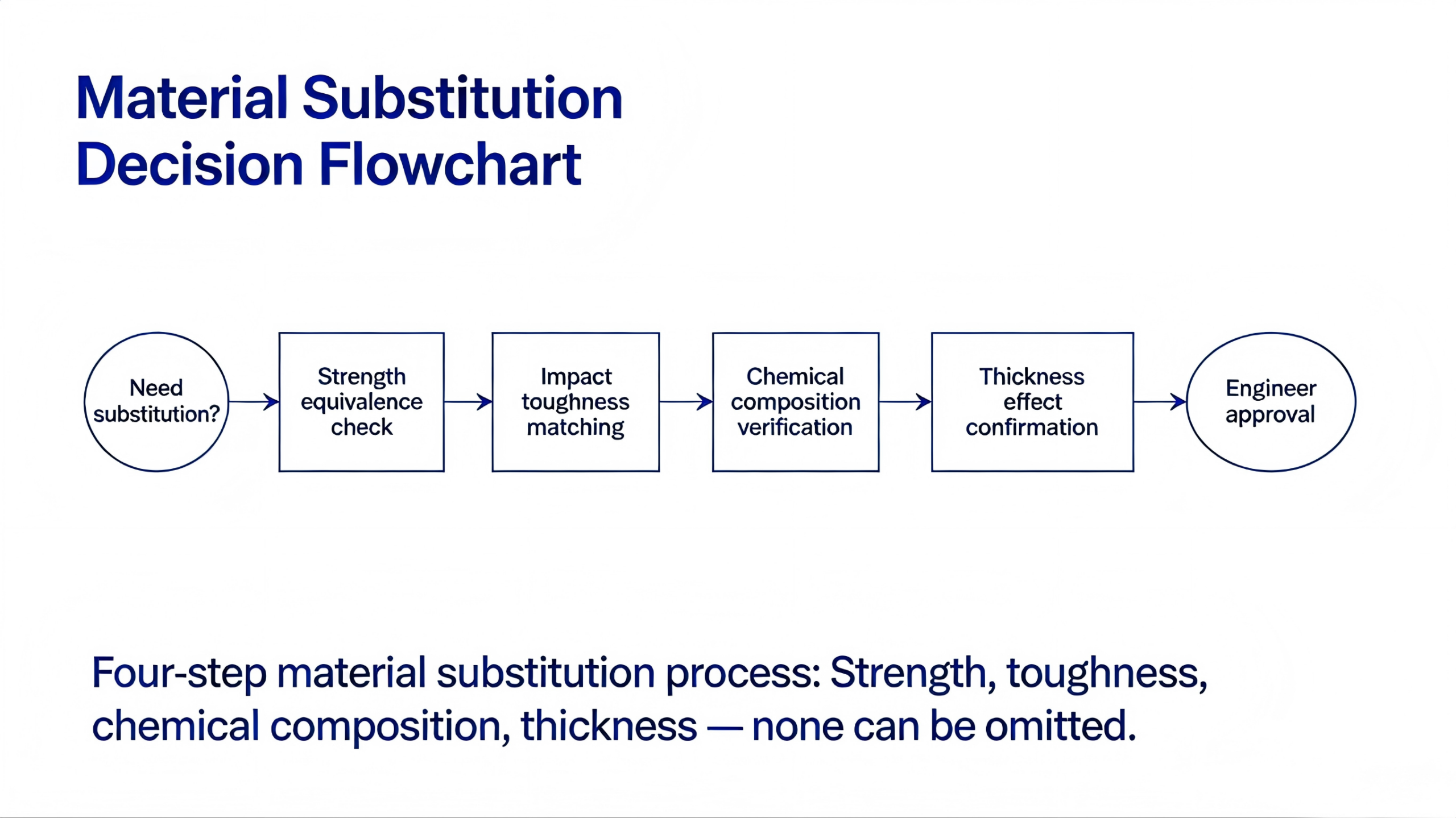
7. Plates vs. Sections: A Critical Distinction
This guide focuses on plates (flat products). However, it is important to note that sections (beams, columns, channels) follow different standards.
| Product Form | EN Standard | ASTM Standard | Typical Grades |
|---|---|---|---|
| Plates (flat) | EN 10025-2 | A36, A572, A516 | S275, S355 |
| Wide-flange beams | EN 10025-2 | A992 (primary), A572 | S355 typically |
| Channels / angles | EN 10025-2 | A36 | S275, S355 |
| Hollow sections (HSS) | EN 10210 (hot), EN 10219 (cold) | A500 (cold), A1085 (hot) | S355, S420 |
Critical distinction: A992 is the default specification for wide-flange beams in North America but is rarely used for plates. For plates, A572 Gr50 is the common high-strength specification -3-9.
If you are specifying plates for built-up sections (welded beams, columns, base plates):
- EN: S355J2 is typical
- ASTM: A572 Gr50 with supplementary requirements as needed
Do not specify A992 for plates – it is not the correct product form standard and may not be available from mills.
8. Compliance Strategies for Overseas Projects
Strategy 1: Standard Locking (Simplest, Safest)
Choose one standard for the entire project and enforce it. Do not mix.
- For European-specified projects: Require EN 10025-2 with appropriate sub-grade (J2 for most outdoor applications). Require EN 1090 execution class certification from fabricator.
- For US-specified projects: Require ASTM A36/A572/A992 as applicable. Require AISC fabrication certification.
Advantage: No substitution decisions. Clear compliance path. Disadvantage: May limit supplier pool.
Strategy 2: Documented Substitution (Flexible)
Allow substitution but require:
- Engineering review of mechanical properties (yield, tensile, elongation) for each substituted grade.
- Impact toughness verification against service temperature requirements.
- Welding procedure re-qualification if chemistry differs significantly.
- Mill certificates for both original and substitute material, with side-by-side comparison.
- Third-party inspection (SGS, BV, TÜV) to verify compliance.
Advantage: Wider supplier pool. Disadvantage: Higher engineering overhead, risk of rejection.
Strategy 3: Pre-approved Equivalent List
Develop a project-specific substitution table before procurement begins, approved by the engineer of record.
| EN Required | Approved ASTM Substitutes | Conditions |
|---|---|---|
| S275JR | A36 | Engineering approval if yield utilization >90% of 250 MPa |
| S355J2 | A572 Gr50 + S1 | Impact at -20°C documented. Mill certificate required |
| S355JR | A572 Gr50 | No impact required. Verify thickness-specific yield |
Advantage: Clear rules, faster procurement. Disadvantage: Requires upfront engineering work.
Which strategy is best for most overseas clients? For large projects, Standard Locking. For smaller or retrofit projects where material availability is uncertain, Pre-approved Equivalent List with clear conditions.
9. Real-World Failure Case Study
Scenario: A Middle Eastern contractor ordered “S355JR equivalent” plates from a Chinese mill for a European-designed warehouse. The mill supplied ASTM A572 Gr50 plates with no impact testing. The plates passed strength tests but failed document review because:
- The European specification required S355J2 (27J at -20°C) – not JR. The procurement agent incorrectly specified JR to save cost.
- The A572 Gr50 plates had no documented impact toughness (no S1 supplement).
- The project site was in a region with -15°C winter temperatures.
- The supervising engineer rejected 120 tons of plates already shipped.
Result:
- $180,000 in material replacement costs
- 6-week project delay
- Legal dispute between contractor and supplier over “equivalent” definition
Lesson: “Equivalent” is not a legal or technical defense. The specification must match the project requirements exactly, and the supplier must provide documented evidence of compliance for every parameter – including impact toughness -5.
10. Link to International Standard Steel Processing Service
We fabricate steel structures to both EN and ASTM standards – and we provide the documentation that inspectors demand.
Our international standard services include:
- EN 10025-2 plates: S275JR/J0/J2, S355JR/J0/J2/K2. EN 10204 Type 3.1 certificates. Impact testing at specified temperatures.
- ASTM plates: A36, A572 Gr50, A516. MTRs with heat numbers. Supplementary requirements (S1, etc.) available on request.
- Built-up sections (welded beams/columns): Fabricated from plate to your dimensions. EN or ASTM material. Submerged arc welding (SAW) with full penetration.
- Pre-substitution engineering review: We provide documented comparison of mechanical properties, impact values, and chemical composition for cross-standard substitutions.
- Third-party inspection ready: Mill certificates, weld maps, NDT reports (UT/MT), dimensional reports. Compatible with SGS, BV, TÜV, Intertek.
- Traceability: Laser marking or tagging. Heat number traceable from mill to finished component.
For overseas clients:
We can manufacture to either standard. If you must substitute (e.g., using ASTM plates for an EN project), we provide a substitution compliance package – including side-by-side property tables and engineering sign-off – to support your inspection.
👉 [Request an international standard steel quote]
Send us your material specification (EN or ASTM), required grade and sub-grade, plate thicknesses, and project location. We will return a compliance matrix, mill certificate samples, and a budget price within 48 hours.
Summary Table: Quick Plate Substitution Reference
| You Need | Best ASTM Substitute | Critical Check | Documentation Required |
|---|---|---|---|
| S275JR | A36 (with engineering review) | Yield: 250 vs 275 MPa – 9% difference | Engineering approval if design uses full 275 MPa |
| S355JR | A572 Gr50 | No impact required (same as JR) | MTR showing 345 MPa min yield |
| S355J0 | A572 Gr50 + specify 27J at 0°C | Impact at 0°C – not standard | Custom impact test report |
| S355J2 | A572 Gr50 + S1 (27J at -20°C) | Impact temperature matches J2 | MTR + impact test report |
| S355K2 | A572 Gr50 + 40J at -20°C specification | Higher energy (40J vs 27J) | Custom impact test report |
| A36 | S275JR | None – S275JR exceeds A36 | EN 10204 Type 3.1 |
| A572 Gr50 | S355J2 | Check thickness effects (>63mm) | EN 10204 Type 3.1 + impact |