
Recycled & Reusable Steel Materials: Sustainable Solutions for Green Building

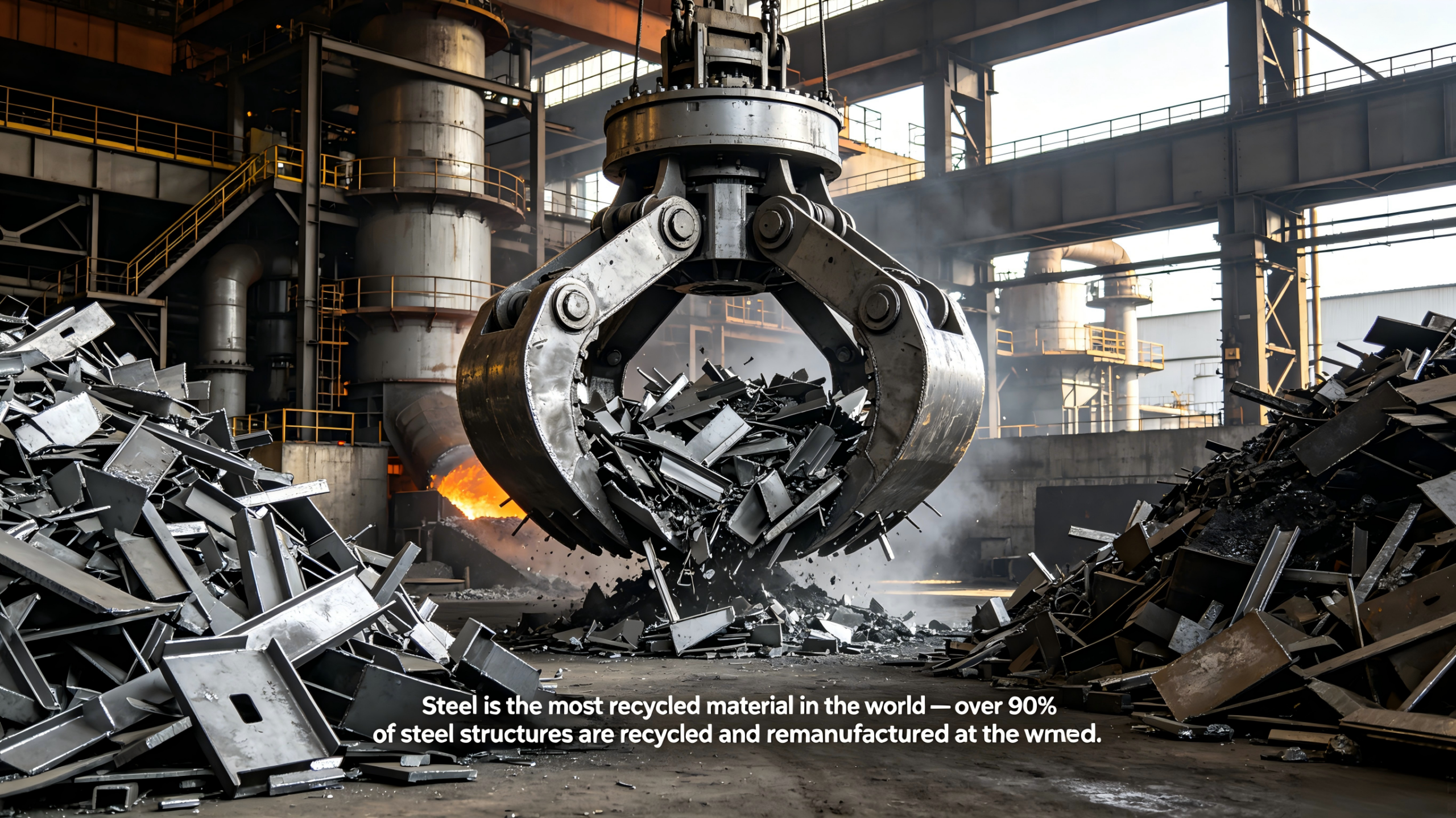
Steel recycling processes, reused structural steel, environmental benefits, and green building certifications. Learn how steel structures support circular economy and carbon reduction goals.
Steel is the most recycled material on Earth. Not plastic. Not aluminum. Steel.
Every year, more than 600 million tonnes of steel are recycled globally. Structural steel has a recycling rate of over 90%—higher than paper, glass, and aluminum combined. This is not accidental. Steel’s magnetic properties make it easy to separate from waste streams, and its metallurgical properties allow infinite recycling without degradation.
For overseas clients pursuing green building certifications (LEED, BREEAM, DGNB), understanding steel’s recyclability and reuse potential is essential. Steel structures are not just strong and durable—they are inherently sustainable.
This guide covers:
- Steel recycling processes and rates.
- Reused vs. recycled steel: definitions and applications.
- Environmental benefits (carbon, energy, waste).
- Green building certification contributions.
- Design for deconstruction and reuse.
- Linking to eco-friendly steel structure solutions.
1. Steel Recycling: The Numbers
Steel recycling is not a niche activity. It is a massive, mature industry.
| Metric | Value | Source |
|---|---|---|
| Global steel recycling rate | 85-90% | World Steel Association |
| Structural steel recycling rate | 98% (at end of life) | Steel Construction Institute |
| Construction sector steel recycling rate | >95% | International Iron and Steel Institute |
| Annual recycled steel (global) | ~600 million tonnes | World Steel Association |
| Energy saved vs. virgin steel | 60-75% | Multiple sources |
| CO2 reduction vs. virgin steel | 58% (EAF route) vs. BOF | World Steel Association |
Comparison with other materials:
| Material | Global Recycling Rate | Recycled Content (typical) | Notes |
|---|---|---|---|
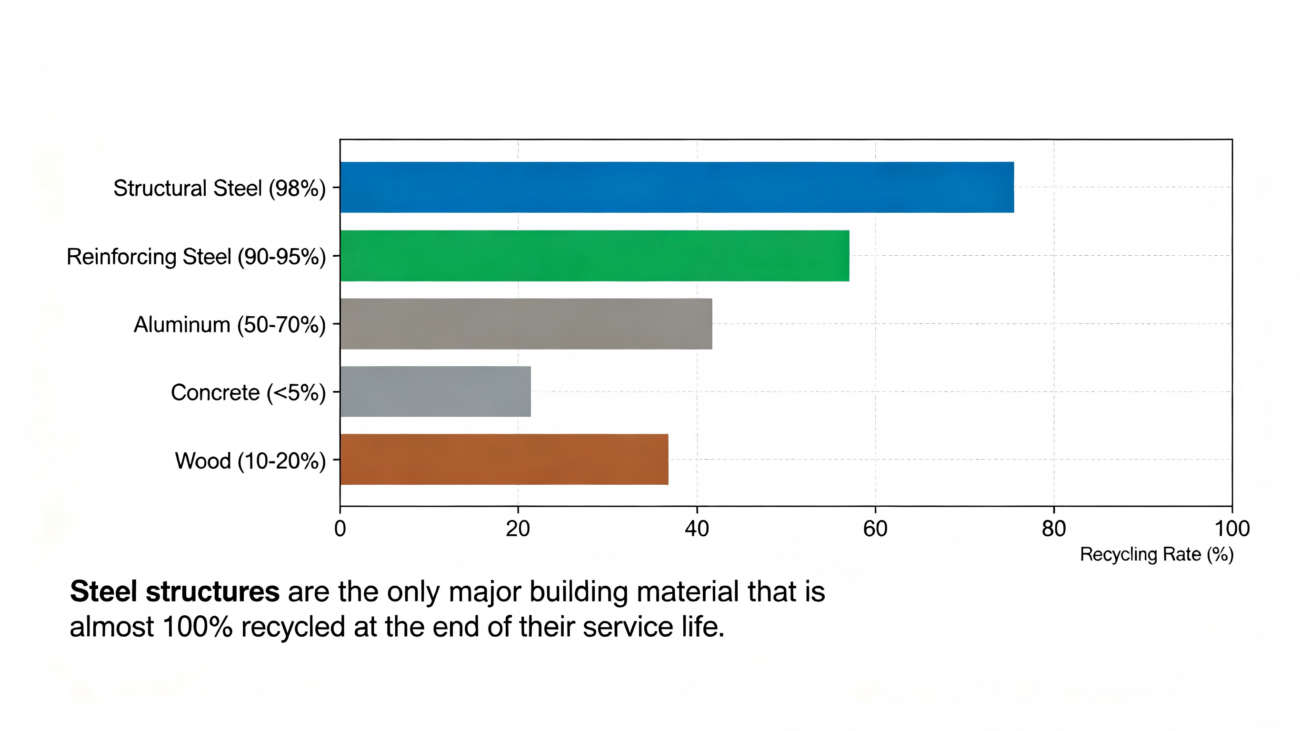
| Structural Steel | 90-98% | 20-35% (EAF), 10-15% (BOF) | Infinitely recyclable |
| Aluminum | 50-70% | 30-60% | High energy for recycling |
| Copper | 40-50% | 30-50% | Valuable, well-recycled |
| Concrete | <5% (as aggregate) | <5% | Downcycled, not recycled |
| Timber | 10-20% (as material) | Variable | Limited reuse cycles |
| Plastic (construction) | <10% | <10% | Degrades with each cycle |
Key insight: Steel is the only major construction material that can be recycled indefinitely without loss of properties. Concrete becomes aggregate. Timber becomes chips or fuel. Steel becomes steel again .
2. Recycling Processes: EAF vs. BOF
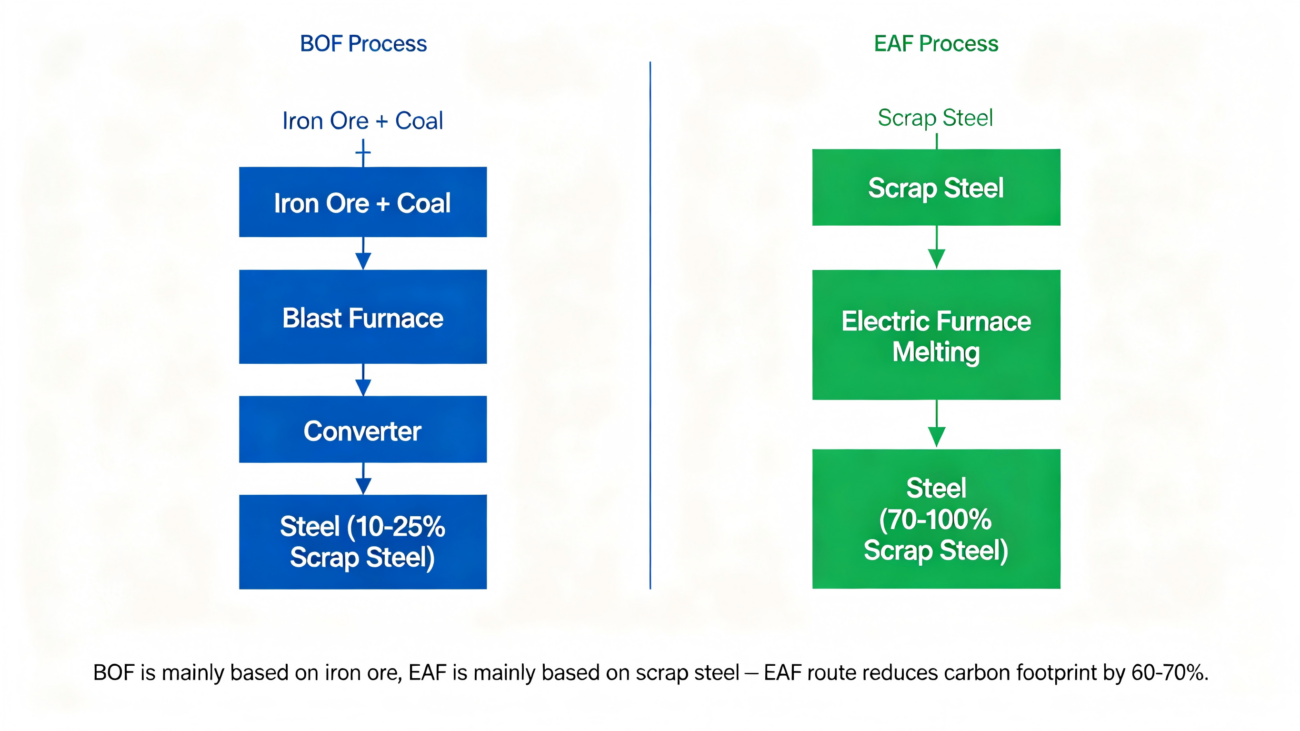
Steel is produced through two primary routes, each with different recycled content capabilities.
| Production Route | Primary Input | Recycled Steel Content | Typical Use |
|---|---|---|---|
| BOF (Basic Oxygen Furnace) | Iron ore, coal, limestone | 10-25% | Automotive, construction (large volumes) |
| EAF (Electric Arc Furnace) | Scrap steel (recycled) | 70-100% | Rebar, sections, beams, plates |
BOF route (integrated mill):
- Starts with virgin iron ore reduced in blast furnace.
- Scrap steel added (up to 25%) to cool the furnace.
- Higher energy intensity, higher CO2 emissions.
- Produces high-quality steel for demanding applications.
EAF route (mini-mill):
- Starts with scrap steel (often 100%).
- Electricity melts scrap (no iron ore or coal).
- Lower energy intensity, lower CO2 emissions (especially with renewable electricity).
- Quality equivalent to BOF for most structural applications.
The trend: EAF steel production is growing faster than BOF, driven by scrap availability and carbon reduction targets. Many new steel plants are EAF-only .
3. Recycled vs. Reused Steel: Important Distinction
These terms are often confused but have different meanings for green building certifications.
| Term | Definition | Example | Environmental Benefit |
|---|---|---|---|
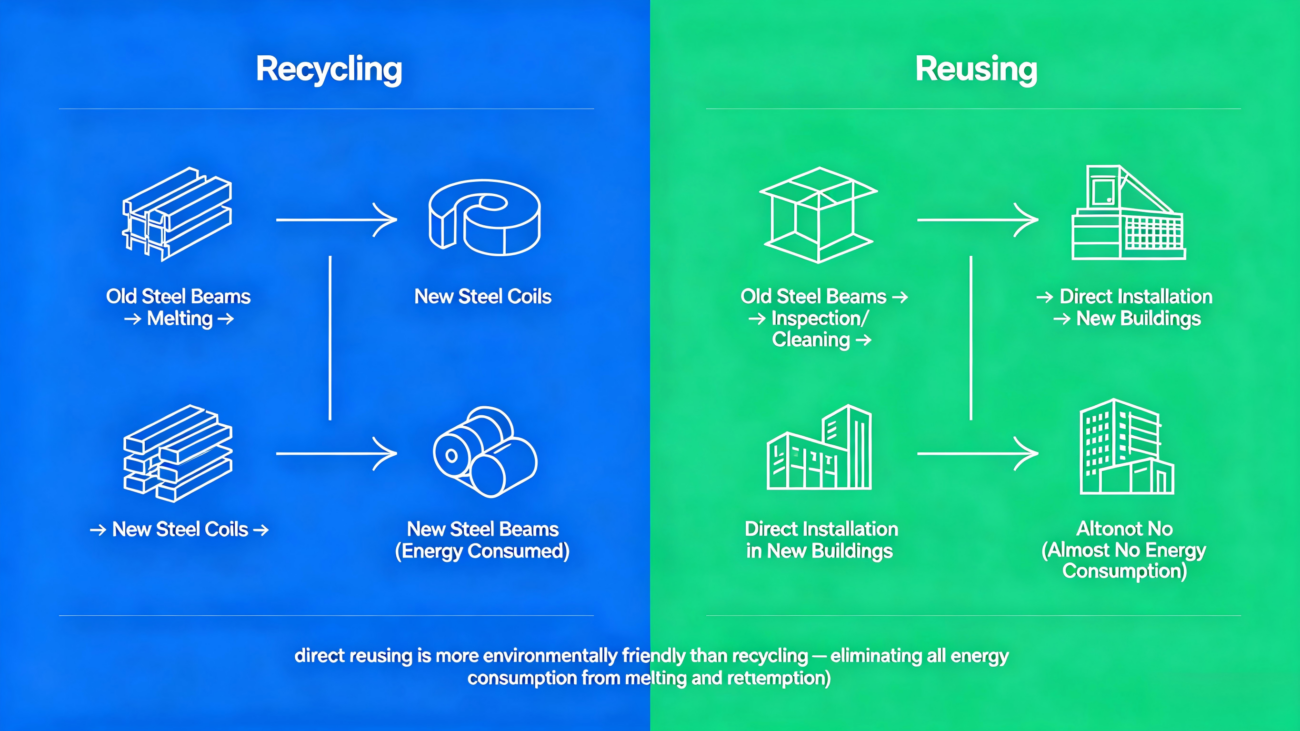
| Recycled steel | Steel melted down and re-processed into new products | Old car becomes new I-beam | Reduces energy and ore mining |
| Reused steel | Steel component used again without re-melting | I-beam from demolished building re-installed as-is | Maximizes benefit (no melting energy) |
| Downcycled steel | Steel recycled into lower-grade product | Structural steel becomes rebar | Still valuable, but not closed-loop |
Reused steel (direct reuse) is far more environmentally beneficial than recycling because it avoids the energy-intensive melting process altogether.
Example: A 10-tonne steel beam reused directly saves:
- 100% of the energy required for melting and re-rolling.
- 100% of the associated CO2 emissions.
- All of the material (zero loss).
Barriers to reuse:
- Traceability (original mill certificates often lost).
- Unknown welding history or fatigue damage.
- Non-standard lengths or sections.
- Lack of certification for reused steel.
- Insurance and liability concerns .
Emerging solutions:
- Digital material passports (blockchain-tracked steel).
- Third-party inspection and certification for reused steel.
- Design for deconstruction (bolted connections instead of welded).
- Manufacturer buy-back programs.
4. Environmental Benefits: Energy, Carbon, Waste
A. Energy Savings
| Comparison | Energy Intensity (GJ/tonne) | Savings vs. Virgin |
|---|---|---|
| Virgin steel (BOF, from ore) | 20-25 GJ/tonne | Baseline |
| Recycled steel (EAF, 100% scrap) | 8-10 GJ/tonne | 60-70% |
| Reused steel (direct reuse) | 0.5-1.0 GJ/tonne (transport + cleaning) | 95-97% |
Practical example: A 100-tonne steel frame:
- Virgin BOF steel: 2,000-2,500 GJ energy
- Recycled EAF steel: 800-1,000 GJ energy
- Reused steel: 50-100 GJ energy
The energy saved by using recycled steel is equivalent to powering 5-10 homes for one year .
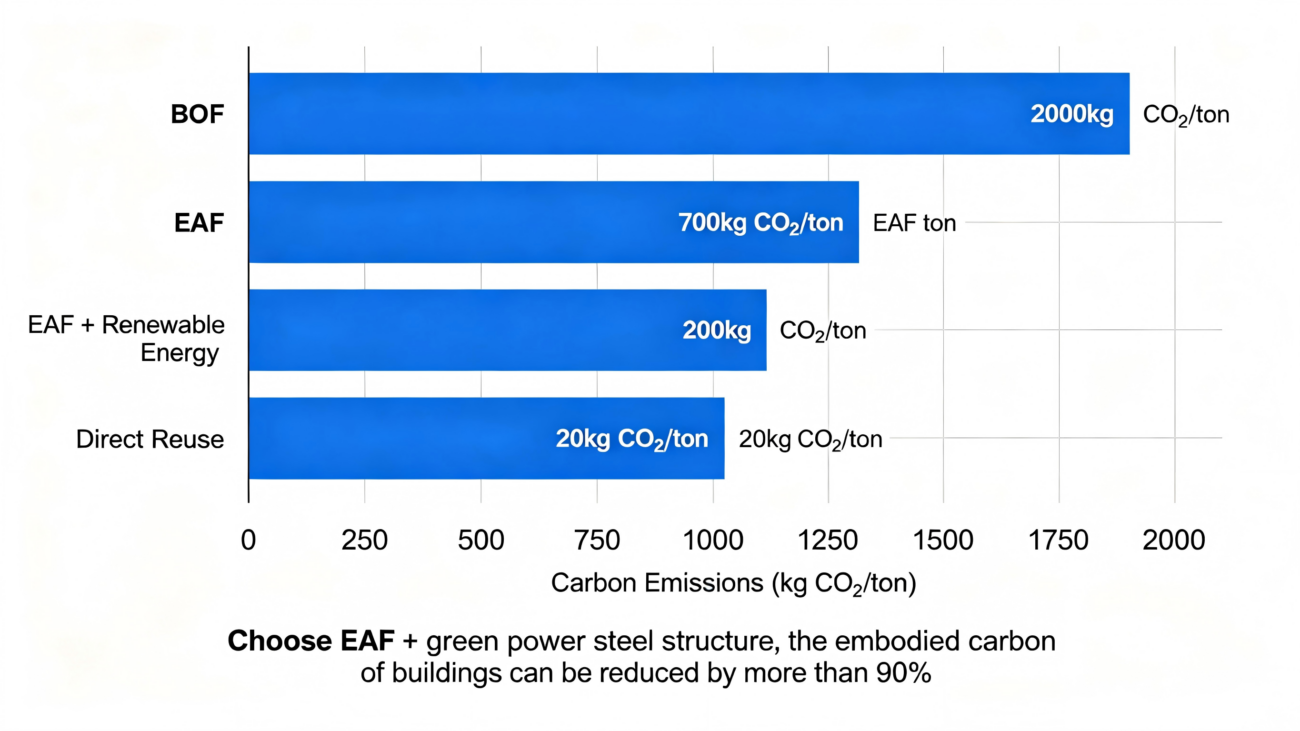
B. CO2 Emission Savings
| Production Route | CO2 emissions (kg CO2/tonne steel) | vs. Virgin |
|---|---|---|
| Virgin BOF (world average) | 1,800-2,200 | Baseline |
| Virgin BOF (efficient plant) | 1,500-1,800 | -15-20% |
| EAF (world average, mixed grid) | 600-800 | -60-65% |
| EAF (renewable grid, e.g., Sweden) | 100-200 | -90-95% |
| Reused steel | 10-20 (transport only) | -99% |
A 100-tonne steel frame using EAF recycled steel (600 kg CO2/tonne) instead of BOF virgin steel (1,800 kg CO2/tonne) saves 120 tonnes of CO2. That is equivalent to taking 25 cars off the road for one year .
C. Waste Reduction
| Material | End-of-life fate (construction sector) |
|---|---|
| Structural steel | 98% recycled |
| Rebar | 90-95% recycled |
| Metal decking | 90%+ recycled |
| Concrete | <5% recycled (mostly landfilled or downcycled) |
| Drywall (gypsum) | 10-15% recycled |
| Wood framing | 20-30% recycled (mostly as fuel) |
Steel is the only major construction material that avoids landfill almost entirely .
5. Green Building Certifications: LEED, BREEAM, DGNB
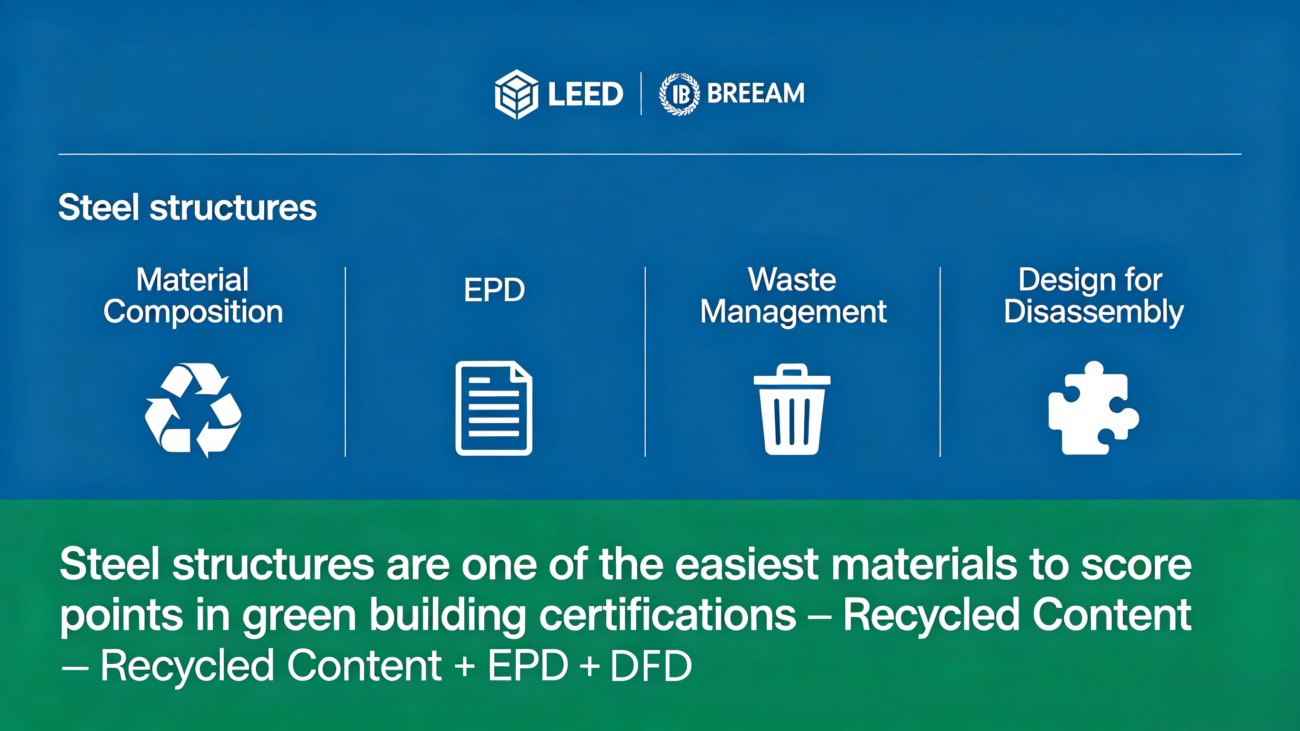
Steel’s recyclability contributes directly to multiple green building credits.
A. LEED v4.1 (USA and international)
| Credit Category | Contribution from Steel | Typical Points |
|---|---|---|
| MR Credit: Building Product Disclosure and Optimization – Sourcing of Raw Materials | Recycled content (post-consumer + pre-consumer) | 1-2 points |
| MR Credit: Building Product Disclosure and Optimization – Material Ingredients | EPD for structural steel | 1-2 points |
| MR Credit: Construction and Demolition Waste Management | Steel recycling at end of life (design for deconstruction) | 1-2 points |
| EA Credit: Optimize Energy Performance | Lightweight steel reduces foundation size (less embodied carbon) | Variable |
LEED recycled content calculation:
Recycled Content % = (Post-consumer recycled % + 0.5 × Pre-consumer recycled %) × Cost
Example for EAF structural steel (85% recycled, 60% post-consumer / 40% pre-consumer):
Recycled content contribution = (60% + 0.5 × 40%) = 80%
LEED requirement for points:
- 10% recycled content (by cost) = 1 point
- 15% recycled content = 2 points
EAF steel easily achieves this .
B. BREEAM (Europe, UK, and global)
| Category | Contribution from Steel |
|---|---|
| Mat 01: Life Cycle Impacts | EPD for structural steel (recycled content reduces LCA impacts) |
| Mat 05: Material Efficiency | Design for deconstruction (bolted connections, reusable sections) |
| Wst 01: Construction Waste Management | Steel recycling and reuse planning |
C. DGNB (Germany and international)
| Category | Contribution from Steel |
|---|---|
| ENV 1.1: Life Cycle Assessment | Recycled content and recyclability contribute to lower LCA |
| ECO 1.1: Life Cycle Cost | Steel’s durability and future reuse value |
| TEC 1.4: Ease of Recovery and Recycling | Design for deconstruction (critical for DGNB) |
For overseas clients: If your project targets LEED or BREEAM certification, structural steel is one of the easiest materials to earn credits with. Document recycled content (mill certificates showing scrap percentage) and design for deconstruction (bolted connections).
6. Design for Deconstruction (DfD)
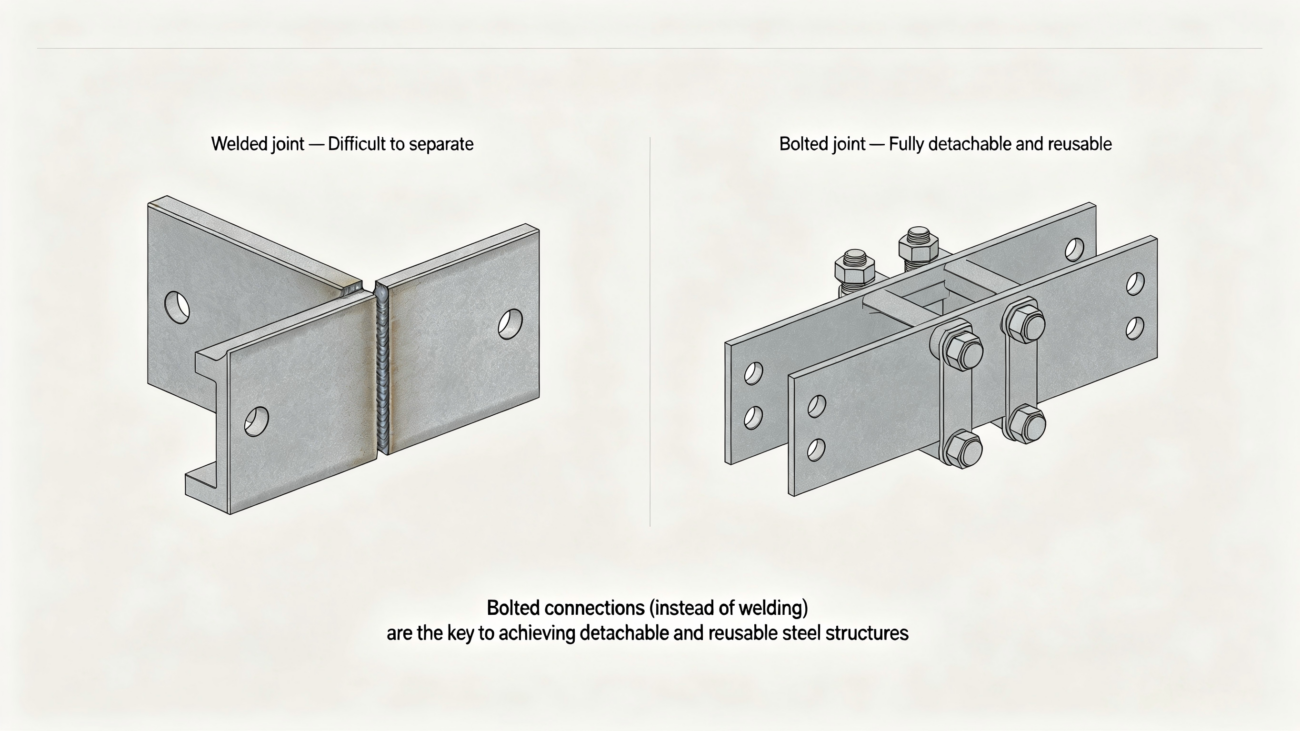
The most sustainable steel building is one that can be taken apart and reassembled elsewhere. This is Design for Deconstruction (DfD) .
| Design Strategy | Conventional Approach | DfD Approach |
|---|---|---|
| Connections | Welded (hard to separate) | Bolted (easy to disassemble) |
| Member sizes | Non-standard (custom lengths) | Modular, standardized |
| Foundations | Integrated (steel cast into concrete) | Demountable (bolted base plates) |
| Documentation | None or paper only | Digital material passport |
| Connections between materials | Poured or cast-in | Mechanical (bolts, clips, brackets) |
DfD benefits:
- Building can be relocated (saves 100% of material for another use).
- Components can be sold or leased (revenue stream).
- Reduced demolition waste (lower landfill fees).
- Future adaptability (easy to add or remove floors).
Real-world example: The SSE Hydro in Glasgow (now OVO Hydro) was designed with bolted connections throughout. The steel frame can be fully disassembled, and 95% of materials can be reused or recycled at end of life.
For overseas clients: If you specify bolted connections (not field welding) and standard section sizes, you have already implemented the core of DfD. The incremental cost is minimal—often zero for prefabricated steel.
7. Environmental Product Declarations (EPD) for Steel
An Environmental Product Declaration (EPD) is a standardized document (ISO 14025, EN 15804) reporting the life cycle environmental impact of a product.
What an EPD for structural steel includes:
- Global Warming Potential (GWP, kg CO2 equivalent).
- Primary energy demand (renewable and non-renewable).
- Water consumption.
- Waste generation.
- Recycled content (post-consumer and pre-consumer).
- End-of-life recyclability.
Why EPDs matter for overseas clients:
- Required for LEED (MR Credit) and BREEAM (Mat 01).
- Required for some government tenders (EU Green Public Procurement).
- Demonstrates environmental commitment to stakeholders.
EAF steel EPD vs. BOF steel EPD:
| Impact Category | EAF (100% scrap, renewable grid) | BOF (virgin ore, average grid) |
|---|---|---|
| GWP (kg CO2/tonne) | 150-400 | 1,800-2,200 |
| Primary energy (GJ/tonne) | 6-10 | 20-25 |
| Recycled content | 80-95% | 10-25% |
How to obtain EPDs: Major steel producers (ArcelorMittal, Nucor, SSAB, Tata, Baowu) publish product-specific EPDs. Request the EPD for the specific mill and product type.
8. Steel Reuse Case Studies
Case 1: King’s Cross Station Redevelopment (London, UK)
| Aspect | Detail |
|---|---|
| Project | Redevelopment of historic train shed |
| Steel reuse | Original 19th-century cast iron and steel columns retained and integrated into new structure |
| Material saved | ~1,500 tonnes of steel |
| CO2 saved | Estimated 3,000 tonnes CO2 |
| Certification | BREEAM Outstanding |
Case 2: Deconstructable Office Building (Netherlands)
| Aspect | Detail |
|---|---|
| Project | 4-story office building, designed for full disassembly |
| Connections | 100% bolted (no welding) |
| Material passport | Digital database of every component (section, grade, coating) |
| Future plan | Building can be moved to new site or components sold individually |
| Circular economy | Steel components have residual value (not demolition waste) |
Case 3: Temporary Event Structure (Multiple locations)
| Aspect | Detail |
|---|---|
| Project | Brand pavilions for international expos |
| Steel system | Modular bolted frame, standardized sections |
| Reuse cycles | Steel frame used for 10+ events across 5 countries |
| Waste | Zero structural steel waste over 8 years |
Common thread: Success requires bolted connections, standardized sections, and documentation.
9. Specifying Recycled Steel for Your Project
For overseas clients who want to maximize recycled content, here is how to specify.
For fabricated steel sections (beams, columns):
Specification language:
“Structural steel shall be produced via the Electric Arc Furnace (EAF) route with minimum 75% recycled content (minimum 50% post-consumer). Supplier shall provide mill certificates indicating scrap percentage and production route.”
For rebar (reinforcing steel):
Specification language:
“Reinforcing steel shall be manufactured from 100% recycled steel via EAF process. Mill certificates shall state recycled content.”
For decking and cold-formed sections:
Specification language:
“Cold-formed steel sections shall have minimum 50% recycled content. Supplier to provide EPD and recycled content declaration.”
What to request from your fabricator:
Mill certificates with heat numbers and production route (BOF vs. EAF).
EPD for the specific product and mill.
Declaration of post-consumer and pre-consumer recycled content.
Confirmation of steel’s end-of-life recyclability (99%+ is standard).
10. Carbon Reduction Strategies for Steel Structures
Beyond recycled content, several strategies reduce embodied carbon.
| Strategy | Carbon Reduction | Implementation Difficulty |
|---|---|---|
| EAF steel (vs. BOF) | 60-70% | Easy (specify EAF in purchase order) |
| EAF + renewable electricity | 90-95% | Moderate (requires supplier with green power) |
| High-strength steel (e.g., S460 vs. S355) | 15-25% (less material for same load) | Easy (use thinner sections) |
| Optimized design (reduced tonnage) | 10-30% | Moderate (requires iterative engineering) |
| Reused steel | 95-99% | Hard (availability, certification) |
| Hybrid design (steel + timber for low-load areas) | 20-40% | Hard (integration complexity) |
Lowest-carbon option: EAF steel with renewable electricity + optimized design + bolted connections for future reuse.
11. Common Myths About Steel Recycling
| Myth | Reality |
|---|---|
| “Recycled steel is lower quality” | No. Steel properties depend on chemistry and processing, not input material. EAF steel can produce premium grades. |
| “Steel cannot be recycled indefinitely” | Yes it can. Steel is infinitely recyclable without loss of properties. |
| “Demolition steel is too contaminated” | Contamination is rare for structural steel (coated steel can be recycled; mixed scrap is sorted magnetically). |
| “Recycling steel costs more” | Often less. EAF steel is frequently cheaper than BOF steel (scrap is less expensive than iron ore + coke in many markets). |
| “Steel reuse is not code-compliant” | Challenging but possible with third-party inspection, material testing, and engineering approval. Codes are evolving to support reuse. |
12. Link to Eco-Friendly Steel Structure Solutions
We incorporate recycled content, design for deconstruction, and carbon reduction strategies into every project—by default, not as an extra.
Our sustainable steel services include:
- Material sourcing: EAF steel with 70-100% recycled content. Mill certificates with scrap percentage documented.
- EPD documentation: Product-specific EPDs provided with every shipment.
- Design optimization: Right-sizing sections to minimize steel tonnage without compromising safety.
- Design for deconstruction: Bolted connections standard (not welded). Standardized sections for future reuse.
- Circular economy support: Buy-back program for steel components at end of building life (value returned to client).
- Certification assistance: Documentation packages for LEED, BREEAM, DGNB.
For overseas clients:
We can provide recycled content declarations and EPDs for every steel component. For projects targeting green building certification, we prepare a complete documentation package (mill certificates, production route, scrap percentages, transportation distances).
👉 [Request an eco-friendly steel structure quote]
Tell us your target green building certification (LEED, BREEAM, or none), desired recycled content percentage, and project location. We will return a steel specification, EAF/BOF options, carbon footprint estimate, and documentation plan within 48 hours.
Summary Table: Quick Sustainability Reference
| Client Goal | Recommended Steel Specification | Documentation Required |
|---|---|---|
| Recycled content (minimum) | EAF steel, 75% recycled (50% post-consumer) | Mill certificate with scrap percentage |
| Lowest carbon footprint | EAF steel + renewable electricity + optimized design | EPD + mill certificates + design LCA |
| LEED v4.1 certification | EAF steel + EPD + recycled content declaration | EPD + mill certificates + cost breakdown |
| BREEAM certification | EAF or BOF with EPD + design for deconstruction (bolted) | EPD + DfD documentation |
| Design for deconstruction | Bolted connections, standard sections, digital material passport | Shop drawings + connection schedule + passport |
| Reused steel | Third-party inspected and certified used beams | Inspection report + engineering approval |