
Prefab Steel Warehouse Cost: Budgeting for Condensation Control and Vapor Barriers

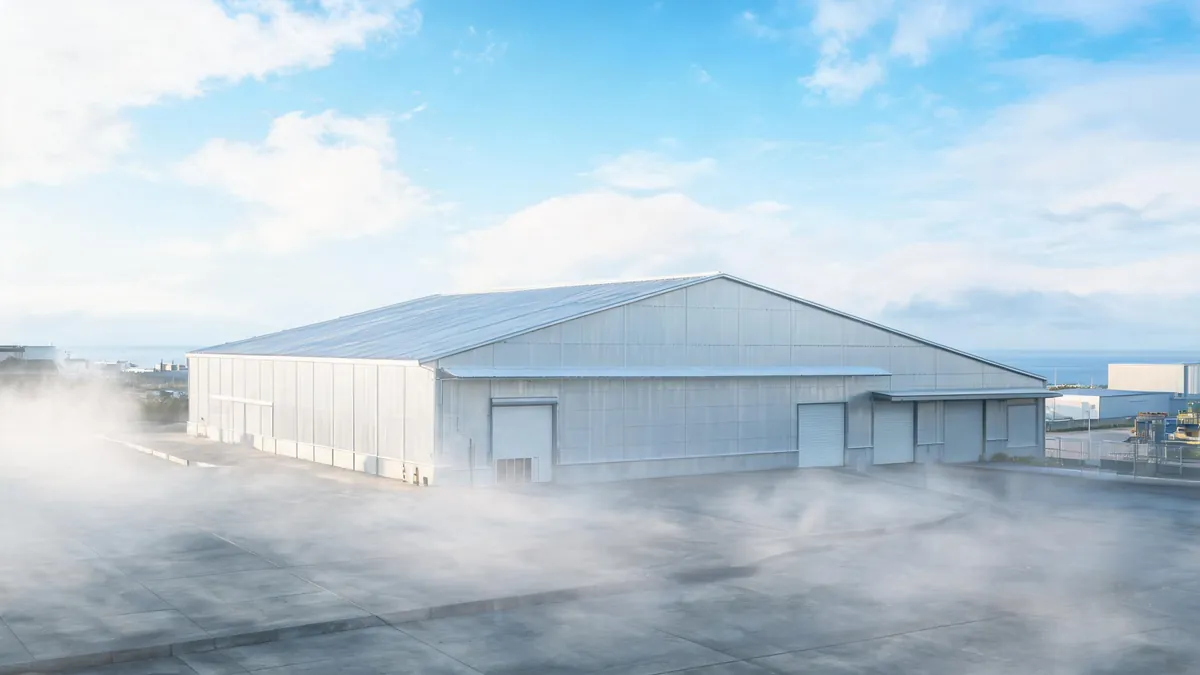
Condensation is the budget item buyers discover after handover, not during quoting. A prefab steel warehouse that looks economical on paper can develop dripping ceilings, rusted purlins and damp stored goods within the first humid season — and fixing it afterwards means re-opening the roof and wall build-up you already paid for. The cost of a warehouse is not only the frame, cladding and freight; it is also the building physics decisions that stop moisture from becoming a maintenance bill.
This guide explains where condensation comes from in a steel warehouse, which specification choices prevent it, and how to make sure the condensation control package is itemised in the prefab steel warehouse cost you compare between suppliers.
Where Condensation Comes From in a Steel Warehouse
Condensation happens when warm, humid air meets a cold surface. In a steel warehouse the classic case is at night or in cool weather: the metal roof sheet cools quickly by radiating heat to the sky, while the air inside the building stays warm and humid from people, machinery, goods or simply the local climate. When that air touches the cold underside of the roof, it releases moisture as droplets — the same physics as a cold drink sweating on a warm day.
Three sources of moisture matter in a warehouse:
- Outside air. In humid climates, every time a dock door opens, moist air floods in. Coastal and tropical sites are the obvious cases, but humidity is a year-round factor in many temperate regions too.
- Inside activity. Unvented forklifts running LPG produce a lot of water vapour. Washing areas, open water, wet goods and even a large team working through a shift add moisture to the air.
- Ground moisture. A missing or damaged vapour barrier under the concrete slab lets ground moisture rise through the floor and into the building air.
Condensation damage shows up in recognisable places: rusty purlins and sheeting screws, stained insulation, water dripping onto racking and goods, mould on packaging, and slippery patches on the floor. If stored product is damaged, the cost of the incident usually dwarfs the price difference between a condensation-safe roof spec and a cheap one.
Why Condensation Control Belongs in the Budget Discussion
Buyers compare warehouse quotes on price per square metre, but the cheapest quote is often the one with the thinnest insulation and no vapour control at all. The problem is not that such a building cannot be built — it can — it is that the operating consequences and the retrofits come back as someone else’s cost line later. Once you understand the failure mode, the conversation with suppliers changes from “what is the lowest price” to “what exactly is included in the wall and roof build-up”.
Four budget lines are directly affected by condensation strategy:
- The roof and wall build-up itself. Sandwich panels, liner trays, insulation thickness and anti-condensation treatments all change the material cost of the envelope.
- The vapour control layer. A proper vapour barrier has a material cost and an installation cost — and it only works if joints and penetrations are sealed properly.
- Ventilation. Ridge ventilation, eave openings or mechanical ventilation change the cost and the roof detailing.
- Future repairs and claims. Rust repair, insulation replacement and damaged goods are the costs that never appear in a quotation but always appear in an operating budget.
A condensation-safe specification is not about buying the most expensive panel. It is about matching the envelope, the vapour barrier and the ventilation to your climate and your use of the building — and making sure the package is itemised so you can compare it across quotes.
Insulated Panel and Liner Options That Reduce the Risk
The metal sheet itself is the cold surface. Insulation works by keeping the inner surface closer to the indoor air temperature, so the air is less likely to reach its dew point against it. That is why an uninsulated single-skin roof in a humid climate is a condensation machine, and why insulation thickness is a climate decision, not a luxury.
| Envelope option | How it handles condensation | Budget position |
|---|---|---|
| Single-skin metal sheet, no insulation | High risk in humid or cold climates; the sheet is the cold surface | Lowest first cost; highest repair and claims risk |
| Single-skin sheet with anti-condensation fleece lining | Fleece traps and holds droplets, reducing drips; needs ventilation to dry out | Moderate added cost; simple retrofit option |
| Insulated sandwich panel (PIR, PUR, EPS or rock wool core) | Inner face stays warmer; core adds thermal performance; vapour behaviour depends on the facing and joint sealing | Higher material cost; usually the most reliable roof solution |
| Liner tray with insulation over it | Inner liner gives a clean warm surface; insulation sits between liner and outer sheet | Higher installed cost; common where a clean interior finish matters |
Sandwich panels are the most common solution for export warehouses because they combine structure, insulation and finish in one product. The core material changes performance and price: PIR and PUR give high insulation value for their thickness, EPS is a lower-cost option with different fire and moisture behaviour, and rock wool adds fire resistance. Do not assume “sandwich panel” means the same thing from every supplier — the core, thickness, facings and joint system are all different products with different price positions.
Does condensation damage the steel frame itself?
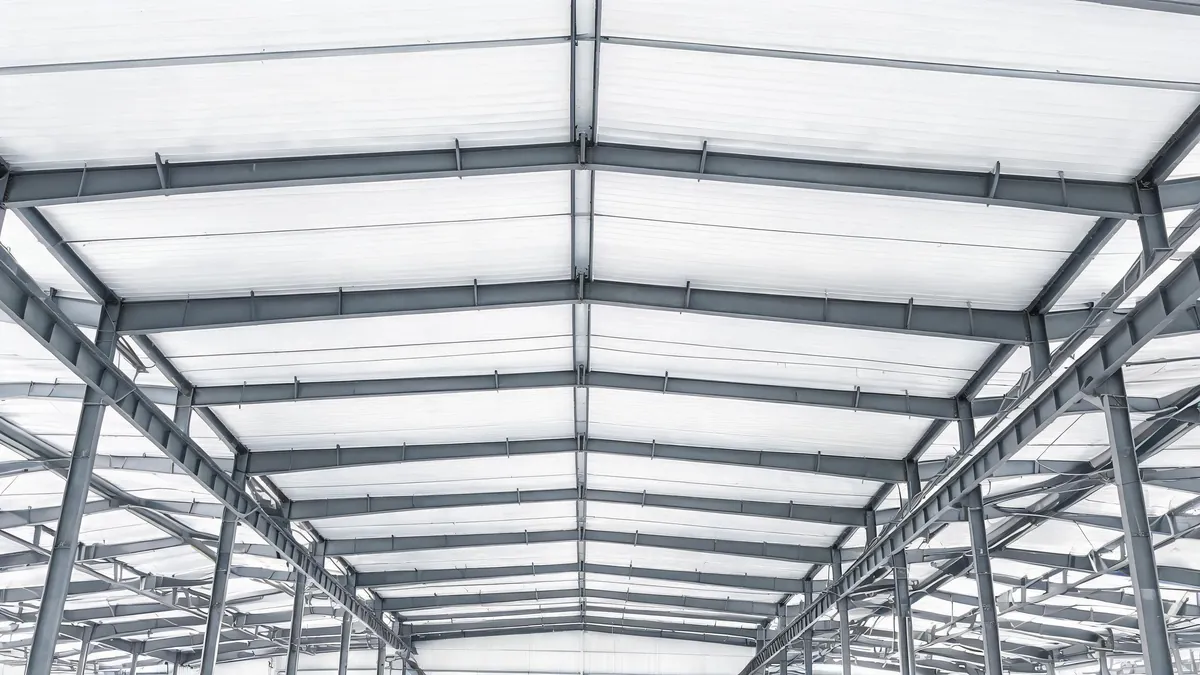
Left unchecked, yes. Water that condenses on the underside of the roof runs down to the purlins, sits around fastener holes and keeps the steel wet for long periods, which is exactly the environment that makes protective coatings fail early. The visible symptom is dripping and stained goods; the long-term symptom is corrosion on members and fasteners that were supposed to last decades. Preventing the condensation in the first place is nearly always cheaper than repairing the corrosion it causes.
For detailed comparison of the envelope options, see our guide on single-skin vs insulated sandwich panels and how cladding panel choices move the budget.
The Vapour Barrier: Where It Belongs and Where It Fails
A vapour barrier slows the movement of water vapour from the warm side of the building towards the cold side. In a heated warehouse in a cold climate, the barrier belongs on the warm side of the insulation — the inner face. In a hot, humid climate where the warehouse may be cooler than the outside air, the logic can reverse, and local practice should guide the design. This is exactly the kind of detail that should be confirmed with an engineer who knows your climate, not assumed from a brochure.
Where vapour barriers fail in practice:
- At joints. The barrier is only as good as its seams. If lapped sheets are not sealed, humid air finds the gap.
- At penetrations. Every roof penetration — vents, skylights, cable entries, pipe supports — is a potential leak path for vapour even when it is watertight to rain.
- At the slab. A warehouse slab without a vapour barrier underneath lets ground moisture rise through the concrete. This is a separate cost line from the building envelope, and it is frequently missed.
- By being left out. Many low-price quotes simply do not include a vapour control layer. Check the specification, not the sales description.
Ask every supplier to state where the vapour barrier sits in their wall and roof build-up and how joints and penetrations are handled. A supplier that cannot answer is not offering a condensation-safe building.
Ventilation: the Partner of Insulation
Insulation slows condensation, but ventilation removes the humid air that causes it. The two work together. A well-insulated, airtight building with no ventilation can still accumulate moisture from activities inside; a ventilated building with no insulation can still condense on cold surfaces.
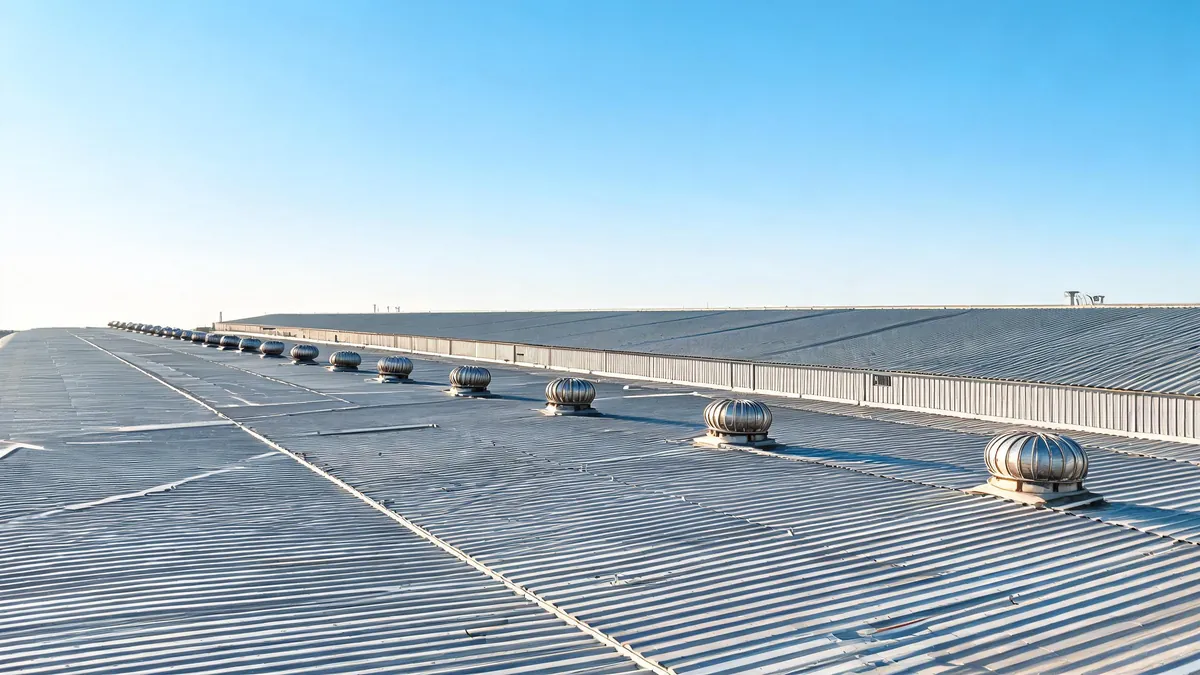
Passive ventilation is the most common approach for warehouses: ridge ventilators at the roof peak let warm, moist air escape, while eave or wall openings allow replacement air in. In hot climates, ridge and eave ventilation also reduces heat build-up, which lowers the cooling load. In cold climates the balance is different — too much ventilation throws away heat — and mechanical or controlled ventilation may be the better answer. Turbine ventilators are common in tropical warehouses because they work with wind and rising warm air, but they need clear roof space and should not be blocked by solar panels or other roof equipment.
Can I add ridge ventilators after the roof is installed?
It is possible, but it is a roof surgery: the sheeting has to be cut, the purlins modified around the ventilator opening, and the flashing and sealing redone. The cost and the risk of leaks are both higher than including the ventilators in the original roof design. If there is any chance the building will need ridge ventilation, put the ventilator layout in the RFQ and let the supplier detail the roof around it from the start.
When you compare quotes, ventilation is not an optional extra to be decided later. Ridge openings change the roof sheet layout, the purlin spacing around the ventilator and the flashing details. If a supplier’s quote does not mention ventilation, ask explicitly what the roof build-up assumes.
Climate-by-Climate Decisions
There is no universal condensation specification, only a specification matched to the site. The table below shows the general direction of thinking; your engineer should confirm the details for your location and building use.
| Site climate | Typical condensation risk pattern | What usually matters most |
|---|---|---|
| Hot and humid (tropical, coastal) | High humidity year-round; condensation on cooler roof sheets at night; moisture enters with dock traffic | Insulated roof build-up, ventilation to flush humid air, vapour control at the slab, sealed joints |
| Temperate with cold winters | Heated interior against cold roof and walls; condensation on the warm side of the insulation | Insulation thickness, vapour barrier on the warm side, low air leakage |
| Hot and dry (desert) | Less condensation overall, but night-time temperature swings and occasional humid events still cause surface moisture | Ventilation, insulated roof, attention to any cooling or air-conditioned areas |
| Cold storage or temperature-controlled use | The building interior itself is the cold side; outside humidity tries to move in | Specialist cold-room build-up with a vapour barrier on the correct side — always engineer this separately |
One point deserves emphasis: if the warehouse will be cooled or refrigerated, do not let a general-purpose building supplier design the envelope by analogy with a normal warehouse. Cold-store envelopes are a specialist subject where the vapour barrier position is reversed and errors are expensive.
What “Insulation Included” Really Means in a Quote
“Insulated building” is one of the least precise phrases in a steel building quotation. It can mean insulated sandwich panels on the roof and walls, single-skin sheeting with a thin insulation layer under the roof only, or a building where the insulation is mentioned in the sales text but missing from the itemised scope. Buyers who compare three quotes on total price are often comparing three completely different envelopes.
To compare honestly, break the envelope down into questions that have factual answers:
- Which surfaces are insulated? Roof only, or roof and walls? In many climates the walls matter as much as the roof.
- What is the insulation product and thickness? A sandwich panel core of 50 mm and one of 100 mm are different products with different thermal performance, different handling and different prices. Ask for the core type (PIR, PUR, EPS, rock wool or another material) and the actual thickness in the quotation.
- What is the stated performance? Thermal performance is expressed as a U-value or R-value in the product data sheet. Ask the supplier to state the value their build-up achieves and what climate it is appropriate for — not just the panel marketing name.
- What is at the joints and the edges? The thermal performance of a panel system depends on the joint design and the sealing. Ask whether joint sealant, gaskets and flashing are included.
- Is there a liner or an anti-condensation layer on the inside? If the answer is no, the interior face is bare metal or the inner panel face — and the condensation behaviour of the building changes completely.
A useful exercise is to ask each supplier for the same three lines: roof build-up, wall build-up, and the condensation control measures included. Put the answers side by side. When one quotation lists a full envelope and another lists “insulation included” without saying where, you already know which supplier is treating the building as an engineered product.
Checklist to Send With Your RFQ for a Condensation-Safe Quote
Put these items in your RFQ and compare the answers line by line:
- What is the roof and wall build-up — panel type, core, thickness, facings — and what design conditions was it selected for?
- Is a vapour control layer included? Where does it sit, and how are joints and penetrations sealed?
- What ventilation is included — ridge, eave, turbine or mechanical — and what is its basis?
- Does the foundation scope include a vapour barrier under the slab?
- What are the design assumptions for indoor temperature, humidity and the local outdoor climate?
- Will the supplier confirm the condensation risk in writing for my site conditions, or is the quote a standard package?
- Is the condensation control package itemised in the price, or bundled invisibly into the total?
Suppliers that give straight answers to these questions are doing engineering; suppliers that deflect are selling steel by weight. For the full picture of what a warehouse budget must cover, use our project budget checklist for prefab steel warehouses alongside the envelope questions above.
Reading Three Warehouse Quotes: Where the Envelope Money Goes
To see how condensation control changes the comparison, walk through the typical difference between three quotations for the same warehouse. The names below are generic; the pattern is what matters.
| Quote | Roof and wall description | Vapour control and ventilation | What the buyer is really comparing |
|---|---|---|---|
| Quote A — “economy” | Single-skin roof and wall sheeting, no insulation stated | Not mentioned | Lowest first cost, highest risk of condensation in humid or cold conditions, no stated thermal performance |
| Quote B — “insulated building” | Sandwich panel roof and walls, core type and thickness listed | Vapour control and ventilation not itemised | Better envelope, but the buyer cannot tell whether the condensation risk has been designed out |
| Quote C — condensation-safe package | Sandwich panel build-up with stated core and thickness, liner or anti-condensation treatment on the interior face | Vapour barrier position stated, joint sealing described, ridge or eave ventilation itemised | Higher line item on the envelope, but the price includes the measures that prevent the costly failures |
The mistake is to read the three totals and conclude that A is the best deal. Quote A has simply moved the condensation cost out of the building price and into your operating future. Quote C costs more on paper and usually less over the life of the building — provided the measures are actually installed as specified.
This is also why the total prefab steel warehouse cost must be compared with the same scope boundaries. Two suppliers quoting the same nominal building can differ by tens of thousands in what they include, before a single piece of steel is fabricated. For a complete view of the line items a warehouse budget should carry — from site survey to handover — work through the project budget checklist.
Warranty, Corrosion and the Lifecycle Cost of the Envelope
Condensation damage does not stop at dripping ceilings. The water that condenses on the underside of a roof sheet runs down to the purlins, pools around fastener holes and sits in contact with cut edges. Over time this is a corrosion process: the protective coating on the steel is only as good as its ability to stay dry, and a building that sweats internally every morning is testing its own coating system continuously.
Three lifecycle effects deserve a place in the budget discussion:
- Coating and warranty performance. Paint and metal coating warranties are written for the product’s intended service conditions. Internal condensation is an aggressive environment that can void or shorten the practical life of the coating, because the steel is wet for hours every day instead of occasionally. Ask the supplier what service conditions their coating warranty assumes.
- Fastener and accessory corrosion. The first components to fail in a condensing building are usually the small ones: sheeting screws, washers, flashings and the cut edges around penetrations. Replacing fasteners across a large roof is a maintenance project, not a quick fix.
- Insulation performance loss. If insulation gets wet repeatedly, its thermal performance drops and it can hold moisture against the steel, accelerating corrosion. Rock wool and some other cores absorb water; a wet insulation layer also becomes a breeding surface for mould and a smell problem in the building.
For a warehouse that will operate for twenty or thirty years, the envelope choice is a lifecycle decision. The cheapest roof system can be the most expensive roof system once maintenance, repair and product protection are counted. This is the same reasoning that applies to the cladding panel budget decision — the panel that looks expensive against the lowest quote is often the one that protects the building’s value over time.
FAQ
Why does my steel warehouse drip from the roof even when it is not raining?
That is condensation: warm, humid indoor air meets the cold underside of the roof sheet and releases moisture. It is common with uninsulated or thinly insulated roofs in humid or cool conditions. The fix is a combination of insulation to keep the inner surface warmer, vapour control to stop moisture reaching the cold layer, and ventilation to remove humid air. Confirm the right combination for your climate with an engineer before changing the roof.
Is anti-condensation fleece enough to stop condensation in a warehouse?
Fleece linings trap droplets and stop them dripping onto goods, which is a useful improvement over bare sheeting, but they do not remove the moisture — the fleece must be able to dry out, which needs ventilation. For continuous or high-humidity operations, an insulated build-up with proper vapour control is usually the more reliable solution. Compare both options in the quotation.
Does a thicker sandwich panel always mean better condensation control?
Not by itself. Thicker insulation reduces the temperature difference that drives condensation, which helps, but the panel facings, the joint sealing and the position of the vapour barrier matter just as much. A thick panel with unsealed joints can still let humid air reach the cold side. Judge the whole build-up, not the panel thickness alone.
Should I add ventilation if my warehouse is air-conditioned?
It depends on the design. A cooled warehouse needs controlled ventilation and a correctly placed vapour barrier — and the engineering is different from a naturally ventilated building. Do not mix assumptions: tell the supplier whether the space will be cooled, heated, or unconditioned, because the envelope design changes with each case.
Where does condensation control appear in the budget?
In the roof and wall build-up (panel type and thickness), the vapour control layer, the ventilation system, the slab vapour barrier and — later — in avoided repairs and claims. Ask for these as separate line items in the quote. A price that shows only frame, cladding and freight has not yet told you what the envelope actually contains.
Condensation control is a specification decision, and specification decisions are where real warehouse costs are made or saved. Compare the envelope build-up, not just the headline price, and ask each supplier to itemise what their quote actually covers. When you are ready, our prefab steel warehouse supplier team can prepare a quotation that states the roof and wall build-up, the vapour control and the ventilation assumptions in writing — send your project details through the contact page and we will include them in the price you compare.