Steel Building Manufacturer: How Production Lead Time Is Set and What Delays Shipment

A typical steel building order takes 4 to 10 weeks from drawing approval to container loading, and the single biggest variable is not factory speed — it is how fast the buyer approves the shop drawings. Production lead time at a steel building manufacturer is built from six stages: drawing confirmation, material procurement, fabrication, surface treatment, packing and loading. Understanding where the days actually go lets you plan a realistic project schedule and spot suppliers whose promises do not match their process.
How a factory builds its production schedule
Every steel building manufacturer runs the same logical sequence, but the time allocated to each stage varies widely with factory size, current order load and the complexity of your building.
The six stages of a steel building order
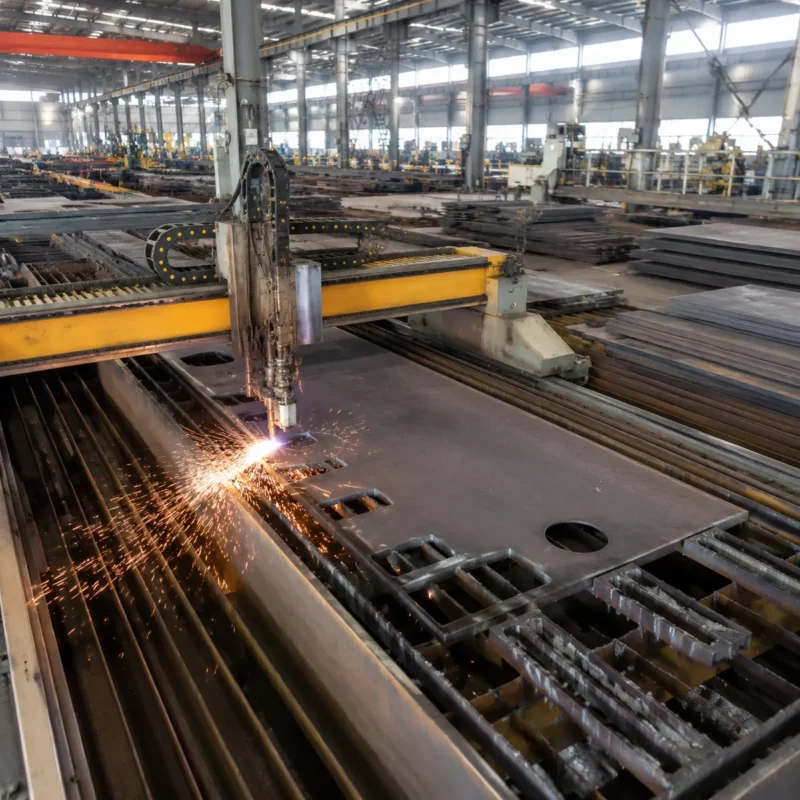
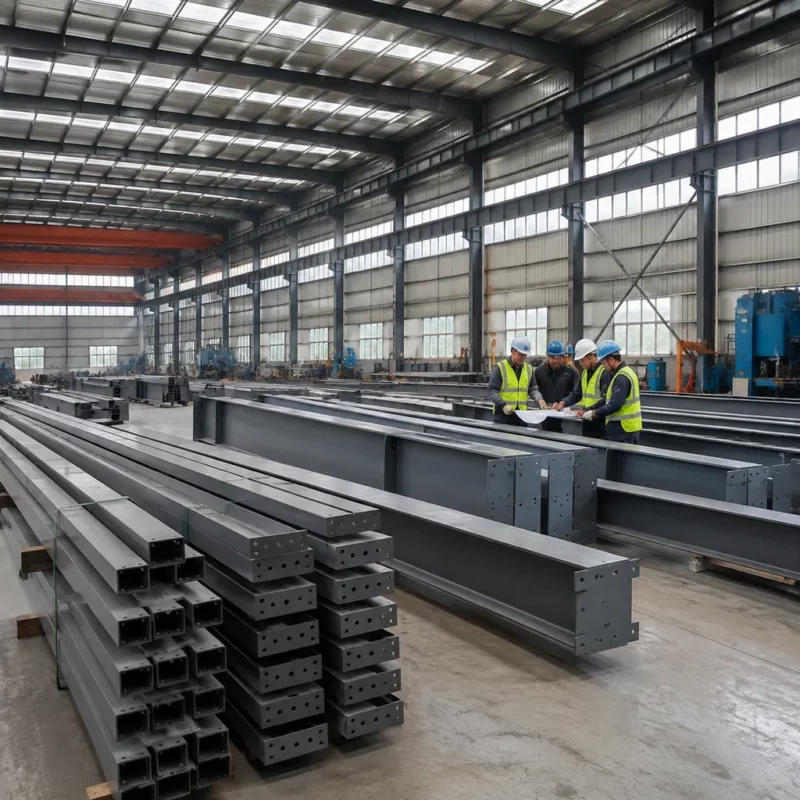
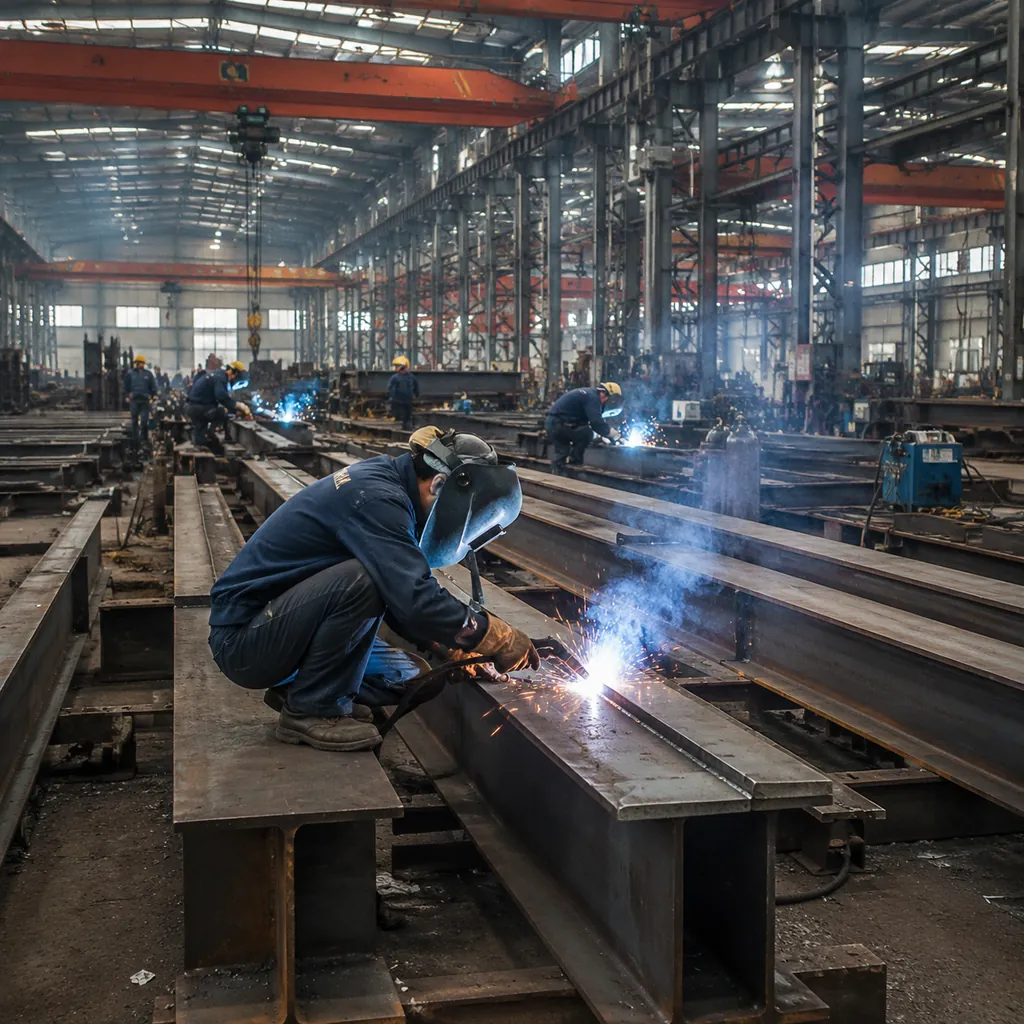
1. Shop drawing preparation and approval (1-3 weeks). 2. Raw material procurement (3-10 days, depending on steel stock). 3. Fabrication: cutting, drilling, welding, assembly (1-4 weeks). 4. Surface treatment: shot blasting and painting or galvanizing (3-10 days). 5. Packing and container loading (2-5 days). 6. Documentation and loading inspection (1-3 days).
These stages mostly run in sequence, which is why the total is a sum rather than a single number. Factories with large dedicated lines overlap stages for different buildings, but a single order still follows the same critical path.
Why the same building takes different times at different factories
Capacity utilization is the biggest difference. A factory at 80% capacity quotes longer lead times than one at 40%, all else equal. Work-in-progress (WIP) is the honest indicator: ask how many tonnes of steel are currently in the workshop and how many orders are ahead of yours.
Automation also matters. Factories with CNC drilling lines and robotic welding produce consistent frames faster than manual workshops, and they hold tolerances better — which matters later during erection.
Q: What is a realistic lead time for a steel building from a Chinese factory?
A: For a standard warehouse of 500-2,000 sqm, 4-7 weeks from drawing approval to loading is common; for complex or multi-building projects, 8-12 weeks. Always confirm the lead time in writing and define it as ‘days after shop drawing approval and deposit payment’.
Stage by stage: where the days actually go
Shop drawing preparation and approval (often 30% of total time)
The factory’s engineers turn your layout, elevations and loads into fabrication drawings. You receive a drawing set for review, and every round of comments adds days. A buyer who reviews drawings quickly and returns precise comments can cut a week or more off the schedule.
This stage is also where scope gaps surface: if your original inquiry did not specify door sizes, eave height or cladding, the drawings will come back with questions, and the clock stops until you answer them.
Material procurement
Steel price volatility pushes some factories to buy material only after the deposit arrives and the drawings are final. Standard sections like H-beams and C-purlins are usually in stock; special grades, thick plates or imported coatings need procurement time.
Ask whether the quote assumes in-stock material. If steel prices moved between quoting and ordering, the factory may also ask for a price adjustment clause — agree on how that works before you sign.
Fabrication and surface treatment
Fabrication time scales with tonnage and joint complexity. A simple portal frame warehouse of 50 tonnes fabricates faster than a 50-tonne multi-span building with crane brackets and complex connections. Surface treatment is a weather-dependent stage: painting must cure at the right humidity, and hot-dip galvanizing depends on bath availability at the coating plant.
For coastal or high-corrosion sites, galvanizing adds a week or more to the schedule but is often the right choice. Plan for it instead of discovering it late.
Packing, loading and documentation
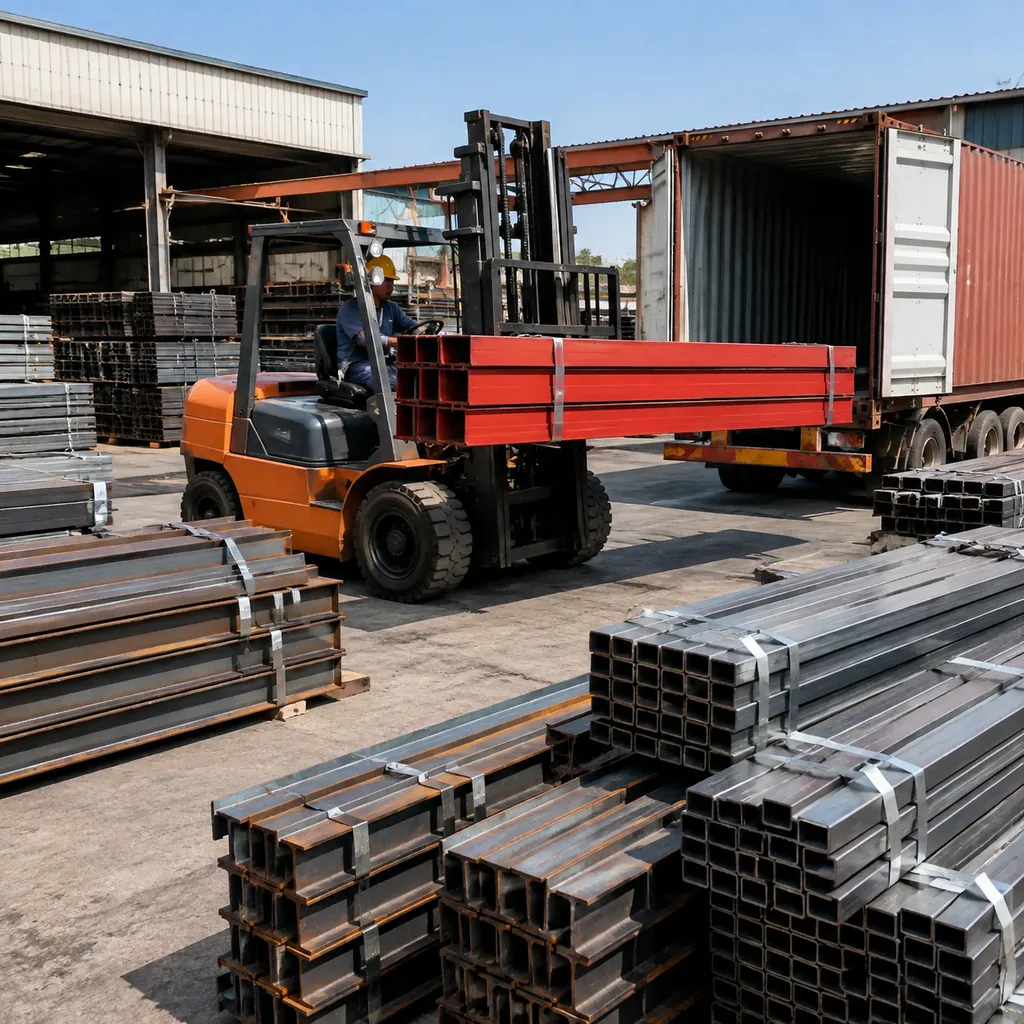
Steel members are packed into containers or break-bulk bundles with detailed packing lists. The loading stage needs the shipping schedule and container booking to align — a missed vessel means waiting for the next sailing.
Documentation (packing list, invoice, bill of lading, mill certificates) is usually prepared during loading. Ask for the document set in advance so customs clearance at destination is not delayed by missing paperwork.

Typical lead time by project type
| Project | Tonnage range | Drawing approval | Fabrication | Total to loading |
|---|---|---|---|---|
| Standard warehouse 500-1,000 sqm | 30-60 t | 1-2 weeks | 2-3 weeks | 4-6 weeks |
| Warehouse 1,000-3,000 sqm | 60-150 t | 1-2 weeks | 3-4 weeks | 5-8 weeks |
| Workshop with crane bays | 80-200 t | 2-3 weeks | 3-5 weeks | 6-10 weeks |
| Multi-building project | 200-600 t | 2-4 weeks | 5-8 weeks | 8-12 weeks |
| Hot-dip galvanized frame (add to any project) | – | – | +1-2 weeks | +1-2 weeks |
These are planning ranges, not guarantees
The table reflects typical Chinese export experience but every factory quotes its own schedule. The important habit is to convert every promise into calendar days with a clear start date: ‘delivery in 45 days’ means nothing unless both sides agree it starts after the deposit and drawing approval.
What actually delays shipment (and how to prevent each one)
The top six delay drivers
1. Slow shop drawing approval from the buyer side. 2. Late answers to technical questions (door sizes, cladding, loads). 3. Deposit arriving late or split into several payments. 4. Material not in stock at order time. 5. Painting/coating delayed by weather or bath capacity. 6. Container booking or vessel missed at the port.
Notice that most delays are commercial or coordination issues, not factory capability. A disciplined buyer who answers questions within 24 hours and pays on the agreed dates usually finishes ahead of a buyer who micromanages every detail late.
Payment timing as a schedule lever
Factories usually start procurement only after the deposit clears. If your payment process takes a week, that week is added to the schedule. Ask the factory to confirm in writing that the lead time clock starts after deposit receipt, and wire the deposit the same day the proforma invoice is signed.
Q: Why did my supplier’s lead time slip by two weeks?
A: The most common causes are late drawing approval, delayed deposit, material not in stock, or a missed vessel booking. Ask for a stage-by-stage progress report with photos — a factory that cannot show where your steel is in the workshop is not managing your order properly.
How to compress lead time without risking quality
Prepare a complete inquiry package
Send dimensions, loads, cladding preference, door and window schedule, and site conditions in the first message. Every missing item becomes a drawing-round question later. A complete brief can save 1-2 weeks across the whole order.
Approve drawings in one round
Review shop drawings with your engineer before they are sent, and return a single consolidated comment list. Approving ‘with minor comments’ instead of starting a second round can save 3-5 days. If you need changes, group them into one round instead of sending them one by one.
Order during the factory’s low season
Chinese factories are busiest between September and December (pre-shipping season rush). Orders placed in the first half of the year often get shorter lead times and more attention. If your project can move, the calendar is on your side.
Red flags in lead time promises
Promises that should make you ask more questions
A 15-day lead time for a 100-tonne building is either a stock design with no customization or a sales pitch. An open-ended ‘about 6 weeks’ with no stage breakdown is a risk. A factory that refuses to put lead time and the start trigger in the contract is the biggest red flag of all.
Also be wary of lead times that never change regardless of building size or coating choice. Serious manufacturers quote different schedules for painted vs galvanized frames and for simple vs complex buildings.
How to verify a factory’s claimed capacity
Ask for current workshop photos and video, the number of active orders, and monthly tonnage output. Cross-check the claimed capacity with the lead time: a factory that claims 3,000 tonnes/month but quotes 8 weeks for 60 tonnes may be overloaded, or may not have the capacity it advertises.
Material procurement in practice
Steel stock, price locks and the deposit trigger
Factories keep rolling stock of common sections — H-beams, C-purlins, Z-purlins, plates — but the quantity varies by season. When the deposit arrives, the factory either releases stock or places a mill order. Mill orders add 5-15 days depending on the mill and the section size.
Ask whether the quote assumes stock material or a mill order. If steel prices are rising, a factory may delay procurement waiting for a better price, which quietly extends your lead time. A written commitment to lock material within a set number of days after the deposit removes this risk.
Mill certificates and traceability
Every steel batch should come with mill certificates (MTCs) stating the grade, heat number and test results. MTCs take time to assemble for multiple suppliers and are often the last documents ready before shipment. If your project requires third-party inspection of materials, add 2-4 days to the schedule for sampling and testing.
Request the MTC plan in the order confirmation so nobody discovers at loading time that certificates are missing.
Q: Does buying more steel in one order shorten the lead time?
A: Sometimes. Larger orders can fill a full production line and may move faster per tonne than a small order that interrupts the line schedule. But the difference is usually modest; the drawing approval speed still dominates the critical path.
Surface treatment options and their schedule impact
Painted, zinc-rich or galvanized?
Most export steel buildings are shot-blasted to Sa 2.5 and painted with a primer plus finish coat. Hot-dip galvanizing gives better corrosion protection and is common for coastal or humid sites, but it adds a week or more because the members travel to a galvanizing plant and back, and the bath schedule depends on that plant’s load.
Zinc-rich primer systems sit between the two in both cost and protection. Choose the system for the site environment, not for the schedule — but know that galvanizing genuinely takes longer.
| Treatment | Typical added time | Best for | Schedule risk |
|---|---|---|---|
| Shot blast + painted | Baseline | Inland, standard industrial | Weather (humidity) during cure |
| Zinc-rich primer system | +2-4 days | Humid, moderate corrosion | Coating plant queue |
| Hot-dip galvanized | +5-12 days | Coastal, high corrosion | Bath capacity at galvanizer |
| Painted + galvanized (duplex) | +7-15 days | Very aggressive environments | Two-stage queue |
The weather factor in painting
Paint cannot cure properly in high humidity or rain. Factories plan coating around weather windows, and a wet week can add several days. This is why coastal and rainy-season orders carry more schedule uncertainty than inland dry-season orders — plan the buffer accordingly.
What good progress reporting looks like
Ask for evidence, not promises
A factory managing your order properly can show: the material with your project mark in the yard, the cutting list released, welded frames with your order number, coating inspection photos, packing lists and container loading photos. These are the milestones worth tracking.
Set a weekly reporting rhythm in the order confirmation: one photo/video update per week plus a stage status line. If the factory cannot produce visual evidence at the promised stage, your order is probably not where they say it is.
The three most useful questions in a progress call
1. What is the current stage and when did it start? 2. What is the next milestone and its date? 3. What risk could delay the next milestone, and what is being done about it? These three questions turn vague updates into a real schedule conversation.
Two orders, two schedules: how the same building differs
Scenario A: the organized buyer
Buyer A sends a complete inquiry with drawings and loads, approves shop drawings in one round on day 10, pays the deposit the same day the PI is signed, and answers all technical questions within 24 hours. Total time from drawing approval to loading: 4-5 weeks. Total from first contact: 6-7 weeks.
Scenario B: the slow buyer
Buyer B sends a one-line inquiry, takes two weeks to answer clarification questions, asks for three rounds of drawing changes, and splits the deposit across two payments a week apart. The same building takes 6-8 weeks from drawing approval to loading, and total from first contact stretches past 10 weeks — with more errors, because changes arrived mid-production.
What the difference teaches
The factory capability is identical; the buyer’s process created the gap. Plan your internal approvals before you contact suppliers, and you effectively gain two weeks of schedule for free.
Planning your project schedule around the lead time
Working backwards from your opening date
If your warehouse must be operational on a fixed date, plan backwards: erection (2-4 weeks), shipping and customs (3-8 weeks depending on route), production (4-8 weeks), drawing approval (1-3 weeks). Add a buffer of 2-4 weeks for the unexpected. The resulting date is when you must start the inquiry process.
Most project delays trace back to a procurement start that was too late. A lead time of 6 weeks sounds long until you count the shipping month on top of it.
| Timeline element | Typical duration | Planning note |
|---|---|---|
| Drawing approval | 1-3 weeks | Runs before production; buyer-controlled |
| Production to loading | 4-8 weeks | Depends on tonnage and coating |
| Sea freight | 2-6 weeks | Route and port dependent |
| Customs and port handling | 1-2 weeks | Broker and documents dependent |
| Erection | 2-4 weeks | Crew size and crane dependent |
| MEP and finishing | 1-3 weeks | Scope dependent |
| Buffer | 2-4 weeks | Do not skip this line |
Total delivery window: what the lead time really means
The factory lead time is only the production slice. A buyer who adds shipping and erection to the factory promise gets the real project duration — typically 3-5 months from first contact to a usable building for a standard warehouse.
When comparing suppliers, compare their production lead times, but plan your project on the total window. A factory that is two weeks faster in production but misses the sailing schedule is not actually faster.
Seasonal factors in the schedule
Shipping peaks before major holidays in Asia (often in September-December), when container space is tight and freight rates rise. Chinese factory capacity also fills during this window. If your schedule is flexible, ordering in the first half of the year typically gets better freight rates and shorter queues.
Q: When should I start the inquiry if I need the building in six months?
A: Start immediately. Between drawing approval, production, shipping, customs, erection and finishing, a standard warehouse realistically needs 3-5 months from first contact. Starting earlier lets you compare suppliers properly and keeps the schedule out of the critical path.
Common lead time myths buyers should drop
Myth 1: a bigger factory is always faster
A large factory may be busier, and a small factory may give your order more attention. Speed depends on current utilization, not capacity on paper. Ask for the current load and the specific production slot for your order, not the factory’s annual output.
Myth 2: paying more guarantees faster delivery
Express fees work only when they buy a real production slot or pre-purchased steel. If the factory is already at capacity, extra money moves you in the queue but does not create capacity. Ask what the extra fee actually buys before paying it.
Myth 3: lead time is the supplier’s problem
Half the lead time is controlled by the buyer: how fast you approve drawings, answer questions and pay. A factory that quotes 6 weeks and delivers in 6 weeks is a partner; a buyer who takes 3 weeks to approve drawings has just made it 9. Own your half of the schedule.
What to put in the contract about lead time
Six clauses that protect the schedule
1. Lead time defined in days from deposit + drawing approval. 2. A stage schedule: drawings, material ready, fabrication start, coating, packing, loading. 3. Liquidated damages for delay beyond an agreed grace period. 4. Price adjustment rules if steel prices move. 5. Progress reporting: photos or video every week. 6. Force majeure defined narrowly so it cannot be abused.
These clauses do not need to be aggressive — they need to be clear. A professional manufacturer will accept them; a trader passing the order to someone else will hesitate, because they cannot control the schedule themselves.
The final check before signing
Ask the factory for the names and roles of the people managing your order: the sales engineer, the drawing engineer, and the production scheduler. Knowing who owns your schedule makes follow-up fast and makes the factory accountable.
Frequently Asked Questions
How long does a steel building take to manufacture?
A standard warehouse of 500-2,000 sqm typically takes 4-7 weeks from drawing approval to loading. Complex projects, galvanized frames or multi-building orders take 8-12 weeks. Confirm the start trigger and the stage schedule in writing.
What makes steel building lead time longer?
The biggest drivers are slow drawing approval, late deposits, non-stocked steel, weather delays in coating, and missed vessel bookings. Most delays are coordination issues between buyer and factory rather than factory capability.
Can I get a faster lead time by paying more?
Sometimes. Some factories offer express lanes for standard designs or for orders that can use pre-purchased steel. But no factory can safely compress a real fabrication schedule by half. Be suspicious of very short lead times on customized buildings.
Does the lead time include shipping?
Usually not. Most export quotes state the lead time as ready-to-load (or FOB port), and shipping time is separate. Ask for three dates: ready for loading, estimated vessel departure, and estimated arrival at destination.
How do I know my order is actually in production?
Request weekly photo or video updates and a stage checklist. A reputable manufacturer will show your marked members in the workshop with your project code. If you only receive text updates, ask for visual evidence.
A realistic lead time starts with a complete inquiry and a factory that can show its production schedule. When you are ready to move, send your building dimensions and requirements to a manufacturer that will commit to a stage-by-stage schedule in writing.