
Steel Building Manufacturer vs Steel Fabricator: Who Handles an Export Project

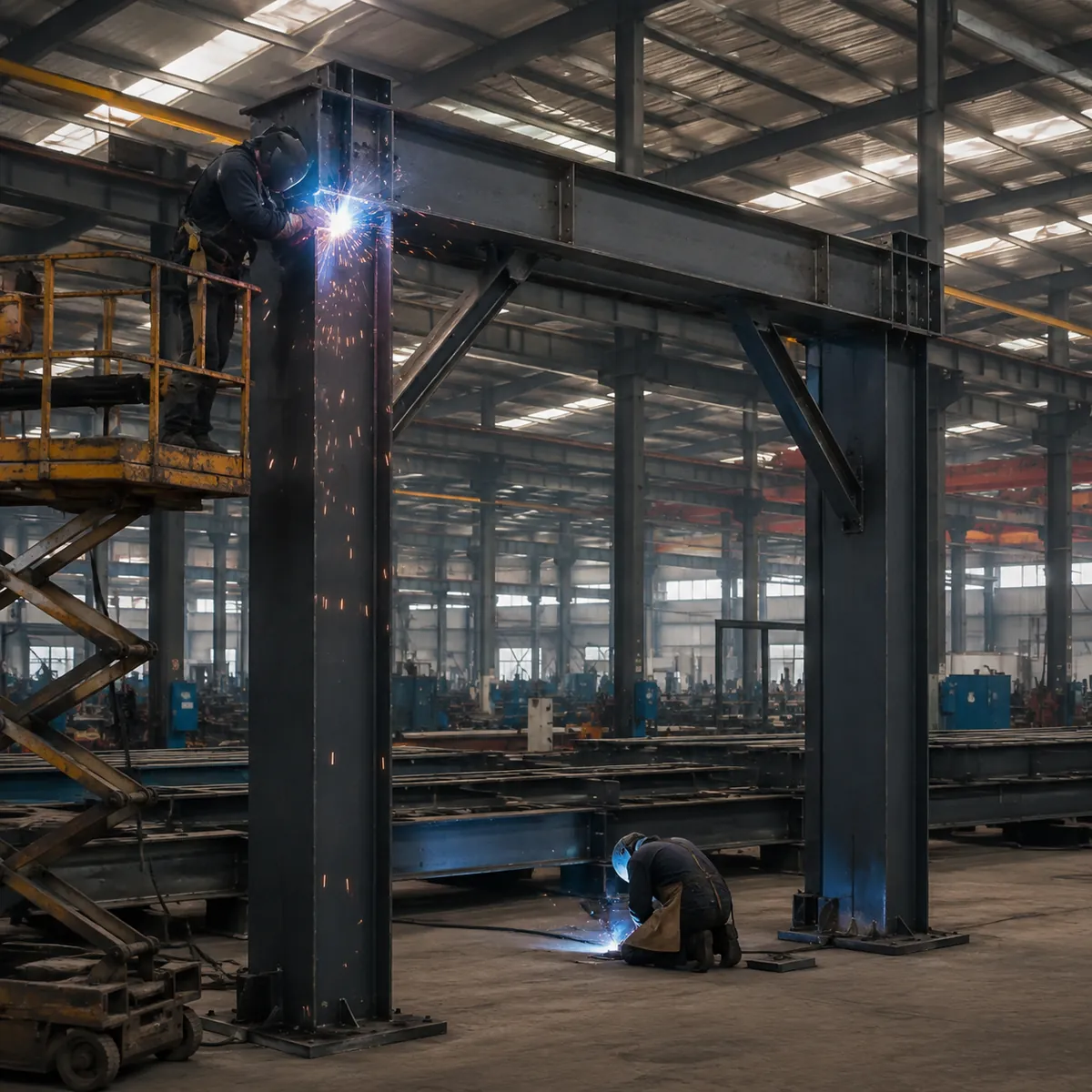
A steel building manufacturer and a steel fabricator are not the same company, and the difference decides who is responsible for your project’s design, quality, and delivery. A manufacturer typically engineers the building, fabricates the frame, sources the cladding, and manages shipping; a fabricator usually works from someone else’s drawings and cuts, welds, and assembles steel only. For an export project, buying from a manufacturer means one accountable party for the whole package — this article explains what each delivers so you know which one you are actually dealing with.
What Does a Steel Building Manufacturer Do Differently?
A steel building manufacturer runs the complete production chain under one roof: structural design and shop drawings, steel cutting and welding, surface preparation and coating, and often cladding and accessory supply. Because the design and fabrication teams work together, changes to span, height, or loads are handled internally instead of being bounced between an engineer and a workshop.
For buyers, the practical result is a single contract for a complete building: the manufacturer answers for the frame’s structural performance, the coating system, the packing for sea freight, and the documentation pack for import approval. That is why B2B buyers sourcing prefab steel warehouse and workshop projects overseas usually prefer manufacturers over standalone fabricators.
https://www.steelstructureprefab.com/wp-content/uploads/2026/08/steel-manufacturer-vs-fabricator-inline1-20260815-071628.webp
What Does a Steel Fabricator Actually Provide?
A fabricator receives approved shop drawings — from the client’s engineer, a consultant, or a licensing partner — and produces the steel members to those drawings. The scope normally covers cutting, drilling, welding, fit-up, and sometimes painting. The fabricator does not take responsibility for the structural design, and the cladding, purlins, and accessories are usually out of scope.
Working with a fabricator can still make sense when you already have a design, when the project is a repair or extension, or when local content rules require fabrication in your country. The risk is that you now manage the interface yourself: design firm, fabricator, coating shop, and shipping each become separate suppliers.
https://www.steelstructureprefab.com/wp-content/uploads/2026/08/steel-manufacturer-vs-fabricator-inline2-20260815-071705.webp
Steel Building Manufacturer vs Fabricator: Comparison Table
| Capability | Steel Building Manufacturer | Steel Fabricator |
|---|---|---|
| Structural design & drawings | In-house engineering team | Uses client-provided drawings |
| Fabrication | Own workshop, own QC | Own workshop, own QC |
| Cladding & accessories | Usually included in package | Usually separate |
| Packing & shipping | Managed for export | Often buyer’s responsibility |
| Accountability | One contract, one party | Multiple interfaces |
| Best fit | Complete new buildings | Designed projects, repairs, local content |
Some Chinese suppliers describe themselves as manufacturers when they are actually fabricators that buy designs from third parties. Before signing, ask which engineering license or calculation basis backs the drawings, and whether the workshop that welds your frame is the one that signs the quality certificate.
Why B2B Buyers Prefer a Manufacturer for Export Projects
Export projects are where the manufacturer model earns its keep. A complete steel building from a manufacturer ships as a coordinated kit: frame members, bolts, purlins, cladding, and fasteners packed to a packing list that matches the erection drawings. If the engineering and fabrication are split, a dimension error can surface only when the second shipment arrives — the classic cause of site delays.
Quality control is the second reason. A manufacturer controls welding inspection, coating thickness, and dimensional checks inside one factory. Our pre-shipment quality inspection guide lists the checkpoints a buyer should confirm before the container closes.
How to Verify a Manufacturer Before You Order
Verification beats reputation. Start with these checks before sending a PO:
- Ask for the engineering basis: which standard (for example AISC, BS, GB) and which calculation software produced the drawings.
- Request recent shop drawings and compare them with the sales quotation — the member sizes must match the quote’s steel tonnage.
- Confirm the coating specification (surface prep grade, primer, and topcoat DFT) in writing.
- Ask who welds: in-house welders or subcontractors, and what weld inspection (visual, UT) is included.
- Check the packing standard for sea freight, especially for coastal or humid destinations.
- Ask for a video walkthrough of the workshop if you cannot visit — live footage of the actual bay is more reliable than photo galleries.
For the full supplier selection process, including factory audit and RFQ documents, our guide to choosing a steel structure manufacturer in China walks through it step by step.
What Should Your Inquiry Include?
A manufacturer can quote faster and more accurately when the inquiry is complete. At minimum include: building dimensions (width, length, eave height), the local design loads (wind speed, snow, seismic zone), cladding preference, door and window sizes, and the destination port. Without the loads, a supplier either pads the tonnage or quotes an unsafe light frame — neither is acceptable.
If you are at the very start of the process and unsure what to prepare, our first inquiry checklist covers the documents buyers typically need to gather.
FAQ
Is a steel fabricator the same as a steel building manufacturer?
No. A manufacturer engineers, fabricates, and supplies the complete building package; a fabricator produces steel members to drawings provided by someone else. For complete export buildings, a manufacturer gives you a single accountable party.
How do I know if a supplier is a real manufacturer?
Ask for the in-house engineering team, the drawing software and design standard used, and a live workshop walkthrough. A real manufacturer can show production of frames, not only trading or assembly.
Can a fabricator design my building too?
Some fabricators work with partner engineers and can offer design as an extra. Confirm who holds responsibility for the structural design and who signs the drawings before relying on the arrangement.
Which is cheaper: manufacturer or fabricator?
Per tonne of fabricated steel, a fabricator can look cheaper, but the total project cost includes design, cladding, accessories, packing, and coordination. Compare complete package prices, not steel unit rates.
What if I only need the steel frame?
Then a fabricator or a manufacturer’s frame-only option both work. Confirm the interface scope: who supplies anchor bolts, purlins, cladding, and who checks fit at site. Frame-only projects need the most careful interface management.
Buy your complete steel building from one accountable manufacturer. Send your dimensions, design loads, and destination port, and our engineering team will return a full package quotation with frame, cladding, and shipping separated clearly.