
Steel Building Manufacturer: Production Lines and Equipment That Prove Real Fabrication Capacity

You can judge a steel building manufacturer faster by its production floor than by its sales page. Cutting machines, welding bays, a shot blasting booth and a painting line are expensive, visible and hard to fake — which is exactly why a genuine factory can show them to you and a trading company usually cannot. Before you compare prices, ask to see the equipment behind the quote.
Why Equipment Matters More Than Brochures When You Choose a Steel Building Manufacturer
Every serious buyer has received the same email: a “manufacturer” with a polished website, a low price and no production floor. Steel structure export is full of trading companies that re-sell another factory’s output and bolt-on names like “group” or “manufacturing” to look bigger. Their quotes can be competitive, but the buyer carries the risk — the real fabricator changes, quality control is not under your supplier’s control, and delivery dates depend on a factory you have never seen.
Equipment cuts through that fog. A production line is capital tied up in land, machines and skilled workers. Nobody invests in a CNC plasma cutter, an H-beam assembly line and a shot blasting booth just to resell someone else’s steel. When a supplier shows you real machines in real time, and can explain what each line does, you are probably talking to the factory that will actually weld your frame.
This is not a reason to reject every trading company out of hand — some traders provide honest service and good projects. It is a reason to make equipment evidence part of your vendor audit, alongside the documents and certificates you already check.
The Seven Production Steps and the Equipment You Should See
A pre-engineered steel building frame goes through the same core steps in almost every serious fabrication shop. Walk through them once, ask the right questions, and you will learn more about a factory than from a week of email negotiation.
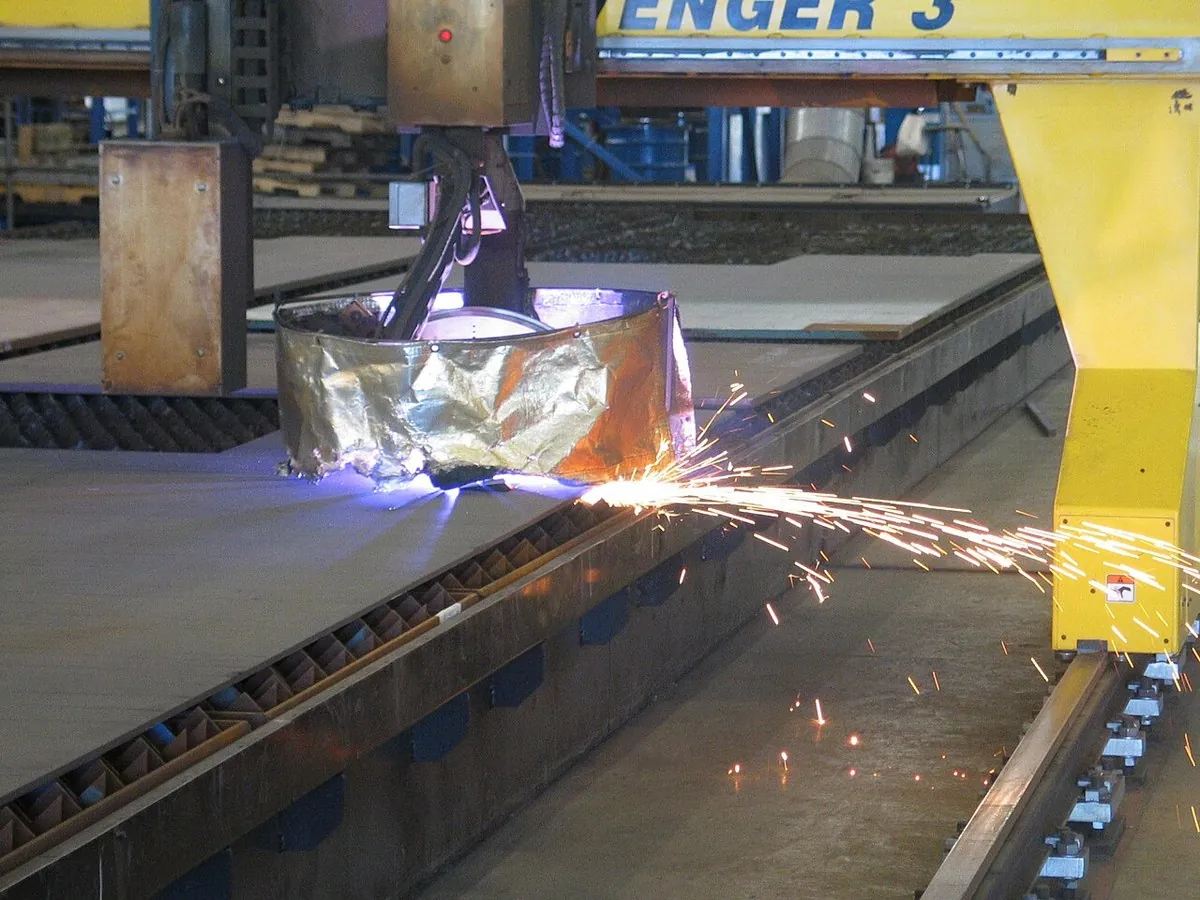
| Step | Equipment to look for | What it proves | Red flag |
|---|---|---|---|
| 1. Material in | Steel plate/coil stockyard, material certificates (MTC) archive | The factory buys its own steel to grade (e.g. Q355B, S355) with batch traceability | No stockyard; “we buy steel per order” with no certificate trail |
| 2. Cutting | CNC plasma / oxy-fuel cutting table or CNC band saw | Accurate plate and section profiles without hand-grinding | All cutting by angle grinder and hand torch |
| 3. Hole making | CNC drilling line or punch/drill combination | Consistent bolt holes that line up on site | Holes drilled by hand template — site fit-up problems later |
| 4. Assembly and tack welding | H-beam assembly line with jigs and tack stations | Straight, repeatable built-up members | Members assembled freehand on the floor |
| 5. Welding | Submerged arc welding (SAW) for main seams; CO2/MAG bays for secondary welds | Weld quality that can pass UT/MT testing; consistent penetration | No qualified welder records; welding outsourced to a sub-shop |
| 6. Surface preparation | Shot blasting booth (aim for Sa2.5 cleanliness) | Coating will actually stick; the difference between a 5-year and a 15-year paint job | No blasting — primer applied over mill scale |
| 7. Painting and QC | Primer/topcoat line, dry film thickness (DFT) gauge, inspection records | Coating spec is measured, not guessed; QC is documented per member | “We paint per standard” but no DFT readings or inspection photos |
You do not need to become a welding engineer to use this table. Ask the supplier for a photo or short video of each numbered step for your current order, or for the last order of the same size. A real factory films its own floor in five minutes; a trader must ask a favor from someone else’s factory and will hesitate.
What Equipment Lists Tell You About Capacity and Lead Time
Equipment also explains delivery time. A factory’s monthly output is limited by its real bottlenecks — cutting table hours, welding bay space and blasting capacity — not by what the salesperson promises. That is why the same building can be quoted at six weeks by one plant and ten weeks by another with a very similar price.
When a supplier states a monthly capacity, ask what limits it. A straight answer (“our blasting booth is the bottleneck, so we schedule 15 days before the painting stage”) tells you the factory understands its own production. A vague answer (“we are very big, no problem”) means the capacity claim is not tied to any real line.
For practical planning, request the production schedule in the contract: material release date, fabrication start, inspection date and packing date. Our earlier guide on steel building manufacturer production lead time breaks down how those dates are set and what can move them.
Embedded FAQ: How can I check equipment without visiting the factory?
How can I verify a steel building manufacturer’s equipment if I cannot fly to China? Start with a live video walkthrough on a video call — ask the salesperson to walk from the material yard to the cutting table, welding bay and blasting booth while you watch. Then request dated photos of each step for your order at the fabrication stage. Most reputable factories already do weekly progress photos; if your supplier cannot produce a single real floor photo, treat that as a serious warning.
Coating Lines: Where Cheap Quotes Hide Their Biggest Cost Difference
The single biggest quality gap between cheap and reliable fabrication is surface preparation. Mill scale on hot-rolled steel looks like dark paint but is not a protective coating — primer applied over it peels within a few years in a humid or coastal climate. Proper practice is shot blasting to a defined cleanliness (commonly Sa2.5 in international specs), then primer at a measured dry film thickness, then the specified topcoat.
A typical export specification asks for blasting to Sa2.5, a primer around 60–80 µm DFT and a topcoat per the project spec — but you should confirm the exact numbers with your supplier and your own engineer, because climate and local standards change the target. What matters here is not the number itself but that the factory can measure it. Ask whether DFT readings are recorded per member and whether you can receive a sample of the coating report. For more detail on material certificates and what to verify in them, see our guide on steel building mill test certificates.
Welding and Quality Evidence: What the Factory Can Show for Its Last Order
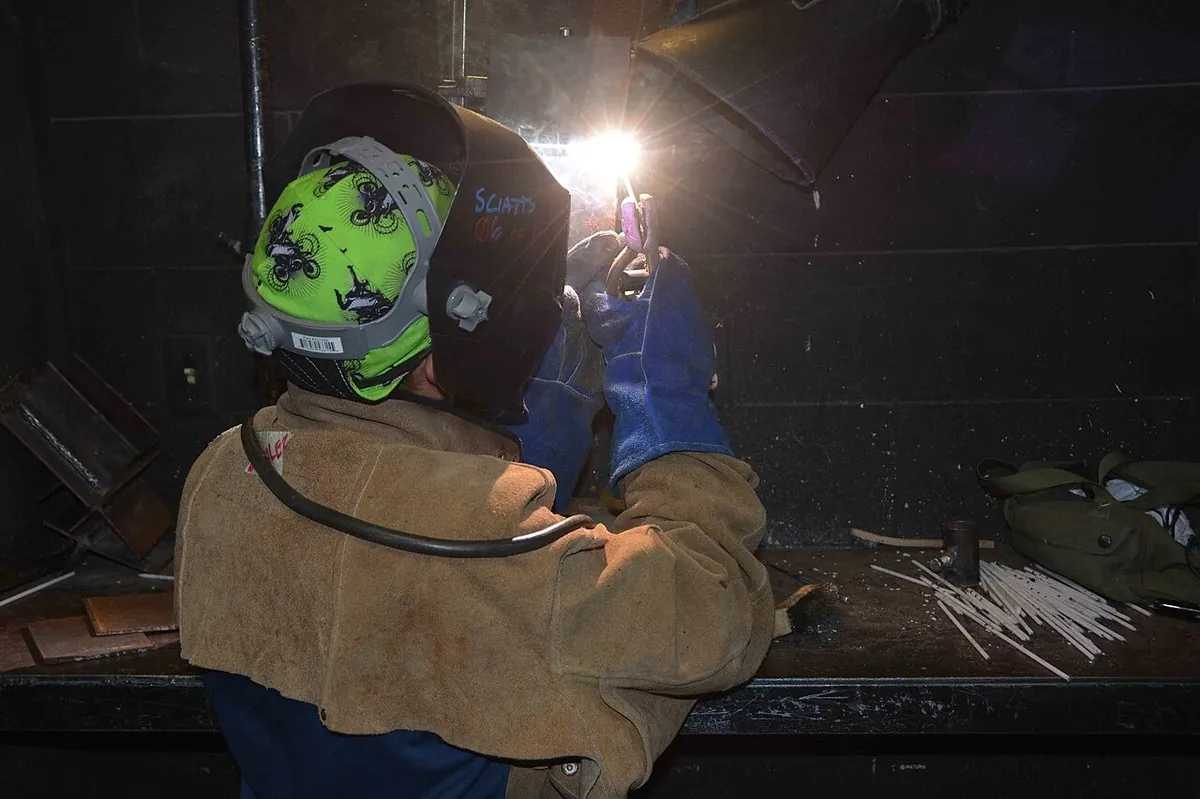
Welding is where structural safety is made or lost, so evidence matters more than promises. A credible fabrication shop keeps welder qualification records, weld maps and, when the spec requires it, NDT reports (ultrasonic or magnetic particle testing) from the inspection stage. Ask for the QA package of the most recent export project of similar size: member lists, weld map, NDT summary and any third-party inspection report. A factory that hands over a clean package within a day is a factory that documents its work.
If you are buying from a supplier who claims to fabricate in-house, this documentation is also your test of that claim. In-house shops hold their own records; traders must chase the actual factory for every page and will struggle to explain gaps.
Red Flags: Claims to Test Before You Believe Them
| Claim you often hear | How to test it |
|---|---|
| “We have four H-beam production lines” | Ask for a live walkthrough and count the lines yourself; request the monthly output in tons tied to those lines |
| “We are ISO 9001 certified” | Ask for the certificate with the issuing body and scope; verify the number with the certifier or check that the scope covers steel structure fabrication |
| “All welding is in-house” | Ask for welder qualification records and a weld map from the last export order |
| “Shot blasting is standard for us” | Ask to see the blasting booth on video and request DFT readings from the last project’s coating report |
| “We can ship in three weeks” | Ask which stage is already booked — material, cutting or welding — and get the schedule in the contract |
None of these tests is hostile. A real factory answers them easily and usually welcomes the questions, because serious buyers are the ones who pay on time and reorder.
From Factory Audit to Contract: Turning Equipment Evidence Into Terms
Once the equipment and evidence pass your check, lock the findings into the commercial terms. Four clauses do most of the work:
- Production schedule: state material release, fabrication, inspection and packing dates, with a mechanism for updates.
- Inspection hold point: your inspector (or a third party you appoint) attends before painting and before packing; shipment waits for the report.
- Document package: MTCs, weld map, NDT summary, coating DFT records and packing list are contractual deliverables, not favors.
- Milestone payments tied to evidence: pay the production-stage installment against documented progress, not against a promise. Our guide on steel building manufacturer factory capability audit lists the audit questions in full, and the factory capacity verification guide shows how to check capacity claims before signing.
This equipment-first approach also protects your budget. When you know what the factory can actually produce, the quote stops being a mystery number and becomes a statement about specific lines, specific steps and a specific schedule — which is the only kind of quote you can compare fairly between suppliers.
Vertical Integration: What Equipment Depth Does to Price and Risk
Equipment depth is also a pricing story. A factory that cuts, drills, welds, blasts and paints in one plant controls its own cost base; it can price a project on its real production hours and its actual steel purchase. A supplier that outsources welding to a sub-shop adds a margin on top of the sub-shop’s margin, and you pay for the extra hand-off even when the final price looks competitive. The structural risk is worse than the price risk: when several sub-shops are involved, nobody owns the full quality chain, and a defect found on site becomes a blame game between companies you never contracted with.
| Supply model | Who welds your frame | Main buyer risk | What you usually pay for |
|---|---|---|---|
| Fully in-house fabricator | Factory’s own welders on its own lines | Quality depends on that one plant — verify it once, then hold them to the contract | One margin; clear responsibility for schedule and documents |
| Partial outsourcing | Core members in-house, secondary items or coating subcontracted | Interface gaps between plants; documents from multiple sources | Two margins on the outsourced share; more coordination for you |
| Trading company reselling a factory | An unknown third plant, possibly different per order | You cannot audit what you cannot see; quality and schedule depend on a factory you never met | A trader margin on top of the factory price; least transparency |
None of the three models is automatically bad. There are honest traders who add real value on documentation, payment and logistics for buyers who do not want to deal with a factory directly. The point is to know which model you are in, because the evidence you demand should match it. If you buy through a trader, ask them to name the fabricating plant, put that plant’s identity in the contract, and request the same floor evidence as if you were buying direct — a good trader will arrange it happily.
Putting Equipment Questions Into Your RFQ
Equipment checks work best when they are part of the formal request for quotation, not an afterthought that arrives after three rounds of price negotiation. Add a short “production and quality” section to your RFQ and the supplier’s answer tells you a lot before any price comparison starts.
- Request the equipment list with machine types and quantities — cutting, drilling, welding, blasting and painting lines.
- Ask whether welding is performed in-house or subcontracted, and request welder qualification records if in-house.
- Ask for the monthly fabrication capacity in tons and what limits it (which line is the bottleneck).
- Request the QA document package of the most recent export project of similar size: MTCs, weld map, NDT summary, coating DFT records.
- State that a live video walkthrough or dated progress photos will be required at the fabrication stage, and that shipment waits for the inspection report.
- Ask the supplier to confirm the coating specification they normally propose for your climate and to explain how DFT is measured.
Send the same section to every shortlisted supplier. You are not asking for secrets — these are the questions any serious buyer asks, and a supplier who refuses to answer them is telling you that the equipment story will not survive contact with the camera.
What a Real Factory Walkthrough Should Cover
A video walkthrough only helps if you know what to look at. Without a checklist, most buyers watch a salesperson walk quickly past machines and come away impressed but none the wiser. Use a simple route instead, and ask the supplier to follow it: material yard and certificate archive first, then cutting, drilling, welding, blasting, painting and finally the packing area. At each stop you are not looking for a spotless showroom — you are looking for evidence of how work actually flows.
- Material yard and certificate archive: is steel stored off the ground and identified by batch? Can they pull the MTC for a coil or plate they bought last month in minutes?
- Cutting and drilling: are profiles cut on CNC tables or by hand? Are cut parts marked with project and member numbers?
- Welding bays: count the stations, look for welder qualification records posted or available, and ask how many welders are on the current export order.
- Blasting and painting: is there an actual booth? Can they show the DFT gauge and a recent coating record?
- Packing area: how are members bundled, protected and marked for shipment? Packing quality decides how much arrives undamaged.
End the walkthrough by asking to see one order currently in production that is similar to yours — a mid-size export project with primary and secondary steel. That single request filters out most pretenders: a real factory has several orders on the floor and can point to one; a trading company has nothing to point to. Take the video with your own phone or ask them to record it with a date board visible; dated footage is useful evidence at the contract stage.
Third-Party Inspection: When Equipment Evidence Is Not Enough
For larger projects, or when you do not have an engineer on your side of the ocean, independent inspection closes the loop. Third-party inspection agencies such as SGS, Bureau Veritas and similar international bodies are commonly hired by the buyer to check fabrication at agreed hold points: material certificates against the order, dimensional checks on critical members, weld quality through visual and NDT methods, coating thickness before packing, and the packing list at loading.
Treat third-party inspection as a process decision, not a sign of distrust. The inspector works to your approved inspection and test plan, which you agree with the supplier before fabrication starts. That plan names the hold points, the standards to check against, and who receives the reports. When the plan is clear, inspection is fast and uncontentious; when it is vague, inspectors and factories argue about scope — so invest the hour it takes to write the plan properly.
Cost is usually borne by the buyer and quoted separately by the agency; for a mid-size warehouse project it is a small fraction of the steel cost, and it buys an independent record that protects you in a dispute years later. If a supplier pushes back on an inspection plan with named hold points, that is a warning sign regardless of what their equipment photos show.
How Equipment Depth Affects Your Building’s Service Life
Equipment choices show up in the building decades after the invoice. Two examples make this concrete. First, surface preparation: the difference between shot-blasted steel with measured primer and primer brushed over mill scale rarely appears in year one; it appears in year five or six, when coating breakdown starts along edges and bolted connections. In humid coastal markets, that difference can cut the first maintenance cycle in half. Second, welding quality under dynamic loads: members that carry crane loads or wind fatigue need consistent weld penetration, which comes from controlled processes and qualified welders — not from the fastest hand welder available on the day.
This is why the equipment audit is not a formality for big buyers only. A 500 sqm workshop owner in a coastal city loses just as much from early corrosion as a 10,000 sqm warehouse investor does, and the audit takes the same hour either way. Pair the equipment check with a review of the mill test certificates and the coating specification, and you have covered the two factors that most often decide whether a steel building looks good after ten years or needs expensive repairs.
Service life is also a maintenance story. The documentation a good factory keeps — coating records, member marks, bolt and connection details — is the same documentation your maintenance team will want in year three, when a fork-lift has scraped a column or a roof panel needs replacing after a storm. Buyers who receive a complete as-built package from the manufacturer can order a matching touch-up paint or a replacement panel by referencing the original spec; buyers whose supplier vanished after shipment must reverse-engineer every fix. Treat the equipment audit as the start of that record: a factory that documents production is usually the same factory that can produce an accurate as-built package at handover.
FAQ: Steel Building Manufacturer Equipment and Capacity
What equipment should a steel building manufacturer have for export quality?
At a minimum: CNC cutting, an H-beam assembly line, submerged arc or CO2 welding bays with qualified welders, a shot blasting booth and a painting line with DFT measurement. The exact spec depends on your project, but a factory missing the blasting step will struggle to deliver a long-lasting coating.
Does equipment alone guarantee good quality?
No. Equipment proves capacity and process, but quality also depends on QC discipline, welder qualifications and documentation. Use equipment as a first filter, then check the QA package of a recent order — weld maps, NDT results and coating records.
Can I ask for a live video walkthrough of the factory?
Yes. Serious manufacturers expect this request from export buyers. Ask for a live or same-day recorded walkthrough from the material yard through cutting, welding, blasting and painting. If a supplier refuses or stalls, treat it as a red flag.
What documents prove a factory really fabricated my building?
Mill test certificates with batch numbers, the fabrication schedule, weld maps, NDT summary, coating DFT readings, inspection photos and the packing list. Together they form a traceable record from steel purchase to container loading.
How long does fabrication take after drawings are approved?
It depends on the tonnage, the factory’s load and the coating spec. Expect the supplier to commit to a written schedule with material release and inspection dates. The factors that move the timeline are covered in our production lead time guide.
Get a Quote From a Manufacturer That Shows You the Floor
We fabricate pre-engineered steel buildings and prefab steel warehouses in our own plant, and we treat equipment evidence as part of the quotation — tell us your project size and location, and we will share the relevant production line details, capacity and schedule alongside the price. Send your building size, local wind and snow conditions, and your planned use case through the contact page, and our engineers will come back with a scope-based quotation and the fabrication plan behind it.
If you are still comparing suppliers, our prefab steel warehouse section shows the building types we manufacture and the design information every serious quote depends on.
