
Steel Warehouse Export Packaging: Structural Specs, Load Data, and Delivery

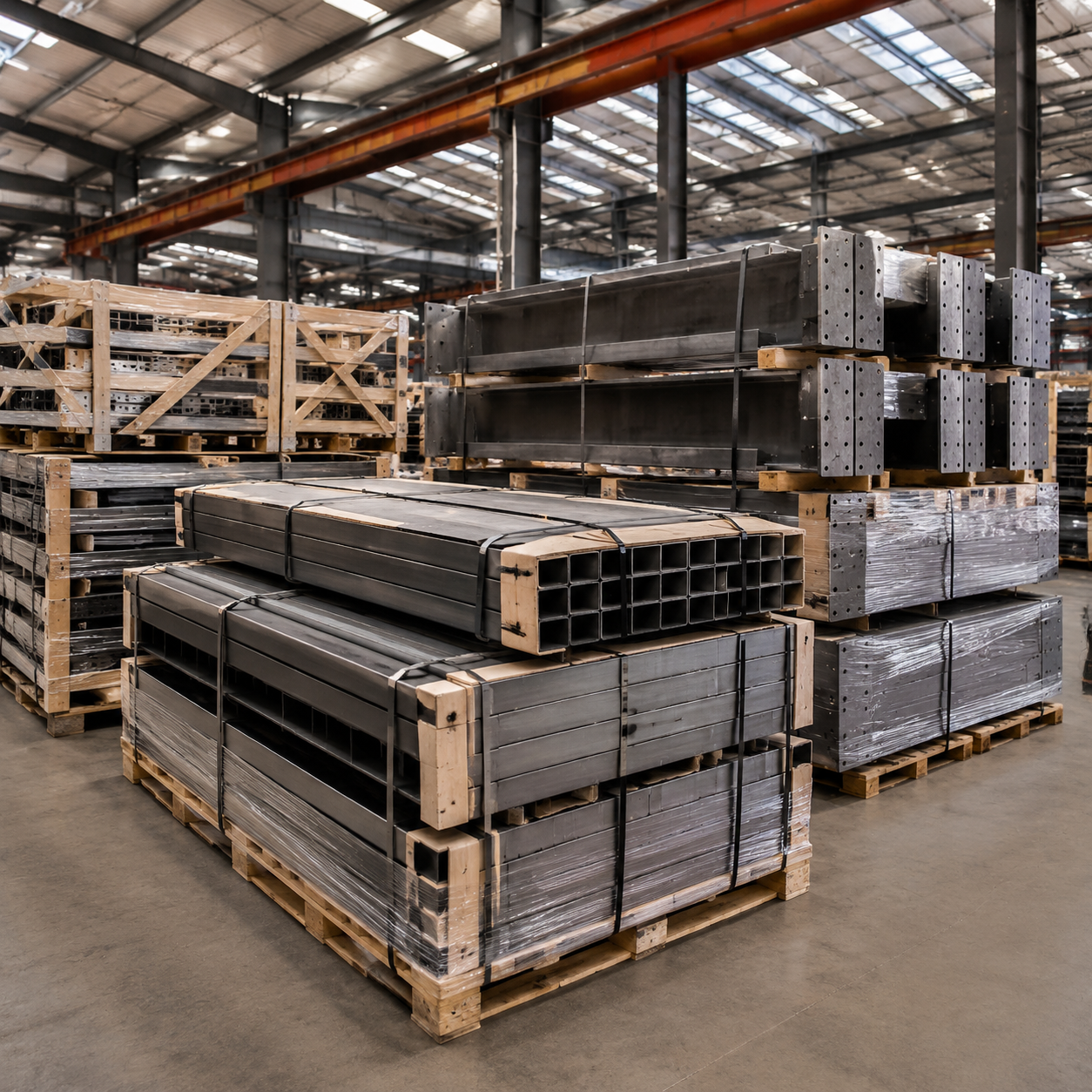
For construction companies and project buyers sourcing steel warehouses from overseas, packaging is not an afterthought. It is the bridge between a well-fabricated structure and a trouble-free installation on site. Poor export packaging can result in bent purlins, scratched galvanized surfaces, missing bolt kits, customs delays, and months of costly rework. This article covers the practical aspects of steel warehouse export packaging: structural specifications, load data, delivery standards, and installation considerations that matter when your building crosses an ocean.
Why Export Packaging Dictates the Success of Your Steel Warehouse Project
A steel warehouse is not shipped as one finished building. It is shipped as a kit of columns, rafters, purlins, bracing, cladding sheets, fasteners, and sometimes crane rails. These components vary in length, weight, rigidity, and surface sensitivity. During a sea voyage, the cargo is exposed to salt air, humidity, condensation, temperature swings, vibration, and sudden impact from vessel movement. Each of these factors can compromise the structural integrity or the protective coating of steel members.
Proper export packaging does more than keep parts together. It reduces the risk of:
- Plastic deformation of long, thin members such as purlins and roof sheet rolls.
- Corrosion from trapped moisture or direct salt water exposure.
- Damage to pre-drilled connection plates and base plates.
- Loss of small items like bolts, nuts, washers, and sealants.
- Loading and unloading hazards caused by unstable bundles.
Packaging strategy should be defined during the design phase of the steel warehouse, not at the factory gate when the containers are waiting. The engineering team and the packaging department need to share the same component list, dimensions, and weight schedule. This coordination avoids last-minute improvisation with non-standard crates or unsafe lashing arrangements.
Structural Specs and Load Data for Shipping-Loaded Packages
Every steel warehouse export package must have a clear structural specification. That means knowing the gross weight, maximum dimensions, lifting points, and stackability of each package. A typical package for a prefab steel warehouse may contain:
- H-shaped or welded columns up to 12 metres long, bolted or welded on site.
- Tapered or trussed rafters, often split and spliced for container transport.
- C- or Z-profile purlins, bundled and strapped with interleaving timber spacers.
- Knee braces, tie rods, bracing bars, and gusset plates, packed by connection group.
- Roof and wall cladding coils or sheets, protected with film and cardboard edge protectors.
Bundle weights are critical for crane and handle capacity at origin, transhipment hubs, and the final site. A common range is two to five tonnes per package, but the safe limit depends on the project equipment and the port’s receiving capacity. Oversized packages also affect container utilisation. A 20-foot container can carry many lighter packages, while a 40-foot high-cube container or flat-rack may be needed for longer members.
From a load data perspective, sea freight creates dynamic forces that packaging must withstand. While exact values depend on route, vessel type, and stowage position, international cargo securing guidelines generally consider vertical forces around 1.0 times the weight of the package, and horizontal forces of 0.3 to 0.5 times the weight in the longitudinal and transverse directions. Lashing points on steel frame packages should be designed with these loads in mind, not just the static weight. Using steel strapping, turnbuckle lashing, and wooden chocking helps restrain movement inside the container.
For corrosion protection during transit, common methods include VCI (vapour phase inhibitor) paper, desiccant bags, plastic stretch film, and bituminous or powder-coated finishes on the steel itself. All timber components used as spacers or inside crates must meet the global ISPM 15 standard for wood packaging material, especially for port state control in Australia, North America, and Europe.
Delivery Standards and Marking for Smooth Export Documentation
Steel warehouse export packaging must also comply with documentation and marking requirements. Each package should display clear shipping marks containing:
- Project name or contract number.
- Port of discharge and final destination.
- Package number in sequence (e.g., WH-001, WH-002).
- Gross and net weight in kilograms.
- Length, width, and height in centimetres.
- Centre of gravity and lifting points.
- International pictograms for sling position, keep dry, and this side up.
The packing list is the single most important delivery document. It must show exactly what is in each package, down to the last bolt. Customs officers, freight forwarders, and site storekeepers all rely on the packing list to verify the shipment. A mismatch between the packing list and the actual contents can cause port holding fees, container re-inspection, and project delays. In many countries, incorrect wood packaging marks cause the entire container to be held until and sometimes treated by quarantine officials. That is why all timber components must have the ISPM mark visible on the outside of the package.
Different delivery incoterms also change the packaging conversation. Under FOB or EXW, the buyer’s freight forwarder is involved, but the seller is still responsible for packaging that is safe for normal export handling. Under CIF or DAP, the seller must anticipate multiple handling steps, storage in a customs yard, and possibly rough forklift treatment. Regardless of incoterm, the best approach is to over-specify edge protection, corner protectors, and lashing capacity rather than cut corners to reduce packaging weight.
Container loading is itself a packaging step. Long steel members should be loaded with their heavy flange or base plate at the bottom to lower the centre of gravity. Purlins and cladding sheets should be placed on top of heavier sections, not under them. Metal-to-metal contact between different steel grades or between coated and uncoated parts should be avoided with plywood or rubber separators. Fasteners and small parts should be packed into steel drums or wooden boxes that can be anchored to the container floor, preventing shifting during the voyage.
Installation Considerations When Receiving Export-Packed Steel Warehouses
When the steel warehouse export packages arrive at site, the installation team should have a clear unpacking and inspection plan. First, check every package against the bill of lading and the packing list before signing the delivery receipt. Photograph all damage, even if it looks cosmetic. Unseen internal damage may be discovered later and, without proof, the shipping or insurance claim can be rejected.
Second, store steel packages off the ground using timber blocks or concrete blocks. Avoid direct contact with soil, which can wick moisture into the steel. Place a tarpaulin or breathable cover over the packages if exposure to weather is expected for more than a week. Do not remove the protective wrapping until the component is ready to be installed, as the wrap also preserves the pre-drilled holes from dust and debris.
Third, organise the installation sequence by package number. Columns and rafters should be unpacked first, followed by purlins and cladding. Bolt kits should be issued to crew leaders by package group, not dumped into a common pile. This reduces confusion and ensures that each connection uses the correct grade and size of bolts as specified on the structural drawings.
Finally, keep a record of the packaging type used in each container. If any re-export or relocation of the steel warehouse is planned in the future, matching components with their original packing design will make the next move smoother. Good packaging is not only a one-time protection; it is part of the building’s long-term logistical identity.
FAQ: What is ISPM 15 and why does it matter for steel warehouse export packaging?
ISPM 15 is the International Standard for Phytosanitary Measures, issued by the International Plant Protection Convention. It requires that all wood packaging materials—such as crates, pallets, dunnage, and spacers—be heat-treated or fumigated and stamped with the IPPC mark. This mark proves that the wood has been treated to kill pests. For steel warehouse shipments, even a few wooden spacers between steel members must comply. Without the ISPM mark, customs officers can quarantine the entire container, forcing you to unwrap packages and treat the wood at your cost. Always ask your supplier to include the ISPM mark on every wooden item, not just the main pallet.
FAQ: Can steel warehouse components be packed in containers without wooden crates?
Yes. Many steel warehouse components, including purlins, columns, and bracing bars, can be shipped as open steel frame packages or directly lashed inside a dry container. This is more common when the members are straight, heavy, and not easily damaged by contact with other steel parts. You must still use plastic film, VCI paper, corner protectors, and non-wood or ISPM-compliant separators between members. For long or bulky sections that exceed container length or width limits, flat-rack or open-top containers are used with steel stillages and lashing systems. The choice depends on the structural specs, the load data, and the project’s available lifting equipment at the site.