
Prefabricated Steel Structure Materials: Advantages, Applications & Efficiency Gains

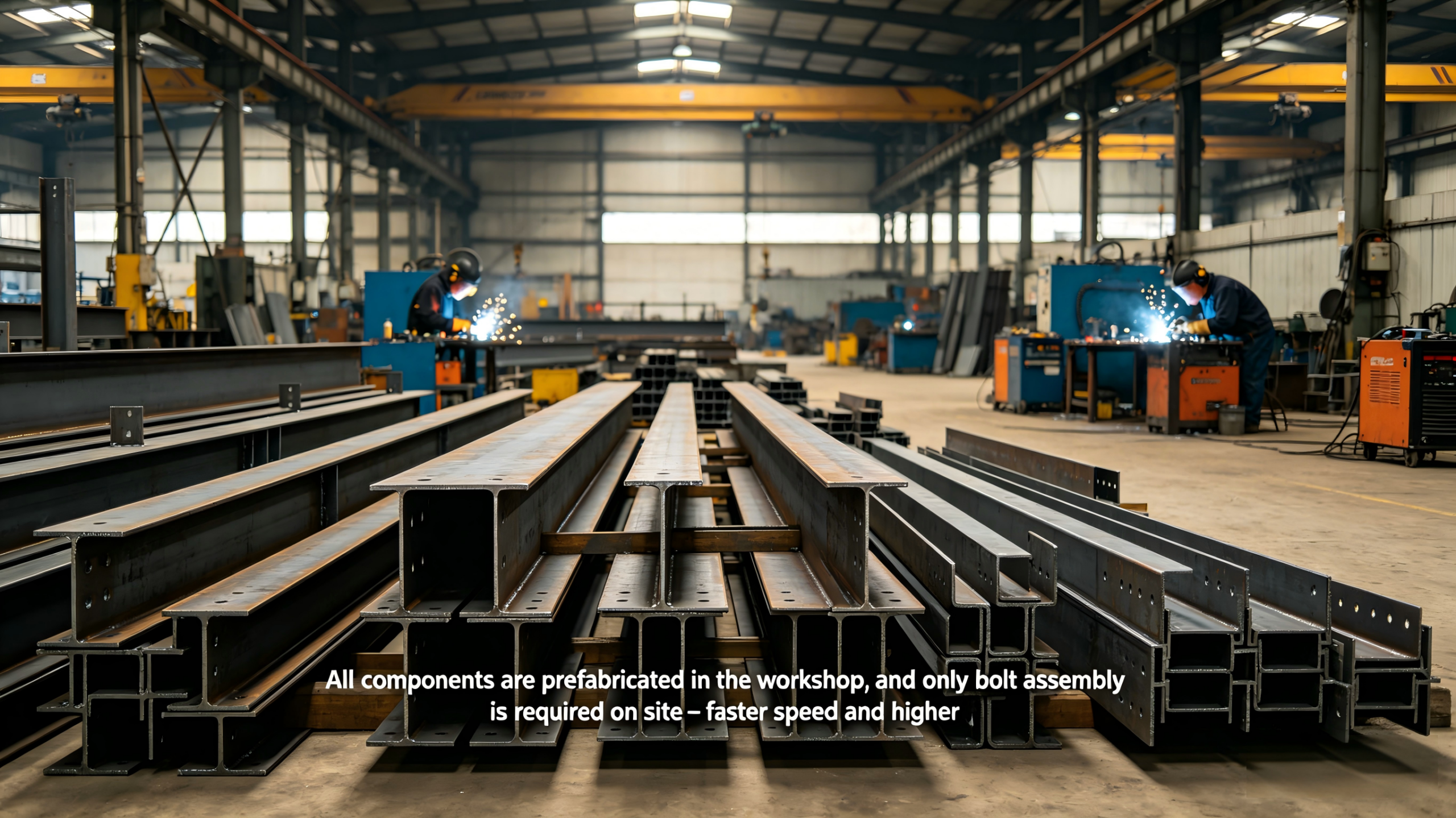
Prefabricated steel vs. site-welded steel. Learn material efficiency, cost savings, design flexibility, and why pre-engineered buildings outperform traditional construction for overseas projects.
Time is money. Labor is expensive. Weather delays are unpredictable. For overseas clients managing warehouses, workshops, or industrial facilities, the traditional “cut and weld on site” approach is dying.
The better way? Prefabricated steel structures—also called pre-engineered buildings (PEBs). Components are designed, fabricated, and coated in a controlled workshop, then shipped to site for bolt-up assembly.
This guide covers:
- Materials used in prefabricated steel structures.
- Processing characteristics (cutting, welding, drilling).
- Efficiency advantages vs. site construction.
- Cost savings and design/installation matching.
- Applications in modern steel buildings.
1. What Are Prefabricated Steel Structures?
A prefabricated steel structure means the primary components—columns, rafters, beams, bracing, purlins, and connections—are manufactured in a factory to precise drawings, then delivered to site for mechanical assembly (bolted or pinned, not welded).
Typical components:
| Component | Material | Fabrication |
|---|---|---|
| Main frame (columns/rafters) | Q355B welded H-section | Full penetration welds, drilled end-plates |
| Secondary framing (purlins/girts) | Q235B or Q355B C/Z sections | Cold-formed, pre-punched holes |
| Bracing (roof/wall) | Q235B round bar or angle | Pre-cut, threaded ends |
| Connections (bolts/plates) | Q355B plate + Grade 8.8 bolts | Laser-cut, CNC drilled |
| Base plates | Q355B thick plate | Cut, drilled, welded to column |
Not prefabricated: Concrete foundations, field welding of main splices, on-site cutting for fit-up.
2. Materials Used in Prefabricated Steel Components
The material selection for prefabricated steel is similar to conventional steel, but with higher requirements for consistency and weldability.
A. Main Frame Material: Welded H-Section (Built-Up)
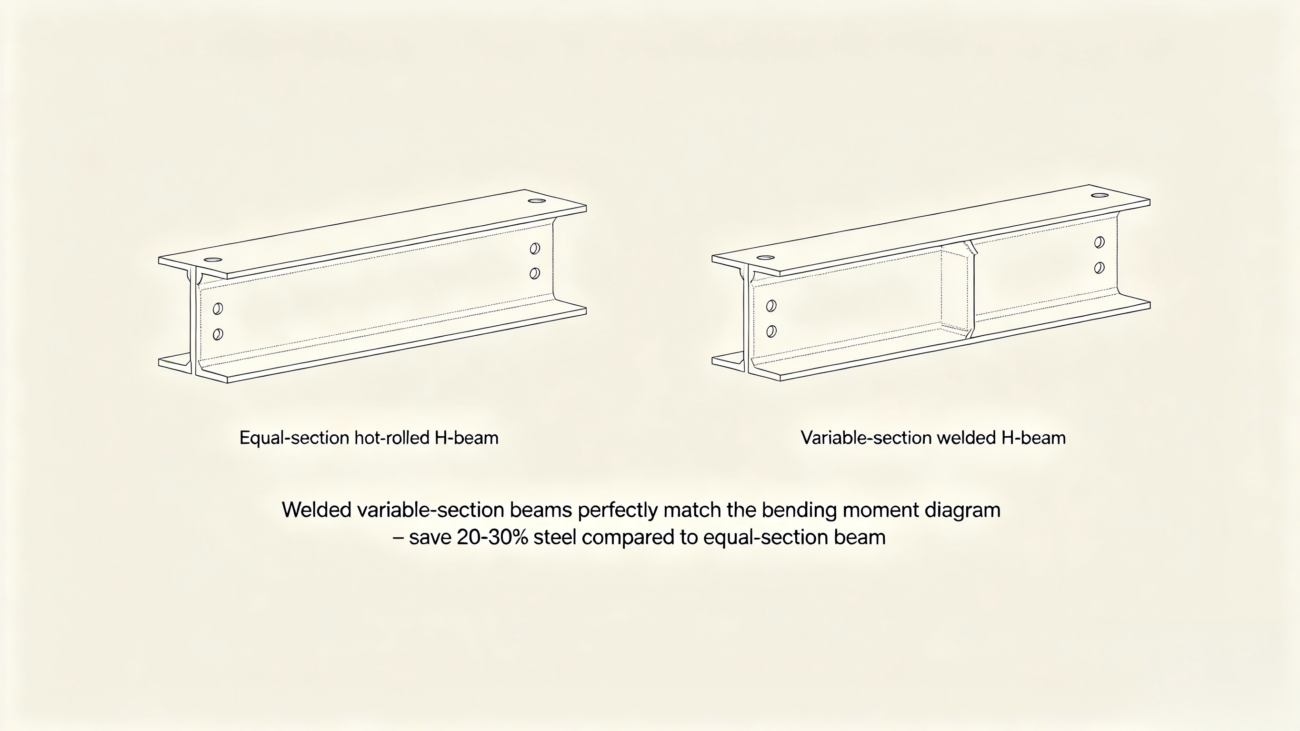
Most prefabricated buildings use welded built-up H-sections, not hot-rolled sections. Why?
| Aspect | Hot-Rolled H-Beam | Welded Built-Up H-Section |
|---|---|---|
| Size flexibility | Limited to mill standards | Any depth, flange width, thickness |
| Material efficiency | Constant section (wastes steel) | Tapered or variable thickness |
| Cost for non-standard spans | Higher (oversized) | Lower (exactly sized) |
| Lead time | Stock dependent | 10-15 days fabrication |
Typical material for welded H-sections:
- Flanges: Q355B (thickness 8-40mm)
- Web: Q355B or Q235B (thickness 6-25mm)
- Welding process: Submerged arc welding (SAW) for straight seams
B. Secondary Framing: Cold-Formed Steel
Purlins (roof) and girts (wall) are typically cold-formed from hot-rolled coil.
| Grade | Yield Strength | Typical Use |
|---|---|---|
| Q235B | 235 MPa | Light roofs, small spans |
| Q355B | 355 MPa | Standard industrial, longer spans |
| S350GD (galvanized) | 350 MPa | Corrosion-resistant, pre-galvanized |
Key prefabrication advantage: Pre-punched holes for bolted connections. No field drilling needed.
C. Connection Materials
| Component | Material | Prefabrication Detail |
|---|---|---|
| End plates | Q355B plate, 12-25mm thick | Laser-cut, CNC drilled, welded to beam ends |
| Bolts | Grade 8.8 (high-strength) or 4.6 | Supplied with nuts/washers, pre-counted per joint |
| Bracing rods | Q235B round bar, 12-20mm dia | Threaded ends, pre-cut to exact length |
| Shear studs | Q235B headed stud | Welded to beams in workshop (for composite floors) |
3. Processing Characteristics: Why Workshop Fabrication Wins
Prefabrication is not just about moving work indoors. The processing methods themselves create higher quality.
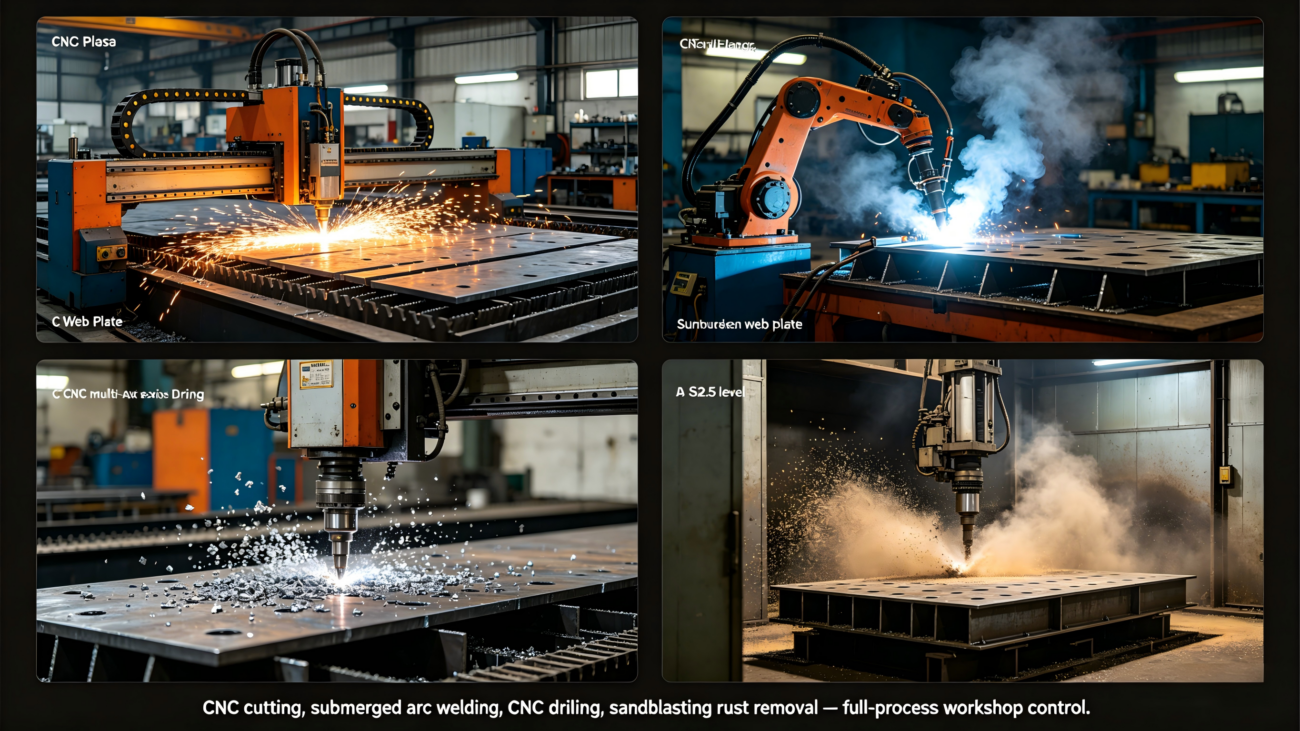
A. CNC Cutting (Plasma/Laser)
- Tolerance: ±1mm for plates, ±2mm for long beams
- Benefit: Holes align perfectly on site. No reaming or slotting.
B. Submerged Arc Welding (SAW)
- Process: Automatic welding with flux coverage
- Benefit: Deeper penetration, no spatter, consistent strength. Superior to site stick welding.
C. CNC Drilling & Punching
- Process: Multi-spindle drill lines for beams, punch presses for angles
- Benefit: All bolt holes factory-drilled. No layout errors.
D. Abrasive Blasting & Shop Priming
- Process: Sa2.5 blast cleaning + 60-80µm epoxy primer
- Benefit: Steel arrives clean and protected. No site blasting needed.
E. Tapered Section Fabrication
- Process: Web plate cut with variable depth, then welded to flanges
- Benefit: Matches bending moment diagram (deeper at mid-span, shallower at ends). Saves 20-30% steel weight vs. constant section.
4. Efficiency Advantages of Prefabricated Steel
This is the core selling point for overseas clients. Prefabrication delivers three forms of efficiency:
A. Construction Speed Efficiency
| Construction Method | Site Man-Hours (per 1000m²) | Total Project Time |
|---|---|---|
| Site-welded steel | 800-1200 | 8-12 weeks (steel only) |
| Prefabricated (bolted) | 200-300 | 2-3 weeks (steel only) |
Why faster:
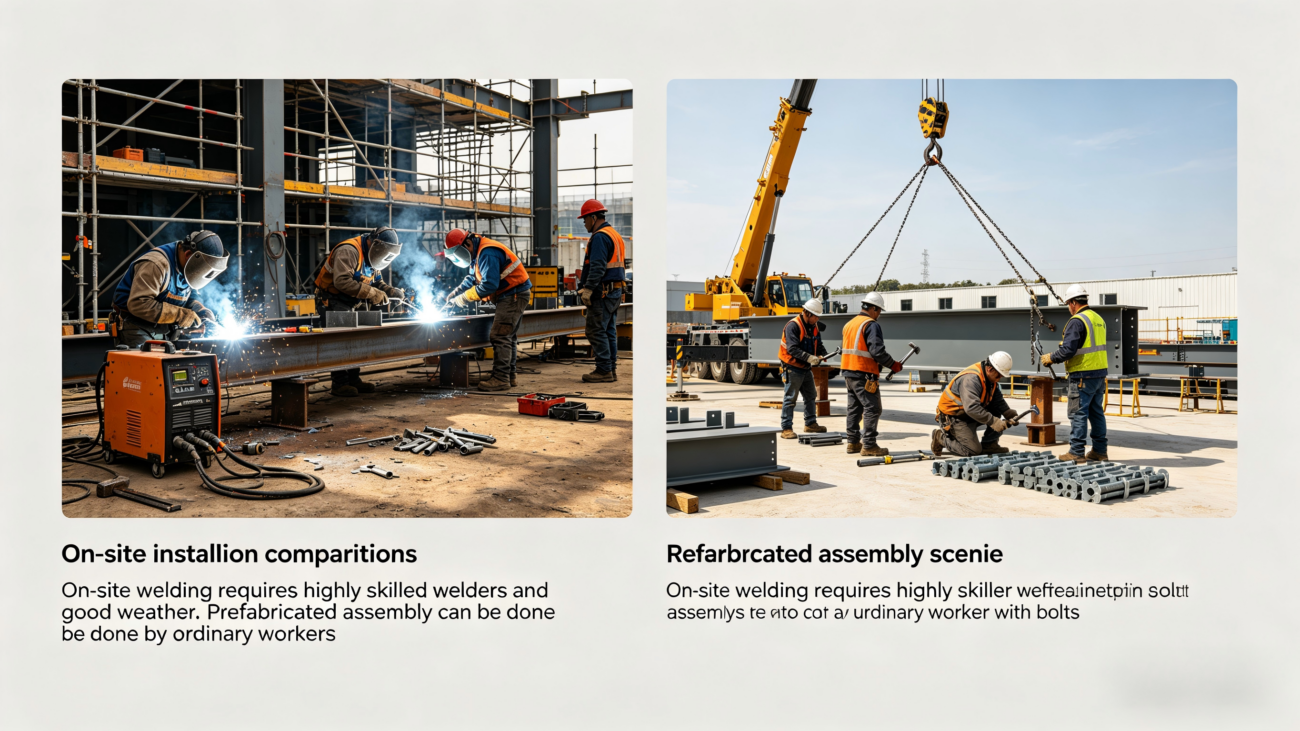
- No waiting for welders (hard to find in many markets).
- No weather delays (rain/wind stop site welding).
- No layout or cutting decisions on site. Just align, insert bolts, torque.
Real-world example: A 2000m² warehouse. Prefabricated frame delivered in 15 days. Erected by 4 workers in 5 days. Site-welded equivalent would take 4 weeks of welding plus 2 weeks of fitting.
B. Labor Efficiency & Skill Requirements
| Task | Site-Welded | Prefabricated |
|---|---|---|
| Required skill | Certified welder (high cost, scarce) | General labor + bolt tightening |
| Crew size | 6-8 (welders + fitters + helpers) | 3-4 (with simple tools) |
| Supervision | Full-time engineer | Occasional inspection |
| Safety risk | High (fire, arc eye, fumes) | Low (mechanical assembly) |
C. Material Efficiency (Less Waste)
| Waste Source | Site-Welded | Prefabricated |
|---|---|---|
| Cutting scraps | 5-10% (site cutting is rough) | 2-3% (nested CNC cutting) |
| Rework due to errors | 3-8% (mis-measured field cuts) | <1% (drawings match fabrication) |
| Excess material “just in case” | 10-15% (site uncertainty) | 0% (exactly what is needed) |
Total material savings: 10-20% with prefabrication.
5. Cost Savings Breakdown
For overseas buyers, the total installed cost matters more than material cost.
| Cost Element | Site-Welded | Prefabricated | Savings |
|---|---|---|---|
| Material (steel) | $100-130/m² | $80-110/m² | 15-20% |
| Site labor | $40-60/m² | $10-20/m² | 60-75% |
| Equipment (crane, lifts) | $15-25/m² | $8-12/m² | 40-50% |
| Quality/repairs | $5-15/m² | $2-5/m² | 50-70% |
| Total installed | $160-230/m² | $100-147/m² | 35-40% |
Hidden savings:
- Faster completion means earlier revenue (for commercial buildings).
- Lower financing costs (shorter construction loan period).
- Reduced site theft (fewer material deliveries, less loose steel).
6. Matching Prefabricated Steel to Design & Installation
Prefabricated steel is not a “one-size-fits-all” product. Proper design integration is required.
A. Design for Prefabrication (DfP)
| Design Aspect | Conventional Approach | Prefabrication-Friendly |
|---|---|---|
| Column spacing | Arbitrary (changes often) | Standardized modules (e.g., 6m, 7.5m, 9m) |
| Connection type | Field welded or mixed | Bolted end-plates (consistent) |
| Beam depths | Multiple different sizes | 2-3 standard depths repeated |
| Bracing | Field-cut angles | Pre-threaded rods with turnbuckles |
| Hole sizes | Standard clearance | Oversized for adjustment (2mm extra) |
Standardization tip: Limiting your project to 3 beam depths and 2 column sizes drastically reduces fabrication cost without sacrificing performance.
B. Installation Matching (Site Readiness)
For a smooth installation, the prefabrication package must include:
Marked components: Every beam/column labeled with location (e.g., “A1-C1 Roof Beam”)
Assembly drawings: Step-by-step erection sequence
Pre-assembled connection kits: Bags of bolts/nuts/washers per joint
Base plate templates: For anchor bolt verification before shipment
What overseas clients should request:
“Provide a digital installation manual with 3D isometric views showing each bolt-up connection. Include a bolt kit list by column grid.”
7. Applications in Modern Steel Buildings
Prefabricated steel is suitable for a wide range of project types.
| Building Type | Typical Span | Why Prefabricated Works |
|---|---|---|
| Warehouses / distribution centers | 20-40m | Clear spans, fast erection, future expandable |
| Industrial workshops | 12-25m | Crane beams integrated, heavy duty |
| Agricultural buildings | 10-20m | Low cost, simple assembly (local labor) |
| Commercial showrooms | 15-30m | Architectural finishes possible (cladding systems) |
| Aircraft hangars | 30-50m+ | Tapered rafters for long spans |
| Sports halls / gymnasiums | 25-40m | Clear interior, no columns |
Emerging application: Multi-story prefabricated steel offices (up to 8 stories) using bolted moment connections.
8. Common Concerns & Myths (Addressed for Overseas Clients)
“Is prefabricated steel weaker than site-welded?”
No. Workshop welding is more controlled (temperature, humidity, procedure). SAW welds are stronger than manual stick welding.
“What if my foundation bolts are off by 20mm?”
Design with slotted holes on base plates (±25mm adjustment) and leveling nuts. Good prefabrication includes this tolerance.
“Can I modify the building later?”
Yes. Bolted connections can be unbolted. Add bays by unbolting end walls, inserting new frames.
“Is prefabricated steel more expensive delivered?”
Upfront material + fabrication may be similar, but installed cost is 35-40% lower due to labor and speed savings.
9. Link to Prefabricated Steel Component Custom Service
Not all prefabricated steel is equal. Some suppliers just cut and ship. Others engineer for your specific site.
We provide full prefabrication services:
- Engineering & detailing: 3D modeling, connection design, shop drawings
- Material sourcing: Q355B plates, cold-formed purlins, Grade 8.8 bolts
- Workshop fabrication: CNC cutting, SAW welding, CNC drilling
- Surface treatment: Sa2.5 blast + primer or HDG
- Marking & packing: Labeled components, bolt kits, packing lists
- Installation support: Digital manual, video guides, remote consultation
For overseas clients:
We optimize for container shipping (component lengths under 12m or spliced). We provide bolted connections only—no field welding. We can install one bay at our yard and send you verification photos before bulk production.
👉 [Request a prefabricated steel quote]
Send us your building dimensions, local wind/snow loads, and intended use. We will return a frame design, weight estimate, and budget price within 48 hours.
Summary: Prefabricated Steel vs. Site-Welded
| Factor | Prefabricated Steel | Site-Welded Steel |
|---|---|---|
| Speed | 2-3 weeks | 8-12 weeks |
| Labor skill | General | Certified welders |
| Quality control | Workshop (consistent) | Field (variable) |
| Weather impact | None (indoor fab) | High |
| Waste | 2-3% | 8-15% |
| Installed cost per m² | $100-150 | $160-230 |
| Modifiable later | Yes (bolted) | Difficult (welded) |
Verdict: For clear-span buildings over 500m², prefabricated steel is faster, cheaper, and higher quality.