
Anchor Bolt Materials for Steel Structures: Quality, Corrosion Protection & Foundation Stability

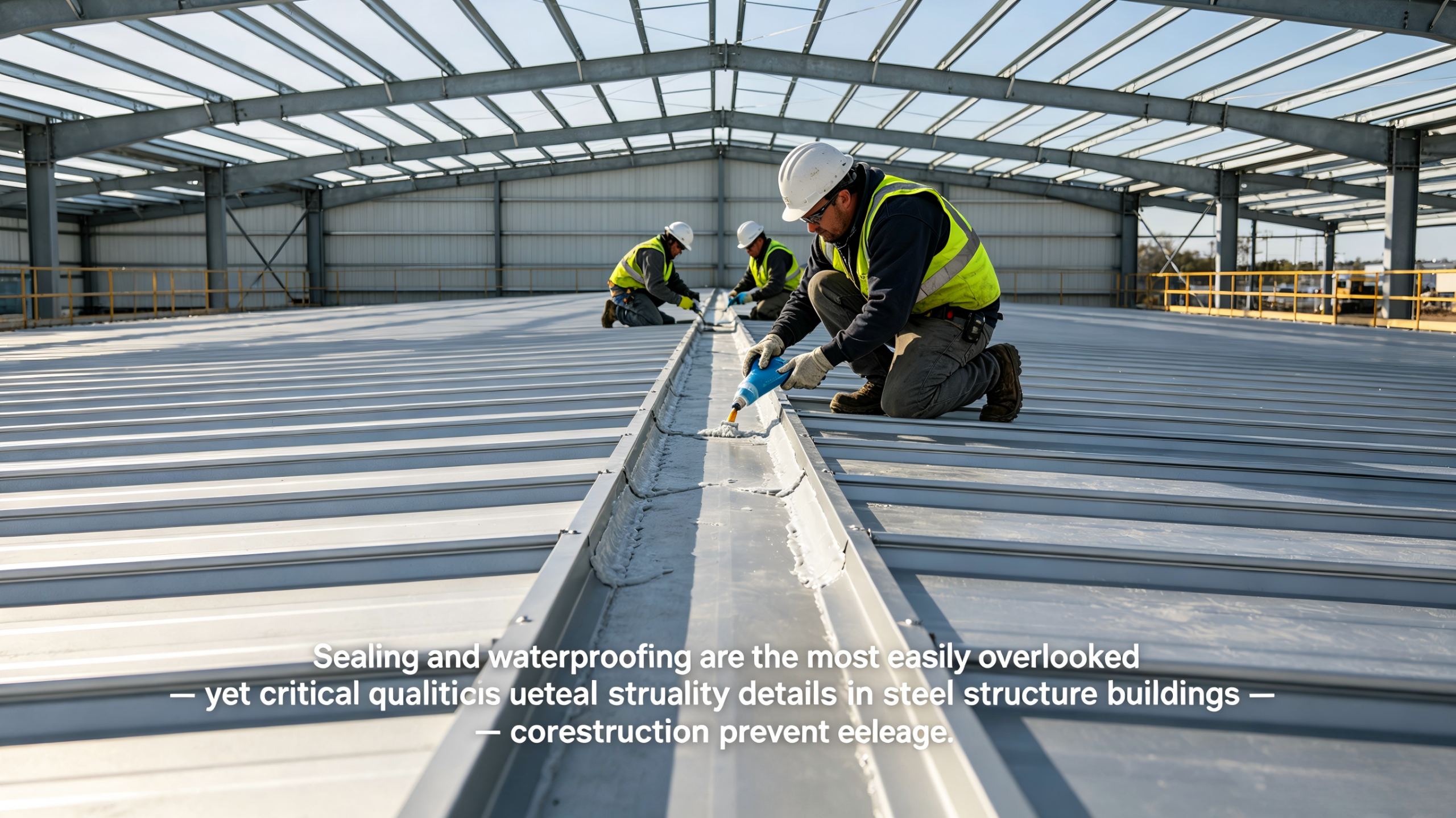
Carbon steel vs. alloy steel anchor bolts. Learn material selection, anti-corrosion processes, and quality requirements for stable steel structure foundations. Build trust with overseas clients.
When a steel structure fails, the failure often starts at the bottom—not the beam or column. Anchor bolts (also called foundation bolts) are the hidden connection between your steel columns and the concrete foundation. If they fail, the entire building lifts, shifts, or collapses.
For overseas clients building warehouses, industrial plants, or communication towers, understanding anchor bolt materials is not optional. It is a safety requirement.
This guide covers:
- Carbon steel vs. alloy steel anchor bolts.
- Anti-corrosion treatment processes (HDG, Xylan, epoxy).
- Quality requirements and testing.
- How anchor bolts ensure foundation stability.
1. Common Anchor Bolt Materials: Carbon Steel vs. Alloy Steel
Anchor bolts must resist tension (pulling up), shear (sliding sideways), and corrosion (underground or exposed). The material determines all three.
A. Carbon Steel Anchor Bolts (Most Common)
| Grade | Tensile Strength (MPa) | Yield Strength (MPa) | Best For |
|---|---|---|---|
| Q235B (ASTM A36) | 400-450 | 235 | Light structures, small workshops, temporary buildings |
| Q355B (ASTM A572 Gr50) | 470-550 | 355 | Industrial warehouses, medium loads, standard projects |
| 45# steel (1045) | 600+ | 355-400 | High-tension applications, crane columns |
Advantages of carbon steel:
- Lowest cost.
- Widely available in all thread sizes (M12 to M64).
- Easy to bend into J or L shapes.
Disadvantages:
- Poor corrosion resistance without coating.
- Lower strength at elevated temperatures.
B. Alloy Steel Anchor Bolts (For Demanding Conditions)
| Grade | Alloy Elements | Tensile Strength (MPa) | Best For |
|---|---|---|---|
| 40Cr (AISI 5140) | Cr + Mn | 800-950 | Heavy industrial, high vibration |
| 35CrMo (AISI 4135) | Cr + Mo | 850-1000 | High-temperature environments |
| 42CrMo (AISI 4140) | Cr + Mo + Mn | 1000-1200 | Extremely heavy loads, seismic zones |
| Stainless steel 304/316 | Ni + Cr | 500-700 | Marine environments, chemical plants |
When to choose alloy steel:
- Crane columns with high dynamic loads → 35CrMo.
- Seismic zones (earthquake resistance) → 42CrMo (higher ductility).
- High-temperature workshops (steel mills, foundries) → 35CrMo.
Key property:
Alloy steel anchor bolts have better fatigue resistance. Under vibrating loads (machinery, cranes), carbon steel bolts crack over time. Alloy steel lasts longer.
2. Anchor Bolt Shapes & Their Applications
The shape of an anchor bolt affects how it transfers load into concrete.
| Shape | Best For | Load Transfer Mechanism |
|---|---|---|
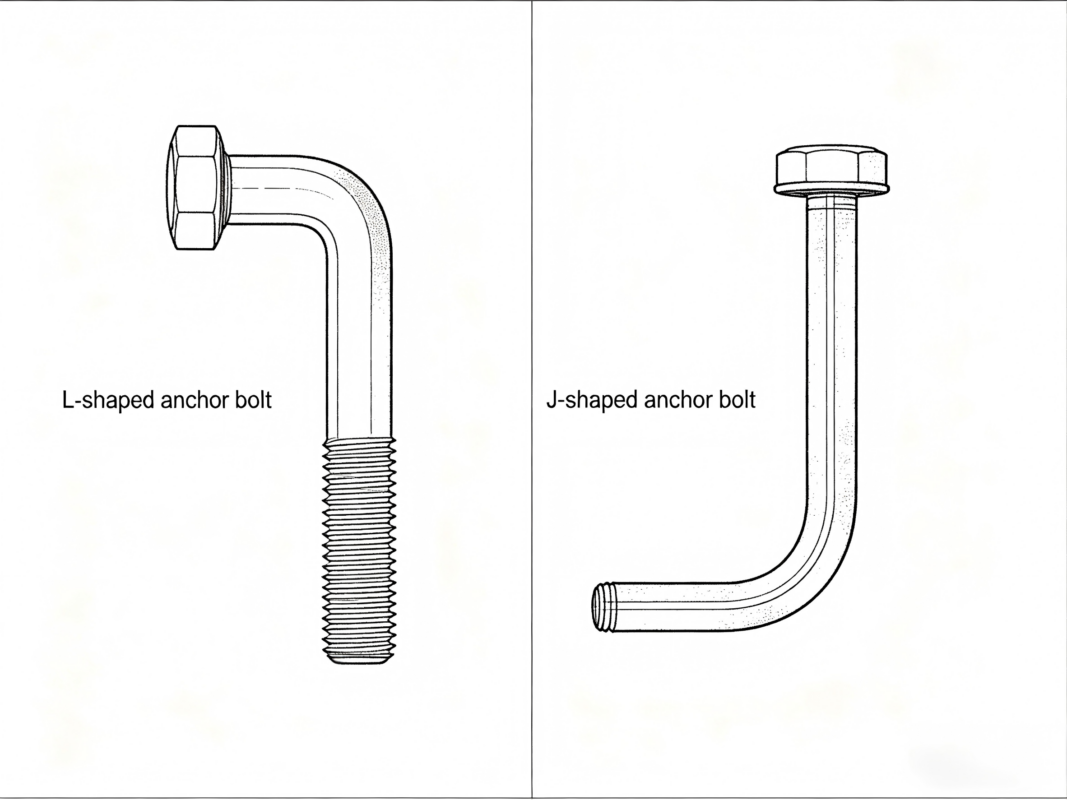
| J-bolt | Light structures, fences, small equipment | Hook embedded in concrete resists pull-out |
| L-bolt | Standard column base plates | Similar to J-bolt, easier to manufacture |
| Straight bolt with plate washer | Heavy loads, seismic zones | Large washer distributes tension into concrete mass |
| Threaded rod with nut + anchor plate | High-tension columns | Double-nut prevents loosening under vibration |
| Expansion anchor (post-installed) | Retrofits, additions | Mechanical expansion against concrete borehole |
Recommendation for most steel buildings:
Use J-bolts or L-bolts for columns under 8m height. For tall columns (>10m) or crane loads, use straight bolts with heavy square washers (minimum 100×100×12mm).
3. Anti-Corrosion Treatment: Protecting Anchor Bolts Underground
Anchor bolts are partially embedded in concrete and partially exposed to air. This creates a galvanic corrosion risk—the buried portion can corrode faster than the exposed portion.
Common Corrosion Protection Processes
| Method | Thickness | Lifespan | Best Environment | Cost |
|---|---|---|---|---|
| Electro-galvanized | 5-15µm | 2-5 years | Indoor, dry | Low |
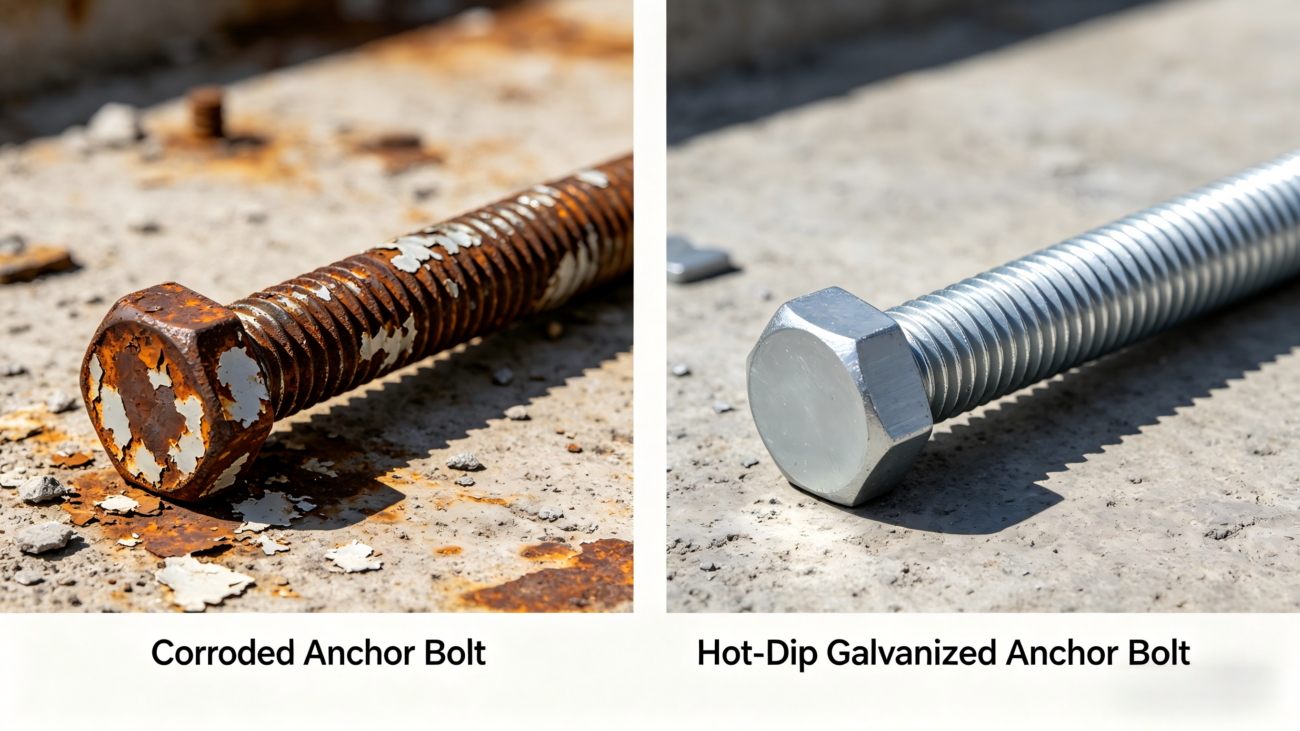
| Hot-dip galvanized (HDG) | 50-100µm | 20-30 years | Outdoor, humid, moderate chemical | Medium |
| Xylan/zinc flake coating | 10-25µm | 10-15 years | High-salt, marine, oil/gas | High |
| Epoxy coating | 100-300µm | 15-25 years | Chemical plants, wastewater | Medium-High |
| Stainless steel (no coating) | N/A | 50+ years | Marine, coastal, food industry | Very High |
Critical Tip for Overseas Buyers: HDG vs. Stainless
Many clients specify hot-dip galvanized (HDG) Q355B anchor bolts. This is cost-effective for 80% of projects.
But:
- HDG adds 50-100µm thickness → Threads must be oversized cut or post-cut galvanized (re-cut after dipping). Otherwise, nuts will not fit.
- For marine environments (within 1km of coast), skip HDG and use stainless steel 316. Chlorides penetrate galvanizing within 5-8 years.
Anti-Corrosion Checklist for Your RFQ:
- Is the environment coastal, industrial, or rural?
- Will anchor bolts be exposed to de-icing salts (cold climates)?
- Is there any chemical exposure (acids, alkalis)?
- What is the design life? (10 years → HDG. 30+ years → stainless or epoxy.)
4. Quality Requirements for Anchor Bolts
Overseas clients often receive poor-quality anchor bolts from unverified suppliers. Here are the non-negotiable quality checks:
A. Material Certification (Mill Test Certificate)
Every batch must provide an MTC showing:
- Chemical composition (C, Mn, Si, P, S, Cr, Mo if applicable).
- Mechanical properties (tensile, yield, elongation).
- Heat number (traceable back to melt).
B. Dimensional Tolerances (ASTM F1554 / ISO 898-1)
| Parameter | Tolerance |
|---|---|
| Bolt diameter | ±0.2mm (for M12-M36) |
| Thread length | ±3mm |
| Bend radius (J/L) | ±5% of nominal |
| Projection above nut | Minimum 2 full threads |
C. Mechanical Testing
| Test | Standard | Requirement |
|---|---|---|
| Tensile test | ASTM A370 | Break at shank, not threads |
| Hardness (HRB) | ASTM E18 | 70-85 HRB for Q355B |
| Stress rupture | ASTM F606 | No failure at 95% yield for 10 minutes |
D. Visual & NDT Requirements
- No cracks at the bend (J or L section). Use magnetic particle inspection (MT) for critical projects.
- No thread damage (flattening, galling, or cross-threading).
- Uniform coating (no bare spots for HDG/epoxy).
Red flags to avoid:
- No MTC provided.
- Threads are greasy or oily (hides poor cutting quality).
- Bend radius is too sharp (cold cracking risk).
- Coating flakes off when tapped lightly.
5. Anchor Bolts & Foundation Stability: How Connection Works
The anchor bolt–column base plate connection is the most critical interface in a steel building.
Forces Acting on Anchor Bolts
| Force Type | Example | What Anchor Bolts Must Resist |
|---|---|---|
| Uplift (tension) | High winds lifting the roof | Pull-out resistance from concrete |
| Shear (lateral) | Earthquake shaking sideways | Bending strength at concrete surface |
| Overturning moment | Tall column, one side lifting | Tension on windward bolts, compression on leeward |
Installation Best Practices for Stability
- Template plate required. Never pour concrete without an anchor bolt template. Bolts will shift during pouring. A steel template holds exact positions (usually laser-cut plywood or steel plate).
- Embedment depth. Minimum 25× bolt diameter for J-bolts. Example: M20 bolt → embed at least 500mm into concrete.
- Concrete cover. Minimum 50mm of concrete around the bolt hook. Less cover leads to concrete blow-out under tension.
- Grouting. After column placement, fill the gap between base plate and foundation with non-shrink grout (minimum 50MPa strength). This transfers compression load evenly.
- Torque control. Use a torque wrench to tighten nuts. Overtightening yields the threads. Undertightening allows movement.
Common Foundation Failure Modes (and Prevention)
| Failure Mode | Cause | Prevention |
|---|---|---|
| Pull-out | Short embedment or weak concrete | Calculate required length. Use concrete grade ≥C25 |
| Concrete blow-out | Low edge distance | Keep bolt center ≥5× bolt diameter from concrete edge |
| Thread stripping | Low bolt grade or overtightening | Use Q355B minimum. Use torque wrench |
| Corrosion failure | No coating or poor HDG | Specify HDG or stainless for exposed conditions |
| Nut loosening | Vibration from machinery | Use double nuts + lock washer or nylon insert |
6. Anchor Bolt Material Selection: Quick Decision Table
| Project Condition | Material | Shape | Corrosion Protection |
|---|---|---|---|
| Small shed, dry climate | Q235B | L-bolt | Electro-galvanized |
| Standard warehouse, indoor | Q355B | J-bolt | Hot-dip galvanized |
| Cold climate (de-icing salts) | Q355B | Straight bolt + plate | Hot-dip galvanized (thick) |
| Coastal (within 1km of ocean) | Stainless 316 | J-bolt | None required |
| Chemical plant | 35CrMo | Straight bolt + plate | Epoxy coating |
| Crane column, high vibration | 40Cr or 42CrMo | Straight bolt + heavy plate | Xylan coating |
| Seismic zone (earthquake) | 42CrMo | Straight bolt + double nut | Hot-dip galvanized |
7. Cost Control: Balancing Safety & Budget
Anchor bolts are a small percentage (2-5%) of total steel structure cost, but they are the most expensive to repair. Replacing a failed anchor bolt means:
- Jacking the steel column.
- Chipping out concrete.
- Drilling and epoxying new bolts.
- Re-grouting and realigning.
Cost: 15-20x the original bolt cost.
Smart buying strategy:
- Grade up, not down. For a $200 extra cost per 100 bolts, go from Q235B to Q355B. The safety margin doubles.
- Use standard diameters. M20, M24, M30 are cheapest. M22 or M27 are non-standard and require custom tooling.
- Order 5% spare bolts. Thread damage during shipping is common. Spare bolts prevent costly project delays.
- Batch with your column order. Most suppliers reduce per-unit cost when anchor bolts ship with the main steel structure.
8. Link to Steel Structure Foundation Construction Service
Anchor bolts are only as good as their installation. Even the best 42CrMo bolt fails if:
- The template shifts during concrete pour.
- The concrete strength is too low.
- The grout is not properly mixed.
We provide complete foundation-to-frame solutions:
- Anchor bolt design (size, grade, embedment depth).
- Fabrication with full traceability (MTC + UT + tensile testing).
- Template plates (laser-cut plywood or steel).
- Installation supervision drawings (bolt layout, torque values).
- Non-shrink grout specification and supply.
For overseas clients:
We can pre-assemble anchor bolts onto a steel template, bolt them to shipping frames, and include a digital installation guide with photos.
👉 [Request a foundation bolt quote + installation drawing]
Send us your column base plate details, soil condition, and local wind speed. We will return anchor bolt specifications, a template drawing, and a torque table within 24 hours.
Summary: Anchor Bolt Quality Checklist for Your Next Project
Before finalizing your anchor bolt order, confirm these six points with your supplier:
- Material grade (Q235B, Q355B, alloy, or stainless)?
- Mill test certificate (heat number, chemical + mechanical)?
- Anti-corrosion treatment (HDG thickness ≥50µm or specified)?
- Thread protection (plastic caps or wax coating for shipping)?
- Embedment length (minimum 25× bolt diameter)?
- Template plate included (yes/no)?