
Steel Beam Materials: Performance, Selection & Span Matching for Steel Structures

Compare steel beam materials vs. columns. Learn load capacity, corrosion resistance, and how to match material grade to span length. Includes shop application tips and testing standards.
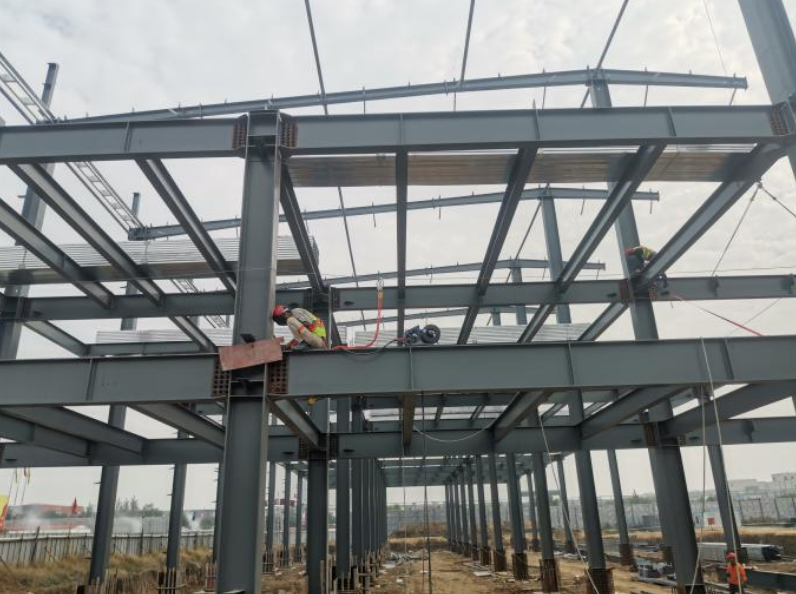
While steel columns hold a building up, steel beams hold it together. Beams resist bending and shear forces across horizontal spans—roofs, floors, crane runways, and mezzanines.
Selecting the wrong beam material leads to excessive deflection (bouncy floors), weld cracking, or wasted tonnage. For overseas clients designing warehouses, workshops, or industrial plants, understanding beam-specific material logic is essential.
This guide covers:
- Common beam materials & grades.
- How beams differ from columns.
- Span-based selection (6m to 30m+).
- Corrosion protection & workshop fabrication.
- Material testing standards (UT, MT, tensile tests).
1. Common Steel Beam Materials & Grades
Steel beams use the same material families as columns, but with different emphasis:
| Grade | Yield Strength (MPa) | Best For | Key Property |
|---|---|---|---|
| Q235B (A36) | 235 | Light beams, short spans (<6m) | Low cost, easy weld |
| Q355B (GR50) | 355 | Standard industrial beams (6-12m) | High strength-to-weight |
| Q390 / Q420 | 390-420 | Heavy crane beams, long spans (>15m) | Fatigue resistance |
| Weathering steel (Q355NH) | 355 | Exposed structures (no paint) | Atmospheric corrosion resistance |
Critical Beam Property:
Unlike columns (compression), beams fail in bending. The critical material property is yield strength (prevents permanent sagging) and fatigue resistance (for moving loads like cranes).
2. Steel Beams vs. Steel Columns: Key Material Differences
Many clients assume “steel is steel.” But beams and columns face different forces:
| Aspect | Steel Column | Steel Beam |
|---|---|---|
| Primary force | Compression (squeezing) | Bending + shear |
| Failure mode | Buckling (sudden collapse) | Deflection (sagging) or flange buckling |
| Critical material property | Yield strength + slenderness ratio | Yield strength + section modulus |
| Web thickness | Less critical (braced) | Highly critical (shear resistance) |
| Typical section | H-beam (strong axis vertical) | I-beam (strong axis horizontal) |
| Welding requirement | Full penetration at base | Fillet welds at web-to-flange (for built-up) |
Practical takeaway:
- Use Q355B for beams over 8m span. Q235B will deflect too much.
- Beam webs need thicker steel than column webs for the same load, due to shear forces.
3. Matching Steel Beam Material to Span Length
Span length is the #1 driver of beam material selection. Here is a practical guide for overseas buyers:
A. Short Spans (3m – 6m)
- Application: Mezzanine beams, residential steel frames, small equipment platforms.
- Recommended section: Hot-rolled I-beam (IPN or IPE).
- Material grade: Q235B (A36).
- Typical size: 150×75mm to 200×100mm.
- Advantage: Lowest cost. No fabrication needed—use stock lengths.
B. Medium Spans (6m – 12m)
- Application: Warehouse roofs, workshop overhead beams, office floors in steel buildings.
- Recommended section: Hot-rolled H-beam or welded I-beam.
- Material grade: Q355B.
- Typical size: 300×150mm to 500×200mm.
- Why Q355B: 50% higher yield strength than Q235B allows 30% lighter beams, saving shipping cost.
C. Long Spans (12m – 20m)
- Application: Clear-span warehouses, aircraft hangars, sports halls, exhibition centers.
- Recommended section: Tapered welded I-beam (web thicker at ends, thinner in middle) or truss beam.
- Material grade: Q355B or Q390.
- Critical factor: Deflection control. Limit L/240 (span divided by 240) for roofs.
- Cost tip: Use hybrid grades—Q355B flanges, Q235B web.
D. Extra-Long Spans (20m – 30m+)
- Application: Bridge crane runways, large industrial sheds, stadium roofs.
- Recommended section: Box beam (two webs) or plate girder (built-up).
- Material grade: Q390 or Q420.
- Special need: Fatigue testing required for crane beams (moving wheel loads).
4. Corrosion Resistance: When Standard Steel Isn’t Enough
For outdoor or humid environments (coastal warehouses, chemical plants), standard Q235B/Q355B will rust.
Three corrosion protection strategies:
| Strategy | Method | Cost | Lifespan |
|---|---|---|---|
| Paint system | Epoxy primer + polyurethane topcoat | Low-Medium | 10-15 years |
| Hot-dip galvanizing | Zinc coating (85µm+) | High | 30-50 years |
| Weathering steel (Corten) | Alloyed steel forms stable rust layer | Medium (no paint) | 25+ years (uncoated) |
Recommendation:
- Indoor dry workshop → painted Q355B.
- Outdoor covered (roof only) → painted with higher DFT (dry film thickness).
- Fully exposed coastal → hot-dip galvanized or weathering steel.
5. Application in Steel Structure Shops (Workshop Fabrication)
Understanding how beams are made helps you specify correctly.
Common beam fabrication processes in a steel workshop:
- Cutting: CNC plasma or laser cutting of web and flange plates.
- Beveling: For full-penetration butt welds (splices).
- Assembly: Tacking web to flanges on an assembly jig.
- Submerged Arc Welding (SAW): Automatic welding for straight, strong beam seams.
- Drilling: For bolt holes (end-plate connections).
- Straightening: Roller straightening to correct weld distortion.
- Blasting + Priming: Sa2.5 blast cleaning, then shop primer.
What to ask your supplier:
- “Do you use SAW for beam flange-to-web welds?” (Manual stick welding is weaker and slower.)
- “What is your straightening tolerance?” (ISO 8501-2 allows max 1/1000 of beam length.)
6. Steel Material Testing Standards (What Overseas Buyers Must Know)
You cannot trust a mill certificate alone. For critical projects, require third-party or supplier-performed tests.
| Test | Standard | What It Checks | When Required |
|---|---|---|---|
| Tensile test | ASTM A370 / ISO 6892 | Yield, tensile, elongation | Every heat batch |
| Bend test | ASTM E290 | Ductility (no cracking after 180° bend) | Structural grades |
| Ultrasonic Testing (UT) | ASTM E164 | Internal flaws (laminations, porosity) | Thick flanges >20mm |
| Magnetic Particle (MT) | ASTM E709 | Surface cracks at welds | Crane beams, seismic frames |
| Charpy V-notch (CVN) | ASTM E23 | Impact toughness (low-temperature) | Projects below -20°C |
Red flag: If a supplier cannot provide UT reports for built-up beams over 500mm depth, find another workshop.
7. Cost Control: How to Save on Steel Beams
Beams are often 40-50% of total structural steel tonnage. Here is how overseas clients reduce cost:
Strategy 1: Hybrid material grades.
- Flanges (top/bottom) face bending stress → Use Q355B.
- Web (center) faces shear → Use Q235B.
- Savings: 15-20% on raw material cost.
Strategy 2: Optimize span vs. depth ratio.
- Deeper beam = lighter weight per meter. A 500mm deep beam uses less steel than a 300mm deep beam for the same span capacity.
Strategy 3: Specify camber (pre-curve).
- For long spans, request a slight upward camber (1/500 of span). This offsets dead load deflection, allowing lighter sections.
Strategy 4: Group similar sizes.
- Instead of 15 different beam depths, design with 3-4 standard depths. This reduces setup time in the steel workshop, lowering fabrication cost.
8. Link to Steel Beam Processing Service
Not every beam comes from a stock catalog. For non-standard spans (e.g., 13.5m clear span), special load conditions (off-center crane runway), or seismic detailing (reduced beam section or RBS), you need custom beam fabrication.
We offer:
- Welded I-beams up to 2000mm depth.
- Tapered beams (variable web height).
- Box beams (double web) for heavy crane loads.
- Hybrid material grades (Q235B web + Q355B flanges).
- Full traceability – mill certs + UT reports + load test videos.
No minimum order quantity. Fabrication lead time: 15-25 days.
👉 [Request a beam material + sizing quote]
Send us your span, load (kN/m²), and environment. We will return a grade recommendation, section size, and estimated weight within 24 hours.
Summary Table: Quick Material Selection Guide
| Project Type | Span | Beam Type | Material Grade | Corrosion Protection |
|---|---|---|---|---|
| Small workshop | 6m | Hot-rolled I-beam | Q235B | Paint (1 coat) |
| Warehouse | 10m | Welded H-beam | Q355B | Epoxy + polyurethane |
| Clear-span hangar | 18m | Tapered I-beam | Q355B (flange) + Q235B (web) | Hot-dip galvanized |
| Crane runway | 12m | Box beam | Q390 | Paint + sacrificial anode |
| Coastal structure | 15m | Welded I-beam | Q355NH (weathering) | None (self-protected) |