




Galvanized Steel Workshop Buildings: Corrosion Protection That Lasts
If your workshop sits near the coast, in a humid climate, or in an industrial area with airborne chemicals, the difference between a painted frame and a hot-dip galvanized frame shows up years before the building is paid off. Hot-dip galvanizing — dipping fabricated steel members into molten zinc at about 450°C — creates a metallurgically bonded zinc coating that protects the steel even where the surface gets scratched, because the zinc corrodes preferentially and keeps the underlying steel intact.
This page covers what hot-dip galvanized workshop buildings are, the specification options we manufacture, and the installation process — so you can judge whether galvanized is the right choice for your site before you request a quote.
Why Hot-Dip Galvanizing Matters for Workshop Buildings
Galvanizing is not paint. A paint film protects only as long as it stays intact; once moisture gets under a scratch or cut edge, corrosion spreads underneath and lifts the coating. A hot-dip zinc coating, by contrast, provides two layers of protection: a barrier coating and sacrificial cathodic protection. Even at damaged areas where bare steel is exposed, the surrounding zinc corrodes first, shielding the steel.
Coating thickness follows international standards — ASTM A123 in North America and ISO 1461 globally — and typical galvanized coatings on structural sections range from 70 to 110 microns depending on steel thickness. In practice, that translates into decades of maintenance-free life in rural atmospheres, and still 15-25 years in aggressive coastal or industrial environments before touch-up is needed. This is why galvanized frames dominate the market for workshops, farm buildings, and chemical-adjacent facilities.
Galvanized vs. Painted Frames: What Changes in the Budget
Hot-dip galvanizing adds roughly 5-10% to the steel frame cost compared with a standard two-coat paint system, depending on steel tonnage and section sizes. In return you get:
- No repainting cycle every 8-12 years, which matters for buildings with hard-to-reach roof structures
- Full protection of bolt holes, cut edges, and internal surfaces that paint cannot reach
- Consistent quality controlled by the galvanizing process itself, not by site workmanship
- Stronger performance in coastal, high-humidity, and chemical environments
For inland, low-corrosion sites, painted frames remain the economical choice. For anything near salt water or heavy industry, the galvanizing premium pays for itself within the first maintenance cycle.
Product Specifications
| Material | Q235B / Q355B Steel |
| Span | 12m – 60m (Customizable) |
| Height | 6m – 12m |
| Roof Type | Single/Double Slope, Curved |
| Wall Panel | EPS/Rock Wool/PU Sandwich Panel |
| Design Life | 50 Years |
| Surface Treatment | Hot-dip Galvanized (ASTM A123 / ISO 1461) / Painted |
| Wind Load | 0.5 KN/m² (Customizable) |
| Snow Load | 0.3 KN/m² (Customizable) |
Key Features
- Hot-dip galvanized frame with 70-110 micron zinc coating for long-term corrosion resistance
- Large clear span design (12-60m) for maximum usable working space
- Fast construction — typically 30% faster than traditional buildings
- Cost-effective — 20-30% savings versus concrete structures on most projects
- Fully customizable dimensions, layout, and cladding
- Fire-resistant and corrosion-resistant panel options
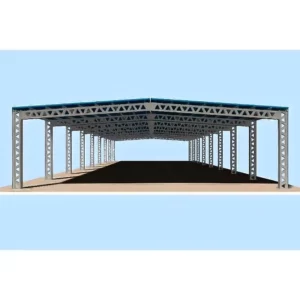
- Free 3D design and engineering drawings included with quotation
Typical Projects This Building Fits
Galvanized workshop buildings are a common choice for facilities where a painted frame would need early maintenance. Typical applications we manufacture for:
- Manufacturing and assembly lines
- Heavy machinery workshops
- Auto repair and maintenance shops
- Industrial processing facilities
- Chemical and fertilizer storage adjacent to workshops
- Coastal logistics and fishing industry support buildings
If your site is within 10 km of the coastline, or your process releases moisture, salts, or chemicals into the air, a galvanized frame is the specification we usually recommend.
Installation Process
- Foundation: Concrete foundation per our engineering drawings
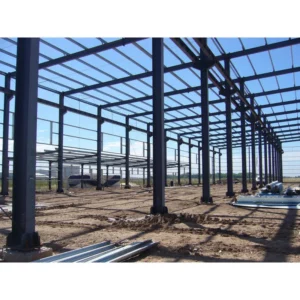
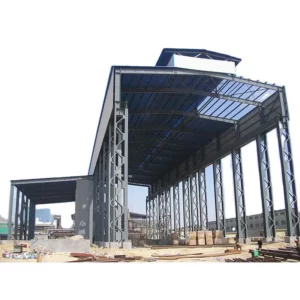
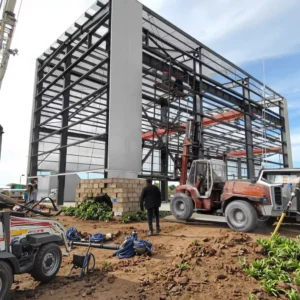
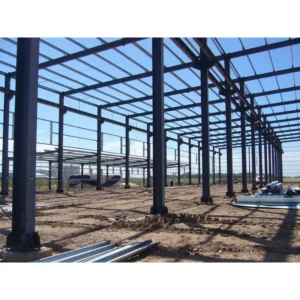
- Steel Frame: Erect main portal frames and secondary members
- Roof System: Install purlins, roof panels and flashing
- Wall System: Mount wall panels, windows and doors
- Finishing: Gutters, downspouts, accessories and inspection
A typical 1,000 sqm galvanized workshop installs in 3-5 weeks on site with a standard crew, assuming the foundation is ready and access is clear.
Galvanizing Life Expectancy by Environment
Corrosion rates depend far more on the atmosphere than on the coating. These planning figures show typical maintenance-free service life for a 70-110 micron hot-dip galvanized coating in different environments:
| Environment | Typical Life Before Touch-Up |
|---|---|
| Dry inland (rural) | 50+ years |
| Inland with moderate humidity | 35-50 years |
| Industrial atmosphere (pollutants) | 20-30 years |
| Coastal / marine (within ~10 km) | 15-25 years |
| Severe marine (direct splash zone) | 10-15 years |
These are typical industry expectations for standard coatings. Where a longer life is required, specifying a thicker coating (up to 140 microns) at the design stage is far cheaper than adding maintenance later.
What to Confirm Before You Order a Galvanized Workshop
Because galvanizing is specified in the details, a short checklist keeps the quote aligned with the finished building:
- Coating standard and target thickness (ASTM A123 or ISO 1461, and microns)
- Whether secondary steel — purlins, girts, bracing — is galvanized too, or only the main frame
- Whether connections use galvanized bolts or stainless fasteners for coastal sites
- Whether cut ends and drilled holes receive touch-up after site modification
- Panel type and thickness matched to your insulation and fire-rating requirements
- Design loads for your actual site (wind speed, snow load, seismic zone)
Suppliers who skip these questions are usually quoting from a template. A galvanized workshop is a 20-50 year asset — the extra five minutes of specification detail decides whether that asset holds up where it is built.
Quality Assurance
- Raw material identification and traceability
- Full quality traceability throughout production
- Rigorous testing and inspection processes
- Galvanizing thickness verification per ASTM A123 / ISO 1461
Technical Specifications
| Parameter | Specification |
|---|---|
| Steel Grade | Q235B (A36) / Q355B (A572 Gr.50) |
| Span Range | 6m – 60m (clear span) |
| Eave Height | 3m – 12m |
| Wind Load | Up to 180 km/h (112 mph) |
| Snow Load | Up to 1.5 kN/m² |
| Seismic Load | Zone 4 (UBC) / 0.3g |
| Roof System | Single skin or insulated sandwich panel (50mm/75mm/100mm) |
| Wall System | Single skin or insulated sandwich panel |
| Corrosion Protection | Sandblasting Sa2.5 + Primer (Epoxy Zinc Rich) + Intermediate Coat + Topcoat |
| Design Standard | GB 50017 / AISC 360 / Eurocode 3 |
| Drawing Format | CAD (DWG) / PDF / 3D model |
| Lead Time | 30-45 days after drawing approval |
nFAQ
Q: What is the delivery time?
A: 30-45 days after design confirmation, depending on project size. Galvanizing adds a short processing step, usually 3-5 days, before dispatch.
Q: Do you provide installation guidance?
A: Yes, we provide detailed installation drawings, manuals, and remote video guidance. On-site engineers are available for large projects.
Q: Can the warehouse be expanded later?
A: Yes, our modular design allows easy future expansion in length or width.
Q: What certifications do you have?
A: ISO 9001, CE, SGS certified. All materials meet international standards.
Q: How long does galvanizing last in a coastal environment?
A: With a standard 70-110 micron coating, expect 15-25 years before touch-up is needed in most coastal atmospheres, and considerably longer inland. The zinc layer also protects scratched and cut edges, which painted frames cannot match.
Q: Can I combine galvanized frames with insulated sandwich panels?
A: Yes. The frame finish and the cladding are independent decisions. A galvanized frame with 50-100mm rock wool or PU panels is a common specification for temperature-controlled and fire-rated workshops.
Ready to discuss your project? Send us your dimensions, site conditions, and application, and our engineers will prepare a galvanized workshop design and quotation with full specification details.



Reviews
There are no reviews yet.