
Steel Structure Fabrication: Cutting, Welding and QA in a Chinese Factory

Steel structure fabrication in a Chinese factory is the stage where drawings become physical steel, and it is also the stage where most quality problems are either prevented or permanently built in. Cutting, welding, drilling, fit-up, surface treatment and inspection are not a single production line but a chain of controlled steps, and a serious exporter treats each step as a quality gate. This article walks through how a prefab steel structure is actually fabricated, what the key processes mean for your building, and what documents and checks let you verify the work before it is shipped.
Why fabrication quality decides the whole project
Buyers usually compare suppliers on price, lead time and service, but the number that matters most is rarely visible in the quote: fabrication quality. A portal frame that is welded properly and drilled accurately goes together on site in days. One that was cut fast and welded without control shows up later as bolt holes that do not line up, purlins that sit crooked, and paint that fails after one rainy season. Since steel structure fabrication happens thousands of kilometers from your site, you cannot watch it — you have to control it through process, inspection reports and third-party verification.
That is why every credible steel structure supplier publishes its fabrication workflow and its QA gates. The workflow below is a typical layout for an export-oriented Chinese steel factory. Individual factories differ in equipment and depth, but the sequence of gates is the industry standard.
| Stage | What happens | What is verified | Document you should receive |
|---|---|---|---|
| Material receipt | Steel plates, hot-rolled sections and coils arrive with mill certificates | Grade, thickness, heat number match the purchase order | Mill test certificate (MTC) |
| Cutting | Plates and sections are cut to the dimensions on the shop drawings | Cut dimensions, squareness, edge quality | Cutting/nesting list, material traceability record |
| Drilling and punching | Bolt holes for end plates, base plates and connections are made | Hole position, hole diameter, hole group tolerance | Drilling checklist, first-article inspection report |
| Fit-up | Components are tacked together into sub-assemblies before welding | Gaps, alignment, dimensions per drawing | Fit-up inspection record |
| Welding | Welds are completed by certified welders under a welding procedure | Weld size, appearance, no cracks or undercut | Weld inspection report, welder certificates |
| Straightening and final dimension check | Distortion from welding is corrected and the assembly is measured | Overall length, camber, twist within tolerance | Final dimensional inspection report |
| Surface preparation | Blasting removes mill scale and rust to a defined cleanliness grade | Surface profile and cleanliness | Blasting report with profile reading |
| Painting | Primer and finish coats are applied to the specified DFT | Dry film thickness, adhesion, color | Painting report with DFT readings |
| Marking and packing | Members are marked, bundled by erection sequence, and containerized | Marking matches drawings; packing protects welds and paint | Packing list, container loading photos |
Cutting: where the first tolerances are set
Cutting is the first place where dimensional accuracy is decided. If a column is cut 10 mm short, the whole frame shifts; if a plate edge is rough, the weld prep will not fit. Export factories use a mix of methods depending on thickness and shape.
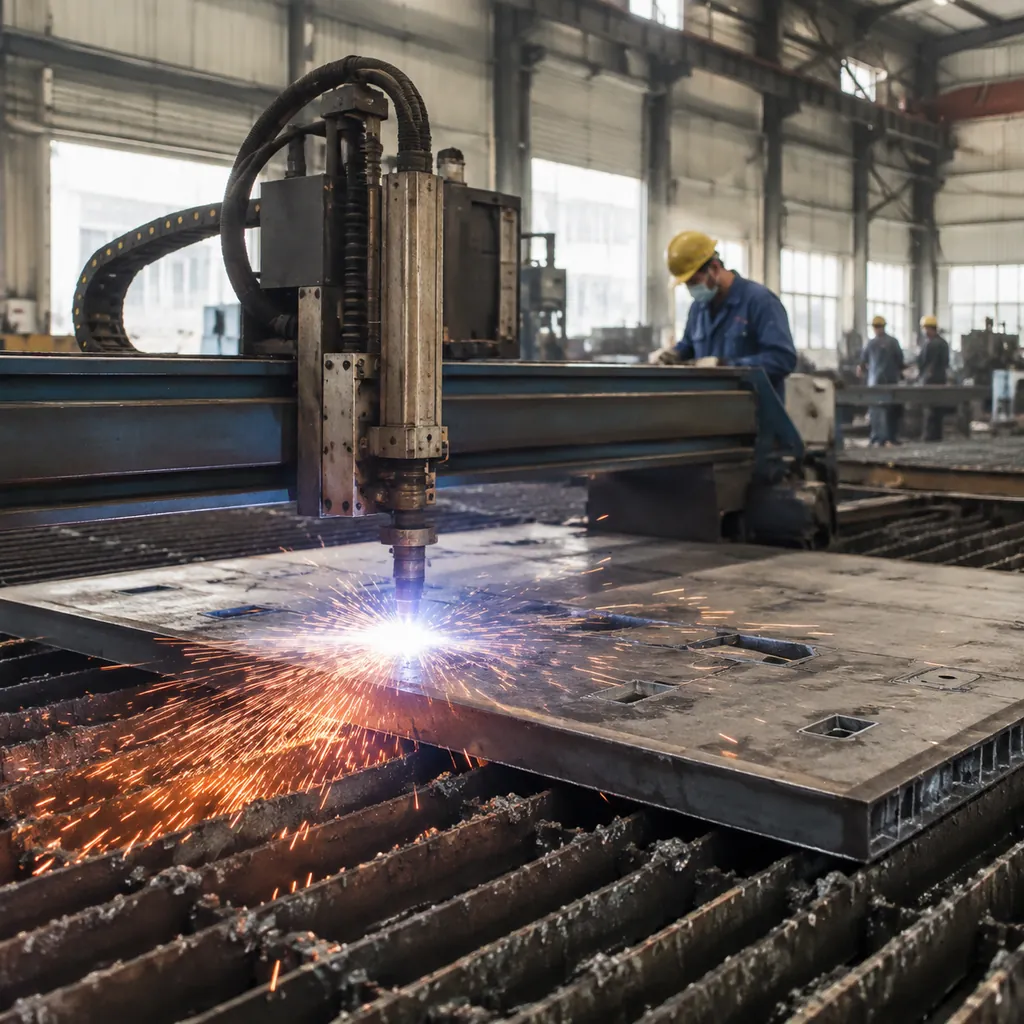
CNC plasma cutting
Plasma cutting is the workhorse for structural plates from roughly 6 mm to 40 mm. A CNC plasma machine follows the nested cutting program, so the main risk is not the machine but the programmer: nesting density determines how much steel is wasted, and the sequence determines thermal distortion. Ask how the factory nests plates and whether the cutting program comes from the shop drawings or from a redrawn model. Mismatches between the drawing model and the cutting program are a common source of on-site surprises.
Laser cutting
Laser cutting gives a cleaner edge and tighter tolerance, typically used for thinner plates, end plates and connection plates. It costs more per meter than plasma, which is why suppliers do not laser-cut everything. If your project has many connection plates or intricate gussets, laser cutting is worth asking about explicitly.
Saw and band cutting
Hot-rolled H-sections and channels are usually cut with a cold saw or band saw. The cut must be square and the burr removed. Sloppy sawing is invisible in a photo but becomes obvious when end plates sit uneven against the column flange.
What you can check without visiting
You cannot watch the cutting, but you can ask three questions: whether the cutting program is generated from approved shop drawings, whether the factory records material heat numbers per member, and whether it keeps first-article inspection reports for cutting tolerances. A factory that cannot produce these documents is a factory that cannot prove its cutting quality. The same logic applies to every later stage.
Welding: the joints that carry your building
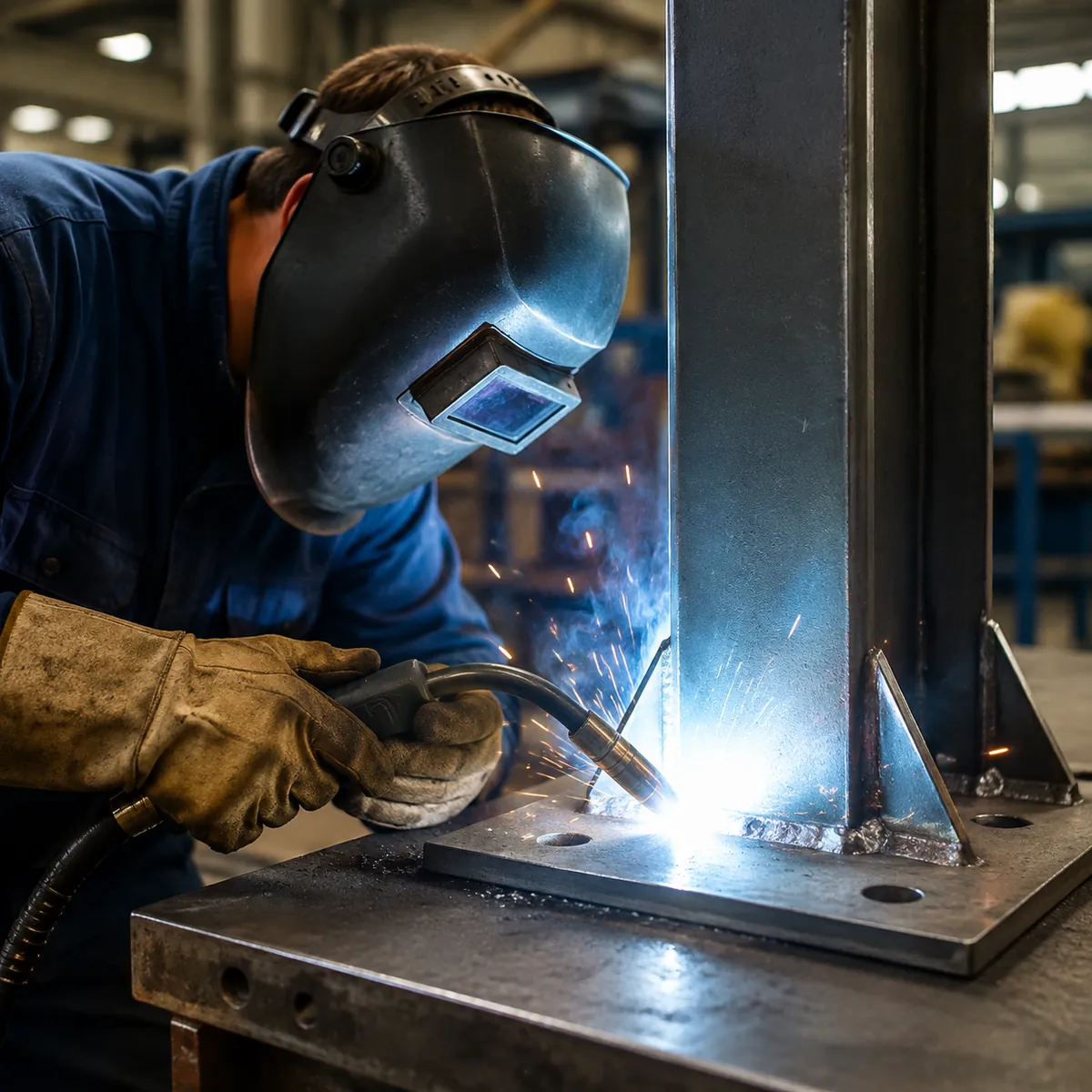
Welding is the single most quality-critical process in steel structure fabrication. Portal frame columns, rafters and their connections depend on full-penetration or fillet welds that transfer loads. A weld that looks fine on the surface can hide porosity, lack of fusion or cracks, which is why welding is controlled by procedure, welder qualification and inspection — not by visual luck.
Welding methods you will meet
- Submerged arc welding (SAW) — used for long straight seams on built-up I-sections (plate girders and columns). Automated, high deposition rate, consistent quality when parameters are controlled.
- Gas metal arc welding (GMAW/MIG) — common for connections, stiffeners and general fabrication. Versatile and fast, quality depends on welder skill and settings.
- Flux-cored arc welding (FCAW) — often used on site and for thicker sections; good penetration outdoors.
- Shielded metal arc welding (SMAW/stick) — used for repairs, small work and some field connections.
What controls weld quality
Three things matter more than the method: the welding procedure specification (WPS), the welder’s qualification, and the inspection plan. A factory should weld to a documented WPS — for export projects this is commonly based on AWS D1.1 or ISO 3834 families of standards. Welders should hold valid qualification certificates for the positions and processes they use. Inspection usually combines visual examination of every critical weld with non-destructive testing (NDT) on a defined sample: magnetic particle testing (MT) for surface cracks, ultrasonic testing (UT) for internal discontinuities, and sometimes radiographic testing (RT) for the most critical full-penetration welds. You do not need to interpret the reports yourself, but you should know which method was used, on which members, and by whom.
Welding distortion
Heat shrinks steel, so welded assemblies distort. Skilled fabricators counter this with weld sequence, back-step welding, restraint and post-weld straightening. Ask how the factory controls distortion on long rafters and whether it straightens or flame-straightens after welding. Flame straightening is common but must be done within temperature limits; uncontrolled heating can damage the steel’s properties. A factory that never mentions distortion control is probably not controlling it.
For a deeper look at how shop drawing approval sets the fabrication schedule — and why the drawing stage is the cheapest place to fix a mistake — see our guide to shop drawing approval and the fabrication schedule.
QA gates between cutting and packing
What separates a controlled factory from a casual one is not the number of inspectors but the existence of formal quality gates that stop work until a check passes. Below are the gates a serious export supplier runs, with the questions that let you audit them remotely.
| Gate | Inspection focus | Typical method | Question to ask the supplier |
|---|---|---|---|
| Incoming material | Grade, thickness, heat number | MTC check, thickness gauge, surface check | Do you keep the mill certificate for every heat you use? |
| Cutting | Dimensions, squareness, edge quality | First-article check, tape and square | Who checks the first cut piece of each batch? |
| Fit-up before welding | Gaps, alignment, prep | Visual, fit-up jigs, dimensional check | Do you inspect fit-up before welding, and can I see the record? |
| Welding | Weld size and appearance | Visual per WPS; NDT sample | Which welds are NDT-tested and by which standard? |
| Final dimensions | Length, camber, twist, bolt hole patterns | Full dimensional survey of assembly | What tolerances do you hold, and who signs the report? |
| Surface treatment | Blast cleanliness, profile, DFT | Profile gauge, DFT gauge, adhesion test | Can I see DFT readings per member batch? |
| Pre-shipment | Marking, packing, completeness vs packing list | Final check per packing list, loading photos | Do you photograph container loading and share the photos? |
Mill test certificates and traceability
Every structural member starts as a specific coil or plate with a heat number. The mill test certificate links that heat number to chemistry and mechanical properties. For export projects, buyers should receive MTCs covering the main structural steel — typically for the flanges and webs of built-up members and the hot-rolled sections. If a factory cannot map a member back to its heat number, you have no proof the steel is the grade you paid for. Our article on mill test certificates and how to verify them explains which certificates to request and what to check on them.
Third-party inspection
Most export buyers add an independent inspection at one or two gates: after welding and before packing, or a single final inspection before loading. Common arrangements are inspection by the buyer’s agent, by an inspection company, or by a factory that is already certified under a recognized quality system. Third-party inspection does not replace the factory’s own QA — it audits it. If your project size justifies the cost, one paid inspection visit saves far more than it costs when it catches a systematic problem early.
You can also review what a completed quality inspection before shipment should include in our pre-shipment inspection checklist.
How fabrication problems appear on site
Every fabrication defect has a site symptom, and knowing the symptom helps you decide what to inspect before shipment:
- Bolt holes that do not line up — caused by drilling from unapproved patterns or accumulated tolerance. On site it means re-drilling in the field, which damages galvanized or painted members.
- Members that do not sit square — caused by welding distortion that was never straightened. Erection crews fight every connection.
- Paint that peels after months — caused by skipping or rushing surface preparation, not by the paint itself. DFT below spec is the most common finding in paint inspections.
- Missing or wrong members — caused by marking errors and packing without a disciplined check against the packing list. This is the most expensive defect because it stops the site.
- Hidden weld defects — found only by NDT or under load. These are rare with controlled processes and more common in factories that weld by speed.
None of these are visible in a factory photo album. They are visible in inspection reports, NDT records, dimensional reports and packing photos. That is the practical definition of fabrication quality you can verify from abroad.
How fabrication is planned before cutting starts
The fabrication floor is only the second half of the story. Before any plate is cut, the factory’s planning team must turn approved shop drawings into a production plan. The quality of that planning determines whether your lead time is realistic and whether the steel you pay for actually arrives as the building you approved.
The typical pre-production sequence in an export factory looks like this:
- Material take-off — every member in the shop drawings is listed with its length, section and steel grade, producing the total steel weight and the material order.
- Material procurement — plates and sections are ordered with mill certificates; the procurement lead time is often the longest single step, especially for non-standard grades or large sections.
- Cutting and nesting plan — plates are nested to maximize yield; the nesting program is generated from the 3D model or the cutting list.
- Production schedule — members are grouped into fabrication batches, usually by building zone or by erection sequence, so packing later matches the site order.
- Tooling and jig preparation — jigs for end plates, base plates and repeated connections are prepared so batches are consistent.
Ask the supplier for the planned production schedule when you place the order: when materials arrive, when cutting starts, when welding starts, when surface treatment starts, and when packing is planned. A factory that cannot give you a schedule at order time will discover the delays later — and you will discover them at your port.
Material procurement: the hidden schedule risk
Structural steel is bought by the factory from mills and distributors, and availability varies by grade and size. Standard grades such as Q235B and Q355B (or S235/S355 equivalents) are usually in stock, but thick plates, wide flange sections and special coatings can have procurement lead times. If your project specifies unusual sections, ask when the material will be in the factory. The most common cause of a late fabrication start is not the workshop — it is the material order.
Surface preparation and painting: the coating that decides service life
Cutting and welding make the building; surface treatment keeps it alive. Corrosion is the long-term enemy of steel structures, and the battle is decided in two steps: blasting that cleans and profiles the surface, and painting that builds the protective film to the specified thickness.
Blasting
Abrasive blasting removes mill scale, rust and contamination, and leaves a surface profile that gives the paint something to grip. The two numbers that matter are cleanliness (how much rust and scale remain) and profile (the roughness depth). For structural steel in export projects, a defined cleanliness grade and a profile in the range of 40 to 75 microns are common targets — confirm the specification with your supplier rather than assuming it.
Painting systems
The coating system depends on the environment. Common options for steel buildings include:
- Primer plus one or two finish coats — the standard economical system for interior-controlled environments.
- Zinc-rich primer systems — used where corrosion protection matters more, such as coastal sites.
- Two-pack epoxy or polyurethane systems — for aggressive environments and long service life.
- Hot-dip galvanizing — for small components, bolts and often purlins where long-term protection without maintenance is preferred; structural members can also be galvanized but it adds cost and lead time.
Whatever the system, the critical verification is dry film thickness (DFT): the paint film must reach the specified thickness on every surface, including edges and inside corners. DFT readings per member batch are the document you should receive. If the supplier cannot show DFT data, treat the coating claim as unverified.
Coating and the site environment
Tell the supplier where the building will stand. Coastal salt, industrial pollution, desert sand and high humidity all change the recommended system. A quote based on a temperate inland spec may under-protect your building — or overcharge you for protection you do not need. The conversation about coating is also a test of whether the supplier designs for your site or sells a default package.
Packing and containerization for export
Fabrication ends at the factory gate, but the building only survives the trip if packing protects it. Steel members are heavy and long; the two main packing methods are:
- Flat racks — open platforms used for long members such as columns and rafters; the standard choice for members longer than a container’s internal length.
- Containers — for shorter members, secondary steel, bolts, cladding and accessories; protects against weather and theft.
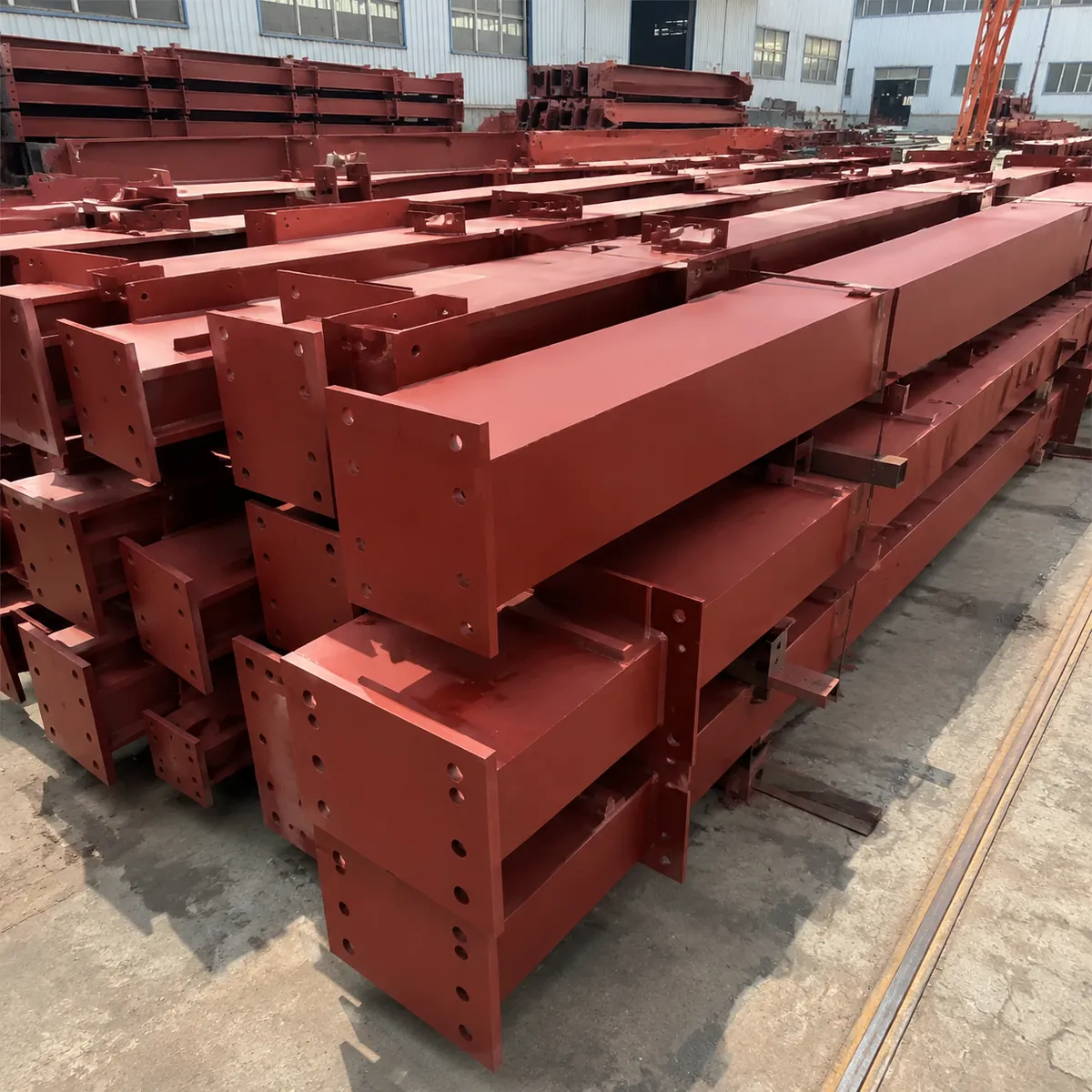
A disciplined packing operation marks every bundle and member by drawing number, sequences the packing list to match the erection order, and photographs the loading so the buyer can see the state of the cargo at departure. Ask for the container loading photos and the packing list before shipment. These documents are cheap, and they are the only evidence you have that the building you approved is the building on the vessel.
For long members, check how the factory supports them on the flat rack to avoid bending, how welds and end plates are protected, and whether sharp edges are guarded. The same care that goes into fabrication should go into packing; a member that arrives bent is as useless as one that was never made.
How to structure fabrication milestones in your contract
Fabrication is the longest phase of a steel building order, and it is also the phase where you have the least visibility. Protect the project by linking payments and inspections to milestones:
| Milestone | What you should receive | Typical payment trigger |
|---|---|---|
| Order confirmation | Proforma invoice, final design basis, fabrication schedule | Deposit |
| Material receipt | Mill test certificates for the ordered heats | Progress payment (if agreed) |
| Cutting and welding start | Progress photos, first-article inspection report | Progress payment (if agreed) |
| Welding complete / inspection gate | Weld inspection report, NDT reports, dimensional reports | Progress payment (if agreed) |
| Surface treatment | Blasting and DFT reports | Progress payment (if agreed) |
| Packing and pre-shipment inspection | Packing list, loading photos, third-party inspection report (if used) | Balance before or at shipment |
The exact payment structure varies by market and by supplier, but the principle is universal: do not pay the full balance before you have seen the evidence at each gate. Even a modest inspection plan — photos, reports, and one third-party visit — protects far more value than it costs.
Frequently Asked Questions
What is the difference between a fabrication shop and a steel building manufacturer?
A fabrication shop cuts and welds steel to supplied drawings; a steel building manufacturer also designs the building, engineers it to your local codes, and coordinates the whole export package. When you buy from a manufacturer, fabrication quality is still delivered by the workshop floor, but you hold one supplier responsible for design, fabrication, coating, packing and documentation.
Which welding standard should a Chinese steel factory follow for export?
For export projects the most commonly referenced standards are AWS D1.1 and the ISO 3834 family. A factory should have a documented welding procedure and qualified welders under whichever standard your project specifies. If the contract does not name a standard, agree one before fabrication starts.
Can I inspect fabrication without flying to China?
Yes, to a meaningful degree: require progress photo reports at each gate, request copies of inspection records and NDT reports, and appoint a third-party inspection company for the critical gates. For large or complex projects, one physical inspection visit around the welding and packing stage is usually worth the cost.
How long does fabrication take for a typical steel warehouse?
Fabrication time depends on tonnage, complexity and factory load; it typically runs from several weeks to a couple of months for a medium warehouse, excluding design approval and material procurement. The schedule is usually driven by shop drawing approval, so delays in approval extend fabrication more than any other factor.
What documents should I receive with a fabricated steel building?
A complete export package includes mill test certificates, shop drawings and as-built drawings, welding and inspection records, painting/DFT reports, a packing list and container loading photos. The exact set should be written into your contract so the factory cannot argue about it after production.
Get a fabrication plan you can verify
SteelStructurePrefab is a Chinese steel structure manufacturer with export experience in warehouses, workshops, PEB buildings and industrial structures. When we quote a project we show the fabrication gates, the documents you will receive, and the inspection points you can audit — before you pay. Send your drawings or a requirement list and get a clear prefab steel warehouse supply plan with fabrication schedule and QA documents included.