
Industrial Steel Building in Kenya: Nairobi, Mombasa and Naivasha Design Loads, Cost and Buyer Guide

Industrial Steel Building in Kenya: Nairobi, Mombasa and Naivasha Design Loads, Cost and Buyer Guide
A industrial steel building in Kenya is not a catalogue item. Buyers in Nairobi, Mombasa and Naivasha need a building package that fits local heat, wind, corrosion, authority review, erection labour and import logistics. This guide is written for engineering procurement teams, contractors, project owners, architects and industrial park decision makers who compare overseas steel structure suppliers for real projects.
The focus keyword is industrial steel building Kenya, but the practical issue is simpler: how to specify a steel building that reaches site with the right drawings, the right coating, the right fasteners and a realistic erection plan. SteelStructurePrefab supplies factory-made columns, rafters, bracing, purlins, cladding, bolts and accessories for export projects. Related resources include Prefab steel warehouse steel structure design guide installation timeline quality control guide. For local climate and code background, review National Construction Authority Kenya and World Bank Kenya climate profile with your local engineer.
Project use cases and buyer priorities
Kenya projects commonly include industrial park factories, logistics sheds, food processing buildings, machinery workshops and export-processing facilities. A B2B buyer should freeze the operation brief before asking for a quotation: storage height, vehicle turning path, crane capacity, fire compartment need, office mezzanine, dock doors, process loads and future expansion. A steel frame can be economical only when these inputs are clear at the RFQ stage.
- Confirm local design loads before fixing steel tonnage.
- Match coating class to climate and cleaning access.
- Separate civil works, MEP, doors and steel package scope in the contract.
- Keep spare panels, bolts and touch-up paint on the packing list.
Structural design basis for Kenya
The design basis must cover highland rainfall, coastal corrosion in Mombasa, wind on open plots, crane runway loads, roof drainage capacity and seismic checks where required by the project engineer. The supplier can propose member sizes, but the final basis should be reviewed by a licensed local engineer. Ask for load combinations, deflection limits, connection design assumptions, anchor bolt reactions and a foundation load table. Do not accept a price that only lists tonnage without design criteria.
Wind, snow, seismic and roof service loads
Most target markets in this region do not have heavy snow, yet roof live load, maintenance load, solar panel allowance, suspended equipment and dust accumulation still matter. Wind uplift often governs roof sheeting, screws, edge zones and large door frames. Seismic checks may control bracing layout, base plate details and anchor bolt ductility in selected zones. If cranes, conveyors, HVAC platforms or poultry equipment hang from the roof, list every point load before fabrication.
Material specification and fabrication control
Main frames normally use welded H-section or hot-rolled sections with mill certificates. Secondary framing uses galvanized Z or C purlins, eave struts, tie rods and sag rods. A serious factory package should include material traceability, welding procedure records, bolt grade lists, trial assembly for complex nodes, and packing marks that match the erection drawings. For export projects, container loading plans reduce site sorting time.
| Typical bay spacing | 6–9 m for logistics and workshop grids; adjust to local cladding module and door positions |
|---|---|
| Common clear span | 18–36 m for standard buildings; wider spans need heavier rafters and tighter deflection checks |
| Steel grade | Q355 / ASTM A572 Grade 50 equivalent for main frames; Q235/Q345 for secondary members where allowed |
| Roof and wall panels | 0.45–0.60 mm color-coated steel sheet, sandwich panel or insulated roof system based on heat and condensation risk |
| Surface treatment | Shot blasting Sa 2.5, zinc-rich primer or hot-dip galvanizing for aggressive zones; top coat selected by C3–C5 exposure |
| Design life target | 25–50 years with planned coating inspection and fastener maintenance |
| Installation period | 4–10 weeks for a 2,000–6,000 m² building after foundations and material arrival |
| Budget signal | US$62–138/m² FOB for standard industrial steel building packages; complete project budgets often range from US$105–245/m² excluding land and major process equipment |
Surface treatment and corrosion plan
Coating choice depends on distance from the sea, industrial pollution, chemicals, humidity and cleaning schedule. Standard primer may be enough for a dry inland warehouse, while coastal or poultry projects need stronger corrosion control. Options include shot blasting to Sa 2.5, epoxy zinc-rich primer, polyurethane top coat, hot-dip galvanizing for secondary members, stainless fasteners in exposed zones and isolation pads between dissimilar metals.
Envelope, insulation and ventilation
Roof and wall selection affects heat gain, condensation, energy cost and worker comfort. Single-skin sheet is low cost but may need insulation blanket or reflective foil. Sandwich panels improve thermal control and acoustic performance. Ridge vents, wall louvers, exhaust fans, translucent panels and gutters should be coordinated with bracing bays and equipment locations. In hot climates, white or light-colour roofing can lower solar absorption.
- Confirm local design loads before fixing steel tonnage.
- Match coating class to climate and cleaning access.
- Separate civil works, MEP, doors and steel package scope in the contract.
- Keep spare panels, bolts and touch-up paint on the packing list.
Installation schedule and site coordination
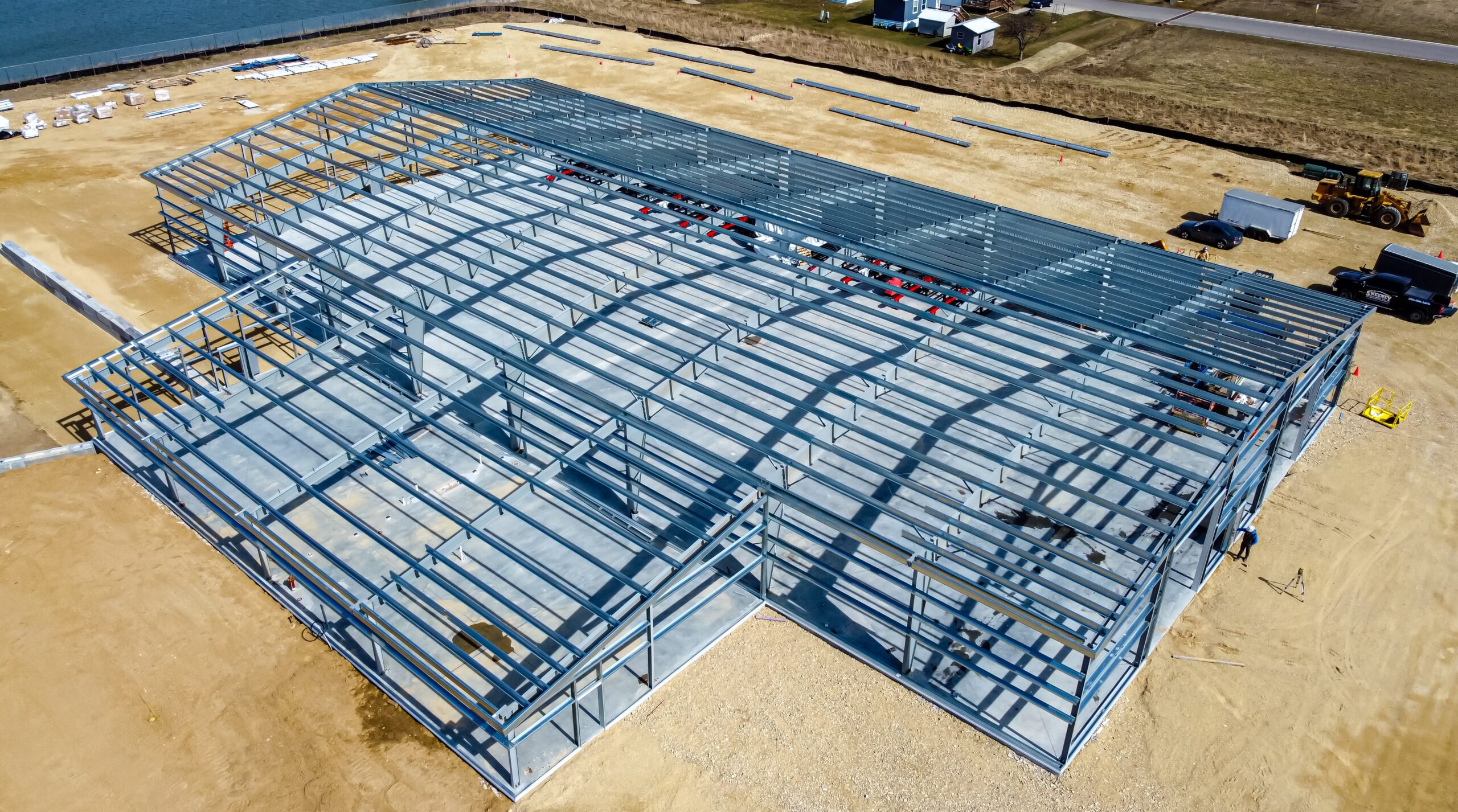
A typical exported steel building needs foundation completion before container arrival. Anchor bolt templates should be checked before concrete casting. Erection normally follows columns, roof beams, bracing, purlins, roof sheeting, wall sheeting, doors, flashings and gutters. For a medium building, the steel package may be erected in 4–10 weeks after the site is ready. Delays usually come from wrong anchor bolt levels, missing lifting equipment, late permits or unclear responsibilities between civil and steel contractors.
Quotation range and what changes the price
US$62–138/m² FOB for standard industrial steel building packages; complete project budgets often range from US$105–245/m² excluding land and major process equipment. Price moves with clear span, eave height, bay spacing, coating class, insulation, crane beams, mezzanine floors, door size, fire rating, wind speed, seismic zone, skylights, gutters, sea freight and erection supervision. Compare quotes by scope, not only by tonnage. A cheaper frame can become expensive if it needs extra local welding, replacement bolts or redesign during permit review.
Local regulations, climate and approval notes
For Kenya, buyers should treat national code references, municipality requirements, fire authority access, environmental rules, airport or farm permits, and industrial park covenants as early design inputs. Ask the local consultant to confirm wind speed, exposure category, seismic parameters, soil report, drainage requirements and fire separation. The overseas supplier should then align shop drawings and calculation notes with those confirmed inputs.
- Confirm local design loads before fixing steel tonnage.
- Match coating class to climate and cleaning access.
- Separate civil works, MEP, doors and steel package scope in the contract.
- Keep spare panels, bolts and touch-up paint on the packing list.
Procurement advice for contractors and owners
Send a complete RFQ package: site location, building plan, section, column grid, clear height, design loads, soil report if available, door schedule, crane data, cladding preference, coating requirement, delivery port and required documents. Request GA drawings, member list, quotation scope, excluded items, lead time, packing method and payment milestones. Before production, sign off the drawing set and check every opening, gutter, bolt and panel colour.
Common Buyer Questions
What information is needed for a firm quotation?
Building size, use, location, design load, clear height, door sizes, crane or equipment load, cladding type, coating class and delivery port are the minimum inputs.
Can the steel frame be designed for future expansion?
Yes. Expansion columns, removable end-wall framing and planned bracing bays can be added if the future bay size and direction are known before production.
Should I choose painted or galvanized steel?
Painted main frames are common for many warehouses. Galvanizing or higher-grade coating is better for coastal, chemical, poultry and high-humidity sites.
How long does fabrication take?
Many projects take 4–8 weeks for drawing approval and fabrication after deposit, while large hangars, crane buildings or insulated panel packages need more time.
Who is responsible for local permit approval?
The project owner or local engineer normally handles permits. The supplier should provide drawings, calculations and material documents to support that review.
For Kenya procurement, keep one revision log for drawings, calculations, bill of materials and packing lists. Mark every change that affects steel weight, hole position, panel length or anchor reaction. This avoids disputes during installation and gives the site team a clear record when containers arrive. The engineering buyer should also request photos of fabrication, coating thickness checks, bolt packing and trial-fit details before shipment.
For Kenya procurement, keep one revision log for drawings, calculations, bill of materials and packing lists. Mark every change that affects steel weight, hole position, panel length or anchor reaction. This avoids disputes during installation and gives the site team a clear record when containers arrive. The engineering buyer should also request photos of fabrication, coating thickness checks, bolt packing and trial-fit details before shipment.
For Kenya procurement, keep one revision log for drawings, calculations, bill of materials and packing lists. Mark every change that affects steel weight, hole position, panel length or anchor reaction. This avoids disputes during installation and gives the site team a clear record when containers arrive. The engineering buyer should also request photos of fabrication, coating thickness checks, bolt packing and trial-fit details before shipment.
For Kenya procurement, keep one revision log for drawings, calculations, bill of materials and packing lists. Mark every change that affects steel weight, hole position, panel length or anchor reaction. This avoids disputes during installation and gives the site team a clear record when containers arrive. The engineering buyer should also request photos of fabrication, coating thickness checks, bolt packing and trial-fit details before shipment.
For Kenya procurement, keep one revision log for drawings, calculations, bill of materials and packing lists. Mark every change that affects steel weight, hole position, panel length or anchor reaction. This avoids disputes during installation and gives the site team a clear record when containers arrive. The engineering buyer should also request photos of fabrication, coating thickness checks, bolt packing and trial-fit details before shipment.
For Kenya procurement, keep one revision log for drawings, calculations, bill of materials and packing lists. Mark every change that affects steel weight, hole position, panel length or anchor reaction. This avoids disputes during installation and gives the site team a clear record when containers arrive. The engineering buyer should also request photos of fabrication, coating thickness checks, bolt packing and trial-fit details before shipment.
For Kenya procurement, keep one revision log for drawings, calculations, bill of materials and packing lists. Mark every change that affects steel weight, hole position, panel length or anchor reaction. This avoids disputes during installation and gives the site team a clear record when containers arrive. The engineering buyer should also request photos of fabrication, coating thickness checks, bolt packing and trial-fit details before shipment.
For Kenya procurement, keep one revision log for drawings, calculations, bill of materials and packing lists. Mark every change that affects steel weight, hole position, panel length or anchor reaction. This avoids disputes during installation and gives the site team a clear record when containers arrive. The engineering buyer should also request photos of fabrication, coating thickness checks, bolt packing and trial-fit details before shipment.
For Kenya procurement, keep one revision log for drawings, calculations, bill of materials and packing lists. Mark every change that affects steel weight, hole position, panel length or anchor reaction. This avoids disputes during installation and gives the site team a clear record when containers arrive. The engineering buyer should also request photos of fabrication, coating thickness checks, bolt packing and trial-fit details before shipment.
For Kenya procurement, keep one revision log for drawings, calculations, bill of materials and packing lists. Mark every change that affects steel weight, hole position, panel length or anchor reaction. This avoids disputes during installation and gives the site team a clear record when containers arrive. The engineering buyer should also request photos of fabrication, coating thickness checks, bolt packing and trial-fit details before shipment.
For Kenya procurement, keep one revision log for drawings, calculations, bill of materials and packing lists. Mark every change that affects steel weight, hole position, panel length or anchor reaction. This avoids disputes during installation and gives the site team a clear record when containers arrive. The engineering buyer should also request photos of fabrication, coating thickness checks, bolt packing and trial-fit details before shipment.
For Kenya procurement, keep one revision log for drawings, calculations, bill of materials and packing lists. Mark every change that affects steel weight, hole position, panel length or anchor reaction. This avoids disputes during installation and gives the site team a clear record when containers arrive. The engineering buyer should also request photos of fabrication, coating thickness checks, bolt packing and trial-fit details before shipment.
For Kenya procurement, keep one revision log for drawings, calculations, bill of materials and packing lists. Mark every change that affects steel weight, hole position, panel length or anchor reaction. This avoids disputes during installation and gives the site team a clear record when containers arrive. The engineering buyer should also request photos of fabrication, coating thickness checks, bolt packing and trial-fit details before shipment.
For Kenya procurement, keep one revision log for drawings, calculations, bill of materials and packing lists. Mark every change that affects steel weight, hole position, panel length or anchor reaction. This avoids disputes during installation and gives the site team a clear record when containers arrive. The engineering buyer should also request photos of fabrication, coating thickness checks, bolt packing and trial-fit details before shipment.
For Kenya procurement, keep one revision log for drawings, calculations, bill of materials and packing lists. Mark every change that affects steel weight, hole position, panel length or anchor reaction. This avoids disputes during installation and gives the site team a clear record when containers arrive. The engineering buyer should also request photos of fabrication, coating thickness checks, bolt packing and trial-fit details before shipment.
For Kenya procurement, keep one revision log for drawings, calculations, bill of materials and packing lists. Mark every change that affects steel weight, hole position, panel length or anchor reaction. This avoids disputes during installation and gives the site team a clear record when containers arrive. The engineering buyer should also request photos of fabrication, coating thickness checks, bolt packing and trial-fit details before shipment.
For Kenya procurement, keep one revision log for drawings, calculations, bill of materials and packing lists. Mark every change that affects steel weight, hole position, panel length or anchor reaction. This avoids disputes during installation and gives the site team a clear record when containers arrive. The engineering buyer should also request photos of fabrication, coating thickness checks, bolt packing and trial-fit details before shipment.
For Kenya procurement, keep one revision log for drawings, calculations, bill of materials and packing lists. Mark every change that affects steel weight, hole position, panel length or anchor reaction. This avoids disputes during installation and gives the site team a clear record when containers arrive. The engineering buyer should also request photos of fabrication, coating thickness checks, bolt packing and trial-fit details before shipment.
For Kenya procurement, keep one revision log for drawings, calculations, bill of materials and packing lists. Mark every change that affects steel weight, hole position, panel length or anchor reaction. This avoids disputes during installation and gives the site team a clear record when containers arrive. The engineering buyer should also request photos of fabrication, coating thickness checks, bolt packing and trial-fit details before shipment.
For Kenya procurement, keep one revision log for drawings, calculations, bill of materials and packing lists. Mark every change that affects steel weight, hole position, panel length or anchor reaction. This avoids disputes during installation and gives the site team a clear record when containers arrive. The engineering buyer should also request photos of fabrication, coating thickness checks, bolt packing and trial-fit details before shipment.
For Kenya procurement, keep one revision log for drawings, calculations, bill of materials and packing lists. Mark every change that affects steel weight, hole position, panel length or anchor reaction. This avoids disputes during installation and gives the site team a clear record when containers arrive. The engineering buyer should also request photos of fabrication, coating thickness checks, bolt packing and trial-fit details before shipment.
For Kenya procurement, keep one revision log for drawings, calculations, bill of materials and packing lists. Mark every change that affects steel weight, hole position, panel length or anchor reaction. This avoids disputes during installation and gives the site team a clear record when containers arrive. The engineering buyer should also request photos of fabrication, coating thickness checks, bolt packing and trial-fit details before shipment.
For Kenya procurement, keep one revision log for drawings, calculations, bill of materials and packing lists. Mark every change that affects steel weight, hole position, panel length or anchor reaction. This avoids disputes during installation and gives the site team a clear record when containers arrive. The engineering buyer should also request photos of fabrication, coating thickness checks, bolt packing and trial-fit details before shipment.
For Kenya procurement, keep one revision log for drawings, calculations, bill of materials and packing lists. Mark every change that affects steel weight, hole position, panel length or anchor reaction. This avoids disputes during installation and gives the site team a clear record when containers arrive. The engineering buyer should also request photos of fabrication, coating thickness checks, bolt packing and trial-fit details before shipment.
For Kenya procurement, keep one revision log for drawings, calculations, bill of materials and packing lists. Mark every change that affects steel weight, hole position, panel length or anchor reaction. This avoids disputes during installation and gives the site team a clear record when containers arrive. The engineering buyer should also request photos of fabrication, coating thickness checks, bolt packing and trial-fit details before shipment.
For Kenya procurement, keep one revision log for drawings, calculations, bill of materials and packing lists. Mark every change that affects steel weight, hole position, panel length or anchor reaction. This avoids disputes during installation and gives the site team a clear record when containers arrive. The engineering buyer should also request photos of fabrication, coating thickness checks, bolt packing and trial-fit details before shipment.
Final purchasing recommendation for Kenya
Choose the supplier that asks technical questions before quoting. For a industrial steel building, the safest path is to confirm local loads, agree coating and cladding, review drawings, then lock fabrication. If you are planning a project in Nairobi, Mombasa and Naivasha, send the building span, length, height, use and site location to SteelStructurePrefab for a project-specific proposal.