
Oman Prefab Steel Warehouse Guide for Sohar, Muscat and Duqm Logistics Projects

Oman’s logistics and industrial buildout is moving on the strength of three anchor zones: the port and freezone cluster at Sohar, the consumption and distribution base around Muscat, and the deep-water special economic zone at Duqm. Buyers planning a prefab steel warehouse in Oman are weighing clear-span storage, ambient heat, coastal corrosion, and shipping lead time against a fixed project budget. This guide walks engineering procurement teams, contractors, project owners, and industrial park developers through the design decisions, material specifications, load cases, corrosion strategy, approval steps, and cost ranges that actually matter for warehouse projects in the Sultanate, with figures you can take into a budget meeting.
Why Prefab Steel Suits Warehouse Projects in Oman
A pre-engineered steel frame gives you long clear spans without internal columns, which is what high-bay storage, racking aisles, and forklift traffic need. Compared with reinforced concrete, a bolted steel portal frame reaches site faster, carries less foundation load, and lets you stage erection around port logistics and customs clearance. For a country importing most of its structural steel and cladding through Sohar and Sohar Industrial Port, factory-cut members that arrive ready to bolt reduce on-site labor and rework.
The practical pull for Omani projects comes down to four points:
- Span and height: Single-span portal frames cover 18 m to 36 m without mid-columns; multi-span layouts push to 90 m or more for distribution centers.
- Speed: Fabrication runs in parallel with foundation work, so a 5,000 m2 shed can be weather-tight in a fraction of the time a concrete equivalent takes.
- Climate fit: Insulated cladding and ridge ventilation handle Oman’s summer heat, while hot-dip galvanized secondary steel resists the salt-laden coastal air at Sohar and Duqm.
- Cost control: A defined bill of materials and fixed connection design make quotes easier to compare and budgets easier to hold.
Structural Design Basics for Omani Warehouses
Frame Type and Span Selection
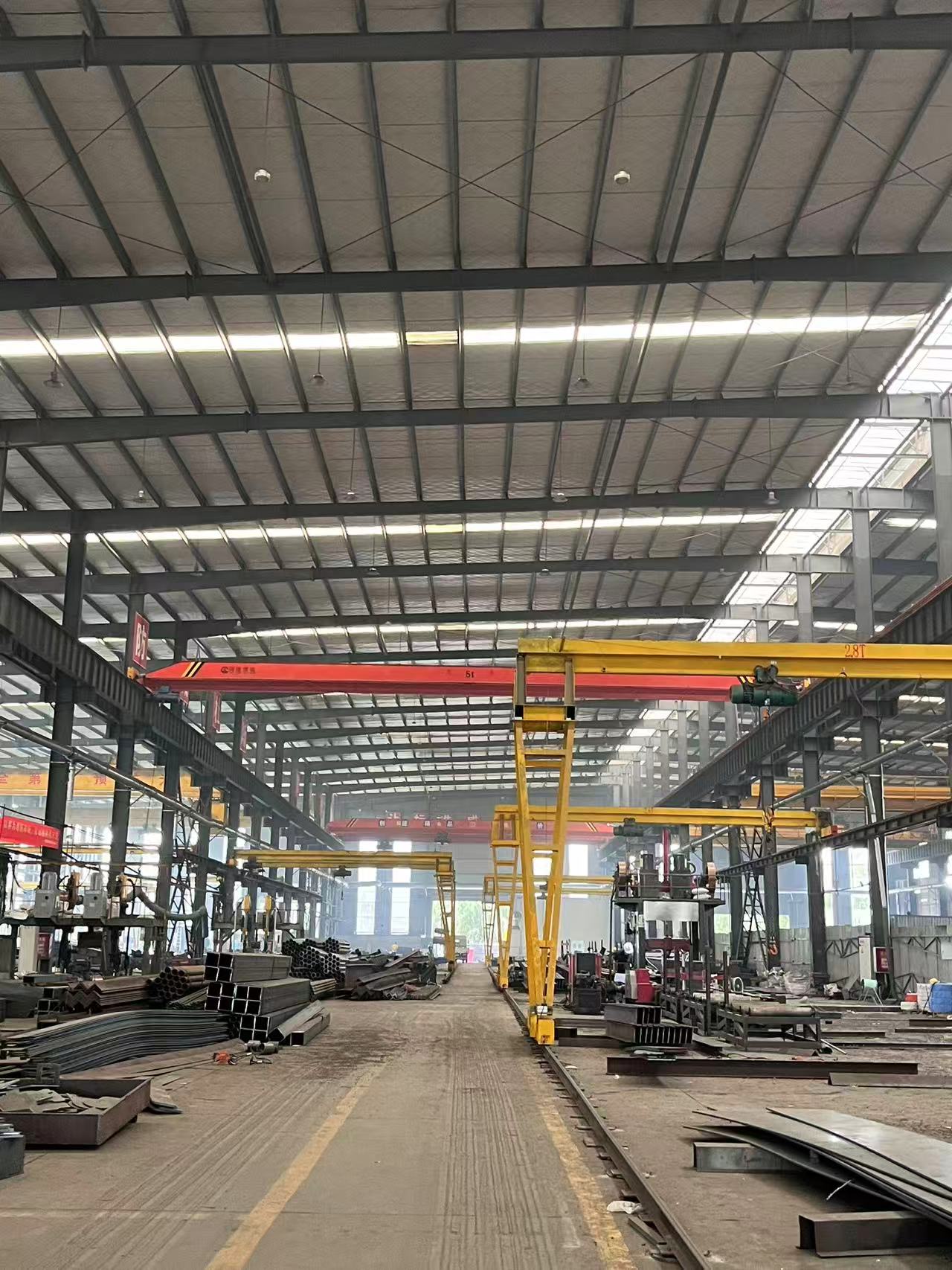
Most warehouse work in Oman uses tapered-column portal frames. The column and rafter are built-up welded I-sections with the web depth varying along the member to match the bending moment. This keeps steel weight down while holding deflection within limits. Selection usually follows the stored goods and handling method:
- 18-24 m span: Workshop-adjacent stores, spare-parts depots, light distribution. Eave height 6-8 m.
- 24-30 m span: General logistics warehouses with selective racking. Eave height 9-12 m.
- 30-36 m+ span: Regional distribution centers and 3PL facilities, often multi-span. Eave height 12-15 m for high-bay or automated storage.
Bay spacing of 6 m to 9 m is standard. Wider bays cut the number of frames and foundations but raise purlin and crane-girder sizes, so the trade-off is checked against the cladding and any overhead crane.
Wind, Seismic and Temperature Loads
Oman design practice references international load codes, most often ASCE 7 for wind and seismic combined with manufacturer engineering to local site data. Coastal sites at Sohar, Muscat (Mina Sultan Qaboos area), and Duqm see strong onshore wind and occasional cyclonic events tracking up the Arabian Sea, so design wind speeds are set conservatively. Key inputs:
- Wind: Basic design wind speeds in coastal Oman commonly fall in the 40-50 m/s range (3-second gust), with exposure category set for open coastal terrain. Cyclone history along the Arabian Sea coast (for example Gonu and later systems) pushes designers toward the upper band.
- Seismic: Most of Oman sits in low-to-moderate seismic zones, but the northern Musandam and Batinah areas near the active zone require a seismic check. Steel portal frames perform well here because of their ductility and low mass.
- Temperature: Design accounts for a wide ambient swing and roof surface temperatures that can exceed 70 C in summer. Thermal movement is taken up with expansion joints on long buildings (typically every 90-120 m).
- Snow: Not a factor in Oman; roof live load is governed by maintenance access and wind uplift instead.
Wind uplift drives a large part of the design. Roof sheeting fasteners, purlin-to-rafter cleats, and holding-down bolts are all sized for net uplift, not just gravity. This is where cheap imports often fail, so it pays to confirm the uplift calculation in the submittal.
Material Specifications and Corrosion Protection
Specifying the right steel grades and coatings up front avoids disputes later. The table below shows a typical specification set for an Omani coastal warehouse.
| Component | Typical Specification | Notes for Oman |
|---|---|---|
| Primary frame (columns, rafters) | Q355B / S355JR welded built-up I-sections | Higher yield reduces section weight for long spans |
| Secondary steel (purlins, girts) | Z275 galvanized cold-formed C/Z sections | Hot-dip galvanizing essential near coast |
| Roof / wall cladding | 0.5-0.6 mm AZ150 aluzinc or PVDF-coated steel | Aluzinc/PVDF resists salt and UV better than standard galv |
| Insulation | 50-100 mm glass wool or PIR sandwich panel | Cuts heat gain; PIR panel for cold storage |
| Bolts | Grade 8.8 / 10.9 high-strength, HDG | Slip-critical connections at moment joints |
| Anchor bolts | Grade 8.8, galvanized, with template | Set in concrete pedestals above flood/splash level |
Surface Treatment and Anti-Corrosion
Coastal Oman is a C4 to C5-M corrosion environment under ISO 12944, especially within a few kilometers of the Sohar and Duqm shoreline. A matched coating system protects the primary frame:
- Surface prep: Abrasive blast to Sa 2.5 (near-white metal). This is the single biggest factor in coating life.
- Primer: Zinc-rich epoxy, 60-80 microns.
- Intermediate: Epoxy MIO, 100-125 microns.
- Topcoat: Polyurethane or polysiloxane, 50-75 microns, for UV and color.
- Total DFT: 240-280 microns for a C5-M coastal site, giving 15+ years to first major maintenance.
For secondary steel, hot-dip galvanizing to a Z275 (275 g/m2) coating or heavier is the baseline. Fasteners exposed to weather should be galvanized or stainless. Inland sites around Muscat’s industrial estates can step down to a C3-C4 system, which trims cost.
Climate, Ventilation and Insulation
Summer ambient temperatures in Oman regularly pass 45 C, and an uninsulated steel shed becomes an oven that degrades stored goods and working conditions. Three measures keep a warehouse usable year round:
- Roof insulation: A PIR or glass-wool sandwich panel roof with a reflective outer surface cuts radiant heat gain. Aim for a roof U-value around 0.4 W/m2K for general goods, lower for temperature-sensitive stock.
- Ridge ventilation and turbines: Continuous ridge vents plus wall louvers create stack-effect airflow that pulls hot air out without powered fans.
- Powered extractors: For high heat loads, roof-mounted extractors clear the upper air layer.
For cold-chain or pharmaceutical storage common around Muscat and Sohar Freezone, the frame is the same but the envelope shifts to thicker PIR panels (100-150 mm), vapor sealing, and insulated dock doors. The structural designer coordinates panel weight and the extra dead load early.
Foundations and Local Ground Conditions
Oman’s coastal plains often have sabkha (salt flat) soils with low bearing capacity and aggressive sulfate/chloride content, particularly around the Batinah coast and parts of Duqm. This affects foundation design more than the steel frame:
- A geotechnical investigation is non-negotiable; isolated pad footings suit firm ground, while sabkha or fill may need piled or raft foundations.
- Sulfate-resisting cement and adequate concrete cover protect against chemical attack.
- Anchor-bolt pedestals are raised above the slab to keep the steel base plate clear of standing water and salt splash.
- The steel supplier provides anchor-bolt layouts and reaction loads so the local civil contractor can design footings to Omani municipal requirements.
Installation Timeline for an Omani Warehouse
A typical 4,000-6,000 m2 single-span warehouse follows this sequence. Shipping from the fabrication yard to Sohar or Salalah port is the longest single block, so it is planned first.
| Stage | Duration | Notes |
|---|---|---|
| Design and approval | 2-4 weeks | Drawings, calculations, municipal/freezone approval |
| Fabrication | 4-6 weeks | Cutting, welding, blasting, coating in factory |
| Sea freight to Oman | 3-5 weeks | To Sohar/Salalah; customs clearance included |
| Foundations (parallel) | 3-5 weeks | Done while steel is fabricated/shipped |
| Frame erection | 2-4 weeks | Crane-set frames, bracing, purlins |
| Cladding and finishes | 3-5 weeks | Roof, walls, doors, gutters, accessories |
Because foundation work runs in parallel with fabrication and shipping, the on-site critical path is usually 8-12 weeks from steel arrival to handover. Detailed timing depends on crew size and crane availability; our steel building installation timeline guide breaks down each phase.
Cost and Specification Ranges for Oman
Pricing depends on span, height, wind design, cladding, and how much you include (mezzanine, crane, dock equipment). The ranges below are indicative ex-works plus typical sea freight to Oman, in USD per square meter of building footprint, for budgeting only.
| Warehouse Type | Span / Height | Indicative USD/m2 | Includes |
|---|---|---|---|
| Basic storage shed | 18-24 m / 6-8 m | $55-80 | Frame, single-skin cladding, one roller door |
| Standard logistics warehouse | 24-30 m / 9-12 m | $80-120 | Frame, insulated roof, dock doors, ventilation |
| High-bay / DC with crane | 30-36 m / 12-15 m | $120-180 | Heavier frame, crane girders, full insulation |
| Cold storage envelope | 24-30 m / 9-12 m | $160-240 | PIR panels, vapor sealing, insulated doors |
Foundations, slab, MEP, fire systems, and racking are separate and often add 30-60% to the steel package, depending on slab loading and fit-out. For a structured quote you can compare, see what data a supplier needs in our steel building quote requirements page, and review the drivers behind pricing in the steel building cost guide.
Regulations, Standards and Approvals in Oman
Warehouse projects in Oman are approved through the relevant municipal authority or, inside a freezone, through the zone authority (Sohar Freezone, Salalah Free Zone, or the Special Economic Zone Authority at Duqm, SEZAD). Practical points:
- Design codes: International codes (ASCE 7, AISC, Eurocodes, or BS) are accepted when applied to Omani site data; the design is signed by an engineer registered to practice in Oman.
- Fire: The Public Authority for Civil Defence and Ambulance (PACDA) sets fire-safety requirements, including access, hydrants, and compartmentation for large stores.
- Freezone incentives: Sohar, Salalah, and Duqm offer customs and tax benefits that affect total landed cost; confirm import duty treatment for structural steel before ordering.
- Vision 2040 alignment: Logistics and manufacturing are priority sectors under Oman’s national strategy, which supports approvals for industrial and distribution facilities.
For background on Oman’s economic direction and the role of logistics, the official Oman Vision 2040 portal is a useful reference, and load-design context is set by the American Society of Civil Engineers through ASCE 7.
Project Scenarios Across Oman
Sohar: Port-Linked Distribution and Light Manufacturing
Sohar Port and Freezone draws metals, food, and logistics tenants. Typical demand is 24-30 m clear-span warehouses with insulated roofs, multiple dock doors, and a C5-M coating because of the shoreline location. Crane-served bays are common for metals and equipment handling.
Muscat: Urban Distribution and Retail Supply
Around Muscat and the Rusayl Industrial Estate, projects lean toward 18-30 m distribution warehouses serving retail and FMCG, often with a small office mezzanine and a focus on heat control for stored goods. Inland estates allow a lighter coating spec than the coast.
Duqm: Heavy Industry and Large-Format Logistics
SEZAD’s scale suits large-format warehouses, fabrication shops, and storage for petrochemical and project cargo. Wind and corrosion design are at the conservative end, and buildings are often multi-span with high eaves for project equipment.
Steel Frame Versus Concrete and Block for Omani Sites
Buyers in Oman often compare a pre-engineered steel building against block-and-concrete construction that local contractors know well. For warehouse and light-industrial use the steel frame usually wins on the metrics that matter to a project budget, but the comparison is worth making explicitly.
| Factor | Prefab Steel Frame | Concrete / Block |
|---|---|---|
| Clear span | Up to 36 m single span, no internal columns | Limited; internal columns or heavy beams needed |
| Build speed | Fabrication parallel to foundations; fast erection | Sequential pours and curing; slower |
| Foundation load | Lighter; smaller footings on poor soil | Heavier; larger footings or piling |
| Future expansion | Bolt-on bays, relocatable | Difficult to extend |
| Heat performance | Needs insulated cladding (specified) | High thermal mass but slow to build |
| Coastal durability | Depends on coating spec; controllable | Rebar corrosion risk in chloride soils |
For storage, distribution, workshops, and most light manufacturing, the steel frame is the practical default. Concrete keeps a role in office blocks, fire-rated rooms, and slabs, which is why most Omani projects end up as a steel frame on a concrete slab with masonry only where it is genuinely needed.
Fit-Out: Mezzanines, Racking, Doors and Fire Safety
The frame is only part of a working warehouse. Plan the fit-out with the structure so loads and openings are designed in, not cut in later.
- Mezzanine floors: A steel mezzanine adds office or light-storage area. Floor loading (commonly 3-5 kN/m2 for storage, 2.5 kN/m2 for office) is set early so beams and columns carry it.
- Racking interaction: Tall selective or drive-in racking can transfer load to the building or stand free; coordinate so seismic and wind cases account for the racking.
- Doors: Sectional overhead doors for dock work, high-speed doors for temperature control, and sliding doors for oversized loads. Each opening needs framed support and wind-rated hardware.
- Dock levelers and canopies: For distribution centers, dock pits and steel canopies are integrated into the frame and slab design.
- Fire safety: PACDA requirements may call for hydrants, hose reels, sprinklers for high-value or high-pile storage, smoke vents, and adequate exits. Sprinkler tanks and pump rooms add load and space that the layout must reserve.
Maintenance and Service Life
A well-specified steel warehouse in Oman is built for a 25-50 year service life, but coastal exposure means maintenance is planned, not optional. A simple schedule keeps the asset sound:
- Annual: Visual check of cladding fasteners, gutters, downpipes, and door hardware; clear salt and dust buildup from the roof and wall sheets.
- Every 2-3 years: Inspect the primary frame coating at connections and bases for chips or rust bloom; touch up with a matched system.
- Every 5-7 years: Detailed coating survey on coastal buildings; localized recoat where DFT has dropped.
- As needed: Re-tension any slip-critical bolts flagged during inspection, and check anchor-bolt grout for cracking.
Quality of the original fabrication and coating sets how cheap this maintenance stays. A frame blasted to Sa 2.5 and coated to the right DFT needs little attention for years; a poorly prepared frame can show rust within a couple of monsoon seasons on the coast. Our steel structure quality control guide covers the inspection points that matter at the fabrication stage.
Oman Market Drivers Behind Warehouse Demand
Warehouse and logistics demand in Oman is tied to a few clear trends that procurement teams can plan around. Understanding them helps size a building for the next ten years, not just current stock.
- Transshipment and re-export: Sohar and Salalah sit on major shipping lanes, drawing distribution and re-export operators who need large clear-span sheds near the quays.
- Manufacturing localization: National policy pushes to make more goods in-country, which raises demand for combined production-and-storage steel buildings in the freezones.
- Food security: Investment in cold storage and dry stores for imported and local food supports steady demand for insulated warehouse envelopes.
- Mining and minerals: Projects around Duqm and the interior need storage and workshop space built to handle heavy goods and project cargo.
- Retail and e-commerce: Growth around Muscat drives last-mile and regional distribution centers with dock-heavy layouts.
For a buyer, the takeaway is to design in flexibility. A frame with spare bay capacity, a slab rated for future racking, and service routes left clear is far cheaper than rebuilding when the operation grows. Steel makes that flexibility practical because bays can be added and internal layouts changed without touching the main structure.
Common Buyer Questions (FAQ)
How long does a prefab steel warehouse take to build in Oman?
From order to handover, plan on roughly 14-22 weeks total: 2-4 weeks design, 4-6 weeks fabrication, 3-5 weeks shipping to Sohar or Salalah, with foundations running in parallel, then 8-12 weeks on site for erection and cladding. Port clearance and crew size move the date most.
What does a steel warehouse cost in Oman?
For the steel building package landed in Oman, budget roughly $55-80/m2 for a basic shed, $80-120/m2 for a standard insulated logistics warehouse, and $120-180/m2 for high-bay or crane-served buildings. Foundations, slab, MEP, and racking are additional.
Do I need special corrosion protection near Sohar or Duqm?
Yes. Coastal sites are C5-M under ISO 12944. Use a blasted, zinc-rich epoxy system with epoxy MIO and a polyurethane topcoat (240-280 microns total) on the primary frame, hot-dip galvanized secondary steel, and aluzinc or PVDF cladding. Inland Muscat sites can use a lighter C3-C4 system.
Can the warehouse carry an overhead crane?
Yes. Crane girders and brackets are designed into the frame from the start. Tell the supplier the crane capacity, span, and duty cycle so columns, girders, and runway connections are sized correctly. Retrofitting a crane later is far more costly.
Who handles foundation design?
The steel supplier provides anchor-bolt layouts and frame reactions; a local civil engineer designs the footings to suit the geotechnical report and municipal rules. Sabkha and fill soils may need piling, so order the soil investigation early.
What standards are accepted for approval in Oman?
International codes such as ASCE 7, AISC, Eurocodes, and BS are accepted when applied to Omani site conditions and signed off by an engineer registered in Oman. Freezone projects follow the zone authority’s submission process.
Procurement Recommendations
For a warehouse project in Oman, the decisions that protect your budget and schedule are made before you place the order:
- Fix the load basis early: Confirm design wind speed, exposure category, and any seismic and crane loads in writing. Ask to see the uplift calculation.
- Match the coating to the site: Pay for a C5-M system on the coast; it is far cheaper than re-coating a corroded frame in five years.
- Order the soil report first: It governs foundation cost and can change the whole budget on sabkha ground.
- Plan shipping around port choice: Sohar suits the north, Salalah suits the south and Duqm; align fabrication completion with vessel schedules.
- Compare like for like: Use a common specification sheet so quotes are comparable on steel weight, coating, and inclusions, not just headline price.
If you are scoping a warehouse for Sohar, Muscat, or Duqm, our team can size the frame, specify the coating for your exact site, and quote delivered to an Omani port. Start with our prefab steel warehouse page, review related GCC projects in the country guides, and request a custom quote with your span, height, and location.