
Ghana Steel Structure Workshop Guide for Tema, Accra and Kumasi Industrial Projects

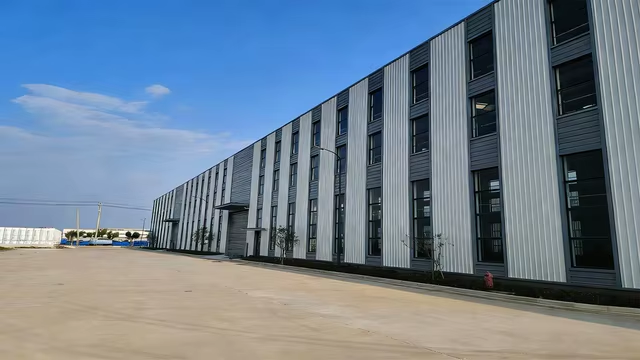
Ghana is moving more goods through ports, industrial estates, cold-chain yards and manufacturing zones, so buyers are asking for steel buildings that can be priced early and still pass local review. This guide is written for procurement teams, EPC contractors, architects and project owners planning a steel structure workshop in Tema, Accra, Kumasi. It focuses on the decisions that change cost, delivery time and site risk: clear span, bay spacing, wind actions, corrosion class, fire access, crane allowance, roof drainage and the information a supplier needs before quoting.
A prefabricated steel frame is attractive in Ghana because factory fabrication reduces site labor, gives better bolt-hole accuracy and shortens the erection window. The building still has to be engineered for the local climate and code route. A warehouse near Tema is not the same as an inland workshop near Kumasi; salt, humidity, heat, rainfall and foundation conditions lead to different paint systems, cladding choices and anchorage details.
For a quick product overview, see our prefab steel warehouse page, review fabrication controls at quality control, or send drawings through Contact Us. Related case-style planning notes are also available in the steel structure blog.
1. Best-fit project scenarios in Ghana
The strongest fit for a steel building in Ghana is a project where long-span space, future expansion and fast enclosure matter. Logistics tenants need truck movement without many internal columns. Manufacturers need clear headroom for production lines and services. Agribusiness owners need durable sheds for feed, packaging, equipment and poultry support. Industrial park developers need a repeatable frame that can be adapted for several tenants without redesigning every detail.
- Distribution centers near Tema with 18-30 m spans, dock doors, office pods and high-level ventilation.
- Factory workshops in Accra or Kumasi with optional 3-20 ton overhead cranes and mezzanine platforms.
- Cold-chain or food processing buildings requiring insulated roof and wall panels, washable linings and controlled drainage.
- Industrial estates where the owner wants phased bays, repeatable column grids and future lean-to expansion.
- Agricultural or poultry support structures using corrosion-aware details around litter, wash-down water and ammonia exposure.
2. Local climate and code checks for Ghana
Early code selection should be agreed by the owner, local engineer and authority reviewer. Many international projects use a mix of local regulations, Eurocode, American standards, or British-derived references. The supplier can design the steel frame to the agreed basis, but the local engineer normally confirms foundations, drainage, fire access, occupancy classification and permit submissions. For climate references, buyers can compare project assumptions with public climate data from the World Bank Climate Change Knowledge Portal and code or public works information from Ghana Standards Authority.
| Design item | Typical question for buyer | Why it matters in quotation |
|---|---|---|
| Basic wind speed | Confirm project city, exposure and height in Ghana | Controls portal frame size, purlin spacing, bracing and cladding fasteners |
| Snow or roof live load | Snow is not governing; roof live load, maintenance load and rain load are more relevant | Changes rafter depth, purlin section and roof slope |
| Seismic category | Seismic demand is usually lower than high-risk zones, but bracing and stability still need formal checks | Affects bracing layout, base plates, anchor rods and drift checks |
| Rainfall and drainage | Heavy seasonal rainfall requires roof slope, gutters, splash control and site drainage | Sets gutter size, downpipes, roof slope and ponding checks |
| Corrosion exposure | Coastal humidity around Tema and salt air require upgraded coatings and fasteners | Determines blast grade, primer, finish coat, hot-dip galvanizing or duplex coating |
| Fire and access | Local fire lane, hydrant, wall rating and exit rules | Influences wall panels, partitions, doors and site layout |
A practical procurement rule is simple: do not compare steel tonnage from two suppliers unless the load basis is the same. A lower weight can mean a smarter design, but it can also mean missing wind suction on corners, crane surge, service loads, or a conservative corrosion allowance. Ask each bidder to state the code, load combinations, deflection limits and coating standard in the offer.
3. Structural grid, span and height decisions
Most steel structure workshop projects start with a portal frame because it gives open floor area and fast erection. Common clear spans are 18 m, 24 m, 30 m and 36 m. Wider spans are possible, but the cost curve rises when rafter depth, transport length and erection lifting requirements grow. For a logistics warehouse, a 24-30 m span with 6-8 m bay spacing often balances steel weight and storage layout. For a crane workshop, column spacing may be set by crane runway loads, equipment foundations and maintenance access.
| Parameter | Common range | Procurement comment |
|---|---|---|
| Clear span | 18-36 m for standard warehouses; larger by design | Select around rack layout, truck movement and future line changes |
| Eave height | 6-12 m for storage; 9-16 m for crane or process buildings | More height increases wind load and cladding area |
| Bay spacing | 6-9 m typical | Affects purlins, girts, bracing and foundation count |
| Roof slope | 1:10 to 1:20 depending on rainfall and cladding | Steeper roof can help heavy rain areas |
| Crane allowance | 3-20 ton common; heavier by design | Must include vertical, lateral and longitudinal crane actions |
| Mezzanine | Office, parts storage, equipment platform | Requires beam vibration and fire egress checks |
Deflection criteria should be listed in the technical offer. Roof beams, wall columns and crane runway beams can all pass strength checks while still moving too much for doors, glazing, bridge cranes or insulated panels. Common checks include roof vertical deflection, column lateral drift, cladding support movement and crane runway alignment. For heavy-duty plants, the design engineer should also review fatigue around crane brackets and runway connections.
4. Materials and fabrication specifications
For international B2B projects, the main frame is commonly fabricated from Q355B/Q355C, ASTM A572 Grade 50, or an equivalent grade agreed in the contract. Secondary members are often galvanized C or Z purlins. Bolted site connections reduce welding at site and make erection faster during the short dry windows that matter in Ghana. The buyer should ask for mill certificates, welding procedure records, welder qualification records, bolt certificates and packing lists linked to member marks.
| Component | Typical specification | Buyer note |
|---|---|---|
| Main frame | Welded H-section columns and rafters, Q355 or equivalent | Check plate thickness, splice location and transport length |
| Purlins and girts | Galvanized Z/C sections, 1.8-3.0 mm typical | Confirm yield strength, zinc coating and lap details |
| Bracing | Round bar, angle steel or tube bracing | Must suit seismic and wind load path |
| Bolts | High-strength bolts for main connections; standard bolts for secondary steel | Ask for grade, quantity and spare percentage |
| Cladding | Single skin steel sheet, sandwich panel, or composite roof build-up | Choose by heat, fire, acoustic and condensation needs |
| Skylight/ventilation | FRP skylight, ridge vent, wall louver, turbine vent or mechanical system | Coordinate smoke venting and rain protection |
Fabrication accuracy matters more than many first-time buyers expect. Misaligned holes create crane delays and site rework. A factory inspection plan should include cutting, fit-up, submerged arc welding, straightening, trial assembly for key frames, coating dry film thickness and final package marking. Our factory tour gives a general view of how members are cut, welded, drilled, blasted and packed before shipping.
5. Surface treatment and corrosion control
Corrosion protection should be selected by exposure, not by habit. A dry inland warehouse near Kumasi may be served by shot blasting to Sa 2.5 and a zinc-rich primer plus finish coat. A coastal logistics shed near Tema may need a thicker coating system, upgraded fasteners and careful detailing at gutters, door tracks and base plates. Poultry and fertilizer buildings need extra attention because ammonia, moisture and chemical dust attack both steel and fasteners.
| Exposure area | Suggested protection | Details to specify |
|---|---|---|
| Dry inland industrial zone | Sa 2.5 blast, epoxy zinc-rich primer, polyurethane topcoat | Dry film thickness target and touch-up paint |
| Coastal or high humidity site | Heavy-duty epoxy system or hot-dip galvanized secondary steel | Stainless or coated fasteners at exposed zones |
| Food or wash-down area | Galvanized members plus washable liner where needed | Avoid water traps; seal panel laps |
| Poultry/agricultural shed | Hot-dip galvanized secondary steel, coated main frame, protected bases | Separate steel from litter and standing water |
| Chemical process bay | Project-specific coating schedule | Confirm chemical type, temperature and cleaning method |
Good corrosion design is also about geometry. Avoid pockets that hold water, keep base plates above finished floor where possible, add grout and sealant correctly, and slope gutters to outlets. Specify compatible fasteners and washers; a good wall sheet can fail early if the screw system is not suitable for the exposure.
6. Roof, wall, insulation and heat control
Thermal comfort and condensation control are key issues in Ghana. A basic storage shed may use single-skin coated steel sheets with reflective foil. A factory with workers, electronics, food products or packaging material may need mineral wool or polyurethane sandwich panels, ridge ventilation, wall louvers and mechanical extraction. In hot zones, roof color, insulation thickness and air changes can affect productivity and product quality.
- For dry goods storage, combine light-colored roof sheets, roof insulation blanket and high-level vents.
- For cold rooms or food handling, use insulated panels, sealed joints and a vapor control strategy.
- For dusty workshops, coordinate exhaust fans, make-up air and maintenance access before finalizing wall openings.
- For high rainfall areas, use wider gutters, overflow points and safe maintenance walkways.
- For offices inside the shed, isolate the office structure from crane vibration and hot roof spaces.
7. Cost range for a steel structure workshop in Ghana
Budget pricing depends on span, height, loads, coating, cladding and shipping route. The following ranges are planning numbers for early feasibility only. They exclude land, tax, final permit fees and most civil works unless stated. A firm quotation needs drawings, load basis, site city, foundation interface, coating schedule, door list and MEP opening list.
| Building type | Indicative steel package range | Typical scope included |
|---|---|---|
| Basic storage warehouse | US$55-95/m² | Main frame, secondary steel, roof/wall sheet, bolts and standard trims |
| Insulated logistics building | US$85-145/m² | Frame, insulated panels or roof blanket, larger gutters, doors, vents |
| Crane workshop | US$100-190/m² | Heavier frame, crane runway beams, bracing and higher eave height |
| Food or cold-chain support shell | US$130-240/m² | Insulated envelope, sealed details, upgraded coating and openings |
| Poultry or agricultural building | US$65-130/m² | Galvanized secondary steel, ventilation openings, corrosion-aware details |
Freight also matters. Containerized steel packages are usually planned by member length, bundle weight and erection sequence. Long rafters may need splicing to fit containers. For Ghana, buyers should check port route, inland trucking limits, unloading equipment and storage area before shipping. A cheap shipment can become expensive if bundles arrive out of sequence or cannot be lifted safely at site.
8. Installation sequence and project schedule
A normal steel structure schedule has five stages: design confirmation, fabrication, coating, shipping and erection. For a 2,000-5,000 m² warehouse, fabrication often takes 4-8 weeks after drawings are approved, shipping depends on route, and site erection may take 3-8 weeks when foundations are ready and lifting equipment is available. Larger projects or crane workshops take longer because connection checks, runway alignment and staged handover need more time.
| Stage | Typical duration | Owner responsibility |
|---|---|---|
| Concept and quotation | 3-10 days | Provide layout, city, height, loads, doors and preferred cladding |
| Detailed design approval | 1-3 weeks | Confirm code basis, foundation reactions, drawings and colors |
| Fabrication and coating | 4-8 weeks | Approve shop drawings and inspection plan on time |
| Sea freight and inland delivery | 2-7 weeks depending on route | Arrange customs broker, unloading area and lifting plan |
| Erection | 3-10 weeks by size and complexity | Finish foundations, anchor bolts, access road and safety plan |
The biggest schedule risk is not steel fabrication; it is late design data. Door sizes, crane data, mezzanine loads, solar panel loads, sprinkler pipe loads and roof equipment should be issued before shop drawings are frozen. If these are added after fabrication starts, the project may need strengthening, new holes, extra bracing or revised anchor bolts.
9. Procurement checklist for buyers in Ghana
A clear request for quotation helps suppliers price the same building. It also prevents long email cycles where each bidder makes a different assumption. Send a marked layout and a short technical sheet before asking for price.
- Project city and exact site environment: inland, coastal, industrial, agricultural or chemical exposure in Ghana.
- Length, width, eave height, roof slope, column grid and any future extension plan.
- Design code preference, wind speed, roof live load, seismic requirement and service loads.
- Door schedule, loading bay count, canopy needs, skylight area, louvers and ventilation method.
- Crane capacity, span, hook height, duty class and runway length if a workshop is planned.
- Preferred coating system, cladding type, insulation target and fire-rating needs.
- Delivery term, port, site access limits, unloading equipment and installation support required.
If you are comparing several building options, our products page lists common prefab building types, while the contact page is the fastest way to send layouts for a project-specific estimate.
10. Engineering documents to request before deposit
Before deposit, the buyer should receive enough technical detail to understand what is being purchased. A one-line price is not enough for an industrial building. Ask for a preliminary general arrangement drawing, member layout, material list, coating description, cladding specification, design assumptions and commercial exclusions. For larger projects, ask for reactions at column bases so the local civil engineer can begin foundation design.
| Document | Purpose | When to request |
|---|---|---|
| General arrangement drawing | Confirms dimensions, grids, doors, bracing and roof layout | Before contract signing |
| Design load sheet | Records wind, roof live load, seismic and crane data | Before final price comparison |
| Anchor bolt plan | Allows foundation contractor to set bolts correctly | Before foundation casting |
| Shop drawings | Shows member marks, holes, plates and splice details | Before fabrication release |
| Packing list | Links bundles to erection sequence and customs documents | Before shipment |
| Installation drawings | Guides frame erection, bracing, purlins, cladding and trims | Before containers arrive |
11. Local buyer concerns in Ghana
Ghana industrial projects often combine port access, seasonal rain and limited site laydown area. Tema warehouses need good corrosion protection and a delivery plan that accounts for port clearance and inland transport. Kumasi workshops may focus more on production workflow, crane runway alignment and road access for long members. In both cases, a clear anchor bolt plan and early foundation coordination reduce delays.
For factories serving food, packaging, mining supply or automotive repair, ventilation and heat control should be discussed at concept stage. A low-cost single-skin shed may be acceptable for equipment storage, but worker areas and process lines usually need insulation, ridge vents, wall louvers or mechanical exhaust.
International design references can support local review when clearly stated. For wind and load concepts, buyers often refer to ASCE 7 or Eurocode documents in parallel with local requirements. For fire and building safety terminology, the International Code Council code library is also a useful reference, although the authority having jurisdiction in Ghana has the final say.
12. Common buyer questions
Can one supplier design both the steel frame and the foundation for Ghana?
The steel building supplier can provide base reactions, anchor bolt layout and connection details. The final foundation design is normally completed or checked by a licensed local civil or structural engineer because soil bearing, settlement, drainage and permit responsibility are local matters.
How early should crane data be given?
Give crane capacity, span, duty class, hook height, wheel loads and runway length before the frame is priced. Adding a crane later can change columns, rafters, bracing, foundations and even building height.
Is a lighter steel weight always better?
No. A lighter design is good only when it uses the same code, loads, deflection limits and coating scope. Missing wind suction, service loads or crane actions can reduce price on paper but create risk at site.
Can the building be expanded later?
Yes, if expansion is planned in the first design. End-wall columns, bracing positions, purlin laps, cladding removal points and foundation layout should be arranged for the future bay or side extension.
What information is needed for a firm quote?
Send project city in Ghana, layout, dimensions, eave height, load basis, door list, crane data, insulation target, coating requirement and delivery port. Photos or soil notes help the engineering team spot site issues early.
13. How to compare quotations without hidden scope gaps
A steel building quotation for Ghana should be read as an engineering scope, not only a price sheet. Check whether the supplier includes anchor bolts, edge trims, gutters, downpipes, ridge caps, flashing, skylights, louvers, personnel doors, rolling doors, canopy steel and installation bolts. A missing item may look small during tender but can delay enclosure when the erection crew is waiting for matching parts.
Ask bidders to separate the main frame weight, secondary steel weight, cladding area, coating system and accessory list. This makes it easier to see whether one offer is cheaper because of better production efficiency or because it removed insulation, reduced coating thickness, ignored crane loads or assumed a smaller door package. For port projects, also compare packing method and container count because freight, unloading and customs documents affect the delivered cost.
- Request a written exclusion list and check it against your tender drawings.
- Confirm whether the quoted price includes design drawings, shop drawings and installation drawings.
- Check the paint dry film thickness, surface preparation grade and repair method for site scratches.
- Ask for a member marking system that matches packing lists and erection drawings.
- Keep a contingency for local civil works, fire services, floor slab, drains, utilities and authority comments.
14. Risk points during erection and handover
Erection quality in Ghana depends on foundation accuracy, lifting access, bolt control and temporary stability. Anchor bolts should be checked before steel arrives, including projection, spacing and grout allowance. During frame erection, temporary bracing must remain until permanent bracing, purlins and girts create a stable system. Removing temporary supports too early can twist frames or overload connections.
Handover should include as-built notes, bolt tightening records where required, coating touch-up records, roof leak inspection, door operation checks and a list of spare fasteners or panels. For buildings with cranes, runway beam alignment and end-stop installation should be checked before the crane is commissioned. For insulated envelopes, inspect panel joints, sealant lines and penetrations around fans, pipes and cable trays.
Practical purchasing advice
For a serious steel structure workshop order, start with engineering clarity, not only price. Confirm the load basis, corrosion exposure, cladding system, installation responsibility and document list. Then compare bidders using the same scope. A reliable steel package should arrive with marked members, bolts, drawings and a clear erection sequence, so the local contractor can build safely and quickly.
SteelStructurePrefab can support early budget checks, preliminary layouts, fabrication drawings and export packing for warehouses, workshops, hangars, poultry houses and industrial steel buildings. Share your Ghana project data through Contact Us and our engineering team will suggest a practical frame scheme, coating option and shipping plan.