
Photovoltaic (PV) Mounting Steel Materials: Wind, Snow & Corrosion Resistance Standards for Solar Projects

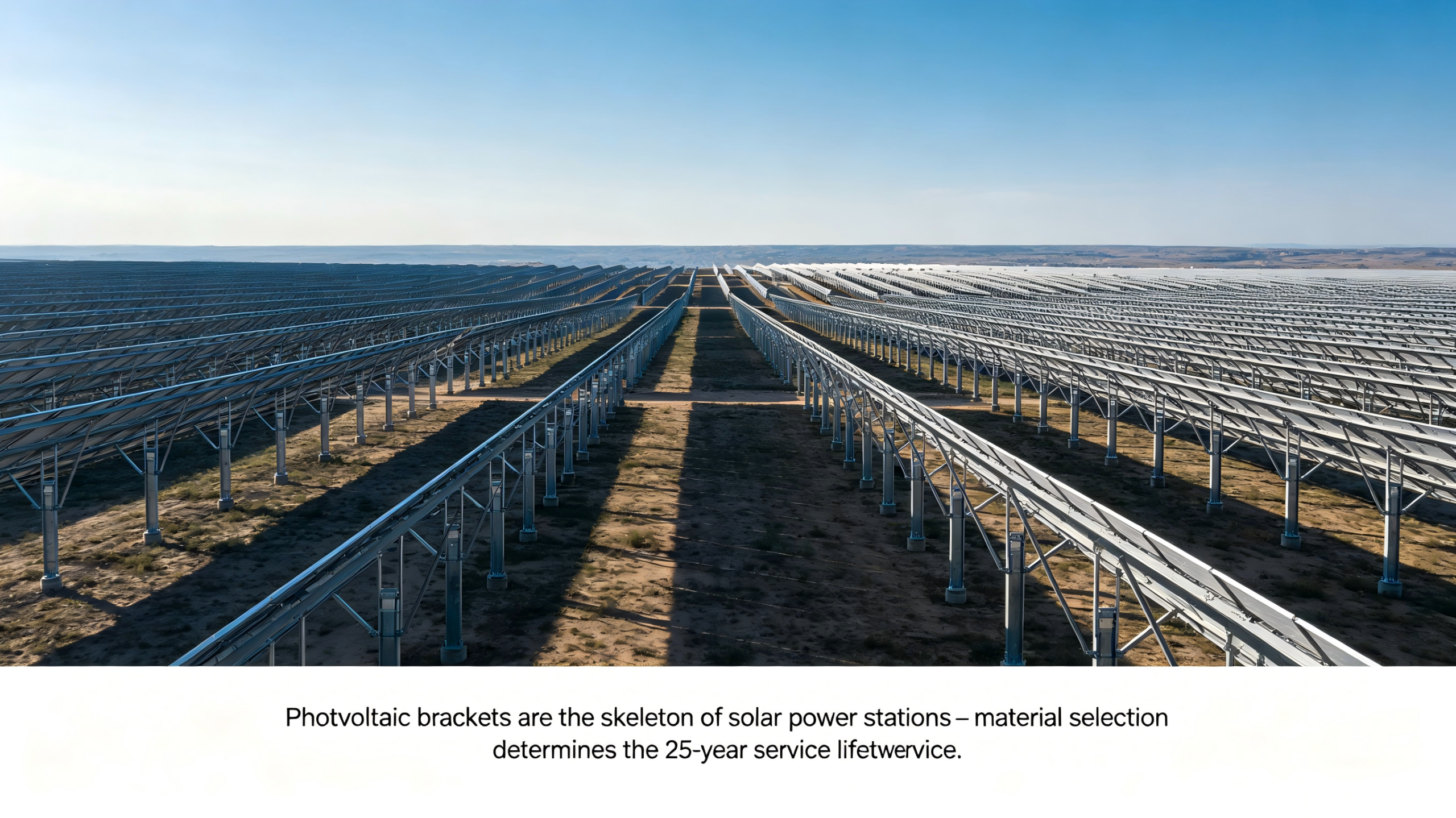
Hot-dip galvanized steel, zinc-aluminum-magnesium (ZAM) steel, and aluminum alloys for PV mounting structures. Material properties, load resistance standards, and corrosion protection for international solar farm projects.
Solar energy is booming worldwide. From utility-scale solar farms in deserts to rooftop arrays on industrial buildings, photovoltaic (PV) installations require one critical supporting structure: the mounting system.
The PV mounting structure must withstand wind uplift, snow loads, seismic forces, and decades of weather exposure—all while keeping solar panels securely in place. Material selection is not just about strength; it is about matching the right material to the specific environmental demands of the project site.
For overseas clients developing PV projects, understanding steel grades, coating systems, and load resistance standards is essential for ensuring system longevity and bankability.
This guide covers:
- Steel materials for PV mounting structures (Q235B, Q355B, S550).
- Zinc-aluminum-magnesium (ZAM) coated steel for corrosion resistance.
- Aluminum alloy (6063-T6) applications and comparisons.
- Wind load and snow load resistance standards.
- Corrosion protection requirements by environment.
- Fasteners and connections for PV systems.
- Selection guide by project type (ground-mount, rooftop, coastal).
1. Why PV Mounting Material Selection Matters
The PV mounting structure supports solar panels for 25+ years—the typical design life of a solar power plant. Material failure during this period leads to:
- Panel misalignment or detachment (power loss)
- Safety hazards (falling panels)
- Costly maintenance and replacement
- Project finance rejection (lenders require proven durability)
Key requirements from international standards:
- Design life: 25 years minimum
- Structural integrity under wind, snow, and seismic loads
- Corrosion protection matching environmental exposure
- Compliance with local building codes
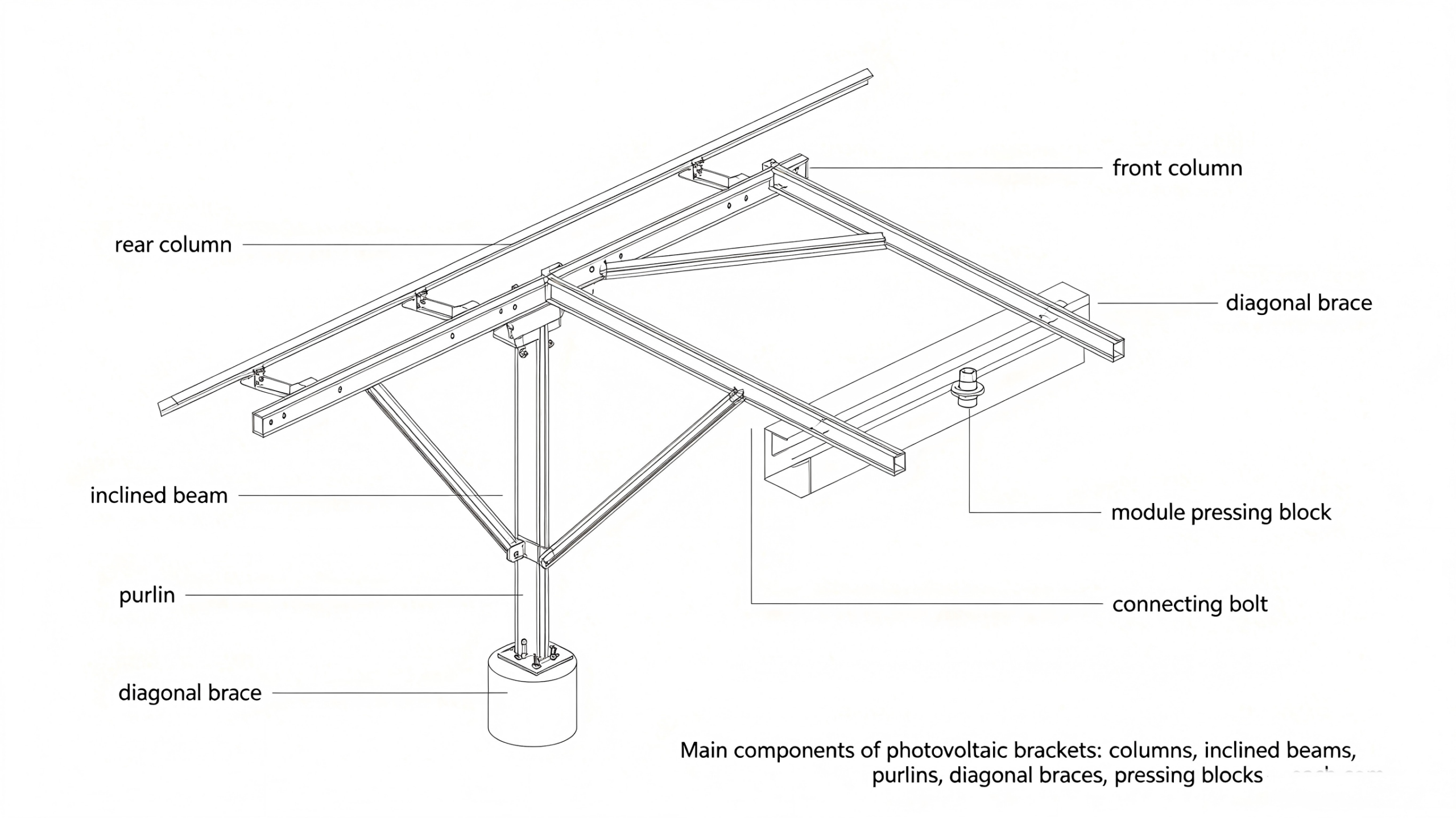
2. Steel Materials for PV Mounting Structures
Steel is the most common material for PV mounting systems due to its high strength, availability, and cost-effectiveness.
A. Standard Structural Steel Grades
| Grade | Yield Strength (MPa) | Tensile Strength (MPa) | Typical Application |
|---|---|---|---|
| Q235B (ASTM A36 equivalent) | 235 MPa | 370-500 MPa | Light-duty mounts, small projects, budget applications |
| Q355B (ASTM A572 Gr50) | 355 MPa | 470-630 MPa | Standard utility-scale PV mounts, medium spans |
| S390-S460 (high-strength) | 390-460 MPa | 470-600+ MPa | Long spans, heavy snow loads, large-scale solar farms |
Design thickness requirements:
- General steel members: minimum thickness 2.0mm
- High-strength steel (≥420 MPa yield): minimum thickness 0.8mm
B. High-Strength Thin-Walled Steel for Lightweight Design
Research demonstrates that upgrading from Q235B to S550 high-strength steel enables significant weight reduction.
| Parameter | Traditional (Q235B) | High-Strength (S550) | Improvement |
|---|---|---|---|
| Thickness | 2.0mm | 1.5mm | -25% |
| Purlin weight per group | 56.0 kg | 42.4 kg | -24% |
| Total mount weight | Baseline | -12% | Lighter structure |
| Total cost | Baseline | -13% | Lower project cost |
Why high-strength steel works: At 550 MPa yield strength, S550 steel allows thinner sections while maintaining load capacity. This is particularly valuable for rooftop PV projects where building load capacity is limited.
Applications: Industrial rooftop PV, carports, projects with weight restrictions.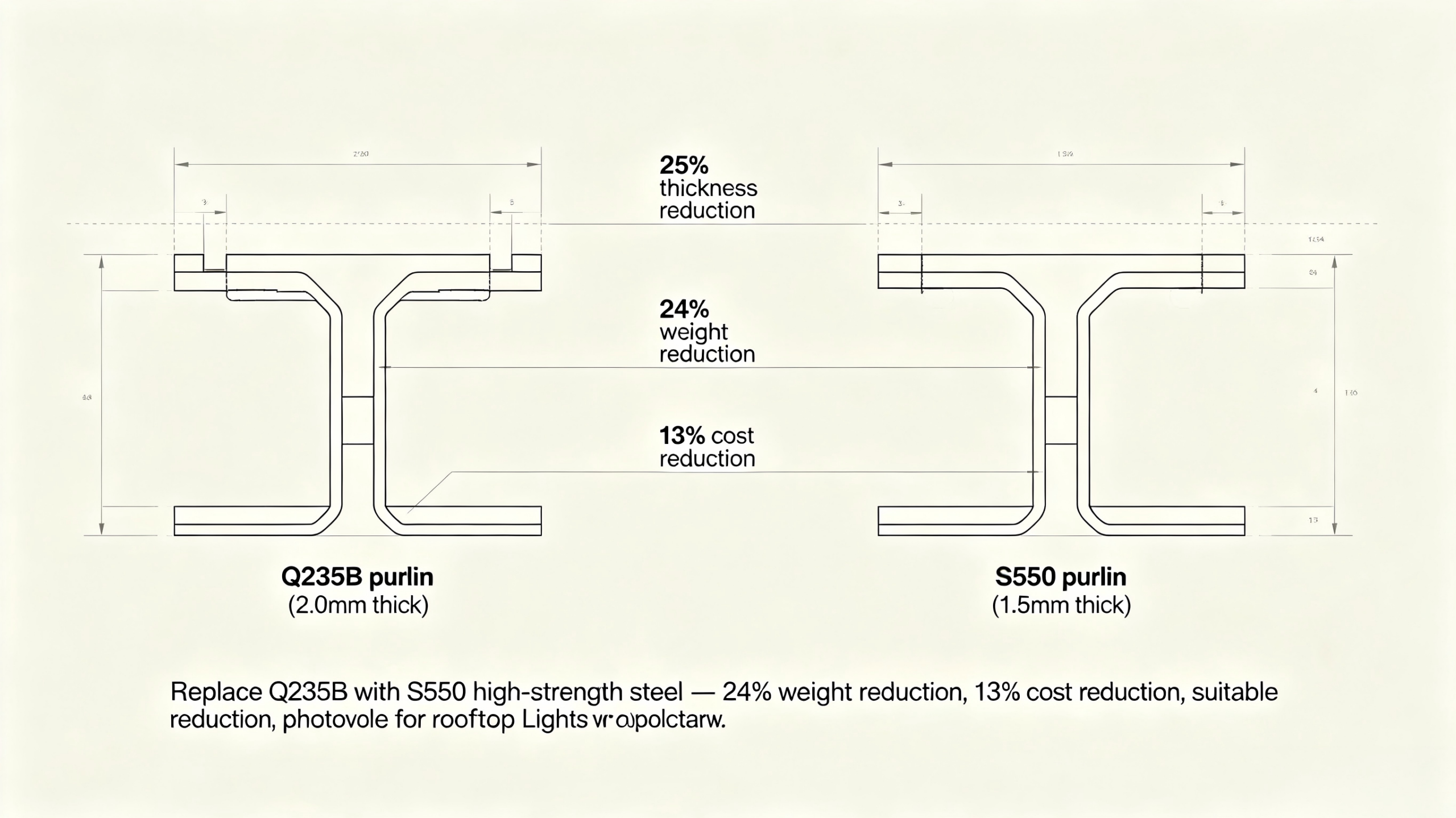
3. Corrosion Protection: Coatings and Standards
PV mounting structures are exposed to weather year-round. Corrosion protection is critical for 25-year design life.
A. Hot-Dip Galvanizing (HDG)
| Parameter | Standard | Requirement |
|---|---|---|
| Coating thickness (general) | ISO 1461 | 55-80μm minimum |
| Coating thickness (corrosive environments) | Custom | 100μm minimum with annual inspection |
| Coating mass | ISO 1461 | 600-800g/m² typical |
Surface preparation requirement: Sa2.5 blast cleaning before galvanizing.
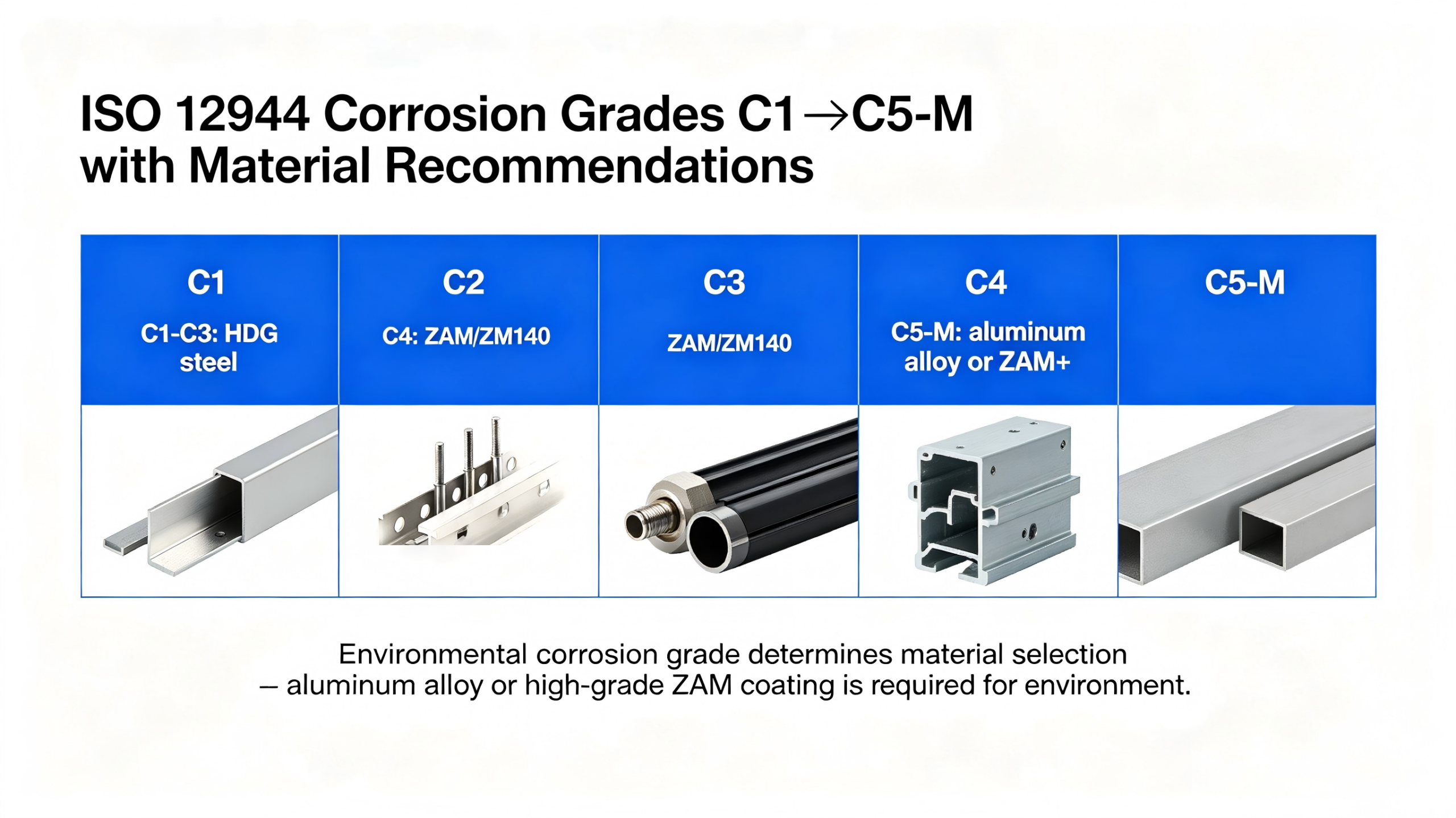
Lifespan: 80μm HDG provides 20+ years protection in C1-C4 environments.
B. Zinc-Aluminum-Magnesium (ZAM) Coated Steel
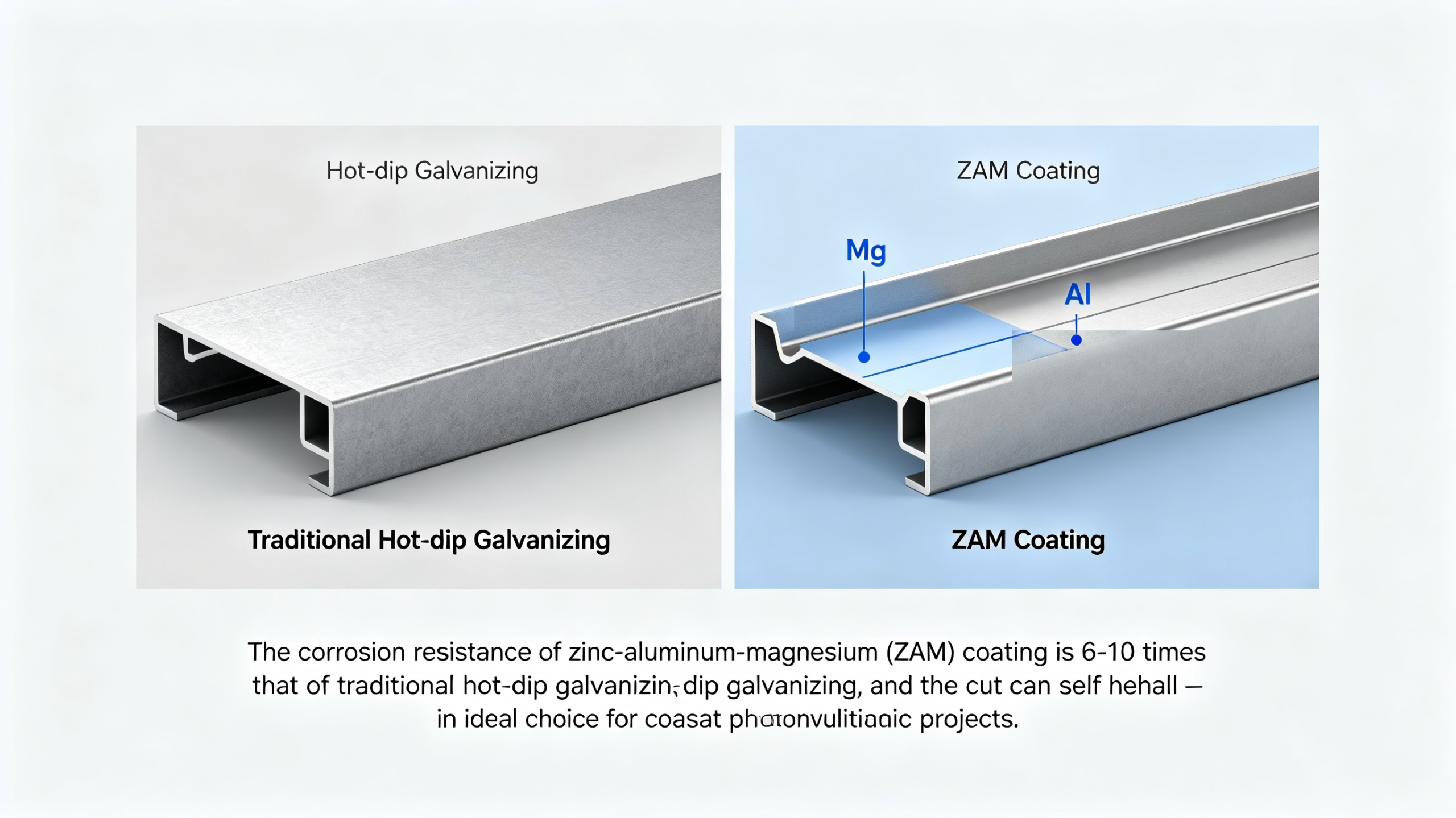
ZAM coating is an advanced corrosion protection technology with significantly higher performance than traditional galvanizing.
| Property | ZAM Coating | Traditional HDG |
|---|---|---|
| Corrosion resistance | 6-10× HDG | Baseline |
| Surface hardness | 2× HDG | Baseline |
| Cut-edge self-healing | Yes (Mg migrates to cut edge) | No |
| Typical coating weight | ZM80 to ZM310 (80-310g/m²) | Z275 (275g/m²) |
Why ZAM is superior:
- Magnesium and aluminum in the coating form stable, dense corrosion products
- Cut edges are protected by zinc/magnesium migration (unique to ZAM)
- Excellent performance in high-humidity and coastal environments
Applications: Coastal PV projects, high-corrosion environments, long-life applications requiring minimal maintenance.
C. Aluminum Alloy (No Coating Required)
Aluminum naturally forms a protective oxide layer, eliminating the need for coating in most environments.
| Grade | Standard | Typical Use |
|---|---|---|
| 6063-T6 | EN 755 | Extruded aluminum rails, clamps, frames |
Corrosion performance: Aluminum is self-protecting in atmospheric environments (passivation layer). Corrosion rate decreases over time, unlike steel which continues to corrode once coating is damaged.
Applications: Rooftop PV (lightweight requirement), corrosive environments (chemical plants, coastal), architectural applications (aesthetics matter).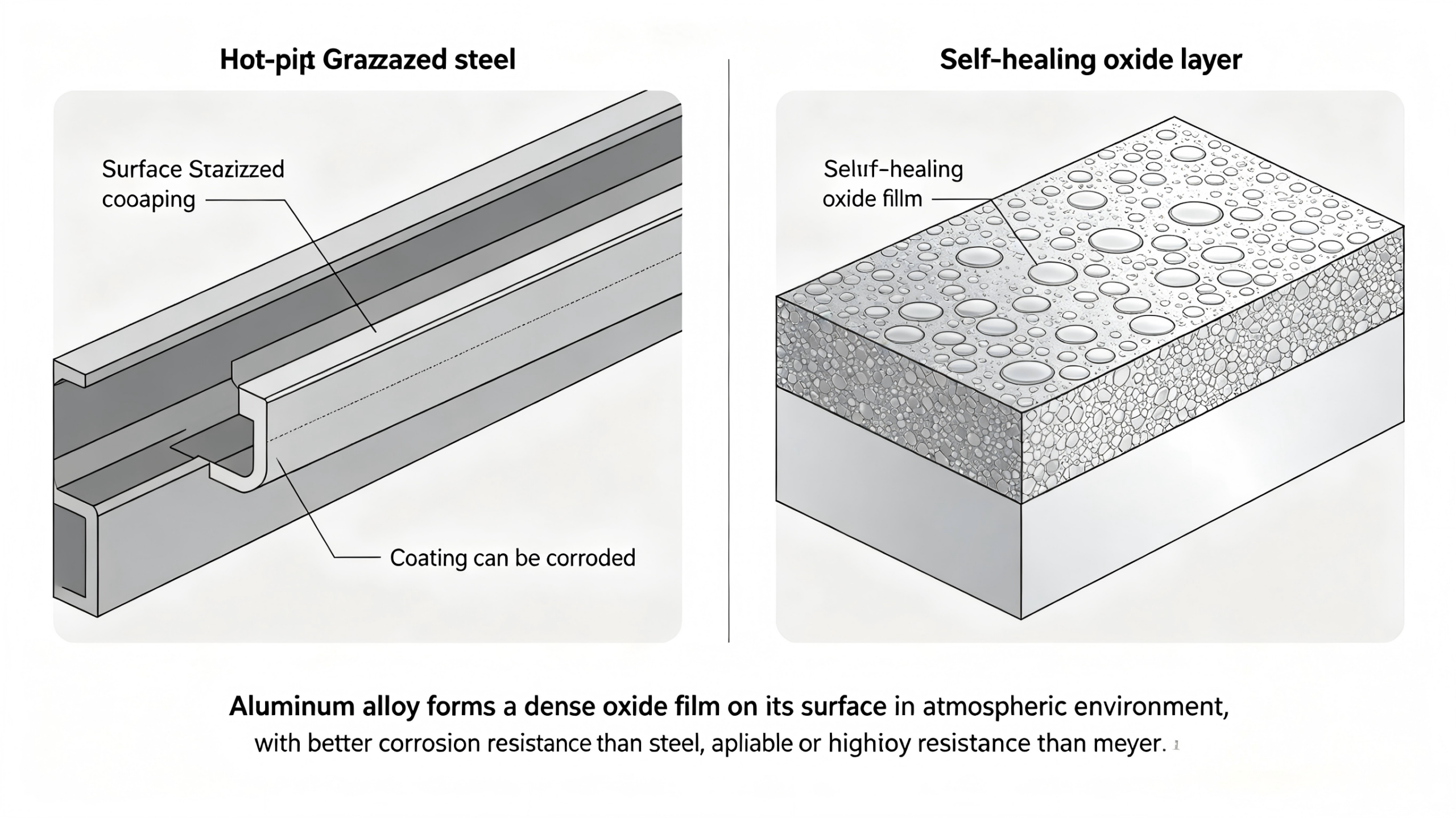
4. Aluminum Alloy vs. Steel: Detailed Comparison
PV mounting material selection often involves choosing between steel and aluminum. Each has distinct advantages.
| Parameter | Steel (Q235B/Q355B) | Aluminum (6063-T6) | Winner |
|---|---|---|---|
| Yield strength | 235-355 MPa | ~160-200 MPa | Steel |
| Modulus of elasticity | 200 GPa | 69 GPa | Steel |
| Deflection under same load | Baseline | 2.9× steel | Steel |
| Density (weight) | 7.85 g/cm³ | 2.70 g/cm³ | Aluminum |
| Corrosion protection | Requires coating (HDG/ZAM) | Self-protecting | Aluminum |
| Aesthetics/finish | Industrial (HDG) | Anodized, polished, painted | Aluminum |
| Section flexibility | Roll-formed (fixed profiles) | Extruded (custom profiles) | Aluminum |
| Initial cost | Baseline | 1.3-1.5× steel (small spans) | Steel |
Selection guidance:
| Condition | Recommended Material | Why |
|---|---|---|
| Large ground-mount solar farm | Steel (HDG) | Lower cost, high strength for long spans |
| Rooftop PV (load-limited) | Aluminum or high-strength steel (S550) | Lightweight reduces building load |
| Coastal / corrosive environment | Aluminum or ZAM-coated steel | Superior corrosion resistance |
| Architecturally exposed (e.g., carport) | Aluminum (anodized) | Aesthetic finish options |
| Long-span applications (agri-PV) | Steel (Q355B or S550) | Higher strength, less deflection |
| Small residential rooftop | Aluminum | Lightweight, easy handling, aesthetic |
5. Wind Load Resistance: Structural Requirements
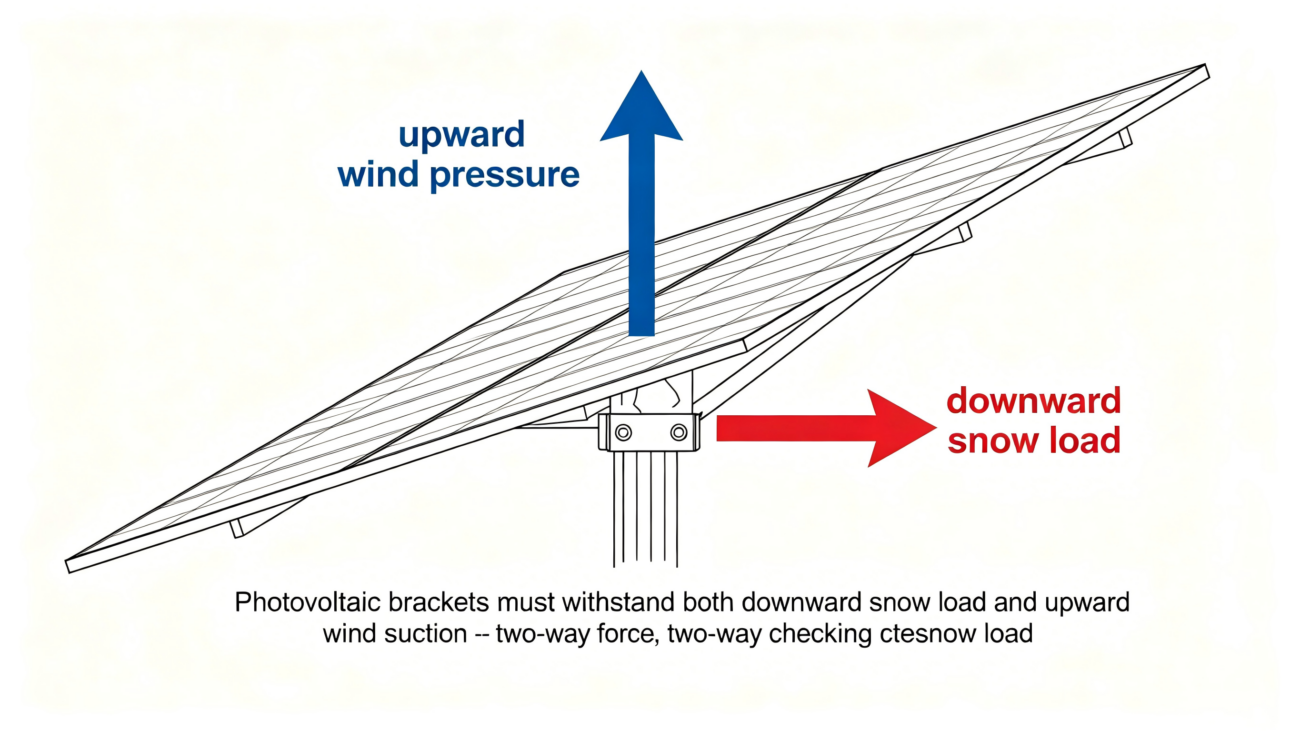
Wind loads are often the governing design factor for PV mounting structures, particularly in open terrain or coastal areas.
Load Calculation Standards
| Standard | Region | Application |
|---|---|---|
| Eurocode 1 (EN 1991-1-4) | Europe | Wind actions on structures |
| ASCE 7 | North America | Minimum design loads for buildings |
Key Design Requirements
| Parameter | Requirement |
|---|---|
| Return period | 50-year basic wind speed |
| Structural check | Strength under wind pressure and wind suction |
| Component verification | Columns, beams, purlins, connections all checked |
| Longitudinal bracing | Required for structural integrity under wind |
| Bolt tension check | Verify pull-out resistance under wind uplift |
Special consideration for typhoon-prone regions (e.g., Southeast Asia, coastal China, Caribbean):
- Factory pre-assembly required (prevent field adjustments that compromise quality)
- Use aluminum clamps parallel to panel frames (maximize contact area)
- Spring washers on all bolts (prevent loosening under vibration)
- U-shaped channels with inner serrated clamps (prevent rotational loosening)
6. Snow Load Resistance: Deflection Control
Snow accumulation creates significant downward loads, particularly in northern climates and mountain regions.
| Load Type | Design Consideration |
|---|---|
| Uniform snow load | Standard design case |
| Drifted snow | Uneven loading at changes in roof height or obstructions |
| Sliding snow | Additional load at lower elevations of sloped arrays |
Deflection limits:
| Member Type | Deflection Limit |
|---|---|
| Roof purlins (general) | L/200 (where L = span length) |
| Rafters (general) | L/250 |
| Cantilever beams | L/100 (where L = 2 × overhang length) |
Material selection for snow loads:
| Snow Load Condition | Recommended Material | Why |
|---|---|---|
| Light to moderate (0.5-1.5 kN/m²) | Q235B or aluminum | Sufficient strength, cost-effective |
| Heavy (1.5-3.0 kN/m²) | Q355B steel | Higher yield strength, less deflection |
| Extreme (>3.0 kN/m²) | High-strength steel (S460-S550) | Maximum strength for deep snow regions |
Design note: Deflection under snow load is often the limiting factor, not strength. Steel’s higher elastic modulus (200 GPa vs. aluminum’s 69 GPa) makes it stiffer under snow load.
7. Fasteners and Connections
Fastener corrosion is a common failure point in PV mounting systems.
| Fastener Type | Material/Coating | Application |
|---|---|---|
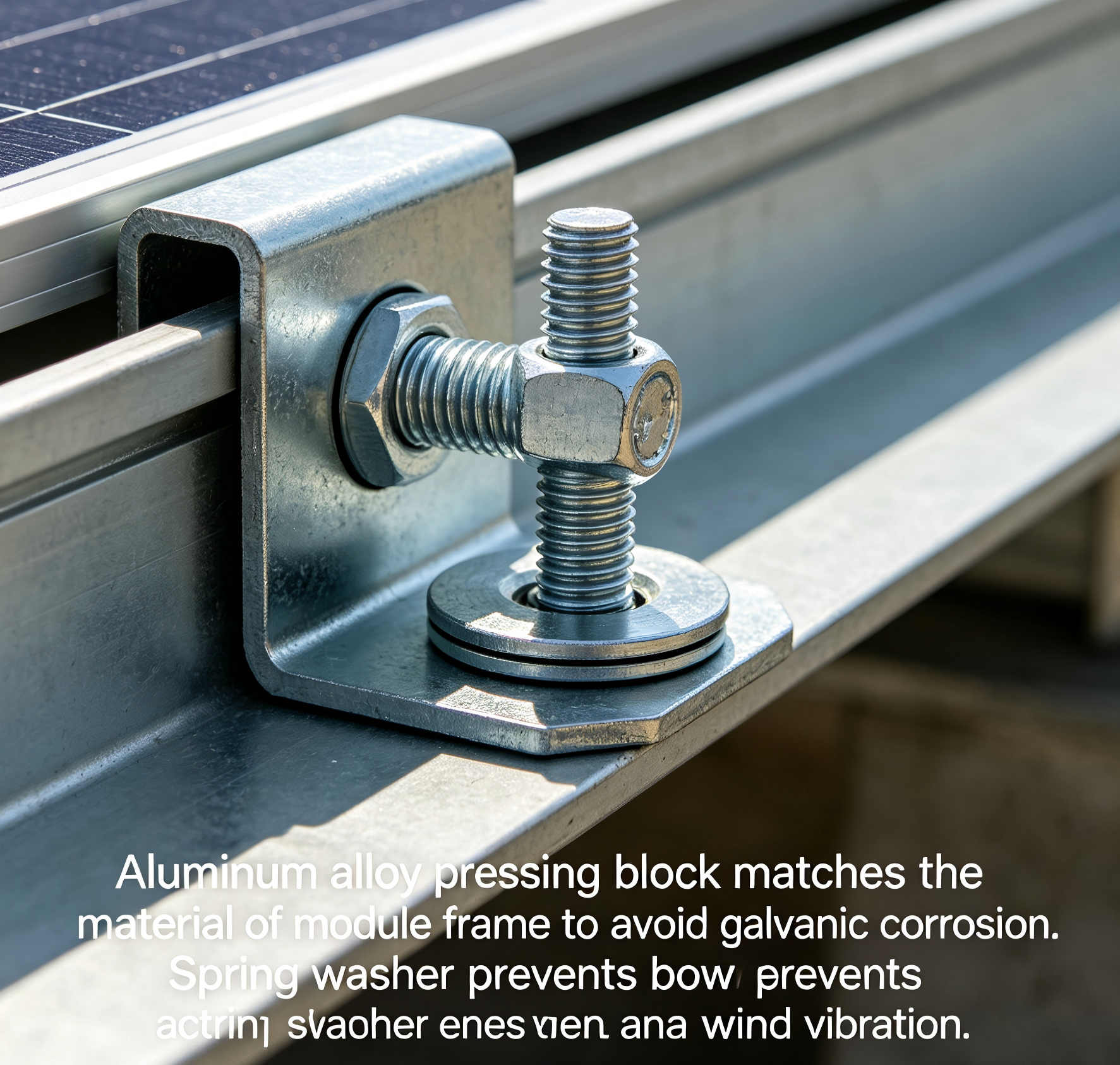
| Module clamp bolts | Aluminum (to match module frame) | Prevents galvanic corrosion with aluminum module frames |
| Structural bolts (steel-to-steel) | Hot-dip galvanized, 45μm minimum coating | Main structure connections |
| Washers | Flat + spring washers (two flat + one spring per bolt) | Prevents loosening under vibration |
| Ground screws/foundation anchors | HDG steel or stainless | Soil-contact applications |
Galvanic corrosion prevention: When aluminum components contact dissimilar metals (steel, copper), isolate with neoprene pads or use stainless steel fasteners.
Quality requirements for high-wind zones:
- Aluminum clamps must be parallel to panel frames (ensure full contact area)
- U-channel inner serrated clamps must be perpendicular to the channel (prevent rotation)
- Spring washers required on all bolted connections
8. Design Life and Maintenance Requirements
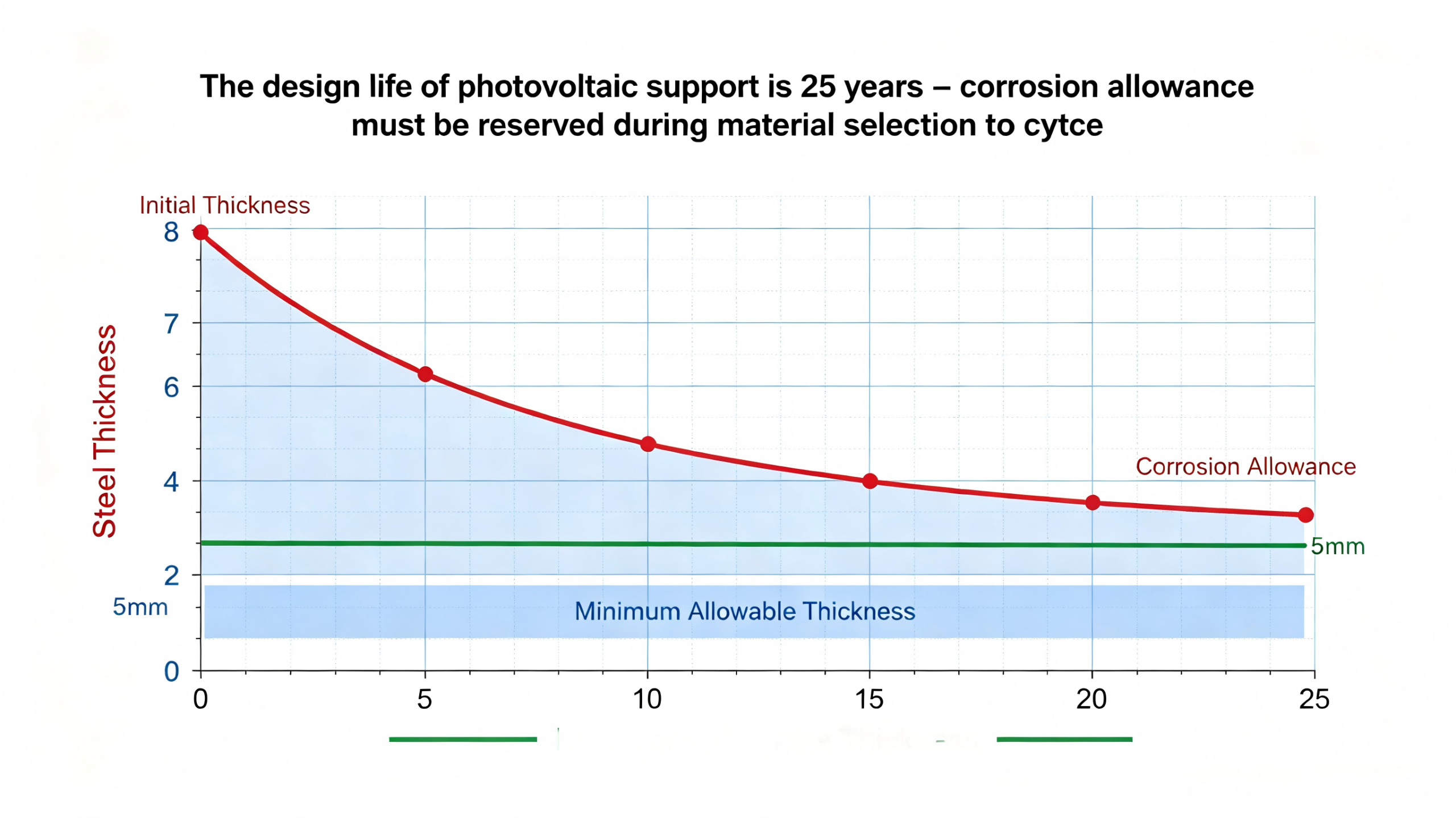
International standards mandate a 25-year design life for PV mounting structures.
| Requirement | Specification |
|---|---|
| Design life | 25 years minimum |
| Corrosion allowance | Appropriate for environmental exposure class |
| Inspection frequency | Regular (specific interval depends on environment) |
| Maintenance access | Designed into structure |
For coastal or corrosive environments: Annual inspection required when using standard HDG steel (100μm coating). Aluminum or ZAM-coated steel reduces maintenance requirements.
End-of-life considerations:
- Steel structures have residual scrap value (~70% of weight as scrap)
- Aluminum retains value (~65% recovery at 30 years)
- Design for disassembly (bolted connections vs. welded)
9. Selection by Project Type
| Project Type | Recommended Material | Coating | Key Considerations |
|---|---|---|---|
| Utility-scale ground-mount | Q355B steel | HDG (55-80μm) or ZAM | Cost-effective, long spans |
| Rooftop industrial (load-limited) | S550 high-strength steel or aluminum | ZAM or anodized | Lightweight critical |
| Coastal / marine environment | Aluminum or ZAM-coated steel | Anodized (Al) or ZM275+ | Salt spray resistance |
| Agri-PV (agricultural) | Q355B or S460 steel | HDG (80μm min) | Long spans, high strength |
| Carport / shade structure | Aluminum (anodized) or HDG steel | Architectural finish | Aesthetic + structural |
| Residential rooftop | Aluminum 6063-T6 | Anodized | Lightweight, easy handling |
| Cold climate / heavy snow | Q355B or high-strength steel | HDG or ZAM | High stiffness, strength |
| High-wind region (>150 km/h) | Q355B steel | HDG (80μm min) | Strength under uplift |
10. Quality Documentation for Overseas Projects
For international PV projects (especially those requiring project finance), documentation is essential.
| Document | Required For | Content |
|---|---|---|
| Mill certificate (MTC) | All steel | Heat number, chemical analysis, mechanical properties |
| Coating certificate | HDG/ZAM | Coating thickness, adhesion test results |
| Third-party test report | Bankability (project finance) | Independent verification of material properties |
| Load calculation report | Design approval | Wind, snow, seismic analysis per local code |
| Corrosion protection plan | Coastal projects | Corrosion control strategy |
Recommended third-party inspection: SGS, BV, TÜV, or Intertek witness testing for large-scale projects.
11. Link to PV Mounting Steel Structure Service
We supply complete PV mounting steel structures—engineered to your local wind, snow, and seismic conditions.
Our PV mounting services include:
- Material supply: Q235B, Q355B, S550 high-strength steel; aluminum 6063-T6
- Coating options: Hot-dip galvanizing (55-80μm or custom), ZAM (ZM140-ZM310), anodized aluminum
- Fabrication: Cold-formed C/Z sections, aluminum extrusions, cut-to-length, pre-punched holes
- Load engineering: Wind load, snow load, seismic calculations per Eurocode, ASCE, or GB standards
- Fasteners: Aluminum clamps, HDG or stainless steel structural bolts, spring washers
- Documentation: Mill certificates, coating reports, load calculation reports
👉 [Contact Us] — Send us your project location, panel specifications, wind speed, snow load, and environmental conditions. We will return material recommendations, section sizes, coating specifications, and a budget price within 48 hours.
Summary Table: Quick PV Mounting Material Selection
| Site Condition | Recommended Material | Coating | Why |
|---|---|---|---|
| Desert / dry climate | Q235B or Q355B steel | HDG (55μm) | Low corrosion, cost-effective |
| Temperate grassland | Q355B steel | HDG (80μm) | Balanced performance |
| Coastal (<1km from sea) | Aluminum or ZAM-coated steel | Anodized (Al) or ZM275 | Salt spray resistance |
| Industrial / polluted | ZAM-coated steel or aluminum | ZM200 or anodized | Chemical resistance |
| Heavy snow region (>2 kN/m²) | Q355B or S460 steel | HDG (80μm) | High stiffness, strength |
| High wind region (>150 km/h) | Q355B steel | HDG (80μm+) | Uplift resistance |
| Rooftop (weight limited) | Aluminum or S550 steel | Anodized or ZAM | Lightweight |
| Cold climate (<-20°C) | Q355D (impact-tested) | HDG or ZAM | Low-temperature toughness |