
Prefab Steel Warehouse Cost: Insulated Panel vs Single-Skin Cladding Budget Impact

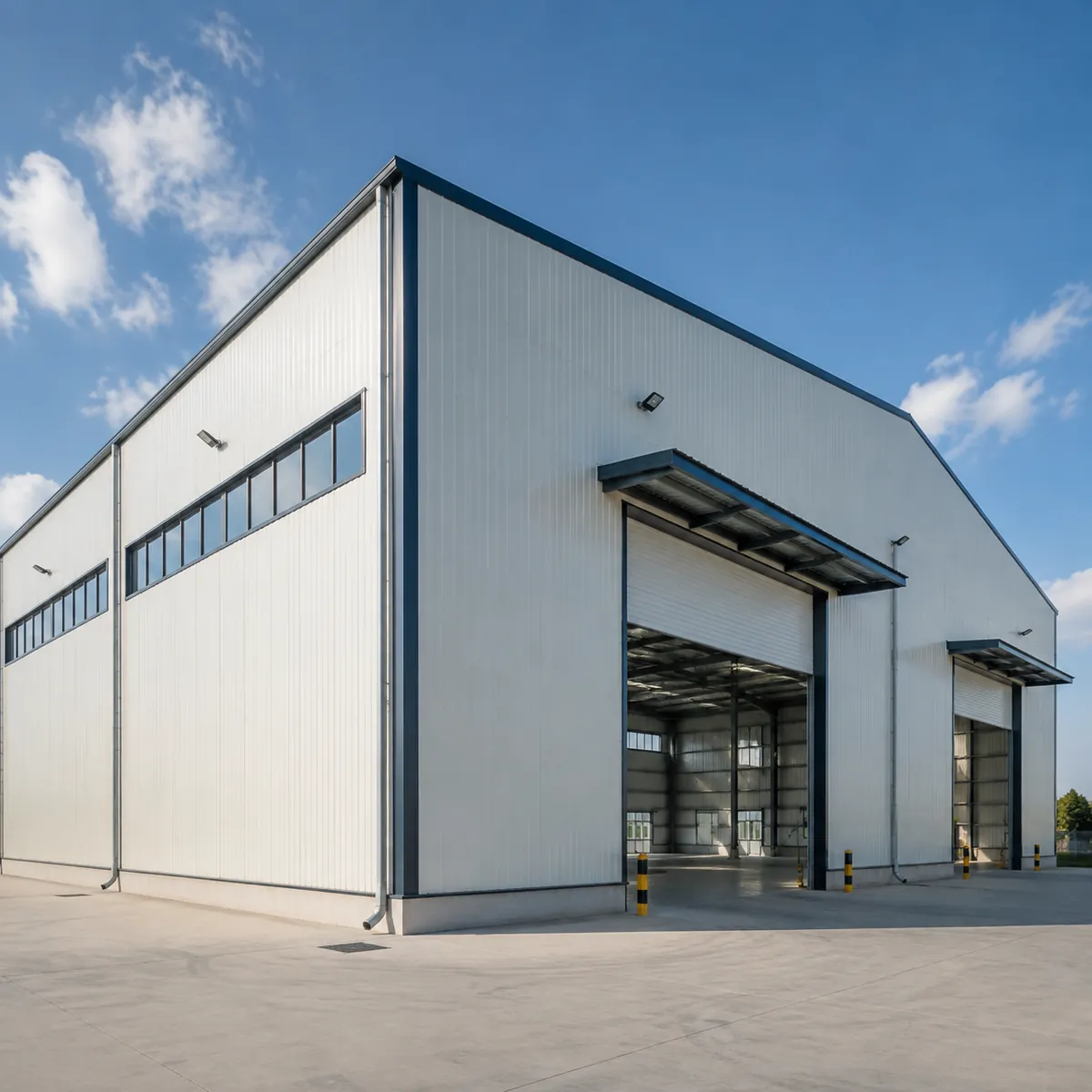
Cladding is where prefab steel warehouse cost splits into two very different budgets: a single-skin metal sheet building is noticeably cheaper per square meter, while an insulated sandwich panel building costs more upfront but changes your operating costs, condensation risk, and in some cases your insurance and compliance position. The right choice is not “which is cheaper” but “which matches how the warehouse will be used”. This guide compares the cladding options by price impact, thermal performance, condensation behavior, and payback, so you can make the budget decision with the numbers that actually matter.
Why cladding drives a big part of warehouse cost
For a typical single-storey steel warehouse, the roof and wall cladding can represent a substantial share of the total building cost — in many projects the envelope is one of the three largest cost items after the steel frame and the foundation. That makes the cladding specification one of the highest-leverage decisions in the whole project. A small change in panel type or thickness moves the budget by thousands of dollars on a mid-size warehouse, and the decision affects energy bills for the life of the building.
The cladding decision also interacts with the frame: insulated panels are heavier than single-skin sheets, which can increase purlin sizes and frame loads slightly, and they need different edge details and fixings. So the choice should be made before the design is finalized, not as a last-minute substitution.
The two cladding families
Single-skin metal cladding
Single-skin cladding is a formed steel sheet (usually 0.4 to 0.6 mm, with a color-coated finish) fixed directly to the purlins and girts. It is the lowest-cost envelope, fast to install, and perfectly adequate for unheated storage, workshops, machinery halls, and any building where temperature control is not critical. Its weakness is thermal performance: a single metal skin transfers heat quickly, so interiors heat up under sun and cool down fast at night. It also creates condensation risk in humid climates when warm moist air meets the cold metal surface.
Insulated sandwich panels
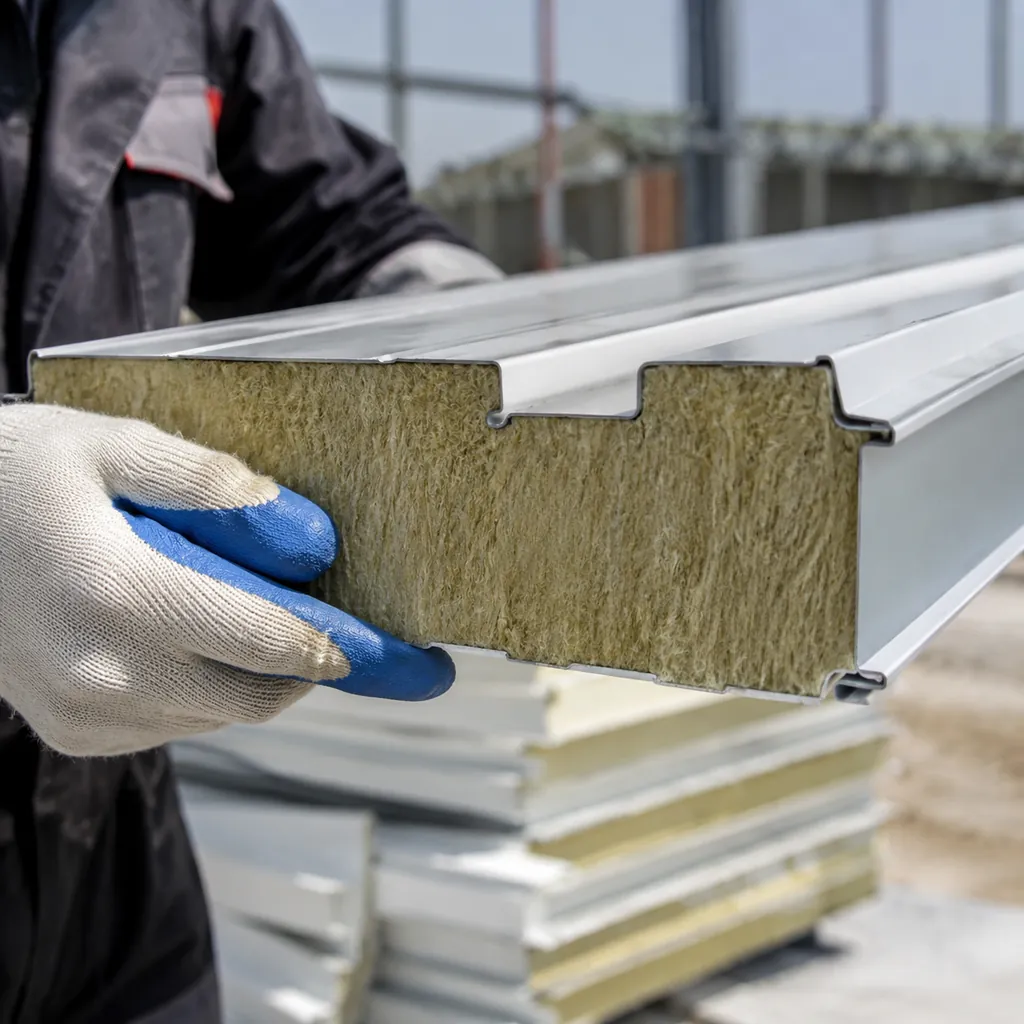
Sandwich panels bond two metal skins around a core of insulation — commonly EPS (expanded polystyrene), PIR/PUR (polyurethane/polyisocyanurate), or rock wool (mineral wool). They provide thermal insulation, reduce condensation, and improve the interior environment with a single installation step. Sandwich panels cost more per square meter than single-skin sheet, and the price difference grows with panel thickness and core type. For conditioned spaces, cold storage, offices inside the warehouse, or humid climates, they are usually the right call.
| Cladding option | Typical thickness | Relative material cost | Thermal performance | Best use |
|---|---|---|---|---|
| Single-skin steel sheet | 0.4–0.6 mm | Lowest | Poor — high heat transfer | Unheated storage, workshops, machinery halls |
| EPS sandwich panel | 50–100 mm | Low–medium | Good for the price | Dry warehouses, offices, moderate climates |
| PIR/PUR sandwich panel | 50–120 mm | Medium–high | Best insulation per thickness | Conditioned space, cold stores, energy-sensitive projects |
| Rock wool sandwich panel | 50–120 mm | High | Good, with fire resistance | Fire-rated buildings, production facilities |
Budget impact: what changes with the choice
The honest answer to “how much more does insulated cladding cost” is: it depends on panel type, thickness, and your building area, but plan for the envelope cost to move up by a meaningful percentage when you switch from single-skin sheet to sandwich panels — and more for PIR or rock wool than for EPS. Do not rely on a single number from this article; your supplier’s quotation will show the exact difference once the panel spec is fixed.
Three cost effects beyond the panel price itself:
- Frame and secondary steel: heavier panels can mean slightly heavier purlins and girts. The difference is usually small but real.
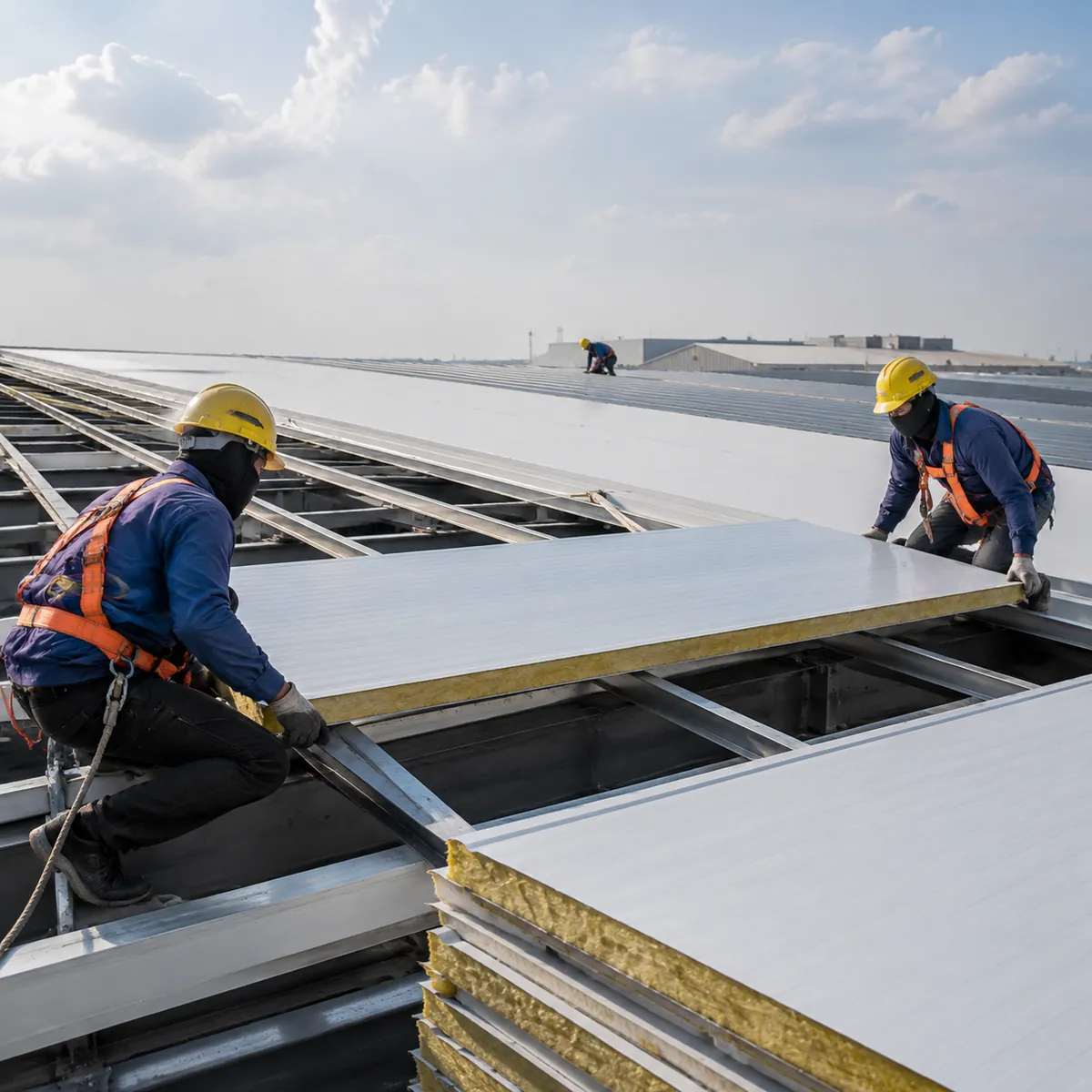
- Installation: sandwich panels are larger and heavier to handle, so erection cost per square meter is a bit higher than sheet cladding.
- Accessories: insulated panels need different flashings, sealants, and edge trims. Ask for these in the cladding scope so the comparison is complete.
Operating cost and payback
For a heated or cooled workshop building, insulated cladding pays part of its premium back through lower energy use. The payback depends on local energy prices, climate, and building use — in hot climates with air-conditioned interiors, the payback can be fast; for an unheated storage shed, it may never pay back because there is no energy bill to save. Run a simple calculation with your local electricity price and expected usage before choosing. For many buyers, the decision is not purely financial: an insulated building is also more comfortable for staff and more stable for stored goods.
Quick question: Is an insulated warehouse worth the extra cost?
It depends on use. For heated or cooled space, insulated panels usually pay back through energy savings. For unheated dry storage, single-skin cladding is often the sensible budget choice. Define the interior temperature requirement first, then the cladding follows.
Condensation: the cost nobody budgets for
In humid climates, single-skin metal roofs are prone to condensation on the underside of the sheet, which drips onto goods and causes rust on the frame over time. Fixes exist — breathable membranes, ventilation, or insulation layers — but they add cost and complexity. Sandwich panels largely solve the condensation problem because the insulated core keeps the inner skin close to the interior temperature. If your warehouse will store paper, electronics, food, or anything moisture-sensitive, treat condensation control as a requirement, not an upgrade.
Fire rating and compliance
Some occupancies require the envelope to meet a fire performance standard. EPS cores are combustible and not suitable where fire-rated cladding is mandatory; rock wool panels provide fire resistance and are commonly specified for production facilities, buildings close to property lines, or uses with higher fire risk. Check the local building code for your occupancy class before choosing the core. This is a compliance decision, and the cladding type should be confirmed with the local authority or your engineer early.
How to ask your supplier for a fair comparison
When you request quotes for a prefab steel warehouse, ask each supplier to price the same building with three cladding options: single-skin sheet, 75 mm EPS sandwich panel, and 100 mm PIR panel (adjust thicknesses to your climate). Keep the frame, doors, and accessories identical so the only difference is the envelope. The resulting table shows the real price ladder, and you can then apply your own operating cost and payback logic.
Three warehouses, three cladding decisions
Concrete scenarios make the cladding trade-off easier to see than abstract tables.
Scenario 1: unheated storage shed
A 600 square meter shed storing pallets of non-perishable goods in a mild climate, used a few hours a day. There is no air conditioning and no heating. Single-skin cladding keeps the budget low, the building is quick to erect, and the main condensation control is good ventilation at the ridge and eaves. Spending on sandwich panels here would add cost with no energy bill to pay back.
Scenario 2: conditioned distribution center
A 2,000 square meter center where goods are sorted and staff work all day, with cooling in a hot climate. The interior temperature target drives the choice: insulated panels — usually PIR for the best insulation per thickness — reduce the cooling load, prevent condensation on the roof, and make the space comfortable. The panel premium is offset by smaller HVAC equipment and lower running costs, and the payback is often quick in hot climates.
Scenario 3: production workshop with fire rating
A 1,200 square meter workshop where the local code requires a fire-rated envelope because of the occupancy or the distance to the property line. The envelope uses rock wool sandwich panels to meet the fire performance requirement. Here the cladding choice is a compliance decision first and a budget decision second — EPS is not an option, and the rock wool premium is simply part of the project cost.
Installation and maintenance cost differences
The price difference does not end at the panel purchase. Installation of sandwich panels is heavier work: panels are larger, heavier, and need careful handling to avoid edge damage, so erection cost per square meter is a little higher than sheet cladding. The flashing and sealant system for insulated panels also needs more care at junctions — doors, windows, eaves, and corners — which shows up in the labor line.
Maintenance runs the other way. Single-skin cladding needs periodic checks for fastener corrosion and re-tightening in high-wind areas, and condensation management may need additional ventilation. Insulated panels have fewer condensation issues, but damaged edges must be repaired promptly because a wet core loses insulation value and can corrode the facing sheets from the inside. In coastal environments, both systems need corrosion-resistant fixings and regular inspection of cut edges.
How to read a cladding quotation
A clean cladding quotation separates the envelope into line items. Check that you can see:
- Panel or sheet type and thickness — for example “0.5 mm color-coated steel sheet” or “75 mm PIR sandwich panel with 0.5/0.4 mm faces”.
- Quantity in square meters, and whether waste and laps are included in the calculation.
- Flashings, trims, ridge caps, eaves, and corner pieces — a common place for cost to hide.
- Fasteners and sealants — count, type, and whether they are included per square meter.
- Accessories such as gutters and downpipes, and doors and windows if they are part of the envelope scope.
- Installation labor, if the supplier offers erection, and the crane requirement.
If the quotation shows only a total for “cladding”, ask for the breakdown. The line-item view is what lets you compare suppliers fairly and trim the right parts later.
Climate-specific guidance
- Hot and humid climates: insulated panels reduce condensation and cooling load; add ridge ventilation for any single-skin areas.
- Hot and dry climates: insulation keeps interiors cooler; light-colored finishes reduce heat gain and can lower the cooling bill.
- Cold climates: thicker insulation (100–120 mm) and careful thermal-bridge detailing at purlins and girts prevent condensation on the inner skin.
- Coastal climates: use corrosion-resistant fixings and inspect cut edges; salt-laden air attacks exposed metal faster than inland sites.
- High-wind regions: follow the fastener schedule and panel fixing details from the design — cladding performance in wind is about the fixings, not just the panel.
Match the cladding decision to the climate and the use, and the cost question answers itself.
Insulation core comparison in depth
The core is the part of the sandwich panel that does the work, and the three common cores differ in real ways. EPS (expanded polystyrene) is the value option: its thermal conductivity is typically in the range of about 0.035–0.040 W/m·K, which is perfectly adequate for many warehouses, and it is the lowest-cost core. PIR and PUR (polyisocyanurate and polyurethane) cores typically reach about 0.022–0.028 W/m·K, meaning a thinner panel gives the same insulation — valuable where panel thickness or weight matters. Rock wool (mineral wool) sits around 0.035–0.045 W/m·K depending on density, but its differentiator is fire resistance and its behavior in a fire, which is why it is specified for fire-rated envelopes. These are typical published ranges, not project guarantees — the supplier’s data sheet for the exact panel should carry the tested value.
Weight follows the core too: rock wool panels are heavier than EPS or PIR at the same thickness, which can affect handling and the secondary steel. If your project has strict weight limits or a long crane reach, ask for the panel weight per square meter in the quotation and let the design team factor it in.
Sound insulation and acoustic performance
If the building is near housing, or the interior is a workspace where noise matters, consider acoustic behavior. Single-skin steel transmits rain noise and external sound almost directly, which is fine for a storage shed and uncomfortable for a workshop or office. Insulated panels reduce sound transmission noticeably, and rock wool cores perform better acoustically than EPS because the dense fiber structure absorbs more sound. For buildings with office sections, a common pattern is insulated panels on the office areas and single-skin on the storage volume, with the partition between them designed for the noise difference. Ask the supplier for the acoustic data if the building use depends on it — panel suppliers publish sound reduction values, and the engineer can check them against your requirement.
Durability, warranty, and lifecycle cost
Cladding is bought once and lives for decades, so the lifecycle view matters more than the first invoice. The face steel of the panel or sheet — its coating type and thickness — determines how long the color and the corrosion protection last. Galvanized and color-coated faces with the correct coating weights survive coastal and industrial environments far better than thin generic finishes, and the difference shows in the warranty the supplier offers. Ask what warranty covers the cladding: the sheet manufacturer’s warranty and the panel assembler’s warranty are separate documents, and both should be in the proposal.
Lifecycle cost thinking also includes repairability. A dented single-skin sheet can be replaced in a section; a damaged sandwich panel usually means replacing a full panel because the core cannot be repaired in place. Keep spare panels and sheets from the original order — matching color and profile years later is rarely possible. Ordering 2–3 percent spares at the start is cheap insurance that most buyers skip and later regret.
Common cladding specification mistakes
Most cladding problems start in the specification, not on the roof. Five mistakes repeat across projects. First, specifying the panel thickness without the core type — “75 mm panel” means nothing until you know whether the core is EPS, PIR, or rock wool, because the performance and the price differ completely. Second, forgetting the fastener schedule in high-wind areas: the sheet or panel is only as strong as its fixings, and the schedule must come from the design, not the installer’s habit. Third, ignoring the flashings and trims in the scope — the envelope leaks at the edges, and under-specified flashings are a classic hidden-cost and hidden-performance failure. Fourth, choosing the panel color for looks alone: light colors reduce heat gain in hot climates and can lower the cooling bill, while dark colors do the opposite. Fifth, skipping the spare panel order: color and profile are never matched years later, so 2–3 percent spares from the original batch are the only way to repair without replacing whole areas. Put all five into the specification in writing, and the cladding will behave.
Questions to ask before choosing the cladding
Walk through these questions with your engineer and the supplier before the cladding spec is fixed. Is the building heated or cooled, and to what temperature? If the answer is “no”, single-skin cladding is likely right. Will stored goods or work processes be damaged by condensation? If yes, insulated panels or an engineered ventilation strategy are required. Does the local code require a fire-rated envelope for the occupancy? If yes, rock wool panels and the panel’s fire certificate become mandatory. Will staff work inside for full days? If yes, thermal comfort and acoustic performance justify the panel premium. Is the site coastal or industrial, where corrosion is faster? If yes, coating weights and fixing materials matter more than the panel type. What is the local energy price? In expensive-energy markets the insulation payback is quicker. Answer these six questions in writing, and the cladding decision stops being a guess.
Start with the use case, end with the price
Cladding decisions fail when they start with price. Start instead with the use case: what the building stores, who works inside, what temperature and humidity the interior needs, and what the local code requires. Those answers narrow the cladding options to one or two, and only then does price become a comparison between realistic alternatives. A buyer who asks “which cladding is cheapest” gets a single-skin quote that fails in the first humid week; a buyer who asks “what does this warehouse need from its envelope” gets a spec that performs for decades. The price is the last question, not the first.
FAQ
Which sandwich panel core is best — EPS, PIR, or rock wool?
EPS is the budget option with good basic insulation. PIR/PUR gives the best insulation per millimeter and is a strong choice for conditioned space. Rock wool adds fire resistance at a higher price. Choose by the priorities of your building: energy, cost, or fire rating.
Does insulated cladding require a stronger steel frame?
Insulated panels are heavier than single-skin sheet, so purlins and girts may need to be slightly larger. The effect on total frame cost is usually small, but it should be included in the design from the start.
Can I mix single-skin and insulated panels on one building?
Yes — a common pattern is insulated roof panels with single-skin walls, or insulated walls on an office section with single-skin cladding on the storage area. Just make sure the transition details and flashings are designed properly.
How much does cladding affect the total warehouse price?
Cladding is one of the three largest cost items after the frame and foundation. Switching from single-skin sheet to sandwich panels increases the envelope cost by a meaningful percentage; the exact figure depends on panel type, thickness, and building area, so ask for a side-by-side quote.
What thickness of insulated panel do I need?
Common choices are 50–75 mm for moderate climates and 100–120 mm for hot or cold extremes or conditioned interiors. Your supplier can recommend a thickness based on your local climate and the interior temperature target.
Final recommendation
Make the cladding decision before the frame design is finalized, and base it on the interior temperature requirement, not on the price per square meter alone. For dry unheated storage, single-skin cladding keeps the budget lean. For conditioned, humid, or fire-sensitive spaces, insulated panels — EPS for value, PIR for performance, rock wool for fire rating — protect the goods, the staff, and the building. Ask every supplier for the same three-option price ladder, then choose with the full picture.
Get a three-option cladding price comparison for your prefab steel warehouse — send your building size, location, and interior temperature requirement for a design-based quotation.