Nigeria Industrial Steel Building Guide for Lagos, Lekki Free Zone and Kano Manufacturing

Nigeria’s manufacturers, food processors, and logistics operators are moving away from slow block-and-mortar construction toward the industrial steel building for one reason: it gets a production line under roof faster and cheaper. From the manufacturing clusters around Lagos and the Lekki Free Zone to processing plants in Kano, Ogun, and Port Harcourt, a steel frame answers the practical problems Nigerian project owners face, namely unreliable timelines, high finance costs that punish slow builds, and the need for wide column-free space. This guide is written for Nigerian factory owners, contractors, consulting engineers, and industrial park developers who want to specify and budget an industrial steel building that performs in local conditions.
Why Industrial Steel Buildings Fit Nigeria
Steel earns its place in Nigeria on speed and value. With lending rates high and project finance expensive, every month a factory sits unbuilt is a month of interest with no revenue. A pre-engineered steel building compresses the construction program dramatically compared with traditional methods.
The recurring reasons Nigerian buyers specify steel:
- Wide clear spans of 24 to 50 meters give a production hall the open floor a manufacturing or packaging line needs, with no internal columns interrupting the layout.
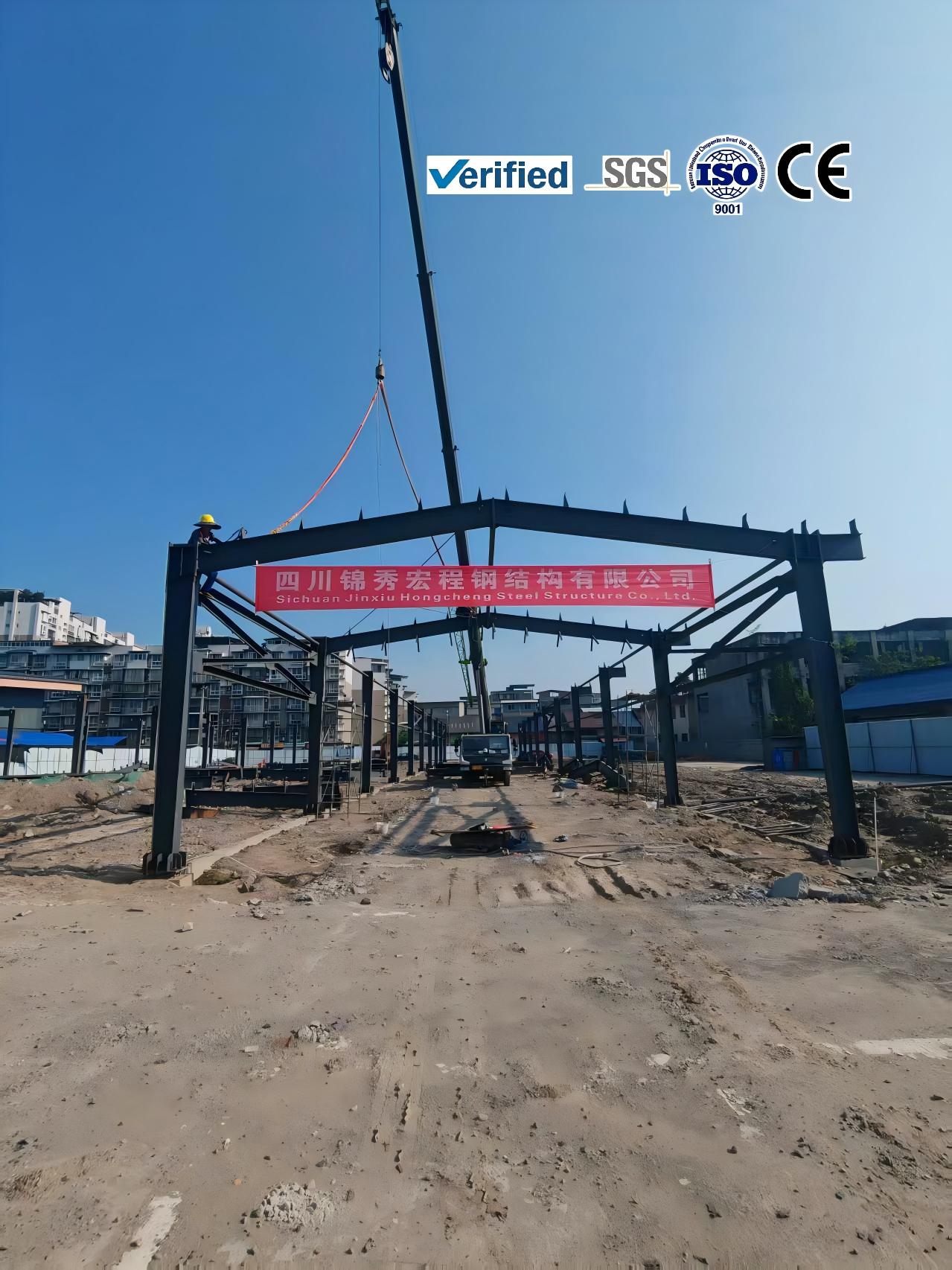
- Fast erection means a frame goes up in weeks. For a developer in an industrial park near Lagos, that turns a plot into leasable space far sooner.
- Predictable cost from a factory-engineered package, which protects budgets against the material price swings and on-site waste that plague block construction.
- Crane and process readiness. Steel frames carry overhead cranes, mezzanines, and heavy services that a manufacturing operation depends on.
If you are scoping a production or processing facility, our commercial and industrial steel buildings page shows the configurations we supply for factory and plant use.
Nigerian Climate and Load Conditions
Nigeria spans two broad climate zones that change how a steel building should be specified. The south, including Lagos, Port Harcourt, and the Niger Delta, is humid tropical with heavy rainfall and high humidity year round. The north, around Kano and Kaduna, is hotter and drier with a pronounced harmattan dust season. A building specified for Lagos humidity carries different corrosion protection from one built for Kano’s dry heat.
Wind Loads
Nigeria does not face cyclones, but seasonal thunderstorms and squall lines, particularly at the onset of the rainy season, produce strong gusts. Design wind speeds for most of the country fall in the 35 to 45 m/s range depending on location and exposure. Coastal Lagos and Niger Delta sites at open exposure sit at the higher end. A proper wind analysis sizes the bracing and anchor connections to resist uplift on large roof areas, which is where storm damage concentrates.
Rainfall and Drainage
Southern Nigeria receives intense rainfall, and roof drainage often dictates the roof design more than structural load. Generous gutter sizing, adequate roof slope, and well-detailed downpipes prevent ponding and overflow during the heaviest storms. Underspecified drainage is one of the most common failures in tropical steel buildings.
Seismic
Most of Nigeria sits in a low seismic zone, so seismic load rarely governs design. Wind and roof live loads usually control. That said, connection detailing still follows good practice so the frame behaves as a coherent structure under all loads.
Structural Design and Material Specifications
An industrial steel building for Nigeria is typically a clear-span portal frame, often with provision for an overhead crane in manufacturing applications. The table below shows representative specifications across three building scales we quote for Nigerian projects.
| Parameter | Light Workshop (2,000 m2) | Factory Hall (6,000 m2) | Large Plant (15,000 m2) |
|---|---|---|---|
| Clear span | 24 m | 30 m | 2 x 33 m multi-span |
| Eave height | 7 m | 9 m | 11 m |
| Main frame | Q355B welded H-section | Q355B welded H-section | Q355B welded H-section |
| Crane provision | Optional 5 t | 10 t overhead | 20 t overhead |
| Roof cladding | 0.5 mm color steel | 50 mm PU panel | 75 mm PU/rock wool panel |
| Wall cladding | 0.5 mm color steel | Block dado + panel | Block dado + panel |
| Design wind | 40 m/s | 42 m/s | 45 m/s |
Material notes for Nigerian specification:
- Steel grade. Q355B (S355 equivalent) for primary frames gives strength efficiency that lowers shipping weight and landed cost.
- Galvanized secondary steel. Z275 hot-dip galvanized purlins and girts as standard, stepping to Z450 for humid Lagos and Delta sites.
- High-strength bolts. Grade 8.8 for primary connections, galvanized for humid environments.
- Crane runways. Where cranes are specified, runway beams and brackets are designed for the rated capacity plus impact and fatigue allowances.
For how span, bracing, and connections come together, our steel structure design guide gives the engineering background buyers find useful when reviewing supplier drawings.
Corrosion Protection for Nigerian Conditions
Humidity is the deciding factor in southern Nigeria. Lagos, Port Harcourt, and the Niger Delta sit in corrosion category C3 to C4, and salt-laden coastal air pushes some sites higher. The drier north sits closer to C2 to C3. Matching the coating to the actual environment prevents the early rust that ruins underspecified buildings in the humid south.
| Environment | Corrosion Category | Recommended System | Life to First Maintenance |
|---|---|---|---|
| Northern Nigeria, dry (Kano, Kaduna) | C2-C3 | Sa 2.5 blast + zinc primer + epoxy + PU, ~160 microns | 12-15 years |
| Inland south / Lagos mainland | C3-C4 | Sa 2.5 blast + zinc primer + 2 epoxy + PU, ~220 microns | 10-14 years |
| Coastal Lagos, Niger Delta | C4-C5 | Hot-dip galvanizing or metallizing + epoxy + PU, 260+ microns | 15-20 years |
For a food or beverage plant, hygienic finishes and washable surfaces add another layer to the specification. For a steel mill or chemical plant, the internal atmosphere may be more aggressive than the outdoor air, which the coating system must account for. The principle holds across all cases: specify the coating for the worst environment the steel will actually see.
Installation Timeline in Nigeria
A realistic program keeps a Nigerian project financeable and credible. The figures below assume a 6,000 square meter factory hall on a prepared site, with materials cleared at Lagos (Apapa or Tin Can) or Onne port near Port Harcourt.
- Design and approval: 3 to 5 weeks for drawings, calculations, and state planning approval.
- Fabrication: 5 to 7 weeks, overlapping with site foundation work.
- Sea freight and customs: 5 to 8 weeks from a Chinese port to a Nigerian port, including clearance, which can be the most variable item.
- Foundation: 4 to 6 weeks depending on soil; soft Delta ground may need piling.
- Steel erection: 5 to 7 weeks for frame, crane runways, purlins, and bracing.
- Cladding and finishes: 3 to 5 weeks, overlapping erection.
From contract to weathertight building, plan for 18 to 26 weeks, with customs clearance the biggest swing factor. Our installation timeline guide details how to overlap these phases and protect the critical path.
Cost Range and Budgeting
The figures below are indicative for the supply of a complete industrial steel building package delivered to a Nigerian port, excluding foundations, local labor, and process equipment.
| Building Type | Specification Level | Indicative Supply Cost (USD/m2) |
|---|---|---|
| Light workshop | Single-skin, no crane | 48 – 68 |
| Factory hall with crane | Insulated panel, 10 t crane | 80 – 120 |
| Large processing plant | Insulated, heavy crane, mezzanine | 110 – 160 |
Foundations, slab, electrical, and process fit-out are separate and often add 30 to 45 percent on top of the steel supply, more if heavy machinery foundations are involved. For Nigerian buyers, financing cost over the build period is a real line item, which is exactly why faster steel construction pays back. Our cost guide walks through the full budget so you can present credible numbers to lenders or partners.
Regulations and Approvals in Nigeria
Approval pathways vary by state, which catches out buyers expecting a single national process. Key points:
- Building codes. The National Building Code provides the framework, with structural design commonly referencing British Standards and Eurocodes (BS 5950 / EN 1993 for steel). A registered Nigerian structural engineer (COREN) reviews and stamps the design.
- State planning permits. Lagos State (through the relevant physical planning authority), Ogun, Rivers, and others each run their own development permit process. Free zone projects follow the zone authority’s process.
- Free zone advantages. Lekki Free Zone and similar areas often offer faster approvals and import concessions, which materially affect both schedule and landed cost.
- Factory and safety compliance. Manufacturing facilities also engage with federal and state environmental and labor requirements depending on the process.
Useful references include the Council for the Regulation of Engineering in Nigeria (COREN) for engineering registration matters and the Nigeria Export Processing Zones Authority for free zone procedures. Always confirm current state-level requirements with your local engineer, as processes change.
Project Scenarios Across Nigeria
Lagos and Lekki Free Zone Manufacturing
A consumer goods manufacturer setting up in the Lekki Free Zone needs a 6,000 square meter production hall with a 10-tonne overhead crane and a fire-rated office mezzanine. Humid coastal conditions push the corrosion spec to C4 with galvanized secondary steel. Free zone import concessions reduce landed cost, and the simplified approval process shortens the program.
Kano and Northern Processing
An agro-processing operation in Kano wants a 4,000 square meter facility for grain handling and packaging. The dry northern climate allows a C2 to C3 coating, but harmattan dust drives sealed cladding details and good ventilation. The roof is designed for high solar gain with a reflective finish and ridge ventilation.
Port Harcourt Industrial Plant
An oilfield services company near Port Harcourt needs covered fabrication and storage with a 20-tonne crane. Aggressive Delta humidity and industrial atmosphere call for hot-dip galvanized primary and secondary steel with a heavy-duty topcoat. The frame is designed for crane fatigue loading and future extension along its length.
Common Buyer Questions
How long does an industrial steel building last in Nigeria’s humid south?
With a C4 or C5 coating system matched to coastal conditions, the structural frame readily lasts 30 to 40 years or more. The key is specifying galvanizing or heavy multi-coat protection for humid Lagos and Delta sites, then keeping up a simple inspection and touch-up routine.
Can a steel building carry a heavy overhead crane?
Yes. Crane capacity is designed into the frame from the start, with runway beams, brackets, and bracing sized for the rated load plus impact and fatigue. Common Nigerian factory cranes run from 5 to 20 tonnes, and heavier is possible. Tell us the crane capacity and duty early so the frame is right the first time.
What slows down delivery to Nigeria, and how do we manage it?
Customs clearance is the most variable factor. Complete documentation, a certificate of origin, material test certificates, and an experienced clearing agent keep things moving. Free zone projects often clear faster. We sequence fabrication and shipping so steel arrives as the site is ready to erect.
Do you supply foundations, or only the steel building?
We supply the engineered steel package and cladding. Foundations and slab are usually executed locally to our anchor bolt and loading drawings. We can advise on foundation design parameters, but local ground conditions are best handled by a Nigerian geotechnical engineer. The quote requirements page lists what we need to scope your package.
How do we get an accurate quote for our factory?
Send building dimensions, eave height, location, intended process, any crane requirement, and your preferred cladding level. A site plan and, ideally, a soil report help. Submit details through our quote request page and we will return a detailed proposal sized to your Nigerian project.
Steel Versus Block Construction in Nigeria
Block and concrete construction remains common in Nigeria, but for industrial buildings it carries real penalties that a steel frame avoids.
| Factor | Industrial Steel Building | Block / Concrete |
|---|---|---|
| Build time | 18-26 weeks | 35-50 weeks |
| Clear span | Up to 50 m | Limited, needs internal columns |
| Finance cost over build | Lower (faster) | Higher (slower) |
| Crane support | Built into frame | Difficult and costly to retrofit |
| Expansion | Bolt-on along length | Major works |
| Quality control | Factory-fabricated, consistent | Site-dependent, variable |
For most Nigerian manufacturing, processing, and warehousing uses, the combination of speed, span, and crane capability makes steel the practical choice. A hybrid approach, steel frame with a block dado wall to about 2.5 m for impact resistance, gives the best of both and is widely used in Nigerian factories.
Foundations, Floors, and Site Preparation
Steel frames are light, but Nigerian sites vary widely in ground quality. Firm lateritic soils in parts of the north and inland areas support simple pad footings. Soft, waterlogged Delta and coastal Lagos ground often needs piling or ground improvement. The floor slab carries the real load in a factory, designed for machinery, racking, and forklift traffic. Specify slab flatness and joint layout to suit the process, and set anchor bolts with templates and survey control to hold erection tolerance. A short geotechnical investigation early in the project is money well spent, since foundation surprises are the most expensive thing to discover after steel has arrived.
Procurement Recommendations
For Nigerian industrial buyers, prioritize these decisions:
- Specify corrosion protection for the real climate. Humid Lagos and Delta sites need galvanizing or heavy multi-coat systems, not a generic spec written for a dry climate.
- Design crane capacity from day one. Retrofitting a crane into a frame that was not designed for it is costly and often impractical.
- Use free zone advantages where available. Lekki and other free zones can cut both approval time and landed cost materially.
- Plan customs early. Engage an experienced clearing agent and prepare complete documentation before shipment.
- Invest in a soil report. Foundation surprises are the most expensive thing to discover after steel has arrived on site.
- Insist on material certificates. Q355B steel, galvanizing grade, and bolt grade should all be documented.
For regional context across markets, our country guides compare requirements for buyers in different countries. When you are ready, send your project details through the quote request page for a proposal built around your Nigerian facility.
Roof Drainage and the Tropical Rain Challenge
Southern Nigeria’s rainfall is the single most underestimated design factor in industrial steel buildings. Lagos and the Niger Delta receive intense, concentrated downpours, and a roof that drains fine in a dry climate will overflow and leak in Port Harcourt. Drainage design deserves the same attention as structural load.
- Roof slope. A minimum 5 percent slope helps shed water quickly. Flatter roofs pond and leak at laps.
- Gutter sizing. Gutters are sized for peak rainfall intensity, not average. Undersized gutters back up and overflow into the building.
- Downpipe capacity and spacing. Adequate downpipe count and diameter clear water fast. Box gutters between multi-span roofs need particular care and generous outlets.
- Overflow provision. Secondary overflow weirs prevent water building up if a primary outlet blocks during a storm.
- Sealed laps and flashings. Properly lapped panels, sealed ridge details, and well-formed flashings stop wind-driven rain entering at the worst moments.
Getting drainage right at design stage costs almost nothing. Fixing a leaking, ponding roof after the building is in production costs a great deal and disrupts operations. Nigerian buyers should treat roof drainage as a first-tier requirement, not an afterthought.
Mezzanines, Offices, and Building Services
Most Nigerian factories need more than a bare shell. A steel frame accommodates the additions a working facility needs without compromising the structure.
- Steel mezzanines add office, QC lab, or storage space on a second level, hung off or independent of the main frame, designed for the intended floor loading.
- Integrated offices at the building end or along a side give management and admin space within the envelope.
- Ventilation through ridge vents, wall louvers, and powered extraction manages the heat that builds in a Nigerian production hall.
- Power and lighting routes are planned into the frame, with cable trays and high-bay lighting positions coordinated with the roof structure.
- Service openings for ducts, conveyors, and process penetrations are framed in during design so they do not weaken the structure later.
Planning these elements with the steel design, rather than cutting them in afterward, keeps the structure efficient and avoids costly site modifications. Share your process layout early so openings, loads, and service routes are built into the engineering from the start.
Quality Control and What to Check
The advantage of a factory-fabricated building is consistent quality, but only when the supplier holds standards and documents them. Nigerian buyers should expect and verify:
- Mill certificates for the steel, confirming grade and chemistry.
- Welding records and, for critical connections, non-destructive testing reports.
- Coating inspection documenting surface preparation grade and dry film thickness against the specified system.
- Dimensional checks confirming members and hole patterns match the approved drawings before shipment.
- Bolt certificates confirming grade and, where relevant, galvanizing.
Our quality control guide sets out the checks and documentation a serious buyer should require. Insisting on this paperwork protects the investment and gives the engineer of record what they need to certify the building.
Power Reliability and Building Design
Nigerian industrial operations plan around an unreliable grid, and the building should support that reality. A steel frame makes it straightforward to integrate the infrastructure a self-sufficient factory needs.
- Generator housing. A dedicated steel canopy or enclosure for diesel or gas gensets, sized for ventilation and acoustic control, keeps backup power organized and serviceable.
- Solar-ready roofs. A steel roof is a ready platform for rooftop solar. Designing the roof structure for panel loads from the start lets an operator add generation later without reinforcement.
- Switchgear and transformer rooms. These are framed and located for safe access and cable routing, often in a fire-separated bay.
- Load distribution. High-bay lighting and process power are planned with the roof structure so cable trays and supports do not clash with bracing.
Building for power resilience from the outset avoids the messy retrofits that plague Nigerian facilities where backup power was an afterthought. A steel frame’s flexibility makes these provisions easy when planned at design stage.
Maintenance and Lifecycle in the Nigerian Climate
A steel industrial building is durable but rewards a basic upkeep routine, especially in the humid south.
- Annual coating inspection, with priority on coastal-facing elevations and any areas of impact damage.
- Touch-up painting at scratches and dents before rust takes hold, particularly around doors and loading areas.
- Gutter and downpipe clearing before and during the rainy season to keep drainage at full capacity.
- Roof fastener checks after the first year to catch any loosening from thermal cycling.
- Repaint cycle at years 10 to 14 in the humid south, later in the drier north.
These small, scheduled tasks keep a 30 to 40 year structural life realistic and protect the asset against the humidity that is the south’s main enemy. Owners who track condition and act early spend far less than those who let corrosion advance.
An industrial steel building gives Nigerian manufacturers and developers the speed, span, and crane capability their operations need, at a cost and timeline that block construction cannot match. Settle the corrosion spec, crane design, and approvals early, hold your supplier to documented materials, and the building will support production in Lagos, Kano, or Port Harcourt for decades.