Thailand Steel Workshop Building Guide for the EEC, Bangkok and Rayong Industrial Projects

Thailand’s industrial demand sits in a few clear clusters: the Eastern Economic Corridor (EEC) across Rayong, Chonburi, and Chachoengsao, the manufacturing ring around Greater Bangkok and Samut Prakan, and the northern and northeastern zones serving regional supply chains. Companies planning a steel workshop building in Thailand need a structure that handles heavy monsoon rain, high humidity, moderate seismic demand in the north, and tight industrial-estate schedules, all inside a defined budget. This guide is written for engineering procurement teams, contractors, factory owners, and industrial-estate developers who want practical numbers on workshop design, materials, corrosion control by location, monsoon drainage, approval routes, schedule, and cost across Thailand, with figures you can take into a budget review.
Why Steel Workshops Suit Thai Industrial Projects
A pre-engineered steel workshop gives a clear-span working floor, fast erection, and a frame that supports overhead cranes and process equipment. For Thai manufacturers and EEC tenants, the appeal is direct. Workshop operations need open floor area for machining, fabrication, assembly, and maintenance, which portal frames deliver without internal columns. Industrial-estate plots come with build deadlines, and factory-cut steel erects far faster than concrete. Thailand also has a mature local steel and fabrication industry, so supply is workable for both local and imported packages.
- Clear span: 18-36 m single span for workshop floors; multi-span for larger plants.
- Crane-ready: Overhead cranes for handling parts and assemblies are designed into the frame.
- Rain and humidity ready: Steep roofs, good gutters, and galvanized secondary steel handle the monsoon.
- Expandable: Bays can be added as the operation grows on EEC and Bangkok-ring plots.
Structural Design for Workshops in Thailand
Frame Type and Layout
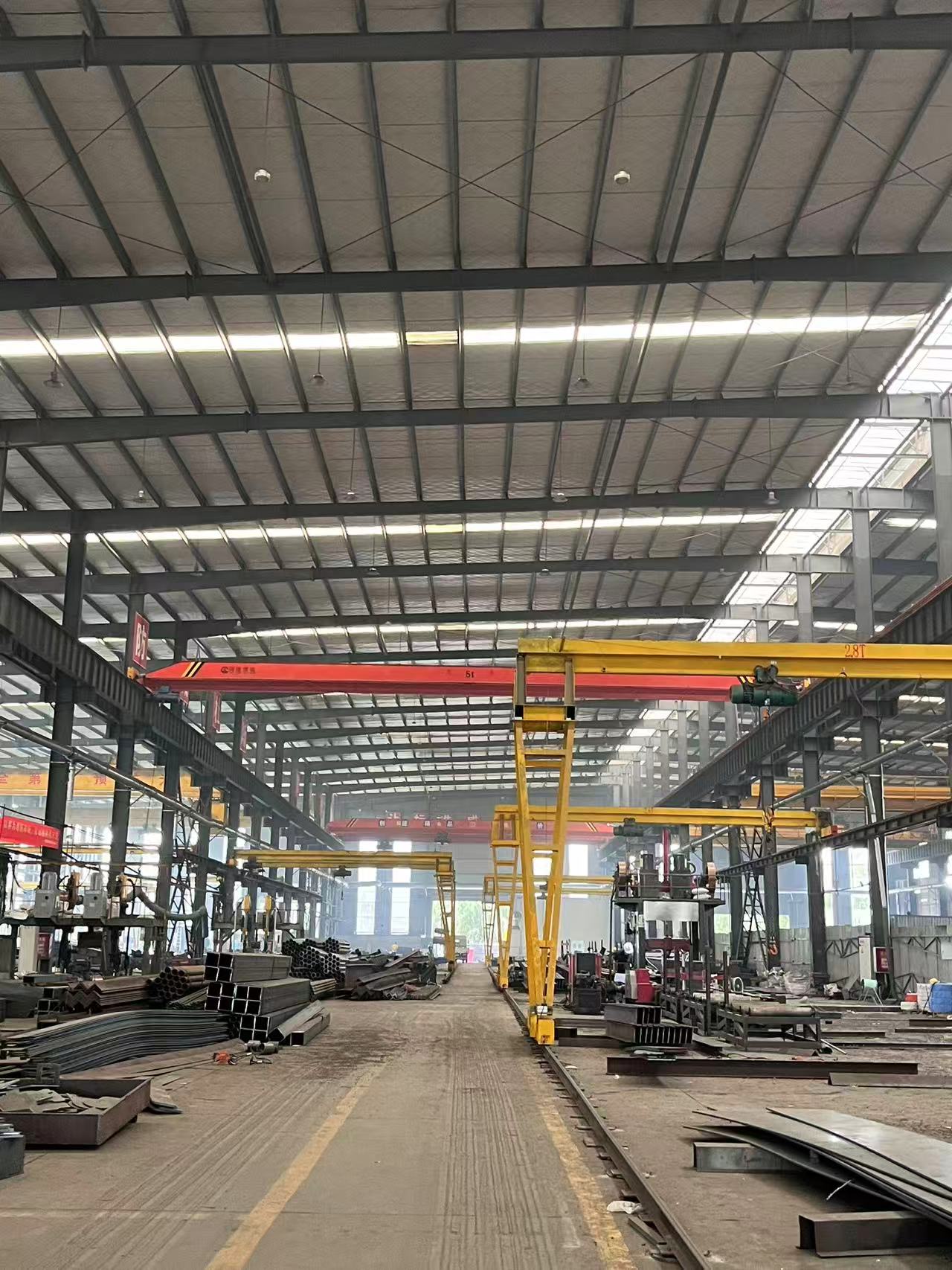
Most Thai workshops use tapered portal frames up to about 36 m span, with trussed or multi-span frames for wider plants. The layout follows the work: machine positions, crane coverage, and the route for moving parts in and out set the span, bay spacing, and door placement. Common configurations:
- 18-24 m span: Maintenance shops, light fabrication, assembly. Eave height 6-8 m.
- 24-30 m span: General workshops with a 5-10 t overhead crane. Eave height 8-10 m.
- 30-36 m span: Heavy fabrication, machinery, and automotive-supply workshops. Eave height 10-12 m.
Bay spacing of 6-9 m is standard. Crane duty and any equipment hung from the frame drive member sizes, so those are fixed before design.
Wind, Seismic, Rain and Temperature Loads
Thai design references the Ministry-issued building load standards (DPT/EIT practice) alongside international codes. Practical inputs for workshops:
- Wind: Design wind speeds across most of Thailand are moderate, but the southern peninsula and coastal areas see stronger storm winds, and the design accounts for tropical depressions tracking in from the Gulf and Andaman Sea.
- Seismic: Northern Thailand (Chiang Mai, Chiang Rai) has real seismic demand on active faults; central and eastern Thailand are lower but not zero. Steel portal frames handle seismic well due to their ductility and low mass.
- Rain: Monsoon rainfall is intense. Roof pitch, gutter sizing, and downpipe capacity are designed for high short-duration rates to avoid ponding and overflow.
- Temperature and humidity: High year-round heat and humidity drive ventilation and corrosion design more than thermal movement.
Gutter and drainage design deserves special attention in Thailand. Under-sized gutters overflow in a monsoon downpour and can damage stored goods and the building envelope, so the rainwater calculation is worth checking in the submittal.
Material Specifications and Corrosion Control
High humidity makes corrosion control central to a Thai workshop spec. Typical specification:
| Component | Typical Specification | Notes for Thailand |
|---|---|---|
| Primary frame | Q355B / S355JR welded built-up I-sections | SS400/Q235 used for lighter spans |
| Secondary steel | Galvanized cold-formed C/Z purlins and girts | Galvanizing essential in humid air |
| Cladding | 0.5 mm color-coated or aluzinc steel sheet | Insulated panel for climate-controlled areas |
| Insulation | 50-100 mm glass wool or PIR panel | Cuts heat and reduces condensation |
| Bolts | Grade 8.8 / 10.9 high-strength | Moment connections at knees and ridges |
| Gutters / downpipes | Sized for monsoon intensity | Oversized vs. temperate-climate defaults |
Surface Treatment and Anti-Corrosion
Most inland Thai industrial sites are a C3 environment under ISO 12944 because of humidity; coastal EEC sites near the Gulf (Map Ta Phut, Laem Chabang) push to C4-C5. Match the coating to the site:
- Inland (C3): Blast to Sa 2.5, zinc-rich or epoxy primer plus polyurethane topcoat, 140-200 microns total.
- Coastal EEC (C4-C5): Blast to Sa 2.5, zinc-rich epoxy primer, epoxy MIO intermediate, polyurethane topcoat, 200-280 microns.
- Secondary steel: Hot-dip galvanized purlins and girts as standard.
- Condensation control: Insulated roofs and good ventilation reduce the internal condensation that drives corrosion in humid workshops.
The blast standard (Sa 2.5) and total film thickness are the two items most worth confirming in any quote, because they govern how long the frame lasts in humid air.
Climate, Ventilation and Working Conditions
Thai workshops run hot and humid year round, and welding, machining, and painting add heat and fumes. Effective measures:
- Insulated roof: PIR or glass-wool panel cuts radiant heat and reduces condensation dripping onto work below.
- Ridge ventilation: Continuous ridge vents and wall louvers drive stack-effect airflow without power.
- Powered extraction: Roof extractors and local fume capture for welding and painting bays keep air quality acceptable.
- Open eaves and high bays: Higher eaves let hot air rise clear of the working zone.
For climate-controlled assembly (electronics, automotive sub-assembly), the envelope upgrades to thicker insulated panels and sealed details, and the structural designer allows for the panel weight and any roof-mounted HVAC.
Foundations and Ground Conditions
Foundation design follows the local soil report. Common Thai conditions:
- Bangkok and central plain: Soft Bangkok clay with a high water table usually needs piled foundations for anything heavy.
- EEC (Rayong, Chonburi): Mixed ground; firmer areas suit pad footings, softer or reclaimed ground needs piling.
- North and northeast: Generally firmer ground, but seismic detailing applies in the north.
The steel supplier provides anchor-bolt layouts and frame reactions so a local engineer designs footings to Thai practice and the soil report. The soil investigation should be ordered before the foundation budget is fixed, because Bangkok clay can swing the cost significantly toward piling.
Installation Timeline in Thailand
A typical 3,000-6,000 m2 workshop follows this sequence. Local fabrication shortens delivery; imported packages add sea freight to Laem Chabang or Bangkok Port.
| Stage | Duration | Notes |
|---|---|---|
| Design and approval | 2-4 weeks | Drawings, calculations, estate/authority approval |
| Fabrication | 4-6 weeks | Cutting, welding, blasting, coating |
| Delivery | 1-4 weeks | Local transport or sea freight if imported |
| Foundations (parallel) | 3-6 weeks | Longer where piling is needed |
| Frame erection | 2-4 weeks | Crane-set frames, bracing, purlins, crane girders |
| Cladding and finishes | 3-5 weeks | Roof, walls, doors, ventilation, gutters |
On-site critical path is usually 8-12 weeks once steel arrives, longer if Bangkok-clay piling extends the foundation stage. Our installation timeline guide details each stage.
Cost and Specification Ranges for Thailand
Cost depends on span, height, crane, cladding, and inclusions. The ranges below are indicative for the steel building package, in USD per square meter of footprint, for budgeting only. A current quote always governs.
| Workshop Type | Span / Height | Indicative USD/m2 | Includes |
|---|---|---|---|
| Light workshop | 18-24 m / 6-8 m | $50-75 | Frame, single-skin cladding, doors, gutters |
| Standard workshop + crane | 24-30 m / 8-10 m | $80-120 | Frame, crane girders, insulated roof |
| Heavy fabrication shop | 30-36 m / 10-12 m | $120-170 | Heavier frame, multiple cranes, full insulation |
| Climate-controlled assembly | 24-30 m / 8-10 m | $140-210 | PIR panels, sealing, HVAC provisions |
Foundations (especially piling on Bangkok clay), slab, MEP, fire systems, and machinery are separate and often add 30-70% to the steel package. See our quote requirements for the data needed to price accurately and the cost guide for the main price drivers.
Regulations, Standards and Approvals in Thailand
Workshop projects are approved through the local authority or the industrial-estate authority. For estates run by or with the Industrial Estate Authority of Thailand (IEAT), approvals and utilities run through the estate. Key points:
- Design standards: The Department of Public Works and Town and Country Planning (DPT) ministerial regulations and EIT practice govern loads and design; international codes support the design, signed by a licensed Thai engineer.
- BOI promotion: Board of Investment incentives apply to many manufacturing projects and affect duty on imported steel and equipment.
- Fire and safety: Fire access, hydrants, and compartmentation per Thai regulations; high-hazard processes need extra provisions.
- EEC framework: Projects in the Eastern Economic Corridor follow the EEC Office’s coordinated approval and incentive framework.
For investment and estate context, the Thailand Board of Investment (BOI) is the official reference, and steel design practice draws on AISC guidance alongside Thai standards.
Project Scenarios Across Thailand
EEC (Rayong, Chonburi, Chachoengsao): Automotive and Heavy Industry
The EEC hosts automotive, electronics, and petrochemical supply chains. Typical demand is 24-36 m crane-served workshops, insulated roofs, and a C3 inland or C4-C5 coastal coating near Map Ta Phut and Laem Chabang, often with phased bays.
Greater Bangkok and Samut Prakan: Diversified Manufacturing
The Bangkok ring hosts food, packaging, plastics, and light engineering. Workshops here often need piled foundations for Bangkok clay, moderate cranes, and strong monsoon drainage.
North and Northeast: Regional Supply and Agro-Industry
Chiang Mai, Khon Kaen, and Korat support regional manufacturing and agro-processing. Northern sites add seismic detailing; firmer ground often allows simpler footings.
Steel Frame Versus Concrete for Thai Workshops
Thai contractors work confidently in both steel and reinforced concrete, so the comparison is worth making for a workshop. For clear-span working floors, steel usually wins on the points that drive cost and schedule.
| Factor | Prefab Steel Frame | Concrete |
|---|---|---|
| Clear span | Up to 36 m, column-free floor | Internal columns or deep beams |
| Build speed | Fabrication parallel to foundations | Sequential pours and curing |
| Crane support | Crane girders built into frame | Heavy corbels and beams needed |
| Foundation on soft clay | Lighter frame, smaller pile loads | Heavier, more piling |
| Expansion | Bolt-on bays | Hard to extend |
| Seismic mass (north) | Low mass, lower seismic force | High mass, higher force |
The common Thai solution is a steel frame on a piled or pad-footed concrete slab, with masonry only for offices and rated rooms. On soft Bangkok clay the lighter steel frame is a real advantage because it reduces the pile load the foundations must carry.
Fit-Out: Cranes, Mezzanines, Doors and Fire Safety
A working workshop is more than the shell. Design the fit-out with the structure so loads and openings are built in from the start.
- Overhead cranes: Bridge or gantry cranes for moving parts and assemblies. Capacity, span, and duty class set the crane girders, brackets, and columns.
- Mezzanines: Steel mezzanines for offices, stores, or QC; floor loading (2.5-5 kN/m2) is fixed at design.
- Doors: Sliding and sectional doors for trucks and large parts; high-speed doors where humidity or temperature control matters.
- Fire safety: Hydrants, hose reels, and sprinklers for high-value or high-hazard work, plus smoke vents and clear exits. Tanks and pump rooms need reserved space and load allowance.
- Services: Compressed air, power busbars, and extraction ducting are often hung from the frame, so their weight is added to the design.
Maintenance and Service Life
A properly specified steel workshop in Thailand is built for decades, but humidity means corrosion control is a planned activity, not an afterthought. A practical schedule:
- Annual: Clear gutters and downpipes before and after monsoon; check cladding fasteners and door gear.
- Every 2-3 years: Inspect frame coating at connections and bases; touch up chips before rust spreads in humid air.
- Every 5-7 years (coastal): Detailed coating survey and localized recoat where film thickness has dropped.
- As needed: Re-tension flagged bolts and check crane rail alignment.
Gutter maintenance matters more in Thailand than in dry climates: blocked gutters overflow in a monsoon downpour and accelerate corrosion at the eaves. Original fabrication quality sets how cheap maintenance stays; our quality control guide covers the fabrication checks that protect service life.
Thailand Market Drivers Behind Workshop Demand
Demand for steel workshops in Thailand follows clear trends buyers can plan around:
- EEC investment: The Eastern Economic Corridor draws automotive, electronics, and petrochemical supply chains needing crane-served workshops.
- Automotive and EV transition: Thailand’s vehicle industry, shifting toward EVs, drives demand for component and assembly workshops.
- Regional manufacturing hub: Thailand’s role as an ASEAN production base supports steady industrial construction.
- Agro-industry: Northeast and central processing plants need durable, ventilated steel buildings.
- Logistics and maintenance: Growth in distribution and equipment servicing adds workshop and MRO demand.
The practical takeaway is to design in flexibility: spare bay capacity, a slab and foundations rated for future equipment, and clear service routes cost far less now than rebuilding later. Steel makes that flexibility cheap because bays and layouts can change without touching the main structure.
Steel Grades, Sourcing and Logistics
Where the steel comes from affects price and lead time on a Thai project. Three routes are common:
- Local fabrication: Thai fabricators using local or imported steel. Shortest delivery and easiest site coordination; best when the schedule is tight and the design is standard.
- Imported pre-engineered package: A complete kit fabricated and coated abroad, shipped to Laem Chabang or Bangkok Port. Best for tight engineering control, heavy crane buildings, or strict coastal coating specs.
- Hybrid: Imported primary frame with locally supplied cladding and secondary steel, balancing cost and lead time.
Whichever route you pick, confirm the steel grade (Q355B/S355 for main structure, SS400/Q235 for lighter work), the mill source, the blast standard (Sa 2.5), and the total coating thickness in writing. For imported packages, plan port time and any BOI duty treatment into the schedule, and check that erection drawings and a bolt list ship with the steel.
Workshop Layout and Process Flow
A workshop earns its return through smooth material flow, so the building should be shaped around the process rather than the process forced into a generic box. A few layout principles apply to most Thai fabrication and machining shops:
- Straight-line flow: Position the goods-in door, fabrication bays, finishing, and goods-out so material moves in one direction without backtracking. The span and bay grid are set to suit this flow.
- Crane coverage: Size the crane span and runway length to cover the bays where heavy lifting happens, not the whole building, to keep the crane and its supporting steel economical.
- Welding and painting zones: Group these where extraction and fire separation are easiest, and allow roof openings for fume extractors in the structural design.
- Maintenance access: Leave clear height and floor space around machines for servicing, and route services overhead off the frame to keep the floor clear.
- Future bays: Place the expansion end of the building toward open ground and keep that gable simple so bays can be added by unbolting and extending.
Getting the layout right at design stage costs nothing extra but saves years of inefficient movement. Share your machine list, crane needs, and expected throughput with the supplier so the frame, doors, and crane are matched to how the shop will actually run. The same information feeds an accurate quote, so it is worth assembling before approaching suppliers.
A short layout checklist before you finalize the frame:
- Confirm the heaviest single lift and where it happens, to set crane capacity and position.
- Confirm the largest part or vehicle that must pass through doors, to size openings.
- Confirm machine foundations and any vibration isolation needed in the slab.
- Confirm where fume extraction and compressed air are needed, to allow for roof openings and hung services.
Common Buyer Questions (FAQ)
How long does a steel workshop take to build in Thailand?
Plan on roughly 12-22 weeks from order to handover: 2-4 weeks design, 4-6 weeks fabrication, delivery (1-4 weeks), with foundations in parallel, then 8-12 weeks on site. Bangkok-clay piling can extend the foundation stage and push the total out.
What does a steel workshop cost in Thailand?
For the steel building package, budget roughly $50-75/m2 for a light workshop, $80-120/m2 for a standard crane-served workshop, and $120-170/m2 for heavy fabrication shops. Foundations, slab, MEP, and machinery are additional, and piling on Bangkok clay adds notably to foundation cost.
How is monsoon rain handled?
Roof pitch, gutters, and downpipes are sized for high short-duration rainfall, not temperate defaults. Oversized gutters and adequate downpipe capacity prevent overflow and ponding. Confirm the rainwater calculation in the quote, since this is a common weak point in cheap designs.
Does the building need seismic design in Thailand?
In the north (Chiang Mai, Chiang Rai) yes, where active faults set real seismic demand. Central and eastern Thailand are lower but the check still applies. Steel portal frames handle seismic loads well when bracing and base connections are designed for the zone.
What coating do I need for a coastal EEC site?
Coastal EEC sites near Map Ta Phut and Laem Chabang are C4-C5 under ISO 12944. Use a blasted, zinc-rich epoxy primer with epoxy MIO and polyurethane topcoat (200-280 microns) on the frame, with galvanized secondary steel. Inland sites use a lighter 140-200 micron C3 system.
Can I add an overhead crane later?
It is far cheaper to design the crane in from the start. Give the supplier the crane capacity, span, and duty cycle at design stage so columns, crane girders, and brackets are sized correctly. Retrofitting means strengthening the frame.
Procurement Recommendations
For a workshop project in Thailand, the decisions that protect budget and schedule are made before the order:
- Define the work first: Span, crane, machine loads, and any controlled areas flow from the process plan, so fix it before sizing the frame.
- Check the drainage design: Confirm gutters and downpipes are sized for monsoon intensity; this is a frequent shortfall.
- Match coating to site: C3 inland, C4-C5 on the coastal EEC. Do not underspend near the Gulf.
- Order the soil report early: Bangkok clay may need piling, which changes the foundation budget.
- Use BOI/IEAT incentives: Confirm duty treatment for imported steel and equipment before ordering.
- Compare like for like: Use one specification sheet so quotes match on steel weight, coating, and inclusions.
If you are planning a workshop for the EEC, Greater Bangkok, or a regional estate, our team can size the frame to your process, set the coating for the site, and quote delivered to Thailand. Start with our steel structure workshop page, browse related projects in the country guides, and request a custom quote with your span, crane, and location.