
Vietnam Prefab Steel Factory Building Guide: Typhoon Wind, Seismic Checks, Corrosion, and Cost Planning

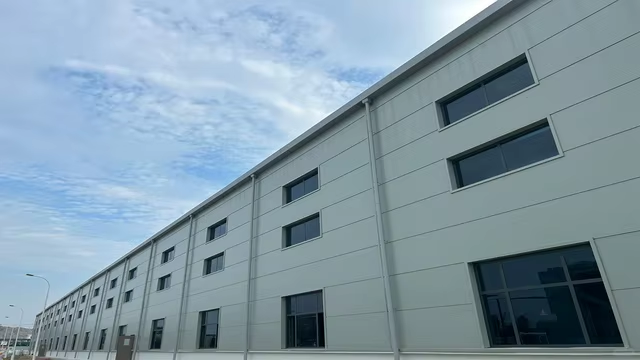
Vietnam Prefab Steel Factory Building Guide: Typhoon Wind, Seismic Checks, Corrosion, and Cost Planning
For engineering buyers planning a prefab steel factory building, warehouse, or production workshop in Vietnam, a prefab steel structure is usually selected for three reasons: predictable fabrication quality, shorter site work, and easier expansion when the tenant mix changes. The decision is not only about the ton price of steel. It is about the clear span required by trucks or production lines, the wind and rain exposure at the site, the corrosion category, the fire strategy, the erection method, and the documentation package needed for local approval. This guide is written for project owners, EPC contractors, architects, and industrial park decision makers who need a practical basis for budget, drawings, and supplier comparison.
Steelstructureprefab.com supplies pre-engineered steel buildings for warehouses, workshops, hangars, factory frames, and farm buildings. If your team is comparing layouts, review our prefab steel warehouse solutions, visit the products page, and send drawings through Contact Us for a project quotation. This article focuses on Binh Duong, Dong Nai, Long An, Hai Phong, Da Nang, and Hanoi industrial parks, while many principles also apply to nearby industrial zones.
1. Where Vietnam Projects Usually Need Prefab Steel Buildings
In Binh Duong, Dong Nai, Long An, Hai Phong, Da Nang, and Hanoi industrial parks, most B2B inquiries fall into four groups: logistics storage, light manufacturing, maintenance workshops, and mixed-use industrial buildings. A logistics building needs wide dock movement, pallet racking clearance, and reliable roof drainage. A workshop needs crane runway beams, reinforced column lines, and ventilation. A factory building may require clean internal spans for equipment foundations, future mezzanine floors, and fire-rated separation between process zones. A poultry house steel structure or agricultural shed needs light corrosion protection, washable surfaces, and controlled ventilation.
- Distribution warehouses serving ports, airports, free zones, and inland industrial parks in Vietnam.
- Steel workshops for machinery repair, metal fabrication, vehicle service, and assembly lines.
- Factory building steel frames for food packaging, plastics, building materials, electrical equipment, and spare parts.
- Covered storage for cement, fertilizers, grain bags, cold-chain panels, or retail inventory.
- Expandable industrial units where the first phase must connect to a future bay without costly demolition.
The early design meeting should confirm the operating flow before column spacing is fixed. A low-cost frame can become expensive if the owner later adds bridge cranes, high-bay racking, or extra loading docks. A good supplier will ask about floor use, forklifts, truck turning, ventilation, roof insulation, fire access, drainage routes, and the local permit package before giving a final price.
2. Local Climate and Code Issues for Vietnam
Vietnam projects must consider monsoon rain, typhoon wind in exposed coastal and northern areas, high humidity, and corrosion near ports or chemical zones. Long roof slopes need careful drainage. Roof sheeting, screws, ridge caps, and wall flashings must resist wind-driven rain. In some regions, seismic checks are also part of responsible design, especially for multi-story office blocks connected to the factory frame. The building frame must be checked for the local combination of dead load, live load, wind load, possible seismic action, and serviceability limits. Approval practice depends on project location, industrial park rules, fire police review, and the local consultant. Many owners use a mix of Vietnamese standards and international references. The exported steel package should include calculations, drawings, material certificates, and coating records that help the local design institute or consultant complete submission. For exported steel structures, the practical approach is to prepare a calculation basis that can be reviewed by the local consultant: design code, material grade, load map, importance factor, deflection limits, connection assumptions, and coating system.
Buyers in Vietnam should not accept a quotation that says only ‘standard design’. The engineer should state roof live load, basic wind speed or pressure, exposure category, seismic coefficient where relevant, and the load allowance for solar panels, suspended utilities, sprinklers, or ceilings. These items affect steel weight and connection design. A warehouse in a sheltered inland site and a coastal workshop near a port can have very different bracing and coating requirements.
- Wind: check roof uplift, wall girts, eave struts, anchor bolts, and large door openings.
- Snow or roof live load: even in warm markets, maintenance load and ponding control still matter.
- Seismic: confirm whether the site is in a low, moderate, or active zone and whether braced frames need ductile detailing.
- Thermal movement: long buildings need expansion joints or sliding details in cladding and gutters.
- Drainage: intense rain needs enough gutter capacity, downpipe spacing, roof slope, and site grading.
Useful references include Vietnam Ministry of Construction, Vietnam Standards and Quality Institute, and American Institute of Steel Construction. Local engineers remain responsible for final approval, but these references help procurement teams ask better questions.
3. Recommended Structural System
Most prefab steel factory building, warehouse, or production workshop projects use a portal frame system with welded H-section columns and rafters, secondary Z or C purlins, wall girts, roof and wall bracing, tie rods, high-strength bolts, and anchor bolts. For spans from 18 m to 36 m, portal frames are usually efficient. For 40 m to 60 m clear spans, truss rafters or tapered built-up sections may reduce weight, depending on roof load and crane requirements. Multi-span buildings with internal columns are often more economical when the process allows columns.
The frame selection should be tied to bay spacing. Common bay spacing is 6 m, 7.5 m, or 8 m. Wider bays can reduce foundations and speed installation, but secondary members may become heavier. If overhead cranes are required, column brackets, crane beams, lateral surge bracing, and runway alignment tolerances must be designed from the start. For high-bay warehouses, frame deflection should be controlled so racking and cladding are not damaged during strong wind events.
Key design checks for engineering buyers
- Frame stability under factored load combinations, including uplift and lateral load.
- Purlin and girt spacing for selected cladding thickness and wind suction pressure.
- Base plate size, anchor bolt grade, embedment, and grout thickness.
- Bracing layout that does not block doors, conveyors, or truck lanes.
- Crane runway beam deflection, end stop load, and maintenance access.
- Mezzanine beam vibration and fire separation when offices are added inside the factory.
4. Material Specifications and Surface Treatment
For Vietnam, material selection should balance initial cost, corrosion risk, and maintenance access. A typical package includes Q355 or equivalent high-strength steel for main frames, Q235/Q355 for secondary members, 8.8S or 10.9S bolts for critical connections, galvanized purlins, color-coated roof and wall sheets, insulation, skylights, ventilators, and gutters. If the owner requests American, European, or local standards, the mill certificates and welding records should match the stated specification.
| Component | Typical specification | Buyer notes |
|---|---|---|
| Main steel frame | Q355B/S355 welded H-section portal frames or multi-span frames | Check deflection limits for cladding and high-bay production areas |
| Secondary members | Galvanized Z/C purlins and girts with bolted cleats | Spacing must match typhoon wind pressure and sheet profile |
| Roof/wall envelope | Single skin sheet, glass wool system, or sandwich panel | Select based on heat, noise, condensation, and fire strategy |
| Fasteners and flashings | Self-drilling screws with washers, ridge caps, trim, and sealant | Wind-driven rain makes detailing important |
| Surface treatment | Shot blast and paint; galvanizing for coastal or wet industrial zones | Humidity and chemical exposure should guide coating choice |
Surface treatment is a procurement item, not a cosmetic detail. Shot blasting to Sa 2.5 improves paint adhesion. Primer thickness should be measured after coating. For inland dry industrial areas, epoxy zinc-rich primer plus intermediate and finish coats may be enough. For coastal, chemical, or fertilizer storage sites, hot-dip galvanizing or a heavier paint system should be reviewed. Bolted connections and cut edges need touch-up paint after erection.
5. Cost Range for Vietnam: What Drives the Budget
For Vietnam, budget planning should separate the exported steel frame package from local foundation, slab, fire protection, MEP, and erection labor. The final cost depends on typhoon wind pressure, insulation level, fire compartment needs, mezzanine loads, coating system, and whether the factory must stay expandable for a second phase. The lowest ton price is rarely the best project price. Steel weight is affected by span, height, wind speed, seismic requirement, roof load, crane capacity, cladding thickness, mezzanine load, and fire system coordination. Freight, container loading method, local tax, port handling, foundation work, erection labor, equipment rental, and site access also change the total installed cost.
| Scope item | Budget influence | Procurement advice |
|---|---|---|
| Main steel frame | Usually the largest factory-supplied cost item | Compare steel weight per m², not only unit price per ton |
| Roof and wall cladding | Affected by thickness, coating, insulation, skylight ratio | Ask for sheet profile, coating mass, color, and warranty terms |
| Doors, windows, louvers | Can change fire access and ventilation performance | Confirm opening size before final frame drawings |
| Surface treatment | Higher cost in coastal or chemical areas | Specify DFT, galvanizing thickness, and touch-up method |
| Freight and packing | Depends on container plan and member length | Request packing list and container loading drawings |
| Installation | Depends on crane access, crew skill, and weather | Use marked members, bolt lists, and erection drawings to reduce delays |
As a starting point for early feasibility, many simple steel warehouse shells are budgeted by square meter, while crane workshops and insulated factories need a line-item quotation. For a fast budget, send span, length, eave height, column spacing, local wind speed, roof live load, cladding type, door sizes, and any crane or mezzanine requirements. Our team can prepare a preliminary scheme through the project inquiry page.
6. Installation Period and Site Coordination
A prefabricated steel building for Vietnam can reduce on-site time because cutting, drilling, welding, and trial assembly checks are completed in the factory. For a 1,500 to 3,000 m² warehouse, steel erection may take several weeks after foundations are ready, depending on crew size, crane access, weather, and inspection steps. Larger projects should be divided into zones so roof and wall cladding can follow frame alignment without waiting for the full site to be complete.
- Before shipment: approve general arrangement drawings, anchor bolt plan, fabrication drawings, coating system, and packing list.
- Before erection: check foundation level, anchor bolt spacing, storage area, crane route, and safety plan.
- During frame erection: install bracing early, tighten bolts by the approved method, and monitor plumbness.
- During cladding: protect coated sheets from scratches, seal laps, and confirm gutter slope.
- Before handover: inspect touch-up paint, door operation, roof fasteners, flashing, drainage, and as-built records.
For international buyers, clear marking is important. Each column, rafter, purlin, girt, brace, and bolt package should match the erection drawings. A good packing sequence places early-erection components in accessible positions, not buried at the back of the final container. See our quality control process and factory tour to understand how fabrication and checking are managed before shipment.
7. Project Scenarios in Binh Duong, Dong Nai, Long An, Hai Phong, Da Nang, and Hanoi industrial parks
The following scenarios show how technical choices differ by use. A port-side logistics shed in Binh Duong, Dong Nai, Long An, Hai Phong, Da Nang, and Hanoi industrial parks may need stronger corrosion protection, large roller shutters, dock shelters, and wide canopies. A machinery workshop may need 5 t to 20 t overhead cranes, side ventilation, and stronger column brackets. A food or packaging factory may need insulated sandwich panels, hygienic wall finishes, controlled dust, and fire-rated internal partitions. A spare parts warehouse may prioritize high-bay racking, forklift aisle planning, and future solar panel load.
| Scenario | Recommended layout | Important specification |
|---|---|---|
| Logistics warehouse | 24-36 m clear span, 8-12 m eave height, dock doors | Wind-resistant cladding, roof insulation, drainage, truck apron coordination |
| Steel workshop | 18-30 m span, crane runway, side ventilation | Crane beam design, column bracket details, industrial floor coordination |
| Factory building | Multi-bay frame with process zones and utilities | Fire separation, ventilation, equipment openings, future expansion joint |
| Cold or clean storage | Insulated envelope with limited thermal bridges | Sandwich panel thickness, vapor control, door seals, roof condensation control |
8. Documents to Request Before Placing an Order
A professional B2B purchase should be based on documents that allow comparison. Ask each supplier for the design basis, GA drawings, steel weight summary, material grade list, coating specification, cladding schedule, door and window schedule, bolt list, anchor bolt plan, packing plan, delivery schedule, and payment milestone. If the building will be submitted to local authorities, ask whether calculation notes can be issued in the format needed by the local consultant.
- Design basis: code, load values, material grades, serviceability limits, and assumptions.
- Drawings: plan, elevation, section, bracing layout, connection details, and anchor bolt drawings.
- Quality records: mill certificates, welding inspection, dimension checking, coating DFT records, and packing photos.
- Commercial terms: Incoterms, delivery time, spare bolts, installation guidance, warranty scope, and exclusion list.
- Local scope split: foundation, slab, fire system, MEP, site crane, labor, permits, and unloading.
9. Common Buyer Questions
What is the best span for a Vietnam steel warehouse?
For many logistics buildings, 24 m to 36 m clear span works well. Wider spans are possible, but the frame becomes heavier. If the operation permits internal columns, a multi-span design may reduce cost.
Can the building be designed for overhead cranes?
Yes. Crane capacity, lifting height, class, runway length, hook coverage, and future crane plans must be provided before structural design. Crane beams and column brackets should not be added after fabrication without engineering review.
How do I compare two quotations fairly?
Compare total steel weight, design loads, material grades, coating system, cladding thickness, included accessories, freight terms, and documents. A lower price may exclude doors, gutters, insulation, bolts, or engineering support.
What corrosion system is suitable for Hai Phong, Da Nang, or coastal Vietnam factory sites?
Inland industrial sites may use a painted system with measured dry film thickness. Coastal, high-humidity, fertilizer, or chemical sites often need hot-dip galvanizing or a heavier epoxy system. The supplier should state the preparation grade and coating thickness.
How soon can installation start after order confirmation?
It depends on drawing approval, production queue, shipment route, customs clearance, and foundation readiness. Early approval of anchor bolt drawings helps the civil contractor start foundations while steel fabrication is in progress.
11. Engineering Data Sheet for Supplier Comparison
A reliable quotation starts with a shared data sheet. The buyer should not send only the floor area and ask for a ton price. The supplier needs the grid line dimensions, eave height, ridge height if fixed, roof slope, bay spacing, column-free areas, local wind data, roof live load, collateral load, suspended ceiling load, solar panel allowance, crane data, floor finish level, and required design code. If the building connects to an existing structure, the interface line, expansion joint, and drainage direction must be shown clearly.
For procurement departments, a data sheet also protects the commercial comparison. When all bidders use the same wind speed, same coating thickness, same cladding profile, and same door schedule, the price difference becomes meaningful. If one bidder assumes no insulation and another includes 50 mm glass wool, the cheaper offer is not a saving; it is a different scope. This is especially important for international steel structure orders where the civil works, fire system, and MEP are usually handled locally.
| Data item | Why it matters | Recommended input |
|---|---|---|
| Building geometry | Controls frame span, steel weight, and container loading | Length, width, eave height, roof slope, bay spacing |
| Operational loads | Changes columns, rafters, crane beams, and foundations | Crane capacity, mezzanine load, equipment supports, racking load |
| Weather loads | Controls bracing, purlins, cladding fasteners, and anchor bolts | Wind speed/pressure, exposure, roof live load, rain intensity, seismic data |
| Envelope | Affects heat, noise, fire, and condensation | Single sheet, insulated blanket, or sandwich panel; thickness and coating |
| Accessories | Often missing from low-price offers | Doors, windows, louvers, ventilators, skylights, gutters, downpipes, canopies |
12. Risk Points That Often Cause Cost Overruns
Many steel building cost overruns are not caused by steel fabrication. They come from incomplete scope definition, late changes, or poor coordination between imported steel and local construction. Anchor bolts may be cast in the wrong position if the foundation contractor works from an outdated drawing. Roof sheets may arrive before safe storage is prepared, leading to scratches or water staining. Large doors may conflict with bracing bays. Crane beams may need redesign if the owner changes crane capacity after the frame has been fabricated.
- Freeze the door and equipment openings before fabrication drawings are released.
- Confirm whether gutters drain inside or outside the building and who supplies underground drainage.
- Check if local fire rules require smoke vents, fire-rated walls, emergency doors, hydrant access, or sprinkler tank space.
- Review transport limits for long rafters, columns, and crane beams before finalizing member splices.
- Keep spare bolts, touch-up paint, and roof fasteners on site during erection.
- Assign one person to control drawing revisions and issue the latest set to the foundation and erection teams.
For large industrial parks, the owner may standardize bay spacing, cladding color, door height, roof drainage, and fire access roads across several buildings. Standardization lowers design time and spare-part complexity. However, the structural design still needs to reflect each tenant’s process load, crane use, and ventilation requirement.
13. Factory Fabrication, Inspection, and Packing Control
Before shipment, the main members should be checked for dimensions, hole positions, weld appearance, member camber where specified, coating dry film thickness, and marking. Inspection does not need to slow the project if the supplier prepares inspection points in the production plan. For a B2B buyer, the most useful records are photos of member marking, DFT readings, bolt packages, cladding bundles, and container loading. These records help the site team identify materials quickly after arrival.
Packing should match the erection order. Columns, rafters, bracing, and anchor bolts needed for the first bay should be easy to access. Small parts need labels and protected boxes. Roof sheets should be protected from sharp steel edges. Painted steel should be separated with pads to reduce coating damage during sea freight. When container loading is optimized only for volume and not for site sequence, unloading takes longer and damage risk increases.
14. Buyer Checklist Before Signing the Contract
- Confirm the final design loads and the standard used for structural calculations.
- Confirm the steel grades, bolt grades, welding method, and coating system in writing.
- Review the exclusion list: foundation, slab, erection labor, crane rental, fire system, MEP, customs, taxes, and local approvals.
- Ask for the anchor bolt plan early so civil works can start while fabrication drawings are completed.
- Agree on inspection records, packing photos, and shipping documents before the balance payment.
- Set a process for handling drawing changes after approval, including cost and schedule impact.
When these items are settled early, the steel structure becomes a controlled industrial purchase rather than a risky overseas order. The result is a building that reaches site with the right members, the right bolts, and the right documents for fast erection.
15. Practical Procurement Advice
For Vietnam prefab steel factory, Binh Duong steel warehouse, Dong Nai industrial steel building, the right buying process starts with a clear data sheet. Share the site city, building length and width, eave height, roof slope, local wind speed, roof live load, seismic category if required, crane data, door sizes, insulation, ventilation, and corrosion environment. Include any local authority requirements and preferred standards. If you already have architectural drawings, send CAD or PDF files so the frame can be optimized around the real operation.
Steelstructureprefab.com can support early budgeting, structural scheme design, fabrication, packing, and export documentation for Vietnam industrial steel building projects. For related examples, review our regional pages for Saudi Arabia prefab steel warehouses, UAE steel structure workshops, and Kenya prefab steel warehouses. To move from budget to a workable offer, send the project brief and required delivery location through Contact Us.