
Low-Carbon EAF Steel: A Green Material for LEED and BREEAM Certified Steel Structures

Electric Arc Furnace (EAF) steel with high recycled content and low embodied carbon. Learn how EAF steel contributes to LEED and BREEAM green building certifications for overseas sustainable projects.
Sustainability is no longer a “nice-to-have” for overseas construction projects—it is a competitive requirement. Green building certifications like LEED and BREEAM are increasingly mandated by investors, tenants, and regulators in Europe and North America.
For steel structures, the most direct path to certification points is Electric Arc Furnace (EAF) steel. Unlike traditional blast furnace steel, EAF steel is manufactured primarily from recycled scrap, dramatically reducing its carbon footprint while contributing to multiple green building credits.
This guide explains:
- How EAF steel is made and why its carbon footprint is lower.
- Carbon emission comparisons: EAF vs. BOF (Basic Oxygen Furnace).
- How EAF steel contributes to LEED v4.1 and v5 credits.
- BREEAM compliance pathways.
- Documentation requirements (EPDs, mill certificates).
- Specifying EAF steel for your next sustainable project.
1. What is EAF Steel and Why Does It Matter?
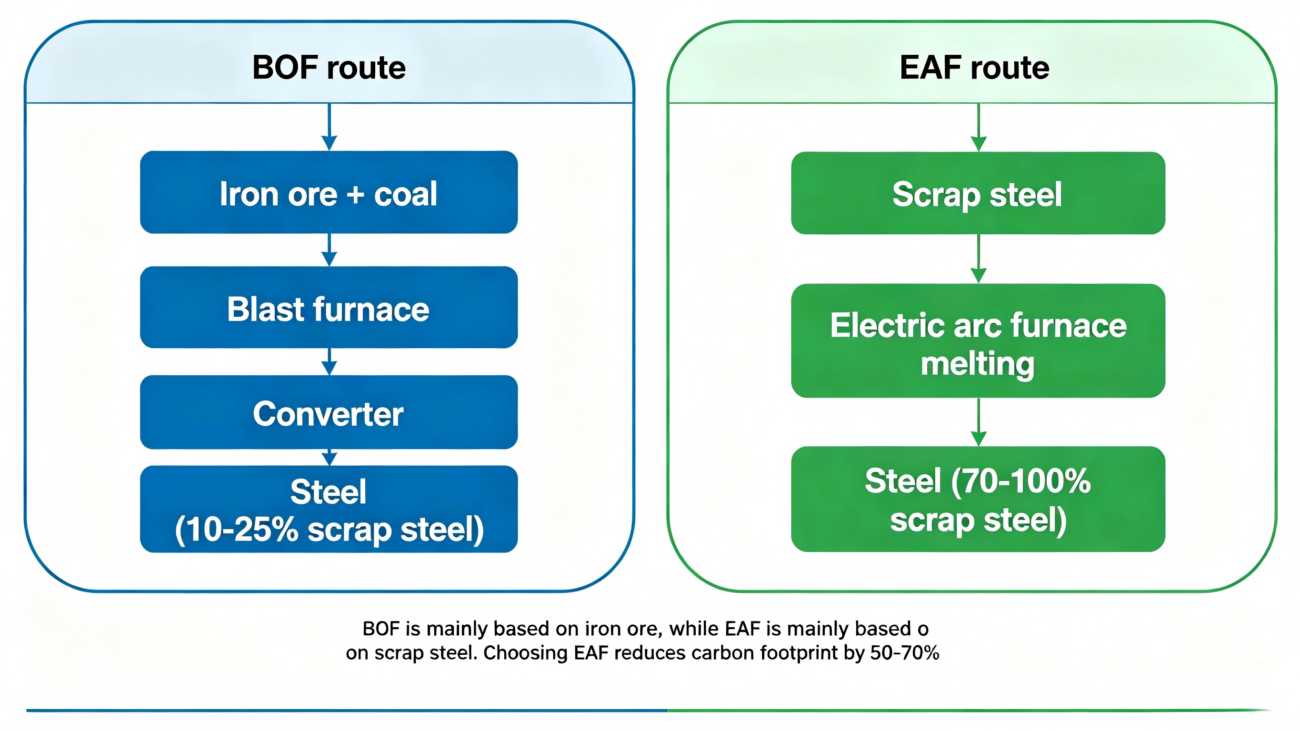
Steel is produced through two primary manufacturing routes: the Basic Oxygen Furnace (BOF) and the Electric Arc Furnace (EAF).
| Production Route | Primary Input | Recycled Content | Typical CO₂ Footprint | Global Share |
|---|---|---|---|---|
| BOF (Blast Furnace) | Iron ore, coal, limestone | 10-25% | ~2.0-2.3 t CO₂/tonne -8 | ~70% |
| EAF (Electric Arc Furnace) | Steel scrap, DRI | 70-100% | 0.7-1.3 t CO₂/tonne -8 | ~30% |
The key difference: EAF steelmaking uses electricity to melt scrap steel, avoiding the coke-fueled blast furnace entirely. This eliminates the majority of CO₂ emissions associated with iron ore reduction.
How the EAF process works:
- Steel scrap (post-consumer and pre-consumer) is charged into the furnace.
- Electrodes are lowered, and an electric arc melts the scrap (temperature >1,600°C).
- The molten steel is refined and cast into new products—slabs, beams, rebar, or coils.
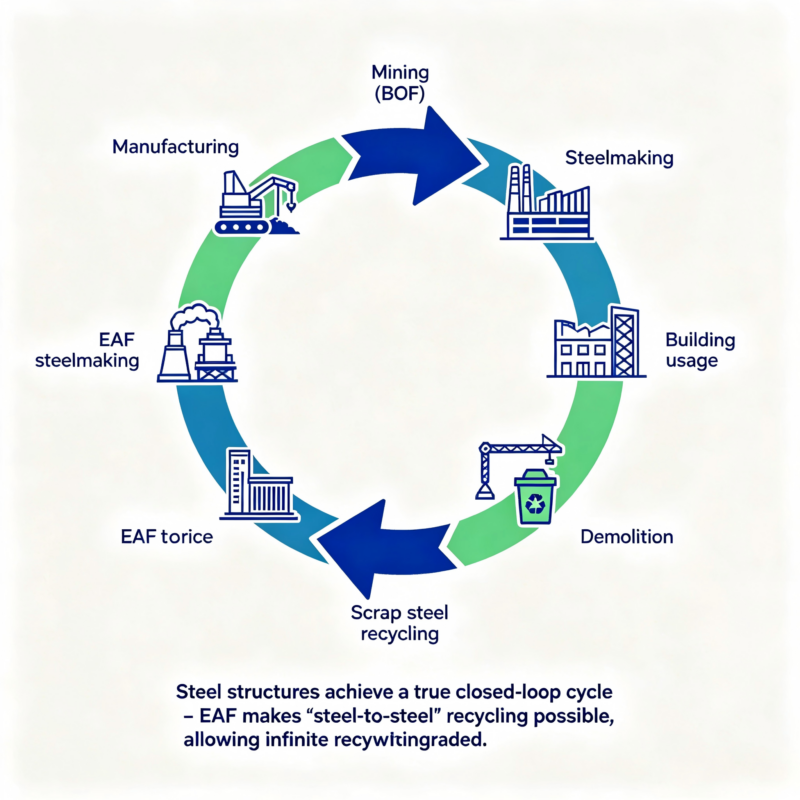
- The process is cyclical: old steel becomes new steel, indefinitely.
The environmental significance: According to the World Steel Association, using steel scrap instead of virgin ore reduces CO₂ emissions by 58% , and recycling one tonne of steel saves 1.4 tonnes of iron ore and 0.8 tonnes of coal -3.
2. Carbon Footprint: EAF vs. BOF in Detail
Understanding the carbon numbers is essential for LEED documentation.
| Impact Category | BOF (Virgin Ore) | EAF (100% Scrap) | EAF with Renewable Electricity |
|---|---|---|---|
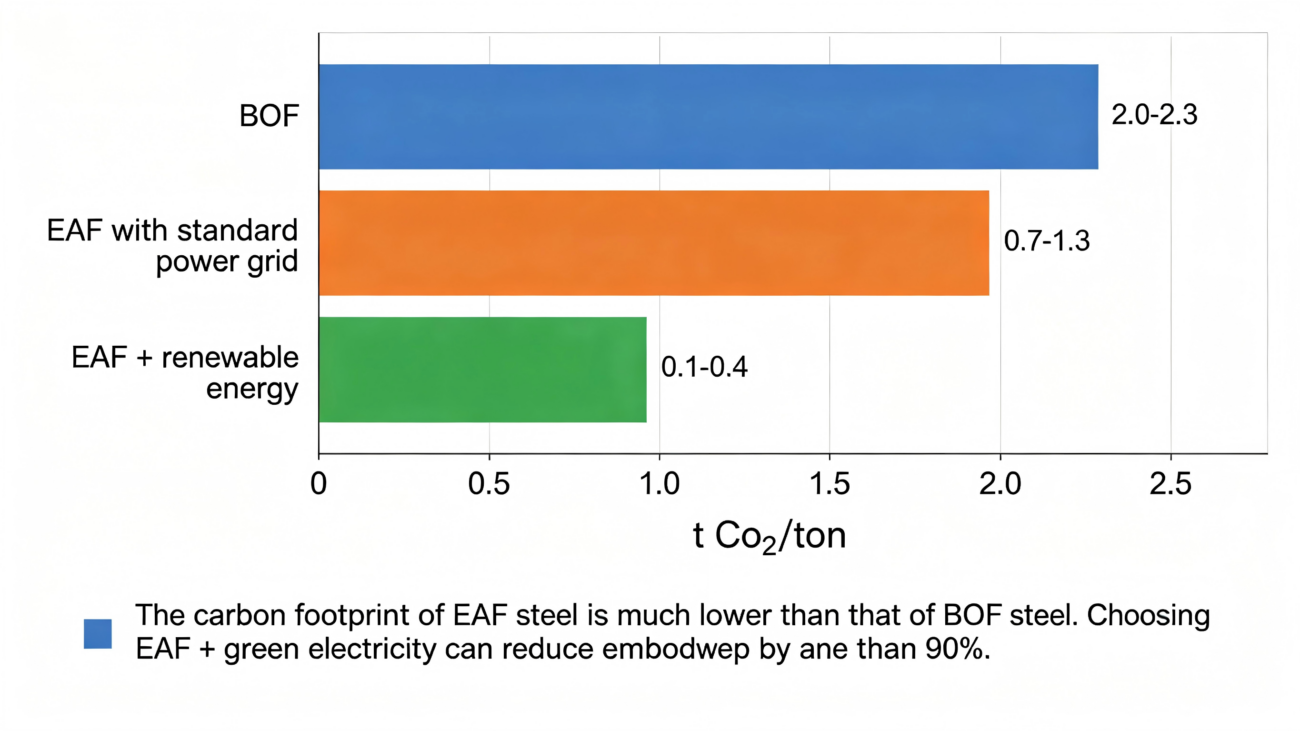
| CO₂ emissions (t/tonne steel) | 2.0-2.3 | 0.7-1.3 | 0.1-0.4 -8 |
| Energy consumption (GJ/tonne) | 17-23 | 2-3 -8 | 2-3 (electricity source varies) |
| Recycled content (typical) | 10-25% | 70-100% | 70-100% |
| Post-consumer recycled content | 5-15% | 30-70% -6 | 30-70% |
Why the range for EAF? EAF emissions vary significantly based on electricity source. An EAF in Sweden using hydroelectric power produces ~0.1-0.2 t CO₂/tonne, while an EAF in a coal-dependent grid may produce 0.8-1.2 t CO₂/tonne. When specifying EAF steel for maximum carbon reduction, ask for the mill-specific carbon intensity.
Real-world EAF recycled content data (ArcelorMittal Dofasco):
- 74.3% post-consumer scrap (e.g., recycled cars, appliances, demolished buildings)
- 17.8% pre-consumer scrap (industrial manufacturing waste)
- 0.7% home scrap (internal mill recycling)
- Total recycled content: 92.8% -6
EAF vs. BOF in perspective: The difference of 1.0-1.5 t CO₂ per tonne of steel is substantial. For a 500-tonne structural steel frame:
- BOF steel: ~1,000-1,150 t CO₂
- EAF steel: ~350-650 t CO₂
- Savings: 350-800 t CO₂ —equivalent to removing 75-170 cars from the road for one year.
3. LEED Certification: How EAF Steel Contributes
LEED (Leadership in Energy and Environmental Design) is the most widely used green building certification system globally, administered by the U.S. Green Building Council (USGBC). The latest versions—LEED v4.1 and the recently introduced LEED v5—place increasing emphasis on embodied carbon reduction -1.
LEED v4.1 Credit Pathways
Under LEED v4.1 Building Design and Construction, structural steel contributes to the Materials and Resources (MR) category through two primary credits -1:
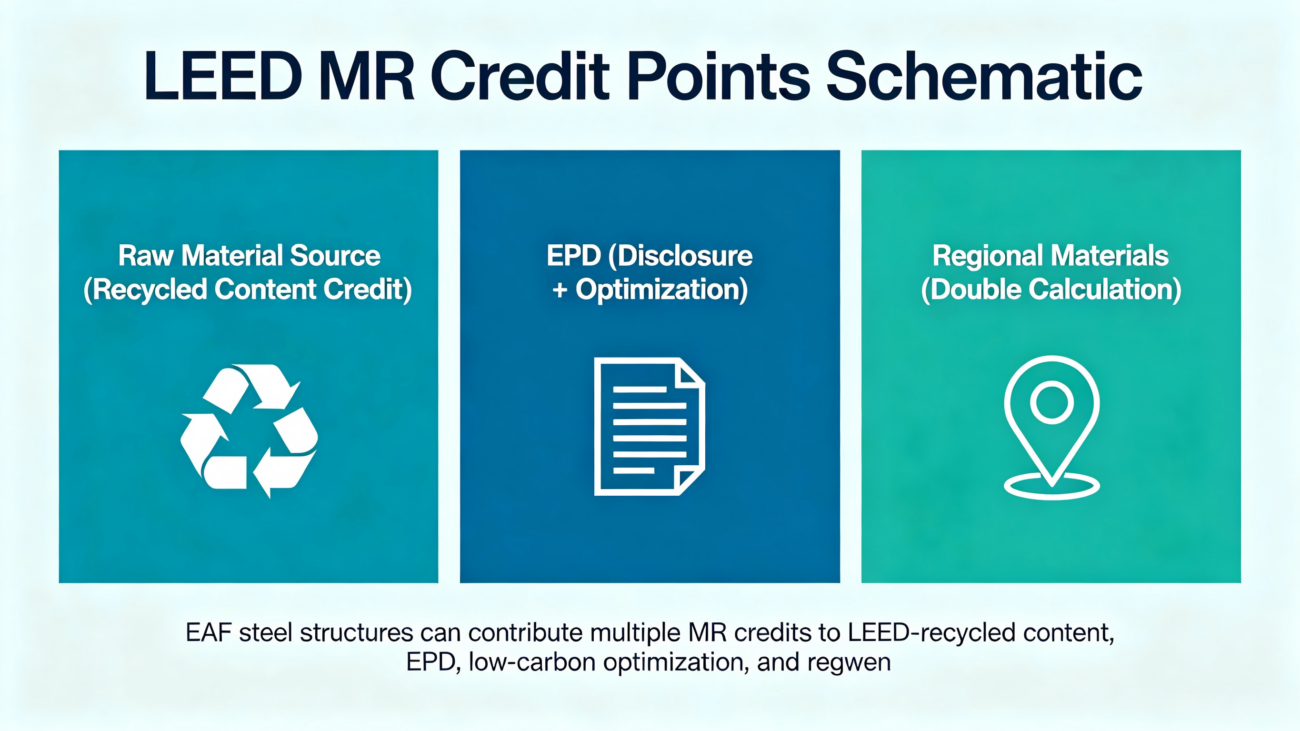
MR Credit: Building Product Disclosure and Optimization – Sourcing of Raw Materials
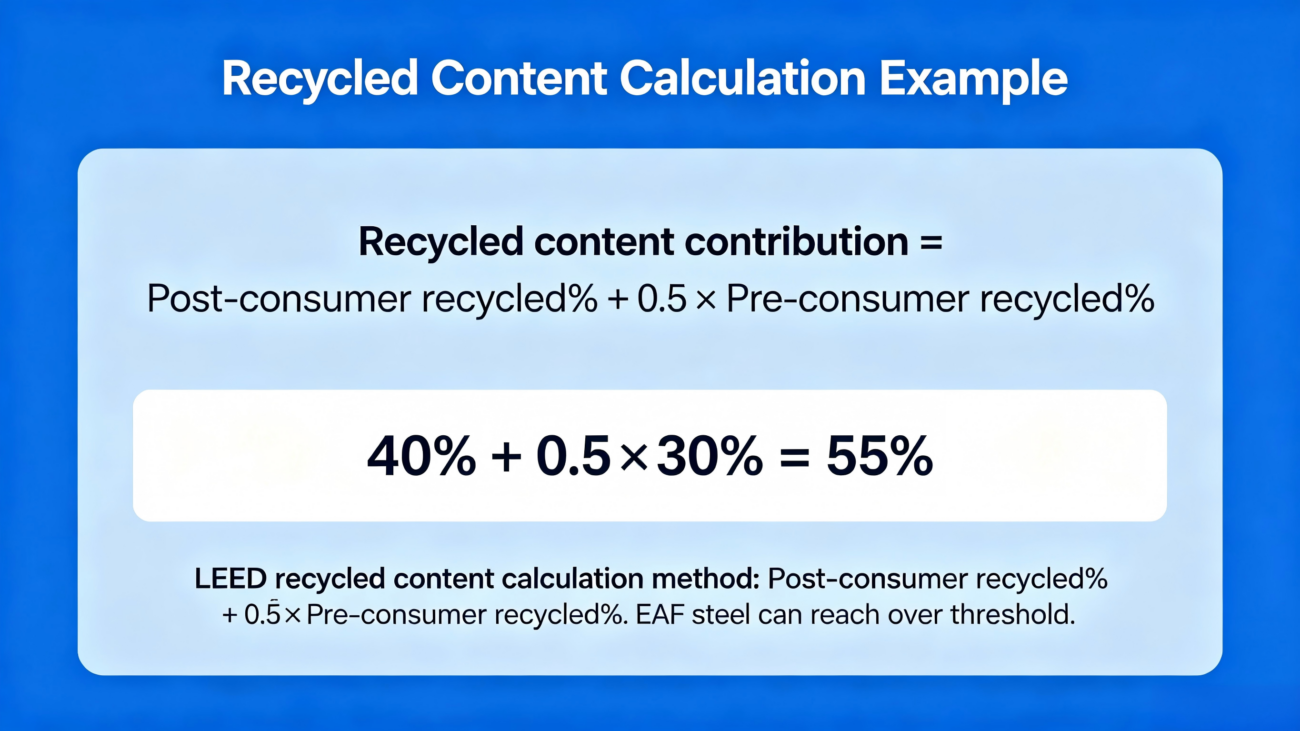
This credit rewards recycled content. The calculation method is:
text复制下载
Recycled Content Contribution = Post-Consumer % + (0.5 × Pre-Consumer %)
| Steel Type | Post-Consumer | Pre-Consumer | Recycled Content Contribution |
|---|---|---|---|
| BOF (typical) | 10% | 10% | 10% + (0.5×10%) = 15% |
| EAF (typical) | 40% | 30% | 40% + (0.5×30%) = 55% -4 |
LEED point thresholds (MR Sourcing of Raw Materials):
- 10% recycled content (by cost) → 1 point
- 15% recycled content (by cost) → 2 points
EAF steel easily achieves the maximum 2 points. BOF steel may only achieve 1 point (or none) depending on actual recycled content.
MR Credit: Environmental Product Declarations (EPDs)
LEED v4.1 offers two compliance options -1:
| Option | Description | EAF Steel Contribution |
|---|---|---|
| Option 1 (Disclosure) | Rewards availability of verified Type III EPDs | EAF steel mills typically provide product-specific EPDs |
| Option 2 (Optimization) | Rewards demonstrated reduction in GWP vs. baseline | EAF steel shows significant GWP reduction vs. BOF baseline (50-70% lower) |
Regional Materials Valuation (LEED v4.1): Products extracted, manufactured, and purchased within 100 miles (160 km) of the project site are valued at twice their base contribution -1. EAF mills located near scrap sources and project sites can leverage this adjustment.
LEED v5: Stricter Requirements
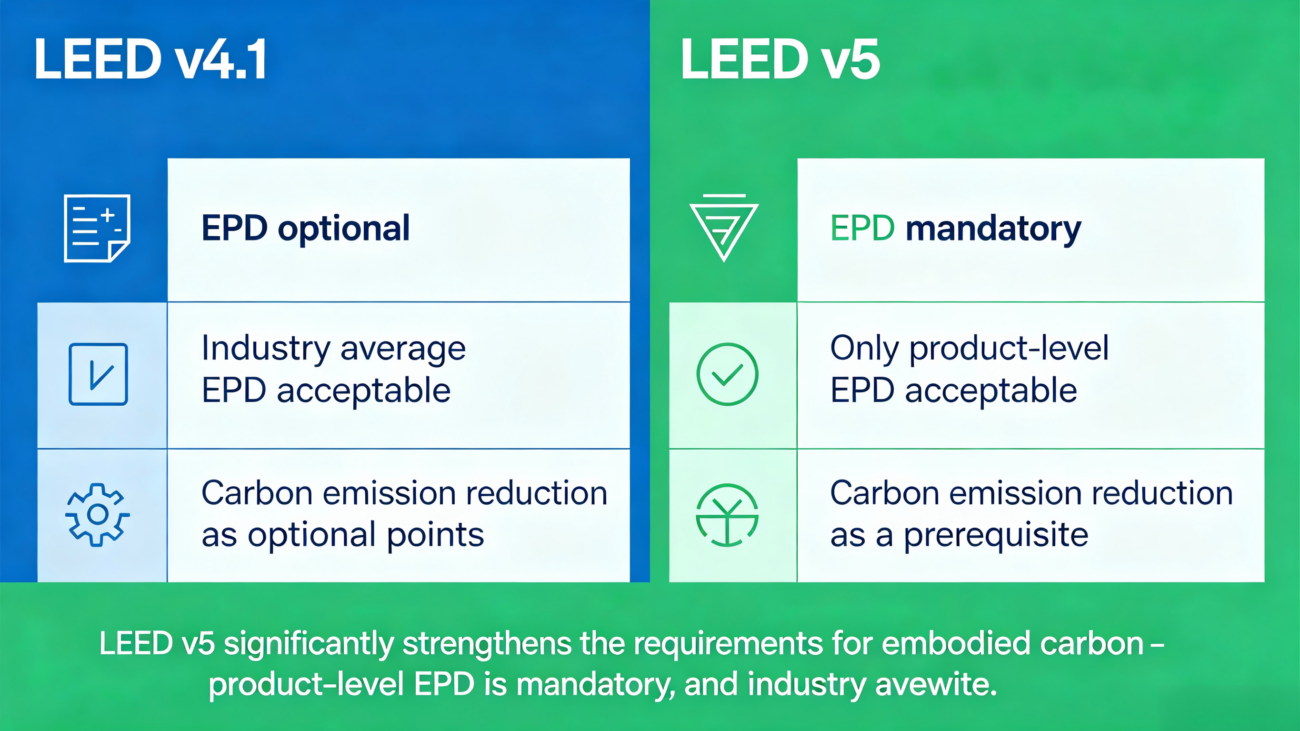
LEED v5 (April 2025 release) significantly strengthens embodied carbon requirements. Key changes -1:
| Requirement | LEED v4.1 | LEED v5 |
|---|---|---|
| Embodied carbon quantification | Optional | Prerequisite (mandatory) |
| Industry-average EPDs | Acceptable for some credits | Cannot be used for compliance |
| Product-specific EPDs | Encouraged | Required for credit compliance |
| Carbon reduction targets | Tiered points | Mandatory reductions |
MR Prerequisite 2: Quantify and Assess Embodied Carbon
All LEED BD+C projects must complete this prerequisite. Project teams are required to quantify embodied carbon for major materials, including structural steel, using product-specific, third-party verified Type III EPDs -1.
MR Credit 2: Reduce Embodied Carbon
Projects earn points by reducing embodied carbon relative to industry baselines. Reductions are measured in kg CO₂e. For structural steel, the baseline is typically BOF steel (~2.0-2.3 t CO₂/tonne). EAF steel achieving 0.7-1.3 t CO₂/tonne demonstrates significant reductions -1.
The practical implication: Under LEED v5, EAF steel with product-specific EPDs is no longer just “helpful”—it is necessary to meet the embodied carbon prerequisite. Projects using BOF steel without documented low-carbon attributes will struggle to achieve certification.
EAF Steel Contribution Summary for LEED
| LEED Credit | EAF Steel Contribution | Documentation Required |
|---|---|---|
| MR Sourcing of Raw Materials (Recycled Content) | 2 points (maximum) | Mill certificate showing recycled content percentages |
| MR Environmental Product Declarations | Option 1 (disclosure) + Option 2 (optimization) | Product-specific Type III EPD (cradle-to-gate) |
| MR Prerequisite 2 (v5) | Required compliance | Product-specific EPD with carbon intensity |
| MR Credit 2 (v5) | Points for carbon reduction | EPD + carbon intensity calculation |
| Regional Materials | 2× contribution (if within 100 miles) | Distance documentation from mill to site |
4. BREEAM Certification: How EAF Steel Contributes
BREEAM (Building Research Establishment Environmental Assessment Method) is the leading green building certification system in the UK and Europe.
Mat 01: Life Cycle Impacts
This credit rewards reductions in environmental life cycle impacts through assessment of main building elements. EAF steel contributes by:
- Lower Global Warming Potential (GWP) compared to BOF baseline
- Reduced primary energy demand
- Lower acidification and eutrophication potential (due to avoided iron ore mining)
Mat 05: Material Efficiency
EAF steel’s infinite recyclability supports circular economy principles. Steel is 100% recyclable and can be recycled indefinitely without loss of properties—unlike concrete (downcycled to aggregate) or timber (limited reuse cycles).
Responsible Sourcing (Hea 02 / Mat 03 equivalents):
BREEAM rewards materials sourced from certified schemes. EAF steel mills with ISO 14001 environmental management systems and third-party certified EPDs contribute to responsible sourcing credits -5.
Documentation for BREEAM:
- Product-specific Type III EPD (EN 15804 compliant)
- Mill ISO 14001 certification
- Responsible sourcing certification (e.g., BES 6001)
5. Environmental Product Declarations (EPDs): The Key Document
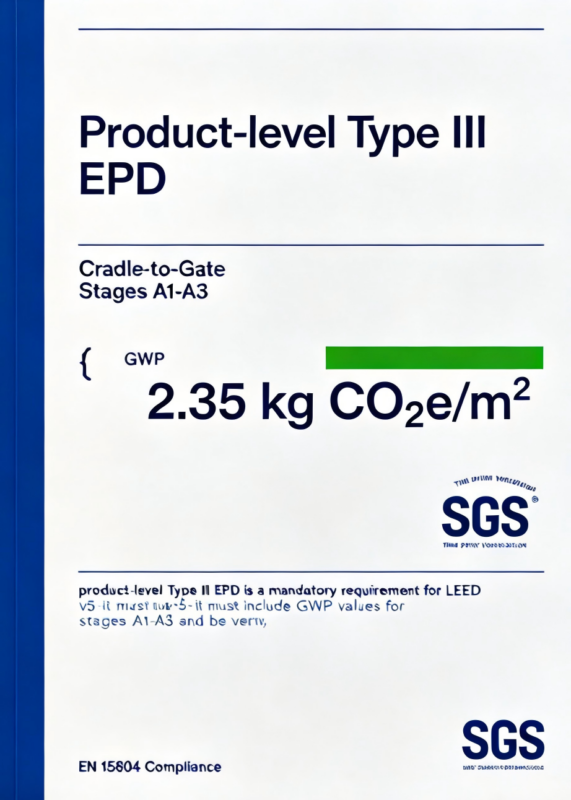
An Environmental Product Declaration (EPD) is a standardized document (ISO 14025, EN 15804) reporting the life cycle environmental impact of a product. For LEED v5, product-specific EPDs are mandatory—industry-average EPDs are no longer sufficient -1.
What a Steel EPD Includes (A1-A3 Cradle-to-Gate):
| Impact Category | Unit | Typical EAF Value | Typical BOF Value |
|---|---|---|---|
| Global Warming Potential (GWP) | kg CO₂e/tonne | 400-1,300 | 1,800-2,300 |
| Primary energy demand (non-renewable) | MJ/tonne | 2,000-5,000 | 18,000-23,000 |
| Recycled content (post-consumer) | % | 30-70% | 5-15% |
How to Request an EPD from Your Steel Supplier:
“The supplier shall provide a product-specific, third-party verified Type III EPD conforming to ISO 14025 and EN 15804 (or ISO 21930), covering A1-A3 cradle-to-gate impacts. The EPD shall include Global Warming Potential (GWP), primary energy demand, and recycled content percentages. Industry-average EPDs are not acceptable for LEED v5 compliance.”
Where to find EPDs: Major EAF producers (Nucor, Steel Dynamics, ArcelorMittal, CMC, Gerdau, SSAB, Baowu EAF divisions) publish product-specific EPDs. The EC3 (Embodied Carbon in Construction Calculator) tool aggregates EPD data for easy comparison -7.
6. Specifying EAF Steel for Your Project
To ensure you receive EAF steel with the necessary documentation, include the following specification language.
For Recycled Content (LEED MR Sourcing of Raw Materials):
“Structural steel shall be manufactured via the Electric Arc Furnace (EAF) process with minimum 75% total recycled content, including minimum 40% post-consumer recycled content. Supplier shall provide mill certificates indicating scrap percentages and production route. For LEED v4.1, recycled content percentages shall be calculated as (post-consumer % + 0.5 × pre-consumer %) on a material cost basis” .
For Embodied Carbon (LEED v5 MR Credit 2 / Prerequisite 2):
“Structural steel shall have a product-specific Type III EPD (EN 15804 or ISO 21930) with third-party verification showing Global Warming Potential (GWP) not exceeding 1.3 t CO₂e per tonne of steel (A1-A3 cradle-to-gate). Industry-average EPDs are not acceptable. Carbon intensity shall be documented in EC3 or equivalent approved platform” -1-7.
For Regional Materials (LEED Regional Materials credit):
“Steel shall be extracted, manufactured, and purchased within 100 miles (160 km) of the project site to qualify for regional materials valuation at 2× base contribution. Mill location and transportation distance shall be documented” -1.
For BREEAM:
“Steel shall be supplied with EN 15804-compliant Type III EPD, and the mill shall maintain ISO 14001 environmental management system certification. Responsible sourcing certification (e.g., BES 6001 ‘Very Good’ or ‘Excellent’) is preferred.”
7. Case Study: EAF Steel for LEED-Certified Projects
Case: Green Spire Tower, Toronto (LEED Platinum, 2024)
This 45-story commercial tower achieved LEED Platinum certification. Key steel-related strategies -2:
- 95% of structural steel sourced from EAF mills with high recycled content
- Optimized A36 angle steel truss systems reduced overall steel usage by 18%
- All steel provided with product-specific Type III EPDs
- Steel purchased from mills within 500 miles (qualified for regional materials credits)
Result: Full points achieved for MR Sourcing of Raw Materials and MR Environmental Product Declarations.
Case: Industrial Warehouse, Sweden (BREEAM Excellent)
- EAF steel from SSAB (fossil-free, hydrogen-DRI/EAF hybrid)
- Carbon intensity: <0.1 t CO₂/tonne (renewable hydroelectric grid)
- Product-specific EPDs for all steel sections
- 98% recycled content (including high post-consumer scrap)
Result: BREEAM Mat 01 and Mat 05 credits achieved, contributing to “Excellent” rating.
8. Beyond Steel: The Complete Sustainability Picture
While EAF steel is the most impactful single material choice, consider these complementary strategies:
| Strategy | Carbon Reduction | LEED/BREEAM Contribution |
|---|---|---|
| EAF steel (high scrap content) | 50-70% | MR Sourcing of Raw Materials |
| EAF steel + renewable electricity | 90-95% | MR Environmental Product Declarations (Optimization pathway) |
| Design optimization (reduced tonnage) | 10-30% | Material efficiency (BREEAM Mat 05) |
| Bolted connections (design for deconstruction) | Future reuse savings | Circular economy credits (emerging) |
| Low-carbon fasteners (EAF bolts) | Minor but additive | Consistent material sourcing |
| Local sourcing (within 100 miles) | Reduced transport emissions | Regional materials (2× valuation) |
The most sustainable approach: EAF steel + renewable electricity + optimized design (less tonnage) + bolted connections (future reuse) + local sourcing.
9. Common Questions from Overseas Clients
Q: Is EAF steel weaker or lower quality than BOF steel?
No. Steel properties depend on chemistry and processing, not input material. EAF steel can produce the same grades (A992, A572 Gr50, S355) with identical mechanical properties. In fact, EAF steel is often preferred for rebar and structural sections requiring tight chemistry control.
Q: Is EAF steel more expensive?
Sometimes, but the premium is typically small (5-15%) and shrinking. In some markets (especially where scrap is abundant and electricity is cheap), EAF steel is actually less expensive than BOF steel. For LEED-certified projects, the certification value usually exceeds any material premium.
Q: Can all steel sections be made via EAF?
Yes. EAFs produce a wide range of products: rebar, structural sections (beams, columns, channels), plate, sheet, and cold-formed sections. Some very heavy plate sections (over 100mm) may be more commonly produced via BOF, but EAF capacity for heavy sections is expanding.
Q: How do I verify that my steel is actually EAF?
Request the mill certificate (MTC). It should state the production route or provide a heat number that can be traced to an EAF mill. Also request the product-specific EPD, which will document the production route and carbon intensity.
Q: What documentation do I need for LEED v5 submission?
For LEED v5 MR Prerequisite 2 and MR Credit 2 -1:
- Product-specific Type III EPD (third-party verified) for each steel product
- Carbon intensity (kg CO₂e per tonne, A1-A3)
- Material quantities (tonnage)
- Calculation of building embodied carbon baseline vs. actual
- EC3 or equivalent documentation platform
10. Link to Low-Carbon Steel Structure Service
We supply EAF steel structures with complete documentation packages for LEED and BREEAM certification.
Our sustainable steel services include:
- EAF steel sourcing: High recycled content (70-95%). Grades: A992, A572 Gr50, S355J2, Q355D/E. Full mill traceability.
- Product-specific EPDs: Third-party verified, EN 15804 compliant, including A1-A3 cradle-to-gate impacts. Ready for LEED v5 submission.
- Recycled content documentation: Mill certificates showing post-consumer and pre-consumer percentages. LEED calculation worksheet provided.
- Design optimization: Right-sizing sections to minimize steel tonnage without compromising safety.
- Local sourcing (regional materials): We can identify EAF mills within 100 miles of your project site where available.
- Certification support: Documentation packages organized by LEED credit or BREEAM issue. EC3 data upload assistance.
For overseas clients:
We provide bilingual documentation (EN/CN or EN/ES) and can coordinate with your LEED consultant or green building advisor. For projects targeting LEED v5, we provide product-specific EPDs for every steel component before production begins.
👉 [Request a low-carbon steel structure quote]
Send us your project location, target green building certification (LEED v4.1, LEED v5, BREEAM, or none), and tonnage requirements. We will return EAF steel specifications, carbon footprint estimate, EPD samples, and documentation package within 48 hours.
Summary Table: Quick EAF Steel Selection for Green Building
| Your Certification Target | Steel Specification | Documentation Required | Expected Contribution |
|---|---|---|---|
| LEED v4.1 (any level) | EAF with 75%+ recycled content | Mill certificate with scrap % | 2 points MR Sourcing of Raw Materials |
| LEED v4.1 (optimization pathway) | EAF with product-specific EPD | Type III EPD (A1-A3) | Additional points MR EPD Option 2 |
| LEED v5 (any level) | EAF + product-specific EPD (mandatory) | Product-specific EPD + carbon intensity | MR Prerequisite 2 compliance |
| LEED v5 (point-earning) | EAF with GWP <1.3 t CO₂/tonne | EPD + EC3 documentation | Points for MR Credit 2 carbon reduction |
| BREEAM (any level) | EAF + EPD + ISO 14001 mill | EN 15804 EPD + mill certification | Mat 01, Mat 05, responsible sourcing credits |
| Maximum carbon reduction | EAF + renewable electricity (GWP <0.4 t CO₂/tonne) | EPD with electricity source documented | Full points for optimization pathways |