
Long-Span Steel Truss Materials: Types, Structural Advantages & Application Scenarios

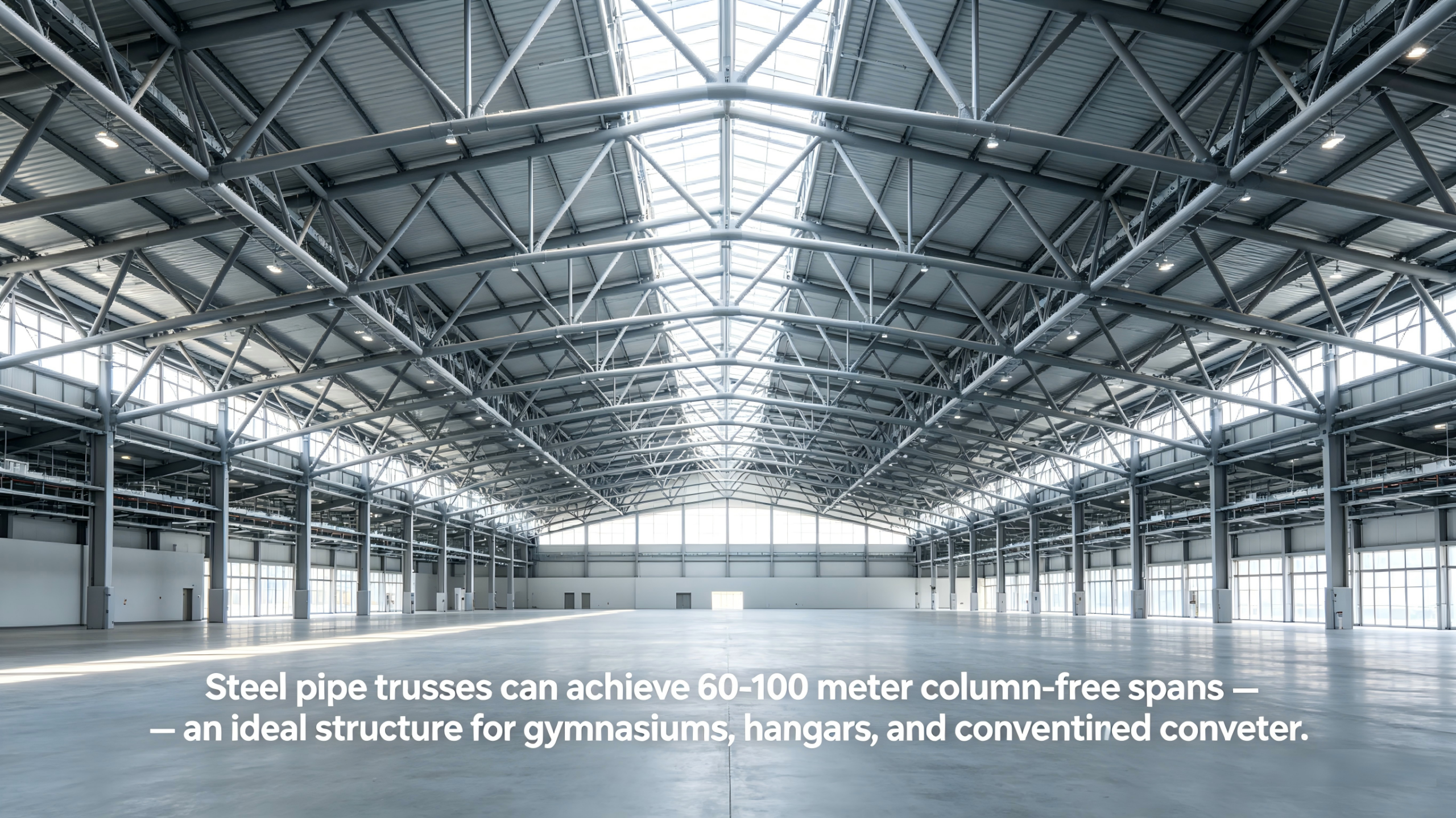
Steel pipe vs. angle steel trusses. Learn material selection, load performance, and application scenarios for long-span projects like stadiums, hangars, and convention centers.
When a building needs to cover 30 meters, 50 meters, or even 100 meters without intermediate columns, standard H-beams stop being practical. The solution? Steel trusses.
A truss converts solid web beams into an open, triangulated system. This uses less steel while spanning farther. For overseas clients designing stadiums, aircraft hangars, exhibition halls, or bulk storage facilities, understanding truss materials is essential.
This guide covers:
- Common truss materials (steel pipe, angle steel, HSS).
- Structural advantages of each type.
- Load performance and span capabilities.
- Real-world project matching.
- Material selection decision framework.
1. What Is a Steel Truss?
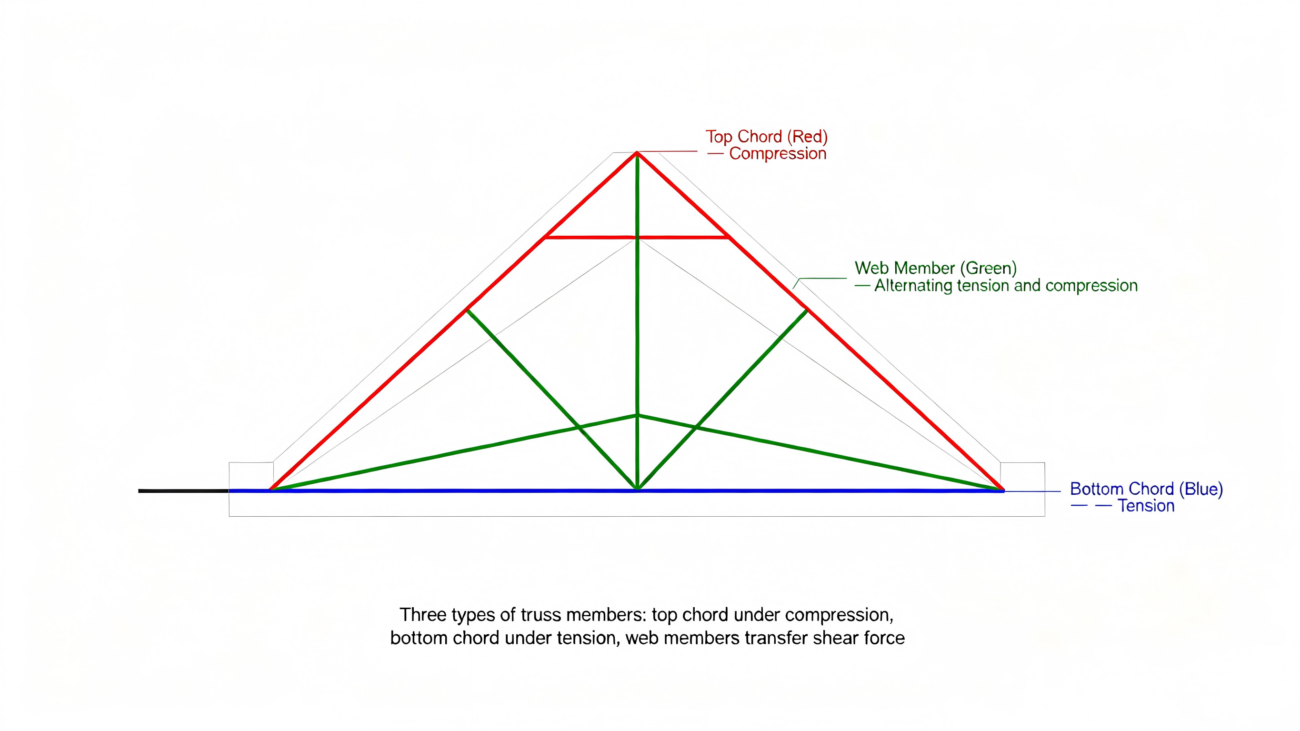
A truss is a structural framework composed of members arranged in triangles. The typical truss has three groups of members:
| Member | Position | Force |
|---|---|---|
| Top chord | Upper edge | Compression |
| Bottom chord | Lower edge | Tension |
| Web members (diagonals/verticals) | Between chords | Alternating tension/compression |
Why triangles? A triangle cannot change shape under load without changing member length. This geometric rigidity allows trusses to span much farther than solid beams of the same weight.
Span capability comparison (same steel weight):
| Structure Type | Typical Max Span | Relative Efficiency |
|---|---|---|
| Solid H-beam | 15-20m | Baseline |
| Open web truss | 40-60m | 2-3x |
| Space frame (3D truss) | 80-120m+ | 4-6x |
2. Primary Materials for Steel Trusses
The material choice depends on span, load, connection method (welded or bolted), and environment.
A. Steel Pipe (Circular Hollow Section – CHS)
Steel pipe is the most common material for modern long-span trusses.
Grades:
| Grade | Yield Strength | Best For |
|---|---|---|
| Q235B | 235 MPa | Light trusses, short spans (<30m) |
| Q355B | 355 MPa | Standard long-span trusses (30-60m) |
| Q420B | 420 MPa | Heavy-duty, very long spans (>60m) |
Advantages:
- Uniform strength in all directions – No weak axis like angle steel.
- High torsional resistance – Resists twisting better than open sections.
- Aesthetic appearance – Clean, modern look for exposed structures.
- Efficient load transfer – Smooth surface reduces stress concentration at welded joints.
- Good fire resistance – Round shape has better surface-to-volume ratio.
Disadvantages:
- Higher fabrication cost (miter cuts, coping, fit-up).
- Requires skilled welding (tubular joints).
- More expensive material per ton than angle steel.
- Internal corrosion risk (sealed pipes can trap moisture).
Connection methods:
- Direct welding (pipe-to-pipe)
- With gusset plates (slotted pipe ends)
- Flanged connections (bolted at chord splices)
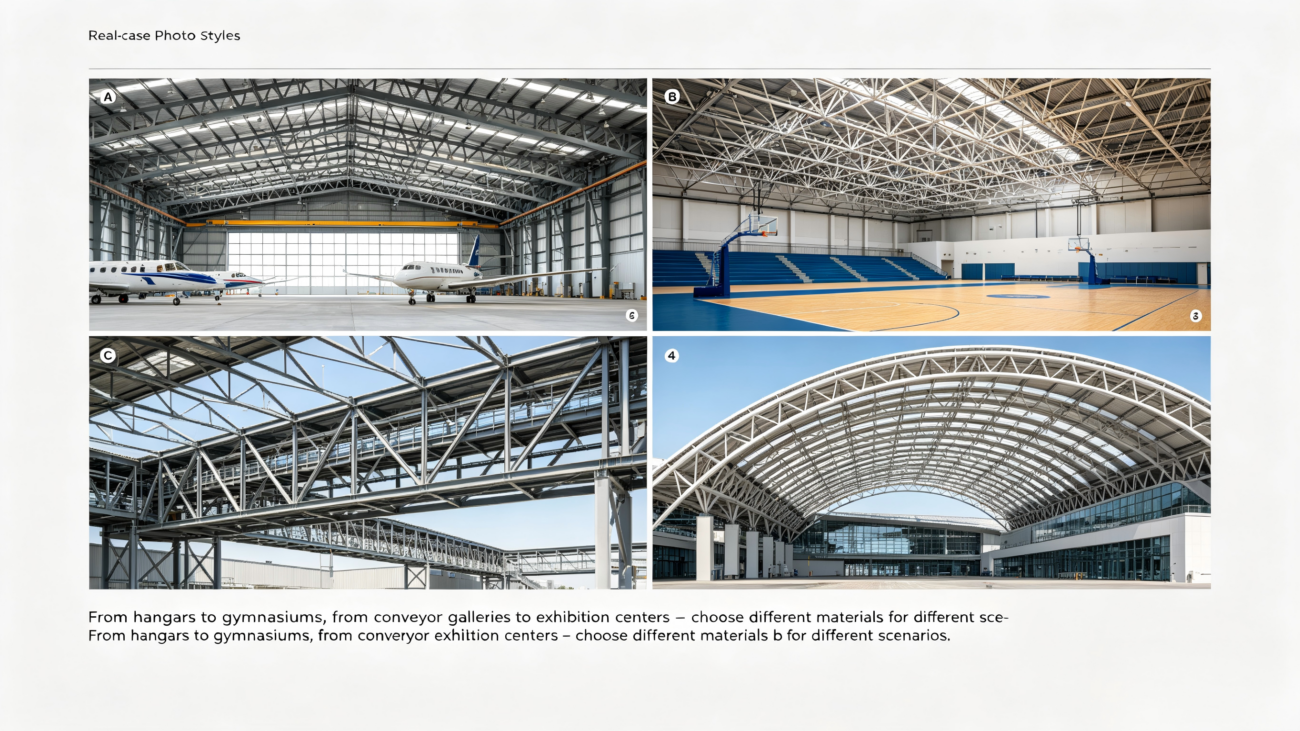
Best for: Stadium roofs, convention centers, airports, exhibition halls, large-span industrial buildings where appearance matters.
B. Angle Steel (L-Shape)
Angle steel trusses are the traditional choice, especially for bolted construction.
Grades:
| Grade | Yield Strength | Typical Sizes |
|---|---|---|
| Q235B | 235 MPa | L50×5 to L100×10 |
| Q355B | 355 MPa | L75×6 to L160×14 |
Advantages:
- Lowest material cost – Angle steel is cheaper than pipe per ton.
- Easy bolted connections – No complex coping or miter cuts.
- Simple inspection – Open section allows visual check of all surfaces.
- Widely available – Stock sizes in most countries.
- Easy galvanizing – Simple shape allows uniform coating.
Disadvantages:
- Weak axis issues – Unsymmetric section requires careful orientation.
- Higher wind drag – Open shape catches more wind.
- Less aesthetic – Industrial appearance, not for architectural exposed trusses.
- More members – Often needs more web members than pipe trusses for same span.
Connection methods:
- Bolted with gusset plates (most common)
- Welded directly (less common)
Best for: Industrial crane runways, conveyor galleries, transmission towers, roof trusses in non-architectural buildings, projects where bolted field assembly is preferred.
C. Rectangular/ Square Hollow Section (RHS/SHS)
RHS combines some advantages of pipe and angle.
Grades: Q355B most common.
Advantages:
- Flat faces for easy bolted connections.
- Better bending resistance than pipe in one direction.
- Clean appearance (modern).
Disadvantages:
- Higher cost than pipe or angle.
- Torsional resistance lower than pipe.
Best for: Trusses requiring bolted connections but cleaner look than angle steel. Often used for top/bottom chords with pipe webs.
D. Channel Steel & I-Beam (Less Common)
Occasionally used for very heavy chords in large trusses.
Application: Heavy industrial trusses supporting crane runways or equipment floors. Not typical for roof trusses.
3. Structural Advantages of Pipe vs. Angle Trusses
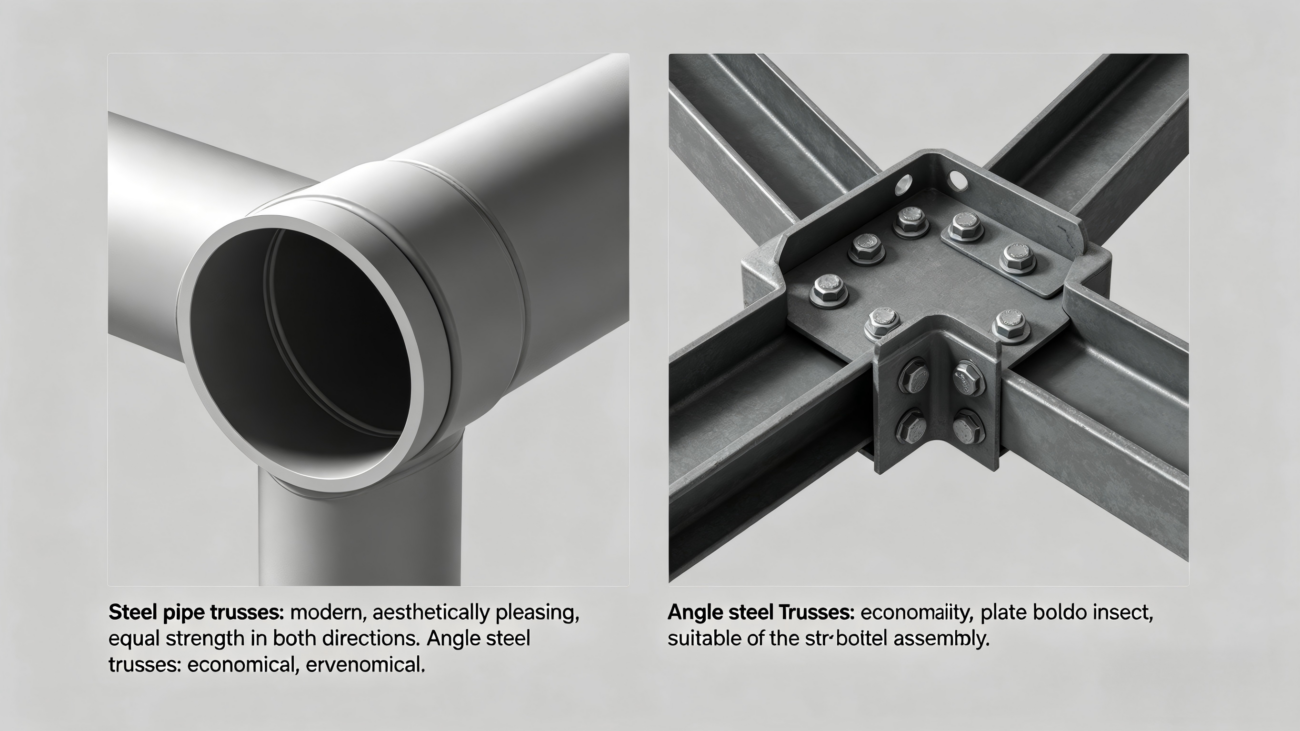
| Property | Steel Pipe Truss | Angle Steel Truss |
|---|---|---|
| Strength-to-weight ratio | Excellent | Good |
| Torsional resistance | High | Low |
| Weak axis bending | No weak axis | Significant weak axis |
| Connection complexity | High (coping/welding) | Low (gusset plates + bolts) |
| Field assembly | Mostly welded (slower) | Bolted (faster) |
| Aesthetic | Modern, clean | Industrial |
| Corrosion vulnerability | Internal (sealed pipes) | External (easy to inspect) |
| Typical max span (light load) | 80-100m | 40-60m |
| Cost per ton fabricated | Higher | Lower |
Design note: For spans under 30m, angle steel trusses are usually more economical. For spans over 50m, pipe trusses become more efficient because the weight savings outweigh the higher fabrication cost.
4. Load Performance & Span Capabilities
A. Load Types on Long-Span Trusses
| Load Type | Description | Truss Design Consideration |
|---|---|---|
| Dead load | Self-weight + roofing/cladding | Chord sizing |
| Live load (roof) | Maintenance workers, snow | Top chord compression |
| Wind load | Uplift and lateral pressure | Bottom chord tension reversal |
| Seismic load | Lateral forces | Diagonal member design |
| Crane load (if applicable) | Moving wheel loads | Fatigue design |
B. Span-to-Depth Ratio Guidelines
| Truss Type | Typical Depth-to-Span Ratio | Example (40m span) |
|---|---|---|
| Light roof truss | 1/15 to 1/20 | 2.0-2.7m deep |
| Medium industrial truss | 1/10 to 1/15 | 2.7-4.0m deep |
| Heavy crane-supporting truss | 1/8 to 1/12 | 3.3-5.0m deep |
C. Maximum Spans by Material & Configuration
| Configuration | Typical Max Span | Steel Grade | Application Example |
|---|---|---|---|
| Angle steel roof truss (bolted) | 30-40m | Q355B | Warehouse, workshop |
| Angle steel heavy truss (welded) | 45-55m | Q355B | Industrial building |
| Pipe truss (parallel chords) | 50-70m | Q355B | Sports hall, hangar |
| Pipe truss (arched/pitched) | 70-90m | Q355B | Stadium, terminal |
| Space frame (3D pipe truss) | 90-120m+ | Q355B/Q420 | Arena, convention center |
Real-world benchmark: A 60m clear-span pipe truss for an aircraft hangar uses approximately 45-60 kg of steel per square meter, compared to 80-100 kg/m² for solid H-beams.
5. Material Selection Decision Framework
Use this step-by-step process to choose the right truss material for your project.
Step 1: Determine your span
| Span | Recommended Material |
|---|---|
| <30m | Angle steel (most economical) |
| 30-50m | Either (compare quotes) |
| 50-80m | Steel pipe (more efficient) |
| >80m | Steel pipe or space frame |
Step 2: Assess your load conditions
| Condition | Material Preference |
|---|---|
| Heavy snow or equipment loads | Pipe (higher strength-to-weight) |
| High wind or seismic zone | Pipe (better bidirectional strength) |
| Standard roof only (light load) | Angle (good enough, lower cost) |
Step 3: Consider connection method
| Connection | Best Material |
|---|---|
| Bolted field assembly | Angle steel (gusset plates) |
| Welded (shop or field) | Steel pipe |
| Mixed (bolted chords, welded webs) | RHS or pipe + angle |
Step 4: Evaluate environment & maintenance
| Environment | Recommendation |
|---|---|
| Indoor, dry | Angle steel (painted) – easy inspection |
| Outdoor, corrosive | Pipe (fully sealed tubes) or HDG both |
| Coastal | Pipe with sealed ends + HDG |
| Chemically aggressive | Pipe (no crevices for acid trapping) |
Step 5: Check architectural requirements
| Requirement | Best Material |
|---|---|
| Exposed, modern appearance | Pipe or RHS |
| Concealed (inside ceiling) | Angle steel (cheapest) |
| Curved or complex geometry | Pipe (easier to curve/weld) |
6. Real-World Project Case Studies
Case 1: Aircraft Hangar – 60m Clear Span
- Location: Middle East (low snow, moderate wind)
- Material: Q355B steel pipe truss, parallel chords
- Configuration: Three-pin arch truss (pinned at both bases and crown)
- Member sizes: Top/bottom chords 219×8mm pipe, webs 114×5mm and 76×4mm
- Connection: Fully welded shop fabrication, field bolted at splices
- Result: 55kg/m² steel weight, erected in 4 weeks
Case 2: Bulk Storage Warehouse – 36m Span
- Location: Southeast Asia (heavy rain, moderate wind)
- Material: Q355B angle steel truss
- Configuration: Fink truss (standard pitched roof)
- Member sizes: Chords L100×10, webs L75×8 and L50×5
- Connection: Bolted with gusset plates (field assembly)
- Result: Low-cost solution, local crew erected using only wrenches and small crane
Case 3: Convention Center – 45m Span, Curved Profile
- Location: Europe (snow load 1.5 kN/m², seismic zone)
- Material: Q355B steel pipe space frame
- Configuration: Double-layer grid, curved to match architectural profile
- Member sizes: Main chords 168×6mm, diagonals 89×4mm
- Connection: Welded nodes (cast steel spherical nodes + pipe welding)
- Result: Clean appearance, no columns, integrated MEP routing through truss depth
Case 4: Conveyor Gallery – 50m Span (multiple spans)
- Location: Mining facility (vibration, heavy dust)
- Material: Q355B angle steel truss (bolted)
- Configuration: Rectangular box truss (4 sides for torsional stability)
- Member sizes: Chords L125×12, webs L75×8
- Connection: Field bolted (easier in remote site)
- Result: Simple maintenance inspection (open sections), easy replacement of damaged members
7. Fabrication Considerations for Truss Materials
For Pipe Trusses:
| Challenge | Solution |
|---|---|
| Miter cuts at varying angles | CNC pipe cutting machine (programmed angles) |
| Fit-up accuracy | Fabrication jigs with roller supports |
| Weld quality (tubular T/Y joints) | Qualified welders, UT inspection |
| Internal corrosion | Seal all openings, vent holes if hot-dip galvanized |
| Shipping (large diameter pipes) | Nest smaller pipes inside larger for container |
For Angle Steel Trusses:
| Challenge | Solution |
|---|---|
| Gusset plate layout | CNC plasma cut plates with marked hole positions |
| Bolt hole alignment | CNC drilling (all holes in one setup) |
| Member length errors | Laser measurement before cutting |
| Galvanizing distortion | Design for venting, specify hot-dip after assembly |
8. Common Mistakes Overseas Buyers Make
Mistake 1: “Angle steel is always cheaper”
Not true for spans over 45m. The extra web members and heavier chords make angle steel trusses heavier than pipe trusses at long spans. The material cost per ton is lower, but the required tonnage is higher.
Mistake 2: “All pipe trusses need complex node connectors”
For moderate spans, direct pipe-to-pipe welding is fine. Spherical nodes are only needed for very large space frames or when members come from many angles.
Mistake 3: “Seal pipes completely to prevent rust”
If you hot-dip galvanize sealed pipes, the trapped gas expands and the pipe explodes in the galvanizing bath. Always specify vent holes (3-5mm) at both ends.
Mistake 4: “Field welding pipe trusses is easy”
It is not. Overhead welding of pipe joints requires highly skilled welders. For overseas remote sites, specify bolted connections or shop-weld into sub-assemblies (max 12m length for shipping).
9. Link to Long-Span Steel Truss Design Service
Not every fabricator understands long-span truss behavior—especially for pipes. The connection design (chord continuity, web intersection, eccentricity) requires specialized engineering.
We provide complete long-span truss solutions:
- Concept design: Span configuration, depth optimization, material recommendation
- Detailed engineering: Node design, weld sizing, deflection checks
- Material selection: Q235B to Q420B, pipe or angle as optimal
- Fabrication: CNC pipe cutting, submerged arc welding (for large chord splices), jig assembly
- Surface treatment: Sa2.5 blast + primer, HDG, or epoxy
- Pre-assembly: Trial fit at our yard (up to 30m span sections)
- Installation support: Lifting plan, temporary bracing design, field bolt tightening guide
For overseas clients:
We design trusses for shipping efficiency—sub-assemblies under 12m, bolted splice connections at mid-span. We provide 3D installation animations showing exactly how each node assembles.
👉 [Request a long-span truss design consultation]
Send us your span, clear height, roof slope, local loads (snow/wind/seismic), and desired appearance. We will return a material recommendation, preliminary section sizes, and weight estimate within 48 hours.
Summary: Quick Material Selection Table
| Project Type | Span | Best Material | Why |
|---|---|---|---|
| Workshop roof | 25m | Angle steel, Q355B | Lowest cost, bolted assembly |
| Warehouse clear-span | 35m | Angle or pipe (compare) | Borderline – get both quotes |
| Sports hall | 45m | Pipe, Q355B | Better strength-to-weight |
| Aircraft hangar | 60m | Pipe, Q355B | Clean appearance, no columns |
| Convention center | 80m | Pipe space frame | Architectural, long span |
| Conveyor gallery (remote site) | 40m | Angle steel, bolted | Easy field assembly, repairable |
| Stadium roof (curved) | 90m | Pipe, Q355B/Q420 | Complex geometry possible |
| Mine processing building | 30m | Angle or channel, heavy duty | Impact loads, inspectable |
Long-Span Steel Truss FAQ
Q: What is the maximum span for a steel truss?
A: Steel trusses routinely span 30-60m, and pipe space frames reach 80-100m for stadiums and convention centers. The practical maximum depends on material, section sizes, and the load envelope — beyond about 60m, pipe trusses and space frames become the standard choice because they offer the best strength-to-weight ratio.
Q: Pipe truss or angle truss — which is cheaper?
A: For spans up to about 30m, angle steel trusses are usually the lower-cost option because fabrication is simpler and bolted field connections keep erection fast. From 35m upward, pipe trusses often win on steel tonnage despite higher fabrication cost, so the comparison flips. The right answer for your project depends on span, local loads, and site assembly constraints — most serious suppliers will quote both.
Q: Can long-span steel trusses be shipped in standard containers?
A: Yes, with the right design. Trusses are typically split into sub-assemblies under 12m length and joined with bolted splice connections on site. This is standard practice for overseas projects and keeps freight practical. Confirm with your supplier that the truss layout is designed for shipping efficiency before fabrication.
Q: What steel grade should I specify for a long-span truss?
A: Q355B is the common choice for long-span trusses because its higher yield strength reduces member sizes and weight compared with Q235B. For very long spans or heavy loads, Q420 and higher grades are used selectively in critical members. Material grade should always be matched to the engineering calculation, not chosen by preference.
Q: How much steel does a long-span truss building use?
A: Consumption depends heavily on span and loads. As a planning range, a 40-50m clear-span truss roof typically uses more steel per square meter than a standard 20m portal frame — often in the range of 35-55 kg/sqm of covered area — because the truss members carry larger forces with less structural redundancy. Your engineer should calculate the exact figure for your loads.
