
Pre-Engineered Steel Building Supplier: How Design Codes AISC Eurocode and GB Change Your Project


The design code your pre-engineered steel building supplier works to changes the steel tonnage, the member sizes, the drawings you submit for permits, and the price — before you change anything else. A building designed to AISC 360 for the US market uses different load assumptions and detailing than one designed to Eurocode for Europe or to GB standards for a Chinese project. This guide explains what each major code family means for your project, how to tell your supplier which code to use, and what to check in the proposal so the design is actually based on the right one.
Why the design code is a commercial decision, not just a technical one
Steel design codes are regional languages for the same engineering problem: proving the structure is safe. Each code family specifies load combinations, safety factors, steel grades, and detailing rules slightly differently. The result is that the same building — same span, same height, same site — can have different member sizes and tonnage depending on the code used. That flows straight into cost, into the drawings your local authority accepts, and into whether your local engineer will stamp them.
Most export-oriented pre-engineered steel building suppliers can design to more than one code. The buyer’s job is to specify the code at the RFQ stage, not to discover after fabrication that the drawings do not match what the local authority expects. Putting the code in the RFQ also makes quotations comparable: two suppliers designing to different codes are quoting different buildings.
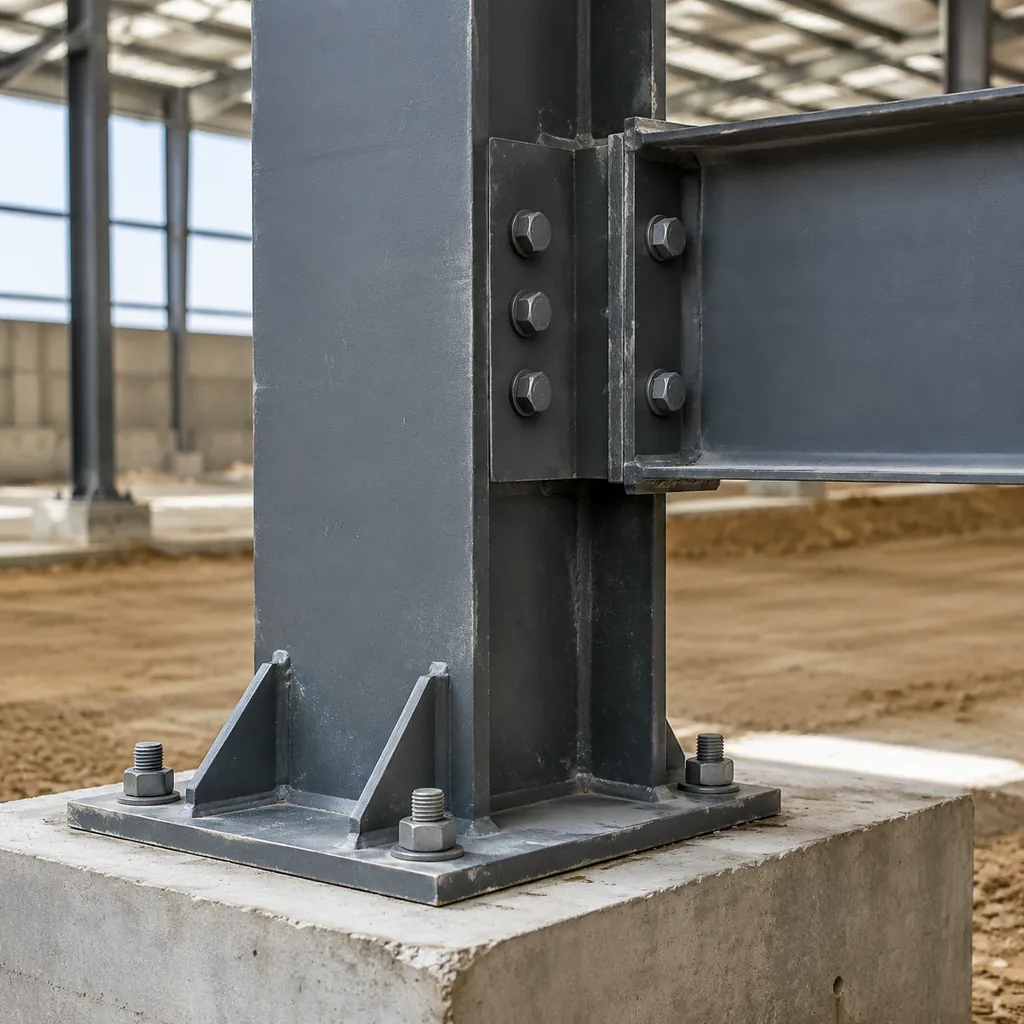
The three code families you will meet
AISC / ASCE (United States and many Americas projects)
Projects in the United States are typically designed to AISC 360 (steel construction) with loads from ASCE 7. The design uses US steel grades such as A36, A572, and A992, and imperial units. If your project will be reviewed by a US engineer or needs to satisfy US building codes, specify AISC 360 and ask for the design parameters — wind speed per ASCE 7, snow load, and seismic design category — for your site.
Eurocode (Europe, Middle East, Africa, Asia-Pacific projects)
Eurocode design uses EN 1993 (steel) and EN 1991 (loads), with steel grades S235, S275, and S355, and metric units. It is widely accepted across Europe and in many countries that adopt European practice, including parts of the Middle East, Africa, and Asia. For EU projects, the fabricator may also need EN 1090 factory production control for CE marking, which is a separate requirement from the design code itself.
GB standards (China and Chinese-led projects)
GB 50017 covers steel structure design in China, with GB 50009 for loads and grades such as Q235B and Q355B. If the project is in China or follows Chinese practice, GB is the natural choice. Chinese factories are fully fluent in GB, and for a domestic or Chinese-funded project it keeps the design, fabrication, and approval in one system.
| Region / project | Typical design code | Common steel grades | What to specify |
|---|---|---|---|
| United States / Americas | AISC 360 + ASCE 7 | A36, A572, A992 | Wind speed, snow, seismic category for your site |
| Europe / EU projects | EN 1993 + EN 1991 | S235, S275, S355 | Load zone and EN 1090 execution class if CE marked |
| China / Chinese-led | GB 50017 + GB 50009 | Q235B, Q355B | Load region and project standard |
| Other countries | Often Eurocode or a local code | Varies | Confirm with local engineer; supplier adapts |
How the code changes your project in practice
Beyond the name on the cover page, the code affects four things you will touch directly:
- Member sizes and tonnage: different load combinations and safety factors can change the governing member. A building designed for a high wind region under ASCE 7 will carry different wind coefficients than the same building under EN 1991. The tonnage difference is usually visible in the quote.
- Drawings and permits: your local authority or engineer will expect drawings prepared to the recognized code for your region. A US city review board is not going to stamp GB drawings without a full re-check; a European project engineer will want Eurocode documentation. Get this right before fabrication.
- Material certification: the steel mill certificates must show compliance with the grade standard used in the design. If the design says S355 but the certificate lists Q355B, the local engineer will ask questions — even though the two are close, the documentation must match.
- Detailing conventions: connection design, weld symbols, and drawing conventions differ between codes. That matters for the erector and the inspector on site.
Quick question: Can a Chinese supplier design to AISC or Eurocode?
Yes — export-oriented pre-engineered steel building suppliers routinely design to AISC 360 and Eurocode, and provide calculation summaries and drawings in the corresponding conventions. Ask for a sample calculation from a past project in your region before ordering.
How to specify the code in your RFQ
Write the design code into the RFQ in one clear sentence: “Design to AISC 360 with ASCE 7 loads; site wind speed X km/h, snow load X, seismic design category X; steel grades per AISC; metric or imperial drawings as follows.” If you do not know the local values, say so and ask the supplier to use the values from your site’s local code, with your engineer confirming them at drawing approval. The important thing is that the RFQ names a code, so every supplier prices the same basis.
If your country does not have a well-known local code, the common choice is Eurocode, which is widely accepted internationally, or a project-specific code agreed with your engineer. Never leave the code unstated — “international standards” is not a design basis.

What to check in the supplier’s proposal
- The proposal names the design code and the load parameters for your site.
- The calculation summary shows member sizes from that code, not a copied generic design.
- The steel grade in the proposal matches the code family (A572 vs S355 vs Q355B).
- Drawing conventions and units match what your local engineer expects.
- The material certification plan references the same grade standard as the design.
Worked example: one warehouse designed to two codes
To see the code’s effect without a calculator, take one warehouse — 40 m by 25 m, 6 m eave height — and imagine it designed to two different codes for two different sites.
Version A is in a US location with moderate wind, low snow, and no significant seismic category. The ASCE 7 load combination is straightforward; the governing frame is probably controlled by wind or gravity loads, and the member sizes reflect a normal-duty portal frame. The steel grade is A572 or A992, the drawings use imperial units, and the local engineer reviews the package against US practice.
Version B is in a European location with a higher design wind speed and a snow load that governs the roof. The EN 1991 load combinations produce a different governing case; the rafter and purlin sizes come out heavier, and the frame tonnage rises. The steel grade is S355, the drawings use metric units, and the calculation references Eurocode clauses that the European reviewer expects to see.
The same warehouse can therefore carry a noticeably different tonnage and price depending on the code and the site loads. That is why comparing quotations on different codes is like comparing two different buildings. It is also why the code choice is a commercial decision: if you pick the code your local engineer can review, the permit path is smooth; if you let the supplier pick by default, you may discover the mismatch after fabrication, when fixing it is expensive.
Load parameters you must provide
The code names the rules, but the site provides the numbers. Collect these before the RFQ:
| Parameter | Why it matters | Where to get it |
|---|---|---|
| Basic wind speed | Governs cladding, purlins, and frame in wind regions | Local code map or your engineer |
| Snow load | Governs roof members in cold regions | Local code map or your engineer |
| Seismic design category / zone | Sets detailing and ductility requirements | Local code or geotechnical/seismic report |
| Live load | Roof access, maintenance, equipment loads | Occupancy and local practice |
| Exposure condition | Wind pressure depends on terrain and surroundings | Site survey or your engineer |
| Soil condition | Foundation design, anchor embedment | Geotechnical report for larger buildings |
| Intended use | Occupancy loads, fire rating, clearances | Your project brief |
You do not need to know every value before contacting a supplier — you need to know which ones you must confirm, and to state them in the RFQ so the design starts on the right basis.
Questions to ask your local engineer before the RFQ
- Which design code will you review and stamp — AISC, Eurocode, GB, or a local code?
- What load values should I provide to the supplier — wind speed, snow, seismic category?
- Will you accept a supplier’s calculation summary, or do you need the full report?
- Which drawing conventions and units do you expect for the permit submission?
- Do you need to review the shop drawings, or only the structural design documents?
- What material certificates will you require at completion?
Asking these six questions first saves the most expensive mistake in the project: designing to a code that nobody on your side can review.
Common code-confusion mistakes
- Letting each supplier choose its own code, then comparing the prices as if they were the same building.
- Assuming a steel grade from one standard is interchangeable with a similar grade from another without checking the design documentation.
- Submitting drawings to a local authority without checking whether the code basis matches local practice — the review then stalls.
- Asking for “international standards” without naming a code; suppliers interpret that however they like.
- Discovering the CE marking / EN 1090 requirement after fabrication, when the factory’s production control does not cover it.
- Forgetting that units matter — a drawing in imperial units reviewed by a metric-based engineer creates rework even when the design is sound.
None of these mistakes is about engineering ability; they are about coordination. Name the code, provide the loads, confirm with the local engineer, and the coordination problem disappears.
Multi-code projects: when a building crosses borders
Some projects span more than one design world: a Chinese supplier fabricates to GB shop drawings, a European engineer reviews the structural design to Eurocode, and the project is erected in a country whose local engineer wants drawings in their own convention. These multi-code projects work, but only when the boundaries are explicit. Decide which code governs the structural design and which governs the permit review, and write both into the RFQ. A common structure: the supplier designs to one recognized code (Eurocode is a frequent choice), the calculation report is translated into the local engineer’s expected format, and the shop drawings follow the fabrication standard of the factory with a note mapping the material grades.
The mapping step deserves attention: steel grades are close but not identical across standards, and the local reviewer will want to see the equivalent grades justified. Ask the supplier for a grade comparison table (for example S355 versus Q355B versus A572) at the proposal stage, and have your engineer confirm the equivalents before fabrication. Mapping grades on paper is cheap; discovering a mismatch after the steel is cut is not.
Design code versus production standard: know the difference
Buyers often confuse the design code with the production standard, and the confusion costs time. The design code (AISC 360, Eurocode, GB) governs how the structure is engineered — the loads, the member sizes, the safety factors. The production standard governs how the factory makes and controls the product — for example EN 1090 with its execution classes for CE-marked structural steel in Europe, or AWS D1.1 for the welding program. A building can be designed to Eurocode without the factory holding EN 1090, and that matters: if the project needs CE marking, the production control certificate is a separate requirement that must be checked in the factory audit, not assumed from the design code.
Ask two separate questions in the RFQ: “Which design code will the structural design follow?” and “Which production standards does your factory hold for fabrication and welding?” The answers protect you twice — the design is right, and the factory’s process is certified for what it produces.
Checklist before you send the RFQ
Run through this list before the first email goes out — the RFQ quality determines the proposal quality:
- The design code is named, or you have the local engineer’s recommendation for one.
- The site load values are collected: wind speed, snow, seismic category, exposure, soil notes.
- The building dimensions and intended use are written down, including any future expansion plan.
- The cladding and accessory requirements are specified, at least at the level of panel type and doors.
- The production standards you require are listed — EN 1090, AWS D1.1, or none.
- The delivery destination and the trade terms you want to compare (EXW, FOB, CIF) are stated.
- You know who reviews the drawings locally and which units and conventions they expect.
Send the same RFQ to every shortlisted supplier. Identical questions produce comparable proposals, and comparable proposals are the only basis for a fair price comparison.
Where the code choice appears in the contract
Put the design code in the contract, not just in the RFQ. Four clauses make it enforceable: the design basis clause names the code and the load parameters, so the calculation is judged against a fixed standard; the material clause requires mill certificates in the grade standard used by the design, closing the documentation gap between S355 and Q355B and similar equivalents; the drawings clause specifies the units and conventions the local engineer expects, preventing a rework round at permit submission; and the change clause states that any deviation from the design basis — a different wind speed, a heavier cladding — requires written agreement before fabrication. With those four clauses, the code choice stops being a technical discussion and becomes the project’s baseline. If a supplier hesitates to sign them, that hesitation tells you more than the price ever will.
Design code terminology cheat sheet
The acronyms around steel design confuse every buyer once, so keep this cheat sheet in the RFQ folder. AISC 360 is the American steel design specification — the rules for designing steel members and connections in US projects. ASCE 7 is the American load standard, which provides the wind, snow, and seismic loads that AISC 360 uses. EN 1993 (Eurocode 3) is the European steel design standard, and EN 1991 (Eurocode 1) is the European load standard; together they are usually called “Eurocode”. GB 50017 and GB 50009 are the Chinese steel design and load standards, using Q-grade steels. EN 1090 is the European production control standard for structural steel, required for CE marking — a factory standard, not a design code. AWS D1.1 is the American welding standard, covering welder qualification and welding procedures. When a supplier says “designed to international standards”, ask which of these they mean. When they name one, you can verify the rest.
The code question is a coordination question
At its core, choosing the design code is not about engineering ability — every serious supplier can design in several codes. It is about coordination: matching the design to the reviewer, the drawings to the authority, and the material certificates to the grade standard. The buyer who names the code early, provides the load values, and confirms the local engineer’s expectations removes the most common failure point in international steel building projects. When coordination is handled on paper at the RFQ stage, the building itself follows without drama. When it is left to chance, the mismatch is discovered at the worst possible moment — after fabrication. One sentence in the RFQ prevents the most expensive mistake in the project.
Finally, remember that the code conversation is not a one-time event. Revisit it at each milestone: at the RFQ, confirm the code and loads are stated; at drawing approval, confirm the calculation matches the named code; and before fabrication, confirm the material certificates use the grade standard from the design. Three short checks keep the whole chain consistent, and consistency is what makes an international steel building project run smoothly from the first inquiry to the final bolt.
FAQ
Which design code should I specify for my steel building?
Use the code recognized in your project’s location: AISC 360 + ASCE 7 for the United States, Eurocode EN 1993/EN 1991 for Europe and many international projects, GB for China, or your local code confirmed with a local engineer. Name the code in the RFQ so all suppliers quote the same basis.
Can a Chinese steel building supplier design to AISC or Eurocode?
Yes. Export-oriented suppliers routinely design to AISC 360, Eurocode, and GB, and can provide calculation summaries, shop drawings, and erection drawings in the corresponding conventions. Ask for a sample from a project in your region.
Do I need a local engineer to stamp the drawings?
For permit submission in most countries, yes — a locally registered engineer usually reviews and signs the structural documents. Give them the calculation report and the code basis early so the review is fast.
How much does the design code affect the price?
It can move the tonnage noticeably because load combinations and safety factors differ. A higher wind or snow assumption raises tonnage; a different detailing rule changes connection weight. Compare quotations on the same code and same site loads to see the real price difference, whether the project is a prefab steel warehouse or a workshop.
What if my country has no widely used steel design code?
Eurocode is the common international default and is accepted in many countries. Confirm with your local engineer which code they can review and stamp, and write that into the RFQ.
Final recommendation
Put the design code in the first line of your RFQ, not in the fine print of the contract. Choose the code your local engineer can review, give the supplier the site load values, and require the proposal to name the code, the grades, and the load basis. A pre-engineered steel building supplier that designs to the right code from day one saves you the most expensive fix in the whole project: redesigning after fabrication.
Specify your design code with confidence — send your building size, site location, and the code you need (AISC, Eurocode, or GB), and receive a design-based quotation for your pre-engineered steel building.